
Can Mark Rober's brick wall test prove Tesla Autopilot is defective?
Mark Rober's viral painted wall test visually demonstrates a crash pattern documented by NHTSA in 46 stationary-object Autopilot collisions. This article examines the test's admissibility as evidence of design defect in active Tesla litigation, including counterarguments over methodology and the hardware-versus-software debate exposed by the Kyle Paul replication.
- Hallucination rate
- Not measured / undisclosed
Mark Rober’s brick wall test is easy to overread because it is so easy to understand. A Tesla approaches what appears, to the camera, to be open road painted on a wall; Autopilot does not stop before impact at roughly 39 to 42 mph, according to contemporary coverage of the test.[1] The clip does what a good courtroom demonstrative is supposed to do: it gives a jury a visual handle on a failure mode that would otherwise be buried in sensor terminology, driver-monitoring language, and software-release caveats.
That does not make it proof of defect by itself. The legal significance of the test is narrower and stronger: it may help explain a stationary-object detection problem that federal investigators had already documented in Autopilot crashes. The question is not whether a YouTube video can substitute for expert proof. It is whether the video can be tied closely enough to a known crash pattern to become admissible, probative evidence in products liability litigation.
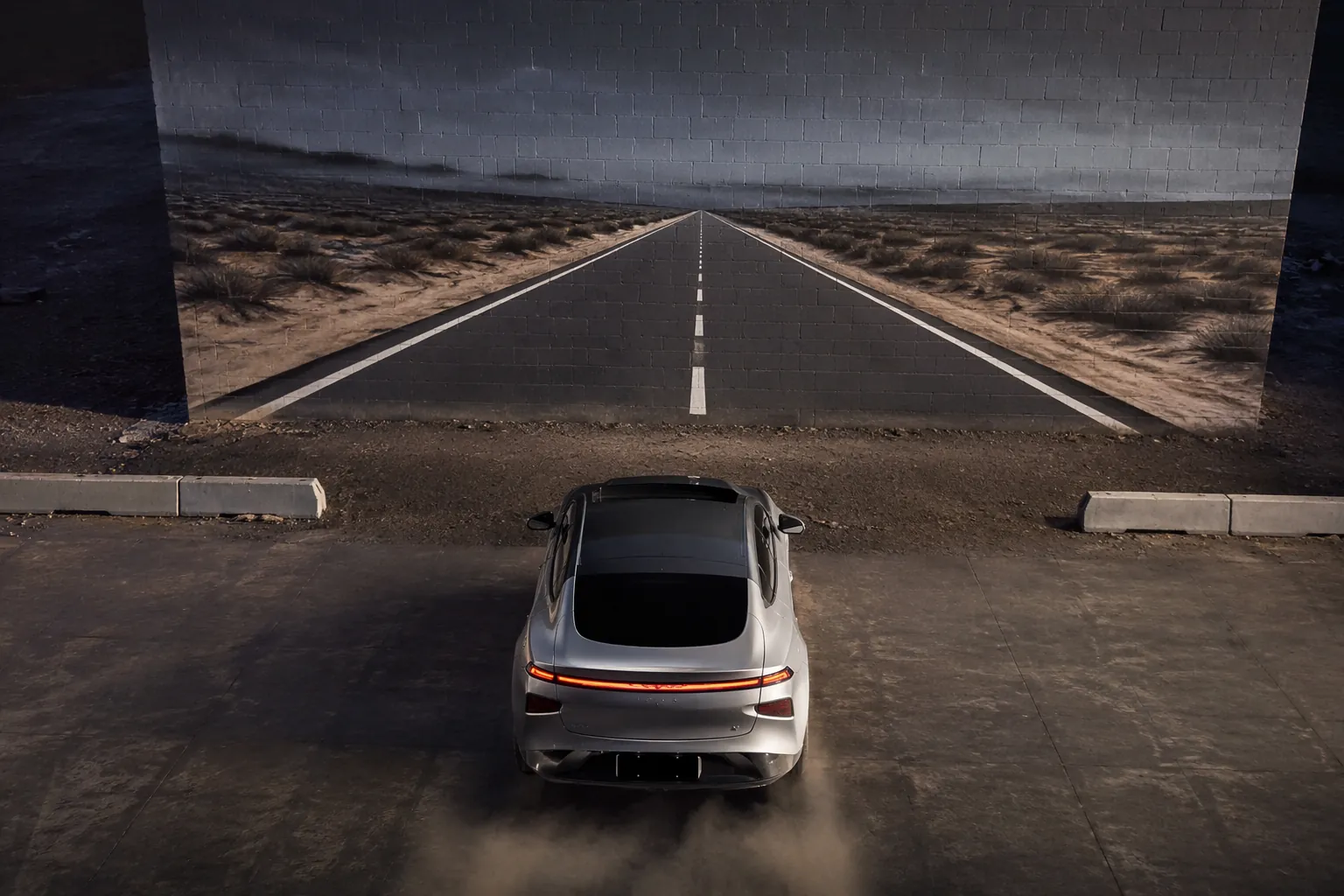
The Wall Test Matters Because NHTSA Had Already Identified the Pattern
Rober’s test has evidentiary force only if it is connected to a real-world mechanism. On its own, a painted wall is theatrical. Paired with NHTSA’s Autopilot findings, it becomes a visual claim about how the system responds to stationary hazards.
In April 2024, NHTSA closed an investigation that reviewed 467 collisions involving Tesla Autopilot, including 13 fatal crashes. CNBC’s coverage of the agency findings reported that, within 46 crashes involving stationary objects, Autopilot aborted vehicle control less than one second before impact in 16 of them.[2] That last number is the bridge. It is not merely that a driver failed to supervise. It is that, in a subset of stationary-object crashes, automated control persisted until the last instant and then returned the problem to a human with no meaningful time to solve it.
For trial purposes, that distinction matters. Tesla can and does emphasize driver responsibility, misuse, warnings, and the need for supervision. Those arguments do not disappear. But a late abort pattern changes the allocation of attention. If a system remains engaged while approaching a stationary hazard and disengages less than a second before impact, the plaintiff’s case is no longer only about whether the driver should have watched the road better. It is also about whether the product created a predictable handoff at a moment when human intervention could not realistically prevent the crash.
The brick wall clip is useful because it makes that timing problem visible. A painted roadway on a wall is not a fire truck, a disabled vehicle, a crash attenuator, or a stopped trailer. But the legal point does not require the wall to be a perfect duplicate of every stationary-object crash. The point is whether the test illustrates a disputed capability: can the camera-based system identify and respond to an object blocking the lane when the visual scene invites a mistaken continuation?
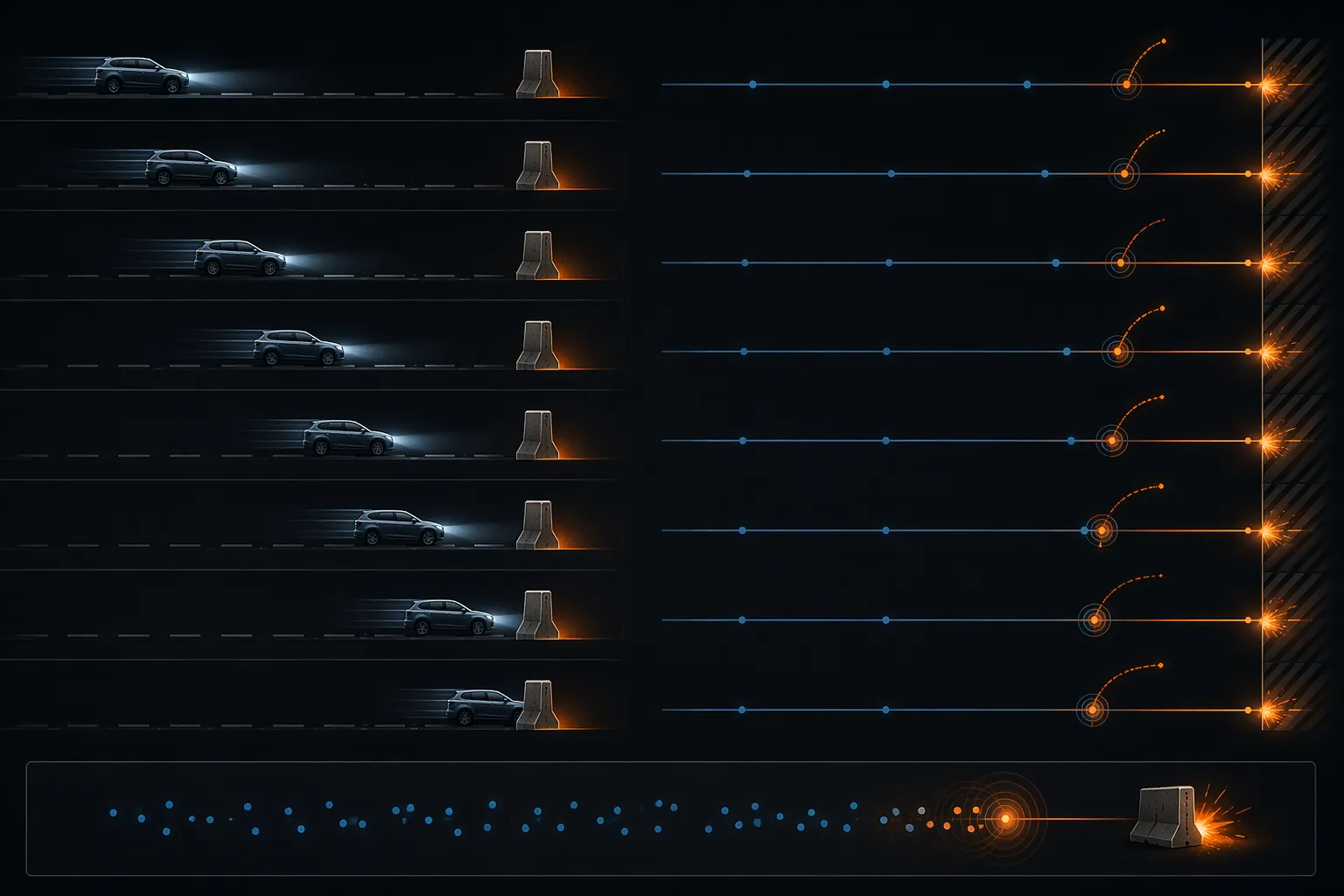
From Viral Demonstration to Design-Defect Theory
A products case cannot stop at “the car hit the wall.” The theory has to identify a defect, connect it to the injury, and survive the comparison between risk, utility, feasibility, warnings, and foreseeable use. The brick wall test fits most naturally into a design-defect argument: that a camera-only driver-assistance architecture has a foreseeable limitation in detecting or reacting to certain stationary obstacles, and that the limitation is safety-significant under real driving conditions.
That is why the NHTSA data does more work than the clip itself. The agency findings give the video a category: stationary-object Autopilot crashes. The video gives the category a shape: an apparent lane continuation, a stationary obstruction, no timely stop. A plaintiff expert could use that pairing to explain why a system’s perception and control behavior should be evaluated at the design level rather than reduced to a one-off driver error.
The design-defect framing also helps separate a legally usable claim from a culture-war claim about LiDAR. The courtroom question is not whether LiDAR is morally superior to cameras or whether one engineering camp won the internet. The question is whether the chosen design, as deployed and marketed, left a foreseeable hazard insufficiently controlled. If alternative sensing, different software constraints, stronger driver monitoring, or more conservative operational limits would have reduced the risk without destroying the product’s utility, those are risk-utility questions. The brick wall test can help present the risk, but it does not answer the entire balancing test.
The Admissibility Fight Is Where the Test Either Gains or Loses Weight
Tesla’s best objections to the wall test are not public-relations noise. They are the objections a court should expect: substantial similarity, experimental control, reproducibility, prejudice, and whether the exhibit helps the jury decide a live issue or merely invites punishment for a dramatic stunt.
The Verge’s coverage noted criticisms of Rober’s methodology, including a pre-scored wall hole and questions about whether Autopilot may have been disengaged by the driver before the collision.[3] Those details matter because an experiment offered as substantive proof carries a heavier burden than a demonstrative used to explain an expert’s opinion. If the plaintiff offers the video as “this is what Autopilot does,” Tesla will press the court on exact system settings, software version, vehicle configuration, speed, lighting, lane markings, driver inputs, engagement status, and whether the wall construction changed the apparent result.
A pre-scored wall does not necessarily make the test irrelevant. It may have been used to reduce vehicle damage or preserve safety during filming. But it gives the defense a clean impeachment point: the crash looks more violent, or at least more cinematic, than an unaltered barrier might have looked. That matters under prejudice analysis. A judge may ask whether the same perception issue could be shown with telemetry, synchronized video, expert animation, or a less theatrical demonstrative.
The possible disengagement issue is more serious. If the system was not engaged at the critical moment, the test cannot fairly be used to prove Autopilot failed to brake. It might still have some impeachment or public-context value, depending on what was said in the video and what data exists, but its role would shrink. In an actual case, the vehicle logs would matter more than the edited clip.
Substantial similarity is the central gatekeeping problem. A painted brick wall is not substantially similar to every real-world Autopilot crash. It may be more similar to some fact patterns than others. A court considering admissibility would likely ask what the plaintiff is using the test to prove:
- As a true experiment proving defect, the test needs tight controls, reliable data capture, and a close match to the crash scenario.
- As a demonstrative aid, it may only need to fairly illustrate an expert’s opinion about perception and stationary-object response.
- As impeachment, it may be useful if Tesla or a defense expert makes broad claims about the system’s ability to identify lane-blocking hazards.
- As punitive-damages context, it would need to connect to notice, knowledge, or conscious disregard rather than merely show a bad-looking impact.
That classification can decide the motion. The same video that is too uncontrolled to prove defect may be permissible to help a qualified expert explain a known failure mode. Conversely, a judge may exclude it if the visual drama substantially outweighs its incremental value over less prejudicial evidence.
Kyle Paul’s Replication Helps, but It Also Narrows the Claim
The Kyle Paul replication is important because it moves the conversation from one viral test toward reproducibility. Coverage of the replication reported that a HW3 Model Y running FSD v12.5.4.2 failed a similar fake-wall test, while a HW4 Cybertruck running FSD V13 passed.[4][5] That result complicates both sides of the argument.
For plaintiffs, the replication reduces the sense that Rober’s result was a one-off artifact. It also opens a hardware-generation question: if HW4 passed and HW3 failed, owners and crash victims involving HW3 vehicles may argue that Tesla knew or should have known that earlier installed hardware had materially different capabilities. That can matter for design defect, warnings, recall theories, and representations about feature parity.
But the replication also prevents a clean overstatement. The HW3 vehicle used FSD v12.5.4.2, not the later software used by the HW4 Cybertruck. The result may reflect a software-version gap, a hardware gap, vehicle-platform differences, or some combination. A careful lawyer would not call it conclusive proof that HW3 can never handle the scenario. The better use is more bounded: the replication supports discovery into hardware capability, software updates, internal validation, and what Tesla told consumers about the relative performance of vehicles already on the road.
| Evidence | What it can support | What it cannot prove alone |
|---|---|---|
| Rober wall test | A vivid demonstration of a stationary-obstacle perception scenario | That Autopilot was defective in any specific crash |
| NHTSA stationary-object findings | A documented pattern involving Autopilot and stationary hazards | The cause of every individual crash in the category |
| Kyle Paul replication | A reproducibility and hardware/software-generation inquiry | A permanent HW3 defect without controlling for software and platform differences |
| Crash litigation verdicts and rulings | Legal context showing these theories are being tested | Final nationwide resolution of Tesla’s liability |
Benavides Shows Why the Video Lands in an Already Active Litigation Field
The Rober test did not create Autopilot products liability litigation. It arrived after plaintiffs had already begun forcing juries and judges to decide how much responsibility belongs to Tesla when driver-assistance software is involved in a crash.
In Benavides v. Tesla, a Florida jury awarded $243 million in connection with a fatal Autopilot crash, assigning Tesla 33% fault and including $200 million in punitive damages, according to NPR and NBC News coverage of the August 2025 verdict.[6][7] Reuters later reported that, in February 2026, a federal judge upheld the verdict against Tesla at the post-trial stage, while the case remained subject to further appellate proceedings and damages issues.[8]
Benavides matters here because it shows that juries can be receptive to the idea that Autopilot conduct and Tesla’s design or marketing choices belong in the fault allocation. It does not prove that every Autopilot stationary-object crash is Tesla’s fault. It also does not make the wall test admissible in unrelated cases. But it changes the litigation environment: plaintiffs can point to an actual verdict where Autopilot-related theories reached a jury and produced substantial liability.
Defense-side commentary on Benavides has emphasized the case-specific facts, driver conduct, comparative fault, and the danger of treating a landmark plaintiff verdict as a general rule for all automated-driving cases.[9] That is the right caution. The value of Benavides is not that it eliminates Tesla’s driver-supervision defense. The value is that it demonstrates the defense is not automatically case-dispositive.
Marketing Evidence Belongs After the Technical Failure, Not Before It
Failure-to-warn and misrepresentation theories become stronger when they are anchored to a specific operational limitation. If Autopilot has a foreseeable stationary-object response problem, then the legal question becomes what Tesla told drivers about the system’s capabilities, limits, and required supervision.
A California DMV administrative law judge ruled in December 2025 that Tesla’s use of “Autopilot” and “Full Self-Driving” was misleading, and TechCrunch reported that the ruling ordered a 30-day license suspension.[10] That administrative ruling is not the same thing as a products liability judgment, and the research record notes uncertainty around enforcement and Tesla’s compliance posture. Still, it is relevant litigation context because marketing language can shape reliance, consumer expectations, and the foreseeability of misuse.
The order of proof matters. If a plaintiff leads only with names like “Autopilot” and “Full Self-Driving,” Tesla can respond that manuals and in-car warnings required supervision. If the plaintiff first establishes a concrete failure mode—late recognition, late handoff, or no effective braking for a stationary hazard—the marketing evidence has a clearer job. It helps explain why a driver may have trusted the system in precisely the kind of situation where additional caution was needed.
The Dryerman Case Shows the Pipeline Risk
The active litigation pipeline is another reason the brick wall test is more than a media episode. Reuters reported in June 2025 that Tesla was sued over a New Jersey Model S crash that killed three people in Dryerman v. Tesla.[11] The significance is not that Dryerman proves the wall-test theory. It is that Autopilot cases continue to present courts with recurring questions about software behavior, driver reliance, warnings, and crash reconstruction.
Plaintiff-side litigation materials have framed Autopilot products cases around design choices, warnings, discovery into internal knowledge, and the need to translate technical behavior into ordinary negligence and products concepts.[12] The brick wall test fits that practice problem. It is a translation device. The danger is letting the translation become the proof.
What a Court Could Do With the Rober Test
In a real Autopilot case, the court does not need to choose between treating the wall test as dispositive proof and excluding it as internet noise. There are intermediate uses, and those uses are where the hard lawyering happens.
- Permit an expert to discuss the test as an illustrative demonstration of a stationary-object perception problem, while prohibiting argument that it recreates the plaintiff’s crash.
- Allow selected clips if supported by vehicle data, engagement status, speed, and software-version evidence.
- Exclude the impact footage but allow stills, diagrams, or expert testimony about the scenario to reduce unfair prejudice.
- Use the test in discovery disputes to justify requests for validation materials concerning stationary obstacles, camera perception, braking thresholds, and disengagement timing.
- Allow the defense to use the methodology flaws on cross-examination rather than treating them as automatic grounds for exclusion.
That last path may be the most realistic in cases where the plaintiff has stronger evidence behind the video. Courts often tolerate imperfect demonstrations when the proponent is careful about what the demonstration is offered to show and the opponent has a fair opportunity to expose differences. But if the clip is offered as a shortcut around expert analysis, Tesla’s exclusion motion becomes much stronger.
The Strongest Legal Use Is a Bounded One
The most persuasive version of the wall-test argument would not ask the jury to conclude, “Tesla hit a fake wall, therefore Autopilot is defective.” It would proceed more carefully.
First, NHTSA documented a category of Autopilot crashes involving stationary objects, including instances where Autopilot aborted control less than one second before impact.[2] Second, the Rober test visually demonstrates a scenario in which the vehicle continued toward a stationary lane obstruction instead of stopping in time.[1] Third, the replication evidence suggests the result is worth testing across hardware and software generations, while also leaving open whether the observed difference is hardware-based, software-based, or platform-specific.[4][5] Fourth, verdicts, administrative rulings, and pending cases show that courts and juries are already being asked to evaluate Tesla’s design choices, warnings, and representations in this space.[6][8][10][11]
That chain does not prove causation in any individual crash. It does not establish that a particular driver reasonably relied on Autopilot. It does not eliminate comparative fault. It does not answer whether a specific software version would have performed differently. Those are not small gaps; they are the issues Tesla will use to keep the case narrow.
But the test is legally significant because it gives a jury a concrete picture of a failure mode that already has regulatory and litigation support. Used carefully, it can help convert an abstract argument about camera perception and stationary hazards into a visual explanation of design risk. Used carelessly, it becomes exactly what the defense will say it is: an uncontrolled video with a painted wall, edited for maximum impact.
The brick wall test cannot walk into court as a verdict. It may be able to walk in as a demonstrative, an expert reference point, an impeachment tool, or a discovery lever. Its value depends on whether plaintiffs can tie the image of the wall to the harder evidence: NHTSA’s stationary-object findings, vehicle logs, software-version proof, comparable incidents, warnings, and the design choices Tesla was prepared to defend before the crash.
References
- Tesla Autopilot Road Runner Test, InsideEVs
- Tesla Autopilot linked to hundreds of collisions, has critical safety gap, NHTSA says, CNBC, April 26, 2024
- Mark Rober Tesla YouTube Autopilot lidar fake claims, The Verge
- Tesla FSD Fake Wall Test 2, InsideEVs
- Someone Recreated Mark Rober’s Tesla Self-Driving Test Using FSD And The Results Were Surprising, Carscoops
- Tesla found partly liable for fatal Autopilot crash, ordered to pay $243 million, NPR, August 2, 2025
- Tesla found partly liable in fatal Autopilot crash trial verdict, NBC News
- Judge upholds $243 million verdict against Tesla over fatal Autopilot crash, Reuters, February 20, 2026
- Benavides v. Tesla: A Defense-Side Perspective on Florida’s Landmark Autopilot Verdict, WSHB Law
- Tesla engaged in deceptive marketing for Autopilot and Full Self-Driving, judge rules, TechCrunch, December 16, 2025
- Tesla sued over New Jersey crash of Model S that killed three, Reuters, June 23, 2025
- Litigating Autopilot products liability cases against Tesla, Plaintiff Magazine
Chronological incident history
No sanction cases have named this tool in the tracked record set to date. This does not imply the tool is safe — see Risk Digest for ongoing monitoring.
← Compare peer toolsReport a correction or tip
Spotted an outdated figure, a misstated fact, or a ruling this tool profile should reflect? Public comments are disabled for this content given the professional cost of a misreported case outcome, penalty amount, or rule text — use the structured correction channel instead.
Report a correction or tip for this record →