
How Trump's $1.8M Self-Deportation Fines Work
This article examines the statutory foundation, regulatory overhaul, and constitutional challenges behind the Trump administration's $1.8 million self-deportation fine regime.
- Hallucination rate
- Not measured / undisclosed
The important thing about the Trump administration’s self-deportation fines is not only the headline number. A civil penalty that can approach $1.8 million is startling, but the harder question is what process now stands between a final removal order and a collectible government debt of that size. Since January 2025, that path has been rebuilt around INA § 274D, a long-dormant civil penalty provision that authorizes daily fines for people who fail to depart after a final removal order.[1]
By mid-March 2026, the administration had issued 65,101 fines totaling more than $36 billion, according to Bloomberg Law.[2] The Marshall Project later described the program as more than 65,000 fines as of May 2026.[3] Those numbers matter because the June 2025 rule did not merely revive an old statute one case at a time. It turned the fine into an administrative workflow: regular mail, a short response deadline, internal DHS review, and then collection machinery that can reach tax refunds, wages, credit reports, liens, private collectors, and federal court.

The Statutory Hook Was Real, but the Scale Is New
INA § 274D, codified at 8 U.S.C. § 1324d, allows civil penalties against an alien who “willfully fails or refuses” to depart after a final order, fails to depart under a voluntary departure order, or fails to comply with certain removal-related requirements. The statute sets a per-day penalty, with the current inflation-adjusted amount described as up to $998 per day, and the penalty can accumulate against the period covered by the order.[1]
That is how a fine can approach the roughly $1.8 million figure now appearing in public reporting: the government is not issuing a single statutory fine of $1.8 million on day one; it is using a daily penalty structure that can accumulate over a period approaching five years.[1][2] Related penalty provisions sit nearby, including INA § 240B(d), which addresses penalties tied to voluntary departure, and INA § 275(b), which concerns improper entry penalties. They help explain the statutory neighborhood, but § 274D is the central failure-to-depart mechanism.
The administration therefore did not invent the civil penalty out of nothing. The sharper point is that Congress’s old penalty authority had mostly sat unused. Bloomberg Law and The Marshall Project describe a dormant statute dating from 1996, a 2018 Trump first-term test involving nine migrants, a Biden-era rescission in 2021, and only 26 active fines under Biden before the 2025 revival.[2][3] Executive Order 14159, issued January 20, 2025, directed renewed immigration enforcement measures, including use of civil fines and penalties.[4]
The legal analysis changes when a provision moves from rare use to mass collection. A dormant or test-period civil penalty can still be severe, but it does not stress notice systems, appeal pathways, mail reliability, debt collection practices, and judicial review in the same way. Once tens of thousands of penalties are issued, procedure stops being a technical appendix. It becomes the program.
What the June 2025 Rule Changed
The operational break came with the June 27, 2025 interim final rule, published at 90 Fed. Reg. 27439. The rule created 8 C.F.R. Part 281 and reorganized how DHS imposes and collects immigration-related civil penalties, including failure-to-depart fines.[5]
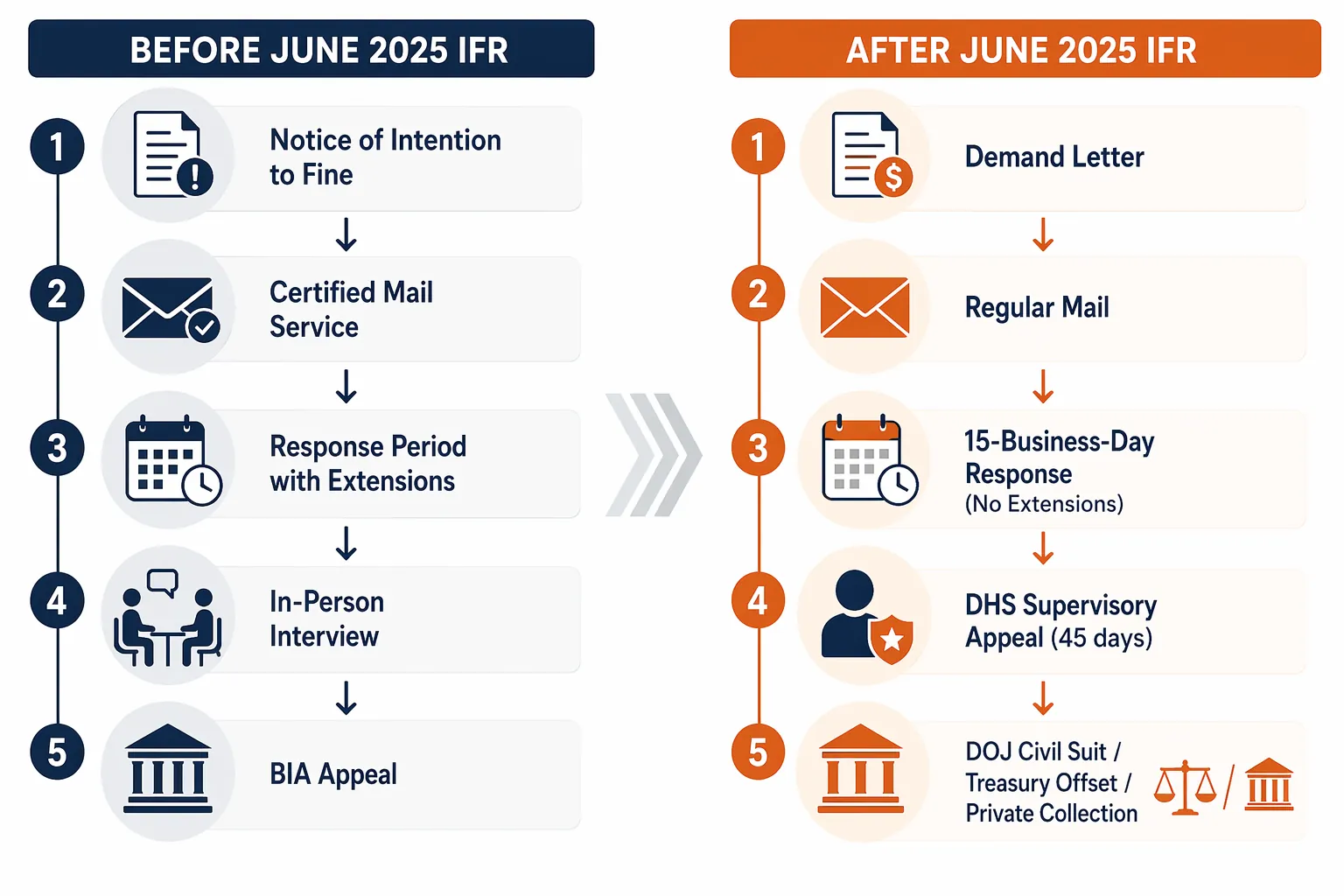
Before the interim final rule, the process included a Notice of Intention to Fine, certified or personal service, an opportunity to request an interview, and review by the Board of Immigration Appeals. After the rule, DHS eliminated the Notice of Intention to Fine, allowed service by regular mail, set a 15-business-day appeal window with no extensions, removed the in-person interview process, assigned appeals to DHS supervisory officers, required those officers to decide within 45 days, eliminated BIA review, and barred motions to reopen by the noncitizen.[5]
| Process Point | Before the June 2025 IFR | After the June 2025 IFR |
|---|---|---|
| Initial notice | Notice of Intention to Fine | Demand letter / notice of fine process without the prior NIF step |
| Service | Certified or personal service | Regular mail, justified by address-update duties under immigration law |
| Time to respond | Prior process allowed more procedural space | 15 business days, with no extensions |
| Fact development | In-person interview available | No in-person interview |
| Appeal | Board of Immigration Appeals review | Internal DHS supervisory officer review |
| Reopening | Prior reopening route available | No motion to reopen by the noncitizen |
DHS justified part of the service change by pointing to noncitizens’ duty to maintain a current address under INA §§ 262 and 265.[5] That explanation may satisfy the agency’s administrative preference for using the last address in its file. It does not answer the practical question that recurs in removal-order litigation: whether the notice actually reaches the person before the deadline expires. A 15-business-day clock is a different legal object when the envelope is sent by regular mail to an address that may already be stale.
The rule also cited the Board of Immigration Appeals’ workload. DHS stated that the BIA had 160,098 pending appeals in the second quarter of fiscal year 2025 and described removal of civil penalty appeals from the BIA as a way to reduce that burden.[5] Backlog is an administrative fact, not a due process conclusion. It explains why an agency may want a faster forum; it does not establish that an internal supervisory appeal is an adequate substitute when the penalty can be financially ruinous.
The New Process Matters Because the Fine Is Collectible
A civil penalty notice could be dismissed as symbolic if the government had no reliable collection path. This program has several. Bloomberg Law reported more than 50 DOJ civil lawsuits since September 2025, including at least five seeking more than $1 million.[2] The Marshall Project reported use of the Treasury Offset Program, including tax refund seizures, and described the pressure these fines can create for immigrants considering whether to leave the United States.[3]
The debt can also move into private collection. Reuters reported on a low-income migrant fined $1.8 million, and the record describes collection mechanisms including private debt collectors, wage garnishment, property liens, and credit reporting.[6] The Marshall Project and Reuters reporting make the same basic point from different angles: once the administrative penalty becomes final, the consequences are not confined to immigration court or an agency file.[3][6]
That is why the procedural compression cannot be separated from the collection apparatus. Regular mail is not just a notice preference. A missed 15-business-day deadline can become the gateway to a debt that follows the person through Treasury offsets, collection fees, litigation, and credit consequences.
Maria L. v. Noem Puts the Procedure on Trial
The concentrated legal challenge is Maria L. v. Noem, filed in the District of Massachusetts on November 20, 2025. Public Justice describes the case as a class action seeking vacatur of the interim final rule, an injunction against further fines, and declarations that the civil penalty scheme violates constitutional and administrative-law requirements.[7] As of July 23, 2026, the case remains unresolved; the allegations are not a final judicial holding.
The Fifth Amendment due process claim goes to the center of the system. The complaint challenges the adequacy of notice, the lack of a meaningful hearing, the short response window, and the replacement of BIA review with internal DHS supervisory review.[7] Those objections are not peripheral. They ask whether the government may impose massive civil penalties through an administrative sequence in which the first missed mail event may be decisive.
The due process problem is especially concrete for people who already have final removal orders. Some may have moved, relied on counsel, misunderstood old orders, or failed to receive prior notices. The administration’s position depends heavily on address-maintenance obligations and administrative finality. The plaintiffs’ position asks whether those obligations can carry the full weight of a million-dollar collection claim without a hearing and without external administrative review.
The Excessive Fines Claim
The Eighth Amendment claim challenges the fines as grossly disproportionate to the government’s stated purpose and financially ruinous for affected people.[7] The argument is not that every immigration-related civil penalty is unconstitutional. It is that a daily fine structure producing penalties up to roughly $1.8 million, imposed through the streamlined procedure created by the IFR, crosses constitutional limits when measured against the conduct and the person’s circumstances.
That claim will require the court to confront the difference between a civil label and punitive effect. Agencies often describe monetary penalties as civil enforcement tools. The Excessive Fines Clause is concerned with punishment in substance, not just labels. A debt large enough to be unpayable for most people, followed by collection actions and credit consequences, gives the plaintiffs a straightforward way to argue that the penalty is punitive in practical effect.
The Jury Trial and APA Claims
The Seventh Amendment claim is narrower but important. The plaintiffs argue that civil penalty amounts of this kind trigger a jury-trial right rather than being finally determined through agency paperwork and internal review.[7] That issue matters most when DOJ later files civil collection suits: the government is not merely recording a debt, but seeking judicial enforcement of a penalty that the recipient says was never tested before a jury.
The Administrative Procedure Act claim attacks the rulemaking path. Public Justice describes the lawsuit as alleging lack of notice-and-comment rulemaking and arbitrary and capricious agency action.[7] DHS used an interim final rule, which took effect without the ordinary pre-promulgation comment process. The APA question is whether the agency had adequate justification for that choice and whether its procedural substitutions were adequately reasoned.
None of these claims has been finally resolved as of the current date. It would be too easy, and legally wrong, to write as if a challenged system has already been struck down. The case matters because it identifies the fault lines: notice, hearing, jury participation, proportionality, and rulemaking procedure.
Self-Deportation Is the Policy Frame, Not the Evidentiary Shortcut
The administration frames the fines as part of a broader self-deportation strategy. DHS has claimed 2.2 million self-deportations since January 2025 and has promoted CBP Home app departures, including a $2,600 stipend offer.[8] Those figures should be treated as DHS claims, not independently established outcomes. Outside demographers and attorneys have publicly questioned the self-deportation totals, and the actual effect of app-based incentives should not be overstated without stronger independent measurement.
For legal analysis, the government’s deterrence rationale does not end the inquiry. Civil penalties can deter. They can also exceed constitutional limits or be imposed through procedures that fail to give a meaningful chance to contest liability. The harder question is not whether DHS wants people with final removal orders to leave. It is whether the chosen mechanism can lawfully convert nondeparture into a seven-figure debt through a compressed administrative process.
What Practitioners Should Watch
For immigration lawyers and legal services organizations, the first triage question is timing. A 15-business-day response period leaves little room to locate the client, reconstruct address history, obtain the removal file, assess prior notice, and preserve constitutional objections. The old instinct to wait for a more developed administrative record is dangerous if the new rule treats silence or lateness as the practical end of agency review.
- Check the mailing address DHS used and whether the client had updated address information in the relevant immigration file.
- Identify the final removal order, voluntary departure order, or other asserted statutory basis for the fine.
- Calculate the alleged accrual period rather than accepting the total fine as a single unexplained amount.
- Preserve objections to notice, hearing, review, proportionality, and collection before the agency deadline expires.
- Track Maria L. v. Noem without assuming that the pending class action automatically stays or invalidates an individual fine.
Public Justice and coalition partners have also made practitioner materials available through noimmigrationfines.org, including model briefs and know-your-rights resources.[7]
There is also a separate May 2026 DHS proposal concerning an increase in in absentia removal order fines from $5,130 to $18,000. That proposal should not be treated as operative unless its comment status and final agency action are verified. It is adjacent to the same enforcement posture, but it is not the same thing as the already operative § 274D failure-to-depart fine process.
The Legal Question Now
INA § 274D supplies a statutory hook for failure-to-depart fines. That much should be acknowledged plainly. But the current regime is not merely the quiet use of an old civil penalty. The June 2025 interim final rule and the administration’s mass collection strategy have produced a new enforcement mechanism: large accrued penalties, regular-mail notice, a short nonextendable response window, internal DHS review, no BIA appeal, no motion to reopen by the noncitizen, and collection tools that can reach ordinary financial life.
Its legality now turns on whether streamlined administrative collection can support ruinous civil penalties without the notice, hearing, jury, proportionality, and rulemaking protections that challengers say the Constitution and APA require. The courts have not yet given the final answer.
References
- 8 U.S.C. § 1324d, Cornell LII.
- Trump Is Taking Immigrants to Court, Seeking Millions in Fines, Bloomberg Law.
- How Fines of $1-Million-Plus May Pressure Immigrants to Self-Deport, The Marshall Project.
- EO 14159 § 8, Immigration Policy Tracking Project.
- Imposition and Collection of Civil Penalties for Certain Immigration-Related Violations, Federal Register, June 27, 2025.
- Trump administration fined this low-income migrant $1.8 million, Reuters.
- New Lawsuit Challenges Federal Government's Unconstitutional Civil Penalty Scheme, Public Justice, November 20, 2025.
- Celebrating One Year of Trump: DHS Now Offering $2,600 Stipend Via the CBP Home App, DHS.
Chronological incident history
No sanction cases have named this tool in the tracked record set to date. This does not imply the tool is safe — see Risk Digest for ongoing monitoring.
← Compare peer toolsReport a correction or tip
Spotted an outdated figure, a misstated fact, or a ruling this tool profile should reflect? Public comments are disabled for this content given the professional cost of a misreported case outcome, penalty amount, or rule text — use the structured correction channel instead.
Report a correction or tip for this record →