
UNRWA funding cuts create complicity risk under international law
An analysis of whether donor states that suspend or permanently withhold funding from UNRWA risk legal complicity under international law for starvation and genocide in Gaza, based on the ICJ advisory opinion, the Genocide Convention, and the ILC Articles on State Responsibility.
- Hallucination rate
- Not measured / undisclosed
The legal significance of the UNRWA funding shortage changed after the International Court of Justice described the agency as the “indispensable provider” of humanitarian assistance in Gaza and found that there was “no realistic alternative” to its role.[1] Those words do not transform every appropriations decision into an adjudicated international crime. They do something more modest, and more difficult for governments to ignore: they fix what donor states can be taken to know.
A state that withheld UNRWA funding in early 2024 could say it was responding to allegations, reviewing risk, and waiting for information. A state that continues to withhold funding after the Court’s October 2025 advisory opinion must account for a different record. The relevant question is no longer whether UNRWA is a politically contested institution. It plainly is. The question is whether a donor state may knowingly weaken the only humanitarian channel the Court has recognized as realistically capable of operating at the necessary scale, while Gaza remains under judicially noted conditions of extreme deprivation.
What the advisory opinion adds
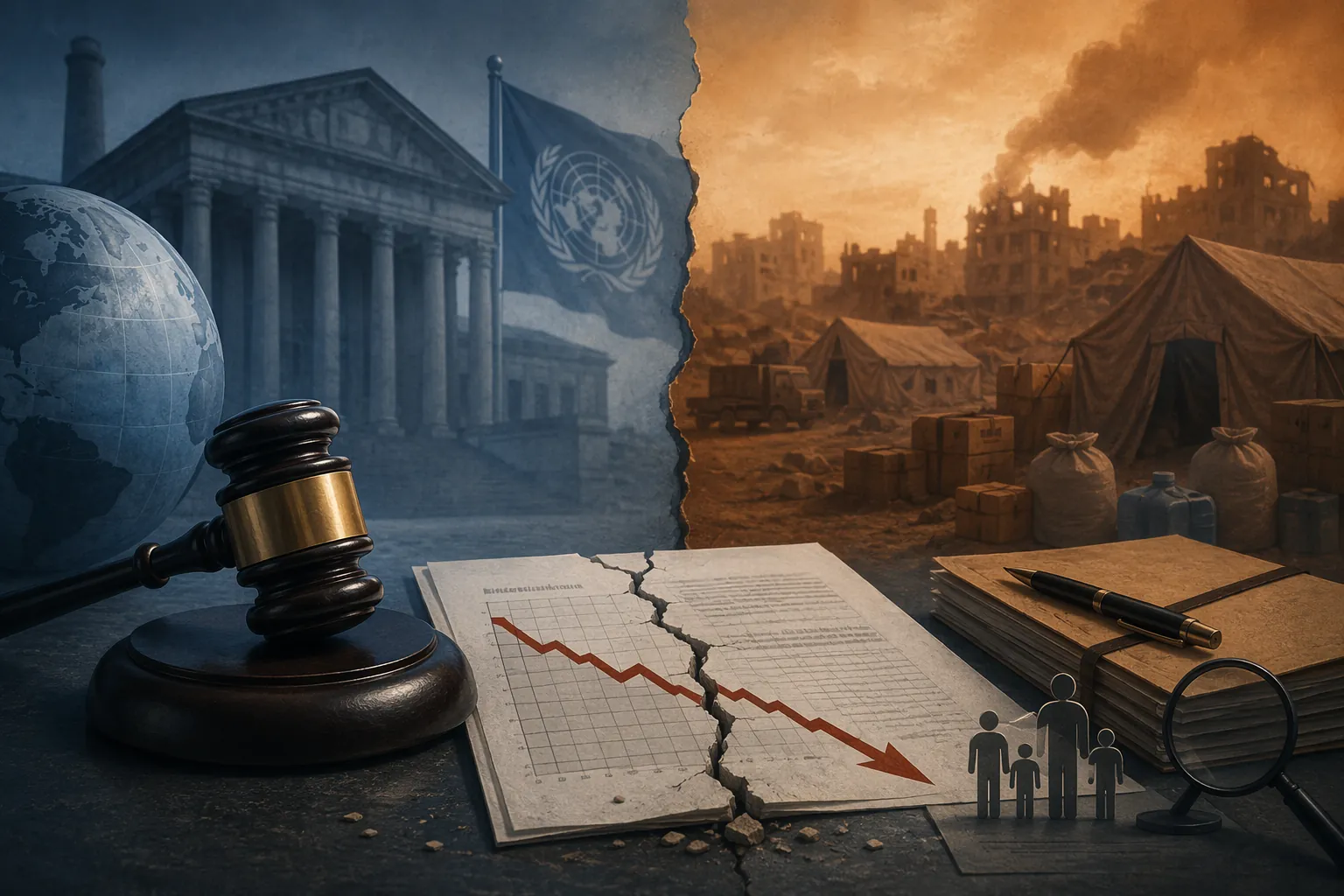
The October 2025 advisory opinion matters because it narrows the space for abstraction. The Court did not merely say that humanitarian aid should reach Gaza. It treated UNRWA’s operational position as legally material. In the same opinion, the Court found that Israel blocked aid from March to May 2025 and that later limited measures failed to “significantly alleviate the situation,” a finding discussed in Marko Milanovic’s analysis of the opinion.[1][2]
The opinion is advisory and non-binding. That limitation matters. It is not a damages judgment against a donor state, and it does not by itself decide that any funding suspension is unlawful. But advisory opinions are not diplomatic pamphlets. They are legal determinations by the principal judicial organ of the United Nations, and governments routinely treat them as authoritative statements of international law even when they contest the consequences.
For complicity analysis, the key contribution is evidentiary as much as doctrinal. Once the Court has found no realistic substitute, a donor’s later refusal to fund UNRWA is harder to describe as a neutral preference among aid channels. It becomes a decision made against a judicial record that says the channel being weakened is functionally irreplaceable.
The funding decisions did not happen in a legal vacuum
The first large funding suspensions came in January and February 2024, after Israel alleged that some UNRWA staff were involved in the October 7 attacks. At least 18 states suspended funding; 16 later restored it, while the United States remained the only major donor subject to a permanent statutory bar, imposed by Congress in 2024 and extended by a 2025 executive order.[3]
The timing was already uncomfortable. In January 2024, the ICJ had indicated provisional measures in South Africa v. Israel after finding that at least some rights claimed under the Genocide Convention were plausible. In May 2024, the Court ordered Israel to ensure the unhindered provision of humanitarian assistance in Gaza.[4] That did not decide the merits of the genocide case. It did, however, place states on notice that the deprivation of humanitarian assistance was occurring within a live Genocide Convention proceeding.
UN human rights experts were explicit about the legal risk. In February 2024, they said states “must reinstate and strengthen support to UNRWA” and warned them to “avoid legal consequences for aiding and abetting, or possible complicity in acts of genocide.”[5] FIDH went further, saying that states suspending funding were “fueling the ongoing genocide against Palestinians” and that the suspension “equals to potentially condemning millions to die of hunger and disease — complicity manifest to the ongoing genocide.”[6]
Those statements are not court judgments. They are advocacy and expert warnings, and their legal force is not the same as an ICJ order. Their importance lies elsewhere: they show that the complicity issue was identified early, in public, and in legal terms. By the time the 2025 advisory opinion arrived, donor states were not confronting a newly invented theory. They were confronting a theory that had been sitting in the file since the first suspensions.
Why “no realistic alternative” is a causation finding in practical terms
The phrase “no realistic alternative” would be thin if it rested only on institutional preference. It does not. UNRWA’s operational scale is the fact that gives the phrase legal weight. Human Rights Watch reported in July 2026 that 390 UNRWA staff had been killed since October 2023, that UNRWA had about 5,000 staff in Gaza compared with 230 for the largest international nongovernmental organization, and that UNRWA provided 80 percent of all aid delivery in Gaza.[3]
Those figures do not prove that a particular donor intended starvation or genocide. They do show why the substitute-channel argument has to be more than a line in a press release. A government cannot responsibly say “other agencies can do this” without identifying who, at what scale, through which logistics network, and under what security conditions. If the largest international NGO has a fraction of UNRWA’s staff presence, the burden is on the state reducing UNRWA support to explain the replacement capacity it is relying on.
By June 2026, the consequences were again described in budgetary rather than atmospheric terms: UNRWA faced a $100 million cash shortfall, and the UN Secretary-General warned that further cuts could “push conditions beyond breaking point.”[7][8] A shortfall of that kind is not merely an accounting problem inside an agency headquarters. In this setting, it is evidence bearing on foreseeability: fewer funds mean fewer operating margins for the very system identified as indispensable.
The state responsibility framework
The International Law Commission’s Articles on State Responsibility provide the basic architecture. Article 16 says that a state which aids or assists another state in the commission of an internationally wrongful act is internationally responsible if it does so with knowledge of the circumstances and if the act would be wrongful if committed by that state.[9] The provision is often discussed in cases involving arms, intelligence, or logistical support. Funding decisions are less direct, but they are not categorically outside the frame.
The difficult point is whether withholding money from UNRWA can count as “aid or assistance” to another state’s wrongful act. Donor states will argue that non-payment is not assistance to Israel, that it is a decision about their own funds, and that they are not directing Israeli military or administrative conduct. Those arguments cannot be dismissed. Article 16 is not a general negligence rule for bad foreign policy.
But the counterargument has become stronger as the factual record has sharpened. If a state knows that Israel is restricting or obstructing humanitarian relief, knows that the ICJ has treated the humanitarian situation as legally urgent, knows that UNRWA is the indispensable provider, and then continues a funding bar that foreseeably weakens that provider, the decision begins to look less like background non-cooperation and more like material assistance in maintaining the conditions created by the primary wrong.
Article 41 raises the stakes where serious breaches of peremptory norms are involved. It requires states not to recognize as lawful a situation created by such a breach and not to render aid or assistance in maintaining that situation.[9] The provision is not limited to direct participation. It is concerned with whether other states help sustain an unlawful situation once the character of that situation is known.
That is why the advisory opinion matters even though it is non-binding. It supplies a legal account of the situation donor states are helping to maintain or alleviate. A state may dispute parts of that account, but it cannot plausibly claim there is no legal record to consider.
Genocide complicity is narrower, and more serious
The Genocide Convention adds a separate and more severe line of analysis. Article III(c) makes “complicity in genocide” punishable.[10] That is not the same as saying every act that worsens civilian suffering is genocide complicity. The legal threshold is higher, and the mental element matters. International lawyers should be wary of using the word as a substitute for outrage.
Still, the threshold cannot be made unreachable by administrative phrasing. The ICJ’s provisional measures in South Africa v. Israel established that plausible Genocide Convention rights were at issue, and later measures addressed humanitarian assistance directly.[4] The OHCHR experts’ warning in February 2024 then tied UNRWA funding decisions to the risk of “aiding and abetting” or “possible complicity in acts of genocide.”[5] After October 2025, the missing link is harder for donors to deny: UNRWA is not one agency among many in the Court’s account, but the indispensable provider.
The stronger conclusion is therefore not that a court has already found donor states complicit. It has not. The stronger conclusion is that continued withholding after the advisory opinion creates a credible, foreseeable complicity risk, especially where the withholding is categorical, long-term, and unaccompanied by a lawful and effective replacement plan.
The United States is the clearest test case
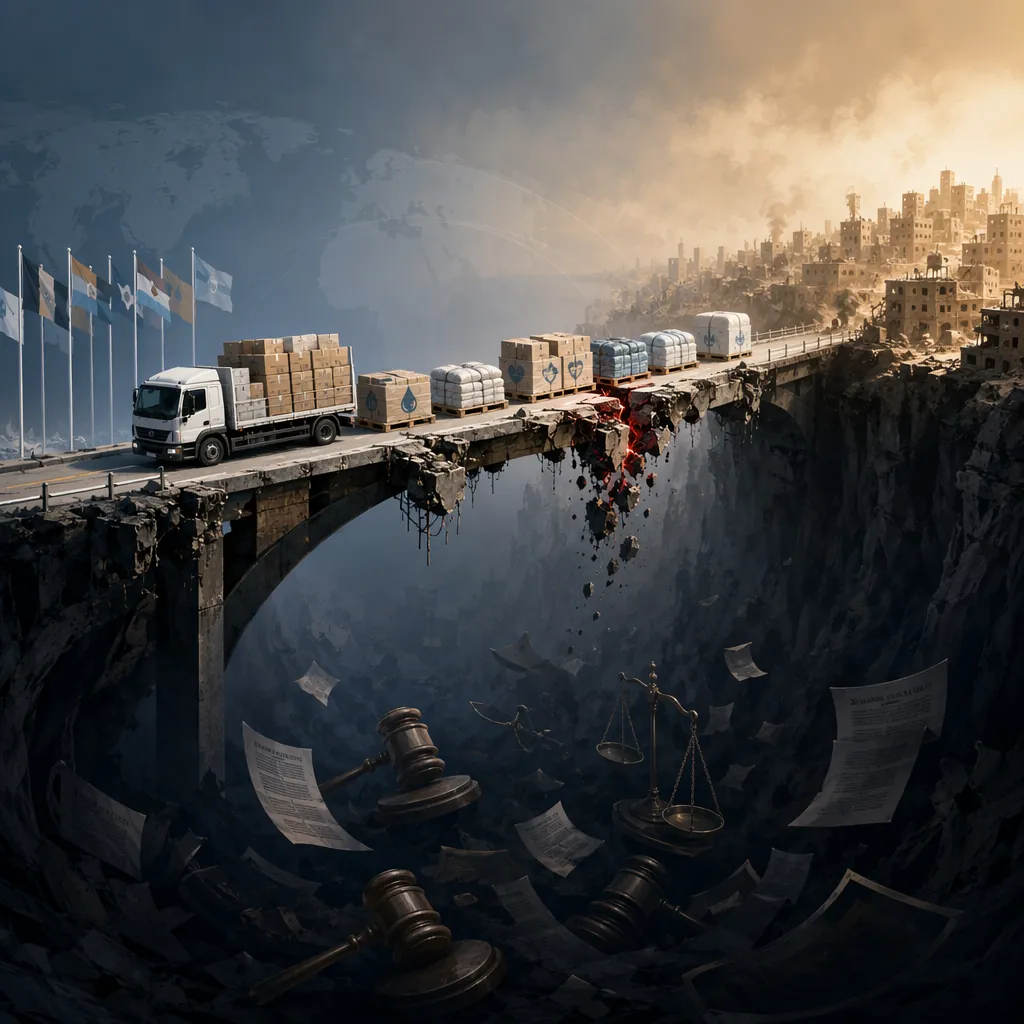
The United States stands apart because its position is not merely a temporary suspension pending review. According to the July 2026 reporting summarized by Human Rights Watch and Al Jazeera, the United States remained the only major donor under a permanent statutory bar after Congress prohibited funding in 2024 and a 2025 executive order extended the restriction.[3][8]
That distinction matters legally. Canada, Sweden, Australia, and the European Union suspended funding and later restored it.[3] Restoration does not erase the consequences of the initial suspension, and it does not make those governments immune from criticism. But it changes the legal posture. A restored donor can argue that its review had an endpoint, that the suspension was temporary, and that it ultimately avoided maintaining the gap once the operational consequences became clearer.
A permanent bar is harder to defend on those terms. It does not ask whether safeguards can be improved, whether allegations can be investigated, or whether funds can be conditioned. It disables funding as a category. After the ICJ’s finding that there is no realistic alternative, that categorical posture carries a different legal exposure from a temporary pause followed by restoration.
The United States can still raise serious defenses. It may say it is not legally required to fund a particular UN agency; that it has supported other humanitarian channels; that its decision responds to legitimate concerns about staff involvement in attacks; and that the causal chain between its appropriations law and any wrongful act by Israel is too attenuated. Those are real arguments. The problem is that each one now has to pass through the Court’s finding of indispensability.
If Washington’s position is that other channels suffice, the legally relevant question is not whether other channels exist. It is whether they can realistically replace the provider that accounts for the scale of aid delivery and personnel presence identified in the record. If the answer is no, continued refusal to fund UNRWA becomes a knowing contribution to a shortage whose effects are no longer speculative.
Israel’s allegations matter, but they do not end the inquiry
The allegations against UNRWA staff cannot be treated as irrelevant. Donor states are entitled to examine whether public funds may be diverted, whether employees were involved in armed attacks, and whether institutional controls are adequate. A government legal adviser who ignored those questions would not be doing the job.
But allegations and institutional objections do not by themselves answer the international law question. They may justify investigation, conditions, audits, dismissals, or temporary measures. They do not automatically justify maintaining a funding bar when the foreseeable result is to weaken the only relief provider judicially recognized as having no realistic substitute.
The legal burden is practical. A donor that refuses to restore funding while invoking UNRWA-related concerns should be able to identify the alternative mechanism that will deliver equivalent humanitarian protection in fact, not merely in aspiration. Without that, the policy file contains a warning, a shortage, a finding of indispensability, and no operational answer.
What a legally serious donor record would need to show
For states still withholding funds, the legal risk turns less on public messaging than on the administrative record. A defensible record would need to show that the state identified the humanitarian consequences of non-funding, assessed the ICJ’s findings, evaluated whether replacement channels could operate at comparable scale, and revisited the decision as conditions changed.
- A review with a defined endpoint, rather than an indefinite suspension labeled as due diligence.
- A documented assessment of UNRWA’s operational role after the ICJ’s October 2025 advisory opinion.
- A concrete substitute plan if funding is withheld, including scale, access, staffing, and delivery capacity.
- A reassessment of genocide, starvation, and peremptory-norm risks in light of ICJ provisional measures and later humanitarian findings.
- A reasoned explanation for why continued non-funding does not aid or assist the maintenance of unlawful conditions.
This is not a demand that states ignore security allegations. It is a demand that they connect the allegation, the remedy, and the humanitarian consequence. International law does not require moral purity from budget officials. It does require states to take legal notice of the conditions their decisions help create or sustain.
The risk after October 2025
The UNRWA funding shortage now sits at the intersection of three legal regimes: Article 16 responsibility for aid or assistance, Article 41 duties concerning serious breaches of peremptory norms, and Article III(c) complicity under the Genocide Convention.[9][10] None of those rules produces an automatic answer from the mere fact of non-funding. Each requires attention to knowledge, contribution, wrongfulness, and, for genocide complicity, the relevant mental element.
But the knowledge element is no longer the weak point it once was. Donor states have had the January and May 2024 ICJ provisional measures, the February 2024 OHCHR experts’ warning, the public controversy over suspensions and restorations, the operational evidence of UNRWA’s scale, the June 2026 shortfall, and the October 2025 advisory opinion’s finding of indispensability.[1][3][4][5][7]
That record does not justify declaring that any particular state has already been adjudicated complicit in starvation or genocide in Gaza. It does justify a narrower conclusion: the risk of legal responsibility is credible, foreseeable, and most acute for states that continue to withhold UNRWA funding after the ICJ has found that no realistic alternative exists.
Once UNRWA has been judicially recognized as indispensable, refusal to restore funding is no longer only a budget decision. It is a legally legible contribution to the conditions international law is already warning against.
References
- Obligations of Israel in relation to the Presence and Activities of the United Nations, Other International Organizations and Third States in and in relation to the Occupied Palestinian Territory, International Court of Justice, October 2025, link
- The ICJ’s Advisory Opinion on Israel and UNRWA, EJIL: Talk!, October 2025, link
- UNRWA is Irreplaceable in Gaza, Human Rights Watch, July 2026, link
- Application of the Convention on the Prevention and Punishment of the Crime of Genocide in the Gaza Strip (South Africa v. Israel), International Court of Justice, 2024, link
- States must reinstate and strengthen support to UNRWA amid unfolding genocide in Gaza, UN experts say, OHCHR, February 2024, link
- Suspension of UNRWA funding: States are fueling the ongoing genocide against Palestinians, FIDH, January 2024, link
- UNRWA faces $100 million shortfall, UN News, June 2026, link
- UN chief warns UNRWA cuts could push Gaza beyond breaking point, Al Jazeera, July 2026, link
- Draft articles on Responsibility of States for Internationally Wrongful Acts, with commentaries, International Law Commission, 2001, link
- Convention on the Prevention and Punishment of the Crime of Genocide, United Nations, 1948, link
Chronological incident history
No sanction cases have named this tool in the tracked record set to date. This does not imply the tool is safe — see Risk Digest for ongoing monitoring.
← Compare peer toolsReport a correction or tip
Spotted an outdated figure, a misstated fact, or a ruling this tool profile should reflect? Public comments are disabled for this content given the professional cost of a misreported case outcome, penalty amount, or rule text — use the structured correction channel instead.
Report a correction or tip for this record →