
How the Val Kilmer AI Movie Tests California's Digital Replica Law
The Val Kilmer AI-generated film appears compliant with California's posthumous digital replica law, but three major uncertainties remain untested — offering a roadmap for entertainment attorneys navigating the emerging legal framework.
- Hallucination rate
- Not measured / undisclosed
The first legal implication of the Val Kilmer AI-generated movie is the unusually clean fact pattern. As Deep as the Grave reportedly uses a digital version of Kilmer after his estate consented, compensation was paid, and SAG-AFTRA’s consent, compensation, and collaboration guidelines were followed.[1] That does not make the project legally frictionless. It does make it a more useful test than the familiar unauthorized-deepfake hypothetical.
Mercedes Kilmer’s public explanation matters here. In an April 29, 2026 TODAY interview, she framed the project as something her father wanted to use to “set precedent” around actor IP ownership.[2] That is not a family discovering an unauthorized synthetic performance after release. It is the family stepping into the authorization role before distribution, with the actor’s posthumous identity treated as an asset that can be licensed, controlled, and documented.
For lawyers tracking the legal implications of the Val Kilmer AI-generated movie, that distinction is the whole point. The production appears to satisfy the consent layer of California’s new posthumous digital replica law. The unresolved exposure sits later in the chain: release, distribution, forum selection, state-law overlap, and whatever a court eventually does with California’s expressive-work language.

Why the California Consent Question Looks Strong
California AB 1836 took effect in January 2025 and targets unauthorized digital replicas of deceased personalities. The statute, as summarized by Fenwick, applies where a digital replica is used in an audiovisual work or sound recording without prior consent from the rights holder, and it provides for the greater of $10,000 or actual damages.[3]
That framework makes the Kilmer production a direct stress test. The reported facts line up with the statute’s threshold concern: the estate consented, the estate was compensated, and the union’s digital-replica norms were reportedly observed.[1] If those records are as clean as the public reporting suggests, the California production file would likely begin with the right documents in the right place.
That is a narrower conclusion than “the movie is legal.” It means the known facts appear to answer AB 1836’s central unauthorized-use problem. It does not answer whether every downstream distributor, platform, advertiser, foreign sales agent, or awards campaign can rely on the same file without additional review.
SAG-AFTRA’s role also should not be overstated. Variety’s April 2026 awards-context reporting described the union’s digital replica consent rules and the risk that certain uses of AI performers could affect awards treatment.[4] But union compliance is not a substitute for state-law clearance. It is one part of the evidence that the project was handled as a negotiated likeness use rather than as a scrape-and-generate exercise.
The Release Problem Starts Where the Production File Ends
The legally important missing fact is distribution. As of July 2026, the film has no confirmed U.S. distribution deal.[1] That means the most practical question is still prospective: what happens when a California-cleared posthumous digital replica is sold, streamed, advertised, or exhibited through a company operating across multiple states?
A distributor will not look only at whether the estate signed off during production. It will ask who owns or controls the relevant posthumous rights, whether the consent covers trailers and marketing, whether the compensation structure covers downstream exploitation, whether any guild paperwork restricts reuse, and whether the law of another state adds a separate clearance burden. The cleaner the production file, the more visible the distribution gap becomes.
That is why AB 1836 is not the end of the analysis. It is a California statute attached to a fragmented right-of-publicity system. The Texas Law Review has described digital replica disputes against a broader background of state-by-state publicity rights rather than a single national rule.[5] Columbia Undergraduate Law Review’s discussion of the NO FAKES Act points to the same federal gap: Congress has considered a national digital-replica framework, but the operative terrain remains uneven without a final federal statute in force.[6]
That gap is not academic for a film. A streamer can ingest a finished master in one state, market it nationally, store assets through vendors elsewhere, and deliver the same synthetic performance to viewers in every U.S. jurisdiction. A consent package that is comfortable under California law may still need to be translated into a distribution clearance memo.
For broader federal context, see What the NO FAKES Act Means for AI Resurrected Actors. For the state-law patchwork around celebrity likeness disputes, see What Sandra Bullock's AI Comments Mean for Celebrity Legal Risks.
The Expressive-Work Carve-Out Is Not a Safe Harbor Yet
AB 1836’s expressive-work carve-out is the provision most likely to be overread. Fenwick’s analysis identifies statutory language addressing expressive works, but no court has yet interpreted that boundary in the context of a deceased performer’s digital replica.[3] Until that happens, the carve-out is an argument, not settled operational protection.
In the Kilmer case, consent may make the carve-out less urgent for the production itself. If the estate authorized the digital replica, the production does not need to lead with a First Amendment-style defense to explain why it used the likeness. But a distributor still has to understand the carve-out because future disputes may not arise from the feature alone. They may arise from trailers, promotional clips, platform thumbnails, behind-the-scenes materials, or reuse of digital assets outside the original creative context.
The important distinction is defensive posture. A consent file says, “we had permission.” An expressive-work carve-out says, in substance, “even without permission, this use may fall outside the statute or receive constitutional protection.” Those are different arguments with different evidentiary needs. Treating the carve-out as if it automatically blesses an AI resurrection project would be premature.
New York and Tennessee Complicate the Clearance Memo
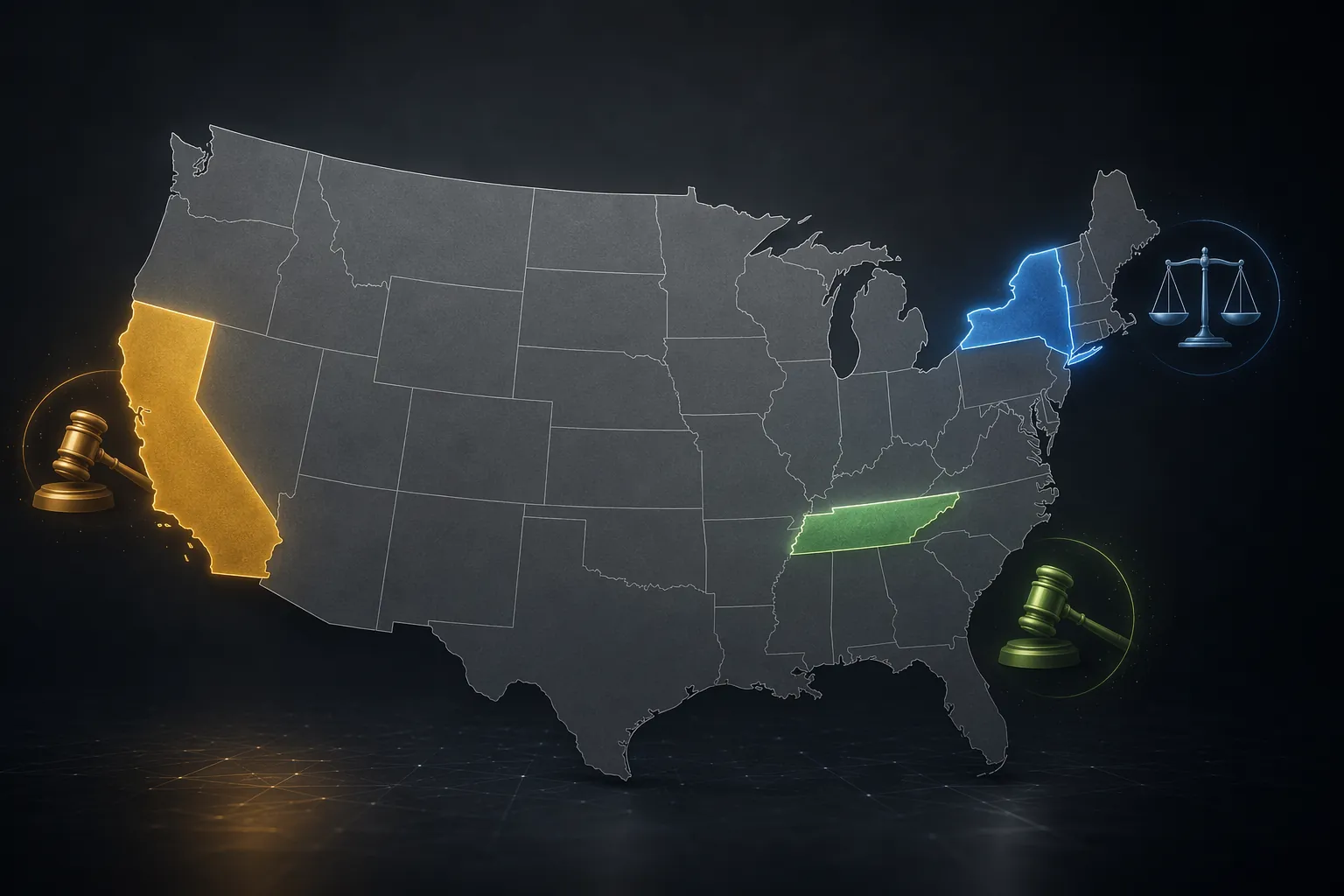
California is only one route through the map. New York’s SB 7676B created a post-mortem right of publicity covering deceased performers and includes a digital replica provision, as analyzed by the Cornell Journal of Law and Public Policy.[7] Tennessee’s ELVIS Act likewise sits in the same practical family of state efforts to control unauthorized digital uses of identity, particularly voice and likeness. The point is not that each statute produces the same answer. The point is that they may not.
| Jurisdiction | Practical question for a Kilmer distribution review |
|---|---|
| California | Does AB 1836’s consent requirement appear satisfied, and does the grant cover the actual uses being distributed? |
| New York | Does the release implicate New York’s post-mortem performer protections or registration-related requirements? |
| Tennessee | Does the distribution or marketing trigger state-law protections for voice, image, or likeness under the ELVIS Act framework? |
| Federal law | Is there a uniform national digital-replica right in force, or is the distributor still relying on a state-by-state analysis? |
This is where a seemingly strong California file can become operationally messy. If a distributor acquires the film for a national release, it will not want a memo that stops at “estate consent obtained.” It will want to know whether the consent is assignable, whether it covers sublicensing, whether it survives platform edits, whether paid media is included, whether the performer’s digital replica can be used in localized marketing, and whether any state-specific notice or right-holder requirement has been missed.
The absence of a U.S. distribution deal leaves those questions unanswered. It also prevents a clean test of interstate enforcement. If a distributor based outside California exploits the film nationally, AB 1836’s practical reach may depend on contacts with California, contract drafting, choice-of-law provisions, and where the alleged violation is framed as occurring. Those are not questions the public production facts can answer in July 2026.
What a Distributor Would Still Need to See
The Kilmer file, if reported accurately, would start in a better place than many AI likeness projects. Still, a buyer or platform would likely want more than a public statement that the family was involved. The practical review would move through the documents.
- Estate authority: who had the power to consent to the posthumous digital replica, and whether that authority is documented.
- Scope of consent: whether the grant covers the film, trailers, advertising, clips, stills, platform art, publicity, and future formats.
- Compensation terms: whether payment covered only production use or also downstream exploitation.
- Guild compliance: whether SAG-AFTRA-related consent, compensation, and collaboration records match the final delivered assets.
- State-law review: whether California, New York, Tennessee, and any other relevant jurisdictions require different handling.
- Asset control: who can access, modify, reuse, localize, or archive the digital Kilmer materials after delivery.
That last item is easy to underestimate. A digital replica is not only a performance captured in a locked film. It may involve files, models, training references, voice elements, approvals, and vendor outputs. The release risk depends partly on whether those materials are locked down or whether they can be repurposed beyond the consent Mercedes Kilmer described publicly.
This is also where production delivery requirements and legal clearance separate. A platform can receive a technically compliant master and still need legal assurances about the underlying synthetic performance. A clean chain-of-title binder for the movie does not automatically prove clean rights in every AI-generated likeness asset used to create or market it.
The Narrow Lesson of the Kilmer Test Case
The Kilmer project is not the hard case for consent. On the public facts, it is the easier case: family participation, compensation, and reported union-guideline compliance. That is why it is useful. If even this project leaves open distribution and interstate questions, weaker projects will not be saved by broad claims that AI resurrection is now accepted practice.
AB 1836 appears to give the production a strong California consent answer. It does not tell a national distributor exactly how to route the film through other states, how to rely on an untested expressive-work carve-out, or how to treat promotional reuse of a deceased performer’s synthetic likeness. The live legal variable is no longer whether the family said yes. It is where, how, and by whom that yes is exploited.
References
- AP News report on As Deep as the Grave, AP News, April 2026.
- TODAY interview with Mercedes Kilmer on Val Kilmer and As Deep as the Grave, TODAY, April 29, 2026.
- Analysis of California AB 1836 and AB 2602 on digital replicas, Fenwick.
- Variety awards analysis discussing SAG-AFTRA digital replica consent rules, Variety, April 2026.
- Note on digital replicas and the right of publicity, Texas Law Review.
- Analysis of the NO FAKES Act, Columbia Undergraduate Law Review.
- Analysis of New York SB 7676B, Cornell Journal of Law and Public Policy.
Chronological incident history
No sanction cases have named this tool in the tracked record set to date. This does not imply the tool is safe — see Risk Digest for ongoing monitoring.
← Compare peer toolsReport a correction or tip
Spotted an outdated figure, a misstated fact, or a ruling this tool profile should reflect? Public comments are disabled for this content given the professional cost of a misreported case outcome, penalty amount, or rule text — use the structured correction channel instead.
Report a correction or tip for this record →