
Why Nintendo Lost the Palworld Patent Case
Nintendo's patent infringement lawsuit against Palworld developer Pocketpair looked formidable at first, but a combination of workaround patches, narrowed claims, patent office rejections, prior art, jurisdictional limits, and unfavorable economics left it with no realistic path to block current sales or recover significant damages. This article explains the six compounding reasons the case effectively collapsed.
- Hallucination rate
- Not measured / undisclosed
Nintendo has not formally lost the Palworld patent case. As of July 23, 2026, Reiwa 6 (Wa) No. 70421 remains pending in Tokyo District Court before Civil Division 40, with Presiding Judge Motoyuki Nakashima; an October 1 technical briefing and a November 9 preliminary opinion are still ahead.[1] That caveat matters. It is also not the same thing as saying the case still has meaningful commercial bite.
The short answer to why Nintendo lost the Palworld patent case, in the practical sense, is that the live product moved away from the accused mechanics faster than the litigation could preserve a useful remedy. Nintendo sued on three Japanese patents — JP7545191, JP7493117, and JP7528390 — all divisionals from December 2021 originals and filed in 2024.[1] Palworld 1.0 then launched on July 10, 2026 without current sales restrictions, leaving the dispute concentrated on older software builds rather than the game now being sold.[1]

That is a remedial collapse, not a fan-war result. Nintendo may still obtain some formal finding. It may still win something on an older accused version. But the case that mattered commercially — stopping current Palworld sales or extracting damages proportionate to the fight — appears to have been hollowed out before the court reaches a final judgment.
The Case Turned on Moving Software, Not Brand Drama
A patent complaint against a live-service or update-driven game has a remedy problem that a cartridge-era dispute did not present in the same way. The accused product is not frozen. If the defendant can remove or rework the accused implementation while keeping the game commercially viable, the plaintiff must decide whether to chase old versions, amend theories, or ask for relief against conduct that no longer exists.
That is what makes Pocketpair’s patch sequence the center of the Palworld case. The public fight often gets flattened into “Nintendo versus Palworld.” The litigation record is more prosaic and more damaging: an accused mechanic disappeared, another mechanic changed, and the complaint later narrowed toward versions that users were no longer buying as the current product.
| Date | Event | Why it mattered |
|---|---|---|
| November 2024 | Pocketpair released v0.3.11, removing Pal Sphere throwing. | The most visible accused summoning interaction no longer existed in the same form. |
| May 8, 2025 | Pocketpair released v0.5.5, changing gliding to equipment-based mechanics. | A second accused gameplay pathway was redesigned rather than litigated unchanged. |
| November 2025 | Nintendo amended its complaint to target pre-patch versions. | The dispute narrowed toward obsolete builds, reducing injunction value. |
| July 10, 2026 | Palworld 1.0 launched without current sales restrictions. | The commercially relevant product remained on the market. |
1. Pocketpair Designed Around the Accused Mechanics
The first reason Nintendo’s case effectively failed is the most practical one: Pocketpair changed the product. In v0.3.11, released in November 2024, Pocketpair removed the Pal Sphere throwing mechanic that had been central to the infringement discussion.[1] That kind of change is not an admission that the original version infringed. It is the familiar, tedious work of designing around a patent claim: identify the accused step, remove or alter it, and make the plaintiff prove that the replacement still falls inside the claim language.
The second major design-around arrived with v0.5.5 on May 8, 2025. Pocketpair changed gliding to an equipment-based mechanic and issued a public statement explaining that the gameplay change was tied to the legal dispute.[1] From a player’s point of view, that is a patch note. From a remedies perspective, it is a turning point: a plaintiff seeking an injunction now has to explain why the redesigned current game should be restrained, not merely why an earlier version might have practiced an asserted claim.
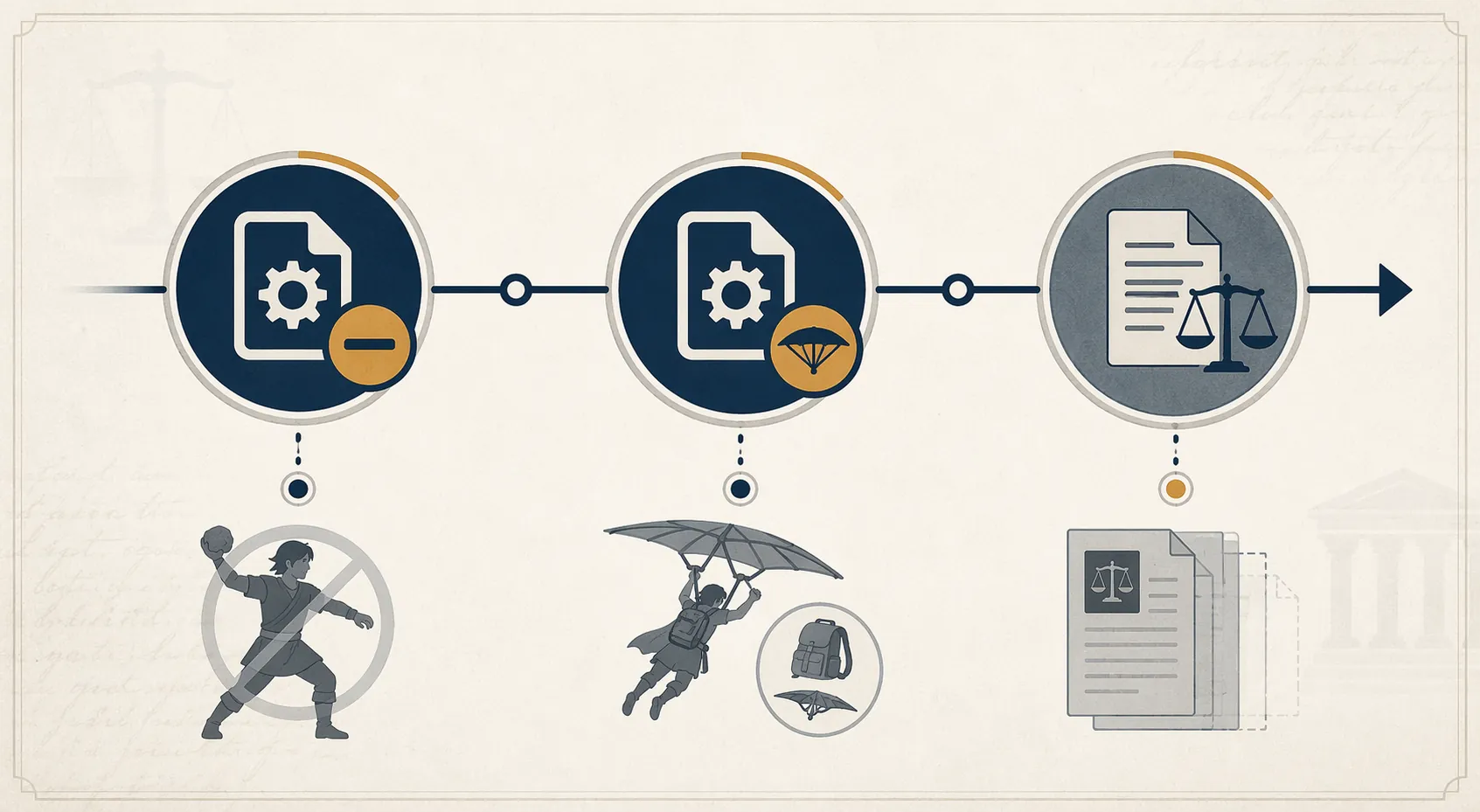
This is where Nintendo’s reputation as a patient, disciplined rights holder runs into ordinary remedial math. A strong plaintiff can force a defendant to spend engineering time, take on user complaints, and document design choices. It cannot make an obsolete software build the commercial center of the market again. Once the accused mechanics were patched out of the live product, the case began to separate into two questions: whether older versions infringed, and whether anything useful could still be done about it.
2. The Amended Complaint Followed the Old Builds
Automaton’s review of Tokyo District Court records reported that Nintendo’s November 2025 amended complaint narrowed the case to pre-patch versions of Palworld.[1] That is not a small procedural footnote. It is the point at which the plaintiff’s own pleading posture appears to concede the practical effect of the design-arounds.
A narrowed complaint can be sensible litigation hygiene. If the current version no longer maps cleanly onto the asserted claims, a disciplined plaintiff may avoid overreaching and preserve a cleaner damages case on earlier conduct. But the same move usually costs leverage. The court is no longer being asked to stop the defendant’s current game in any commercially serious way. It is being asked to adjudicate earlier versions that the defendant has already superseded.
That is why the November 2025 amendment matters more than any broad claim that Nintendo is aggressive or Pocketpair is defiant. The pleading moved with the software history. By the time Palworld 1.0 launched in July 2026, the central commercial remedy — blocking the current product — was not realistically available on the record described by court watchers.[1]
3. Patent-Office Pressure Made the Claims Harder to Defend
The patent-office record did not by itself end the Tokyo case. It did, however, make Nintendo’s position harder to present as a straightforward enforcement story. In July 2025, Nintendo rewrote JP7528390, the ride-switching patent, adding “even when” language in what IGN described as a mid-case patent rewrite.[2] The apparent purpose was defensive: adjust the claim language while the dispute was underway, and try to preserve coverage against the accused or redesigned conduct.
That kind of amendment is not inherently improper. Patent prosecution and litigation often overlap, especially around divisionals and related applications. But it is a warning sign for remedy analysis because it suggests the original claim set may not have been as litigation-ready as the public narrative assumed. When a plaintiff has to refine claim language midstream while the accused product is also changing, the case becomes less about enforcing a clean monopoly and more about preserving a shrinking zone of coverage.
The U.S. record added pressure, even though it is not a Japanese judgment. In November 2025, the USPTO Director ordered reexamination of U.S. Patent No. 12,403,397, a related character-summoning patent.[3] On March 25, 2026, the USPTO issued a non-final Office Action rejecting all 26 claims as obvious, citing prior art from Nintendo, Konami, and Bandai Namco.[3]
That rejection should not be overstated. It is non-final. Nintendo can respond, amend, and appeal. A U.S. obviousness rejection also does not automatically invalidate Japanese patents asserted in Tokyo. PC Gamer’s coverage, relying on Japanese patent-attorney analysis, framed the USPTO rejection as closer to “business as usual” than a final knockout.[4] Still, an all-claims rejection in a related family is not nothing. It supplies defendants, commentators, and potentially settlement negotiators with a concrete reason to discount claim strength.
The JPO record created a similar but narrower problem. GamesRadar reported that the JPO rejected related Patent Publication No. 2026-077713 in October 2025 with unusually sharp language, citing a 13-year-old unofficial indie Pokémon game.[5] That publication is related to, but not identical with, the three patents asserted in the Tokyo lawsuit. It also remains under review following Nintendo’s petition.[5] The cautious conclusion is therefore not “Nintendo’s asserted patents are invalid.” It is that related claim families were encountering obviousness and inventiveness resistance on both sides of the Pacific.
4. Prior Art Made the Gameplay Ideas Look Crowded
Patent cases about game mechanics often become uncomfortable when the asserted invention is translated out of brand language and into functional steps. Summoning creatures, switching mounts, riding, gliding, and deploying companions may feel distinctive in a particular game. The legal question is narrower: what exactly did the claim add over what was already known at the priority date?
The prior-art field identified around the Palworld dispute was not empty. Reports and patent-office materials pointed to ARK: Survival Evolved from 2015, the Monster Hunter series, Pocketpair’s own Craftopia from 2020, and Nintendo’s earlier games as part of the background against which the asserted mechanics would be judged.[3][5] That mix matters because it weakens the instinctive assumption that a familiar Nintendo interaction necessarily produces broad patent control over adjacent survival-crafting mechanics.
Prior art does not have to be identical to be dangerous. In an obviousness analysis, a claim can become vulnerable if earlier references disclose enough pieces that combining them would have been within ordinary skill. The USPTO’s March 2026 rejection, for example, treated the related U.S. claims as obvious in view of prior art rather than as anticipated by one single reference.[3] That distinction is important because it keeps the analysis from turning into a simplistic hunt for one earlier game that did “the same thing.”
The prior-art problem also interacts with Pocketpair’s patches. If the current game no longer uses the accused implementation, Nintendo’s best remaining case is older and narrower. If the patents also face crowded-field arguments, the damages case on those old builds becomes less attractive to litigate aggressively. Claim scope, accused versions, and validity pressure are separate legal concepts, but here they converged in the same direction.
5. The Tokyo Case Could Not Capture Global Palworld Sales
The territorial limit is easy to miss because the audience sees a global game and a global Nintendo. The lawsuit, however, is a Tokyo District Court case asserting Japanese patents. That means damages are tied to infringement within Japan, not to worldwide Palworld revenue, and after the November 2025 narrowing they are tied to Japanese sales of older accused versions rather than the current 1.0 product.[1]
Analysts cited by Games Fray and subsequent coverage estimated the remaining recovery at roughly ¥5–10 million, or about $30,000–$66,000.[6] That figure should be treated as an estimate, not a court award. It is useful because it reflects the combined effect of three constraints: Japan-only patent rights, older accused versions, and design-arounds that make current sales hard to reach.
This is also why “Nintendo lost” is both imprecise and understandable. A plaintiff can win a formal infringement finding and still fail to obtain the remedy that justified the fight. If the surviving damages pool is limited to a small slice of historical Japanese sales, the judgment no longer functions as meaningful market control.
6. The Economics Turned Any Remaining Win Pyrrhic
The economics should come last because they are a consequence of the earlier narrowing, not a substitute for it. Litigation cost alone does not prove a case is weak. Companies sometimes spend more than they can recover in one dispute because deterrence, licensing posture, and internal precedent matter. Nintendo in particular has long been willing to enforce rights in ways that signal seriousness beyond the immediate damages line.
Even so, the scale mismatch here is hard to ignore. Nintendo reported ¥6.414 billion, approximately $41 million, in litigation losses for FY2026, covering April 2025 through March 2026.[7] GameRant correctly cautioned that this figure likely relates mainly to Nintendo’s settlement with Malikie Innovations over BlackBerry patents, not to the Palworld lawsuit.[7] It should not be presented as “Nintendo spent $41 million suing Pocketpair.”
The number still illustrates the scale problem. In a litigation environment where patent disputes can produce eight- or nine-figure yen accounting consequences, a Palworld recovery estimated at roughly ¥5–10 million is commercially trivial.[6][7] Once the current product is out of reach, the injunction value is gone, validity pressure is rising, and damages are limited territorially, the remaining lawsuit looks less like a market-moving enforcement action and more like an expensive fight over residue.
What Nintendo Can Still Win
A careful answer leaves room for formal outcomes that headlines tend to erase. Nintendo can still argue that older Palworld versions infringed one or more asserted Japanese patents. It can still defend amended claims. It can still obtain a preliminary opinion that validates some portion of its theory, or negotiate from whatever pressure remains before final judgment.
But none of those possibilities restores the case Nintendo appeared to have at filing. By Q3 2026, the relevant commercial facts point in the other direction: Palworld 1.0 is on sale, current versions are not under restriction, the complaint has been reported as narrowed to pre-patch builds, related patent claims have faced non-final office rejections, and the damages estimate is closer to a token award than a business-level remedy.[1][3][5][6]
So the most accurate formulation is not that Nintendo has already lost in court. It is that the commercially meaningful case has already collapsed. Based on the available record as of July 23, 2026, Nintendo may still obtain a formal finding or modest damages, but it has no realistic path to block current Palworld sales and no plausible recovery proportionate to the fight.
References
- Tokyo District Court records review for Reiwa 6 (Wa) No. 70421, Automaton Media
- Nintendo Rewrites Patent Mid-Case in Ongoing Lawsuit Against Palworld Dev Pocketpair — but Why?, IGN, July 2025
- USPTO rejection of character-summoning patent, Rock Paper Shotgun, March 2026
- Japanese patent attorney analysis of USPTO rejection as “business as usual,” PC Gamer
- JPO rejection with “rarely seen sass,” GamesRadar, October 2025
- Ahead of October 1 court hearing, Nintendo has zero chance of prevailing over current Palworld versions: it may get $30K chump change, Games Fray
- Nintendo FY2026 litigation loss and Malikie/BlackBerry settlement caveat, GameRant
Chronological incident history
No sanction cases have named this tool in the tracked record set to date. This does not imply the tool is safe — see Risk Digest for ongoing monitoring.
← Compare peer toolsReport a correction or tip
Spotted an outdated figure, a misstated fact, or a ruling this tool profile should reflect? Public comments are disabled for this content given the professional cost of a misreported case outcome, penalty amount, or rule text — use the structured correction channel instead.
Report a correction or tip for this record →