
Why the Zyrtec Recall Is a Manufacturing Defect Case
The July 2026 nationwide recall of generic Zyrtec (cetirizine hydrochloride) contaminated with ranitidine triggers distinct product liability questions. This analysis explains why manufacturing-defect claims against the generic manufacturer are not preempted by PLIVA v. Mensing, maps exposure for the manufacturer and distributor, and assesses available defenses given the FDA's Class III classification and the absence of reported adverse events.
- Hallucination rate
- Not measured / undisclosed
The legally important fact in the July 2026 cetirizine recall is not that the tablets were a generic version of Zyrtec. It is that a pharmacy technician saw red spots and discoloration in the tablets, and the manufacturer later confirmed ranitidine cross-contamination in four lots of cetirizine hydrochloride tablets, NDC 16571-401-10, lot numbers GY825029 through GY825032. [1]
That physical observation does most of the work in any serious assessment of the recall’s legal implications. A tablet that contains something it was not supposed to contain presents a different litigation structure from a tablet accompanied by an allegedly inadequate warning. The first question is composition. The second is labeling. Generic-drug preemption doctrine is built mainly around the second.

The recall was voluntary and nationwide. Unique Pharmaceutical Laboratories, a division of J.B. Chemicals & Pharmaceuticals Ltd. in India, issued the recall, and Rising Pharma Holdings Inc. was identified as the distributor of the affected cetirizine tablets in the United States. [1]
As of July 23, 2026, no publicly filed lawsuit specific to this recall has been identified in the materials reviewed for this analysis. The posture therefore matters: this is not a complaint analysis, a settlement forecast, or a client-specific causation assessment. It is a claim-architecture problem.
The Recall Fact Pattern Points to Manufacturing Defect
A manufacturing-defect theory asks whether the product that reached the consumer departed from its intended design or formula. On the current public facts, the alleged defect is straightforward: cetirizine tablets were found with ranitidine cross-contamination. The FDA notice identifies the affected product, the lot numbers, the NDC, the visual irregularity, and the confirmed contaminant. [1]
That matters because a warning label cannot make a contaminated tablet conform to its approved composition. A manufacturer could add pages of risk language and still leave the core problem untouched if the wrong substance entered the product during production. In that setting, the alleged breach is not failure to say enough. It is failure to ship the drug that was supposed to be shipped.
PLIVA v. Mensing is still relevant, but not in the way recall coverage often suggests. The decision is commonly invoked for the proposition that generic manufacturers cannot unilaterally change FDA-approved labeling, which can preempt certain state-law failure-to-warn claims against generic drugmakers. General drug-recall liability discussions treat that labeling constraint as a central feature of generic-drug defense strategy. [2]
A ranitidine-contaminated cetirizine tablet does not fit neatly into that lane. The plaintiff theory would not need to say that the cetirizine label should have warned more aggressively about ranitidine exposure. It would say the tablets should not have contained ranitidine at all. That is why PLIVA’s warning-preemption rationale is a poor answer to the most obvious claim type.
| Claim Theory | What the Plaintiff Must Attack | Preemption Fit |
|---|---|---|
| Failure to warn | The adequacy of FDA-approved generic labeling | Strongest fit for PLIVA-style preemption arguments |
| Manufacturing defect | The physical composition of the tablets actually sold | Weak fit for warning-preemption arguments |
| Economic loss | Payment for a recalled or allegedly nonconforming product | Less about PLIVA; more about standing, reliance, injury, and state consumer-law requirements |
The distinction is not academic. It affects pleading, removal strategy, motion practice, indemnity demands, insurance notice, and early document preservation. If the case is framed around a production deviation, batch records, deviation reports, testing, supplier controls, distribution records, and lot traceability become more important than label-change authority.
The Primary Exposure Starts With Unique and Rising
Unique Pharmaceutical Laboratories occupies the first and most direct position in the likely defendant set because the alleged problem arose during manufacture. The current public recall notice attributes the recall to Unique and describes ranitidine cross-contamination in the cetirizine tablets. [1]
For a manufacturing-defect plaintiff, that is the cleanest target. The claim would not have to prove that Unique had authority to change generic labeling. It would have to prove that recalled lots were defective when they left the manufacturing process, that the plaintiff received or consumed tablets from those lots, and that the defect caused a legally cognizable injury.
Rising Pharma’s posture is different but still central. The FDA notice identifies Rising as the distributor. [1] In many product-liability systems, a distributor can face strict-liability exposure as part of the commercial chain even if it did not manufacture the product. That does not make Rising’s factual role identical to Unique’s. It makes Rising a likely early defendant because it connects the foreign manufacturer to the U.S. market.
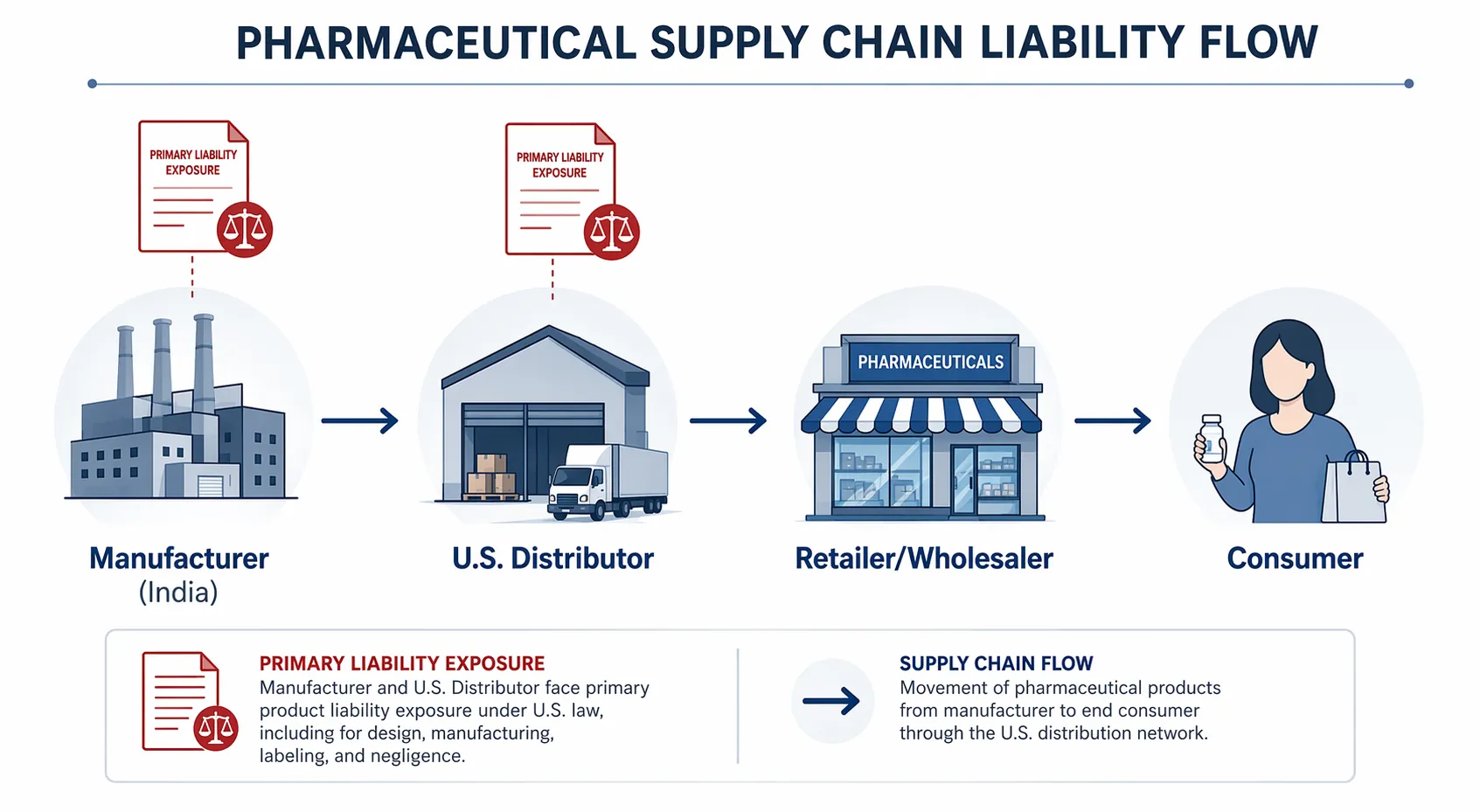
The distinction between manufacturer and distributor affects the defense file. Unique’s file is likely to focus on how the contaminant entered the product, what controls existed, when the deviation was detected, and how the recall was executed. Rising’s file is likely to focus on receipt, distribution, recall communications, contractual indemnity, adverse-event reporting, and whether any alleged plaintiff can trace a purchase to one of the recalled lots.
Retailers and wholesalers should not be ignored, but their role is more contingent. Chain-of-distribution pleading can pull them into complaints, especially where plaintiffs sue where they bought the product. Practical exposure then turns on lot-specific sale proof, state seller-liability statutes, removal and fraudulent-joinder arguments, and the strength of indemnification agreements.
The recalled lots are specific: GY825029, GY825030, GY825031, and GY825032. [1] That specificity helps defendants as much as plaintiffs. It gives plaintiffs a traceability target, but it also gives sellers a way to contest claims from consumers who cannot show they bought or used product from the affected lots.
The Class III Issue Constrains Damages More Than Liability
The FDA recall notice says use of the affected product could expose consumers to ranitidine and identifies the risk of severe hypersensitivity reactions, including anaphylaxis, in patients allergic to ranitidine. [1] Consumer-facing reporting has understandably led with the “potentially life-threatening” phrasing because anaphylaxis is a serious medical event. [3]
That language should not be flattened into a damages theory. A warning that a hypersensitive consumer could suffer a severe reaction is not evidence that any consumer did suffer one. The distinction will matter immediately in intake screening and just as quickly in Rule 12, Rule 23, and causation briefing if complaints follow.
The reported Class III classification points in the same direction, though it should be verified against the FDA Enforcement Report before being treated as a primary-source classification. A Class III recall generally indicates a product is not likely to cause adverse health consequences under ordinary use. If that classification is confirmed, defendants will use it to argue that the recall itself does not imply meaningful physical-injury risk.
But a Class III classification does not erase defect. It is better understood as evidence about health-risk magnitude, not as a determination that the product conformed to its intended composition. The tablets either were or were not cross-contaminated. Classification speaks more directly to likely consequences than to whether the production deviation occurred.
The no-adverse-events record as of July 23, 2026 has similar force. It is highly relevant to damages, medical causation, class certification pressure, and settlement value. It does not supply a complete defense to a properly pleaded manufacturing-defect claim brought by a plaintiff who can prove purchase, use, exposure, injury, and causation.
Economic-Loss Class Actions Are the More Immediate Litigation Shape
Absent verified physical injuries, the more likely near-term complaint is not a catastrophic personal-injury suit. It is an economic-loss class action alleging that consumers paid for tablets that were recalled, contaminated, adulterated, or worth less than represented.
Post-recall consumer class actions have become a familiar move, but standing remains a gatekeeping problem. Cozen O’Connor’s March 2026 alert discusses recent post-recall consumer cases, including Ward v. J.M. Smucker, McLean v. Walmart, and Catalano v. Grimmway, as examples of courts testing whether plaintiffs have pleaded concrete injury after buying products implicated by recalls or contamination concerns. [4]
For the cetirizine recall, the standing fight would be especially lot-sensitive. A consumer who bought cetirizine from an unaffected lot is in a different position from one who can identify a bottle bearing NDC 16571-401-10 and one of the recalled lot numbers. A consumer who discarded the bottle after reading recall news faces a different proof problem from one who retained packaging, receipt records, pharmacy records, or photos of the lot code.
Economic-loss theories also have to avoid overclaiming. A refund theory, a benefit-of-the-bargain theory, and a medical-monitoring theory do not ask the same thing from the court. They require different showings of injury, reliance, causation, and remedy. Treating the recall notice itself as a universal injury will invite a standing challenge.
Ranitidine Adds Context, Not an Automatic Injury Theory
Ranitidine carries its own regulatory history, including FDA action concerning NDMA contamination in ranitidine products. [5] That history explains why the word “ranitidine” in a cetirizine recall attracts attention. It does not, without more, establish injury from the recalled cetirizine lots.
The stronger current theory is narrower: consumers who bought affected cetirizine lots allegedly received a drug that deviated from its intended composition. If a ranitidine-hypersensitive consumer experienced anaphylaxis after using tablets from a recalled lot, the case would look different. On the current public record, that is a hypothetical case pattern, not a reported event.
This is also where media language and litigation language part ways. A health alert may properly describe a severe potential reaction. A complaint must still connect the plaintiff, the product, the lot, the exposure, and the injury. If the case remains injury-free, the pressure shifts toward refund programs, consumer-protection statutes, unjust-enrichment theories, and class standing.
What Defendants Will Likely Press First
The first defense move is likely not a broad claim that generic manufacturers are immune. That argument is too blunt for a contamination case. A more credible defense sequence would separate warning theories from manufacturing theories, concede nothing about defect or causation, and force plaintiffs to plead exactly what they bought, used, and suffered.
- Preemption: strong against claims that try to impose unilateral generic-label changes; much weaker against claims based on physical cross-contamination.
- Traceability: central for consumers who cannot identify NDC 16571-401-10 and lot numbers GY825029 through GY825032.
- Injury and causation: especially important while no adverse events are publicly reported.
- Class standing: likely to turn on whether purchase of a recalled product, without physical injury, is enough under the pleaded theory and jurisdiction.
- Seller liability and indemnity: most important for wholesalers and retailers pulled in through the distribution chain rather than alleged manufacturing conduct.
Unique and Rising will also have different jurisdictional and forum incentives. A foreign manufacturer may contest personal jurisdiction depending on its U.S. contacts and distribution structure. A U.S. distributor will be harder to treat as peripheral at the pleading stage because its role is how the recalled product reached the domestic market.
For retailers, the practical question is whether they sold the recalled lots and whether state law permits dismissal of a nonmanufacturing seller when the manufacturer is identifiable and available. For wholesalers, the documents that matter are shipping records, recall communications, return records, and indemnity provisions. None of that requires a 50-state survey to identify the immediate pressure points.
The Current Legal Posture
As of July 23, 2026, the most legally supportable assessment is narrow. The recall facts describe a manufacturing-defect theory because the tablets allegedly deviated from their intended composition through ranitidine cross-contamination. PLIVA-style warning preemption should not bar that theory simply because the product was generic.
That does not make the recall a high-value personal-injury docket. The reported Class III posture, the absence of publicly reported adverse events, and the need for lot-level proof all constrain the case. If lawsuits follow, the first wave is more likely to test economic-loss and standing theories than to establish a broad injury inventory.
This remains legal-market analysis, not legal advice. The recall may become personal-injury litigation, economic-loss class litigation, or mostly a contained recall event. The answer will depend less on the Zyrtec name than on proof of defect, distribution, purchase, exposure, injury, and causation tied to the recalled lots.
References
- Unique Pharmaceutical Laboratories (Div. of J. B. Chemicals & Pharmaceuticals Ltd.) Issues Voluntary Nationwide Recall of Cetirizine Hydrochloride Tablets, USP 10 mg Due to Ranitidine Cross-Contamination, FDA
- FDA Recalls of Pharmaceutical Drugs, Gilman & Bedigian
- Allergy medication recalled over potentially life-threatening cross contamination, The Hill
- The Continuing Rise of Post-Recall Consumer Class Actions, Cozen O’Connor, March 2026
- FDA updates and press announcements on NDMA in Zantac (ranitidine), FDA
Chronological incident history
No sanction cases have named this tool in the tracked record set to date. This does not imply the tool is safe — see Risk Digest for ongoing monitoring.
← Compare peer toolsReport a correction or tip
Spotted an outdated figure, a misstated fact, or a ruling this tool profile should reflect? Public comments are disabled for this content given the professional cost of a misreported case outcome, penalty amount, or rule text — use the structured correction channel instead.
Report a correction or tip for this record →