
The AI-Fueled Pro Se Surge: How Free AI Lawyer Apps Are Reshaping Federal Litigation in 2026
This article analyzes the systemic impact of free AI lawyer apps on pro se litigation volume, defense costs, and court burdens. Written for legal professionals, it covers the data-driven surge in filings, the hallucination crisis in court records, and strategic implications for law firms and courts.
- Hallucination rate
- Not measured / undisclosed
Introduction: The Data Story
The numbers are no longer anecdotal. In 2025, pro se employment lawsuits surged 49% year-over-year, according to a Fisher Phillips analysis cited by Bloomberg Law. Pro se ADA and FHA federal lawsuits jumped 69% through the first nine months of 2025 compared to the prior year, per Seyfarth Shaw data. A preprint analysis of approximately 2.8 million federal civil filings from FY2008 to 2025 found that the federal civil pro se plaintiff rate rose from 11.33% pre-GenAI to 16.94% post-GenAI — a 5.61 percentage-point increase that persists after trend and covariate-adjusted robustness checks.
These are not isolated spikes. They represent a structural shift in who files lawsuits and how. The common thread is the proliferation of free AI lawyer apps and general-purpose chatbots that lower the barrier to initiating federal litigation to near zero. For legal professionals — litigators, in-house counsel, judges, and legal operations leaders — this trend carries direct consequences for caseload management, defense budgeting, and risk exposure.
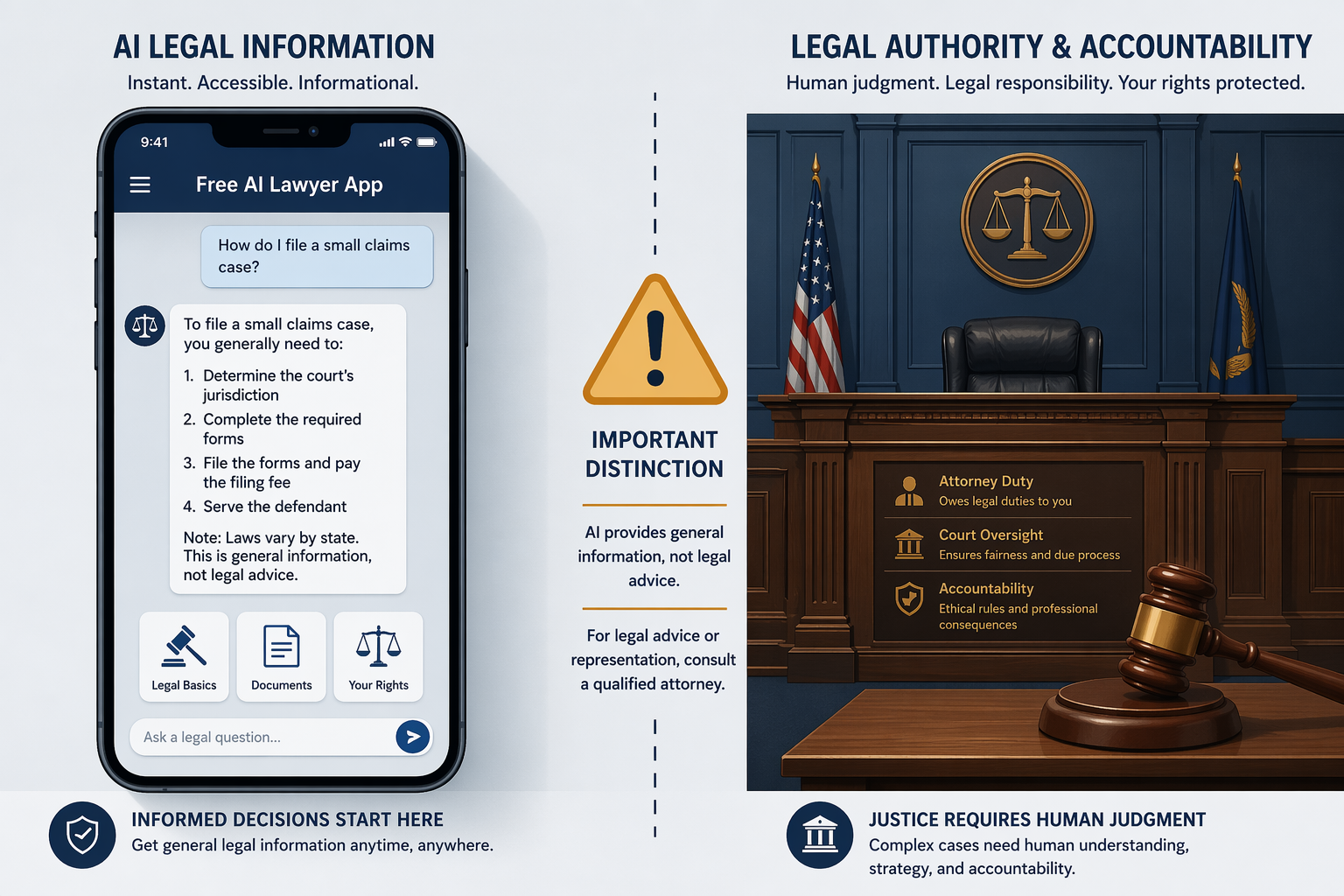
The core thesis of this article is straightforward: free AI lawyer apps and general-purpose chatbots have triggered a measurable, systemic surge in pro se litigation that is increasing defense costs, introducing AI-hallucinated citations into court records at an accelerating rate, and creating a strategic challenge that law firms and courts are only beginning to address. This piece examines the data, the mechanisms, the costs, and the regulatory responses — from the perspective of the legal professionals who must manage the downstream effects.
How Free AI Apps Enable Pro Se Litigation
The mechanism is not subtle. Free AI lawyer apps — including Prosei AI's free plan, LawConnect, Vikk, and general-purpose chatbots like ChatGPT — provide pro se litigants with the ability to generate legal documents, draft complaints, and formulate legal arguments without any legal training. The Stites & Harbison client alert notes that pro se litigants have successfully used AI tools to prevent evictions and defend debt collection actions. But the same tools also produce a darker pattern: they generate plausible-sounding but inaccurate statements, including fictitious quotations, rules, cases, or statutes.
Several dynamics are at play:
- False confidence: LLMs default to validating users' views, reinforcing a litigant's belief that their case is stronger than it is. This leads to filings that would never have been made without AI encouragement.
- Document generation at scale: A litigant can produce a 50-page complaint with dozens of citations in minutes. The Cohen-Sasson preprint confirms that AI-flagged complaints are more citation-dense than traditional pro se filings.
- Scorched-earth tactics: Seyfarth Shaw partner Minh Vu described cases as "all-out, scorched-earth litigations" where responses to filings arrive within an hour. The speed and volume of AI-generated filings force defendants into a reactive posture.
- Lowered cost of failure: Filing a lawsuit costs nothing in time or money when an AI generates the paperwork. Even completely baseless cases can now drag on far longer, as Stites & Harbison notes.
The result is a new class of pro se litigant: one who is more document-productive, more procedurally aggressive, and more likely to persist through early motion practice than the traditional pro se filer. The Cohen-Sasson data confirms that AI-flagged complaints are disproportionately associated with first-time filers — suggesting that free AI tools are not just assisting existing pro se litigants but are creating new ones.
The Cost Impact on Law Firms and Clients
The financial consequences of the AI-fueled pro se surge are beginning to crystallize. Fisher Phillips partner Kristin White, quoted in Bloomberg Law, reported that defending AI-assisted pro se cases costs approximately 10% to 15% more per case compared to traditional pro se matters. The drivers are specific and measurable:
- Larger settlement demands: AI-generated complaints often include inflated damage calculations and broader legal theories, raising the floor for settlement negotiations.
- More motions: AI-assisted pro se litigants file more motions, including opposition briefs, discovery motions, and procedural challenges, because the marginal cost of generating each filing is near zero.
- Bigger discovery battles: The same tools that generate complaints can generate extensive discovery requests, interrogatories, and document demands.
- Extended case duration: Even baseless cases now survive longer because AI-generated filings appear more legally sophisticated on their face, requiring defendants to invest in substantive responses rather than quick dismissals.
For law firms operating on fixed-fee arrangements or billing against capped litigation budgets, a 10-15% cost increase per pro se case is not marginal — it is a structural budget pressure. For in-house legal departments managing self-insured retentions or captive insurance programs, the cumulative effect across dozens or hundreds of cases compounds rapidly.
| Cost Driver | Traditional Pro Se | AI-Assisted Pro Se | Impact |
|---|---|---|---|
| Settlement demand range | Lower, often unrealistic | Inflated, AI-generated | Higher negotiation floor |
| Motion volume per case | 1-3 motions typical | 5+ motions common | Increased defense billables |
| Discovery scope | Minimal | Expanded, AI-drafted | Higher discovery costs |
| Case duration (frivolous) | Short, early dismissal | Extended, survives motions | Longer fee exposure |
| Defense cost premium | Baseline | 10-15% higher | Budget pressure |
The "scorched-earth" dynamic described by Seyfarth Shaw's Minh Vu is particularly challenging. When a pro se litigant can respond to a motion within an hour with a 30-page opposition brief citing fabricated cases, the defense cannot simply ignore the filing — it must respond substantively, often incurring significant fees to identify and rebut the fabricated authorities.
The Hallucination Crisis in Court Records
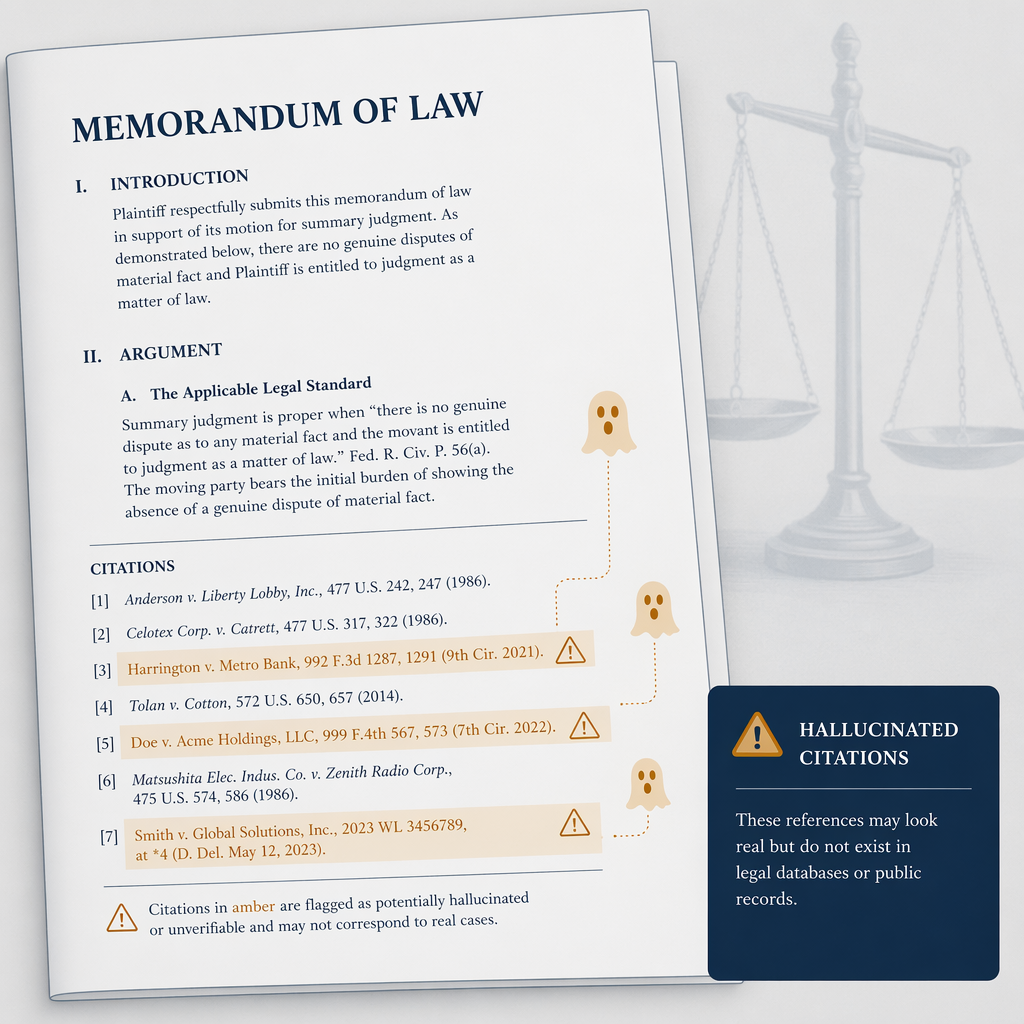
The most alarming dimension of the AI-pro se surge is the contamination of court records with fabricated legal authorities. Damien Charlotin's database, cited by The Indiana Lawyer, recorded 294 instances of AI hallucinations by pro se litigants in U.S. cases in 2025 alone. This is not a trickle — it is a accelerating flow that imposes real costs on the judicial system and opposing counsel.
The sanctions landscape tells the same story. Bloomberg Law reports that at least 24 pro se litigants in the U.S. have been hit with monetary sanctions since H2 2023 for litigating with AI, with more than half of those sanctions imposed since December 2025. The largest single sanction to date is a $66,000+ award in attorneys' fees won by Arnold & Porter against a Chinese plaintiff in December 2025. An Oregon federal order in December 2025 imposed approximately $110,000 in penalties for AI-fabricated citations.
| Metric | Value | Source |
|---|---|---|
| AI hallucination instances by pro se litigants (2025) | 294 | Damien Charlotin database (The Indiana Lawyer) |
| Monetary sanctions against pro se litigants since H2 2023 | 24+ | Bloomberg Law |
| Largest single sanctions award | $66,000+ | Arnold & Porter (Dec 2025) |
| Oregon federal order penalty | ~$110,000 | Oregon federal court (Dec 2025) |
| Total court cases with AI-invented citations (by June 2026) | 1,547 | Damien Charlotin database (ABA Journal) |
For opposing counsel, the burden is significant. Every AI-generated filing must be scrutinized for fabricated citations — a task that requires time, expertise, and often Westlaw or Lexis verification. The Stites & Harbison client alert advises attorneys to "consider seeking sanctions at the first instance of fictitious authority," but this reactive posture still consumes resources. The proactive alternative — training associates to identify AI-generated filings — is itself a cost center.
Court Responses and Regulatory Actions
The judicial and regulatory system is responding, but unevenly. Three distinct threads of action are emerging:
- Judicial cautionary opinions: The 7th Circuit's January 2026 opinion and the Indiana Court of Appeals' Wilcox decision signal that courts are aware of the problem and are beginning to articulate expectations. However, as Frank Emmert of IU McKinney Law noted, regulating AI is difficult because it evolves faster than legislation.
- Legislative action: New York state legislators are considering a bill to ban generative AI from providing legal advice. If passed, this would be the first state-level prohibition of its kind and could serve as a template for other jurisdictions.
- UPL litigation: Nippon Life Insurance Co. of America sued OpenAI for unauthorized practice of law in March 2026 in the Northern District of Illinois. This is the first suit alleging UPL by a general-purpose chatbot and could establish important precedent about the boundary between AI-generated information and the practice of law.
The FTC's DoNotPay order remains the foundational regulatory precedent. The 5-0 Commission vote in January 2025 sent a clear signal: claiming that an AI service performs like a real lawyer is deceptive, and the FTC will enforce against it. For legal professionals monitoring the regulatory landscape, the DoNotPay order establishes the baseline expectation that AI legal services must not misrepresent their capabilities.
Implications for Law Firm Strategy and Client Budgeting
The AI-pro se surge is not a temporary anomaly — it is a structural shift in the litigation environment. Law firms and in-house legal departments should consider several strategic adjustments:
- Budget for increased pro se defense costs: If your firm or department handles employment, ADA, or consumer litigation, assume a 10-15% cost premium per pro se case and adjust matter budgets accordingly. The 49% surge in employment suits and 69% jump in ADA suits mean that pro se cases are no longer a small fraction of the docket.
- Train associates to identify AI-generated filings: Fabricated citations are the most obvious tell, but AI-generated filings also exhibit characteristic patterns — unusually high citation density, formulaic language, and legal theories that are creative but unsupported. Training programs should include practical exercises in verifying citations from AI-generated complaints.
- Develop early sanction strategies: The Stites & Harbison guidance to seek sanctions at the first instance of fictitious authority is sound strategy. Early sanctions motions can deter continued AI abuse and establish a record that may influence future case management.
- Advise clients on the risks: Corporate clients facing high volumes of pro se litigation should understand that the AI-pro se dynamic is driving up defense costs. Transparent communication about this trend helps manage expectations and supports informed budgeting decisions.
- Monitor regulatory developments: The NY legislative effort, the Nippon Life v. OpenAI UPL lawsuit, and potential state bar disciplinary actions could reshape the legal landscape for AI-generated legal content. Firms should track these developments and adjust their compliance posture accordingly.
The broader governance gap in legal AI adoption — where startups flourish while institutional readiness lags — is directly relevant here. As we analyzed in our coverage of the legal AI trust and governance gap, the disconnect between AI tool availability and institutional guardrails creates exactly the conditions that produce the pro se surge: powerful tools in the hands of users who lack the training to use them responsibly.
Regulatory Outlook and Professional Responsibility
The regulatory trajectory is clear but uncertain in pace. Several developments bear watching:
- State bar disciplinary actions: As AI-generated filings proliferate, state bars are likely to issue guidance or bring disciplinary actions against attorneys who fail to supervise AI use — and potentially against pro se litigants who abuse AI tools. The existing sanctions cases provide a template for escalating enforcement.
- AI disclosure requirements: Several federal courts have already adopted AI disclosure rules for attorneys. Similar requirements for pro se litigants may follow, requiring litigants to disclose when AI tools were used to generate filings.
- UPL litigation expansion: The Nippon Life v. OpenAI lawsuit could establish precedent that general-purpose chatbots providing legal information cross the line into unauthorized practice of law. A ruling against OpenAI would have significant implications for the entire free AI lawyer app ecosystem.
- Federal legislation: The NY state bill to ban GenAI legal advice may be a precursor to federal action. The FTC's DoNotPay order demonstrates federal enforcement appetite, but statutory clarity would provide stronger deterrence.
For legal professionals, the key takeaway is that the AI-pro se surge is not a passing phenomenon. The tools are free, the barriers to entry are low, and the incentives for litigants to use them are strong. The data — 49% employment suit increases, 69% ADA suit increases, 294 hallucination instances in a single year, 24+ sanctions cases — tells a story of systemic change. Law firms, courts, and regulators are all playing catch-up.
The question is not whether the trend will continue — it is whether the legal system can adapt quickly enough to manage the consequences. For now, the burden falls on the professionals who face these filings every day: to verify citations, to budget for increased costs, to train their teams, and to advocate for the regulatory clarity that the current environment lacks.
Chronological incident history
No sanction cases have named this tool in the tracked record set to date. This does not imply the tool is safe — see Risk Digest for ongoing monitoring.
← Compare peer toolsReport a correction or tip
Spotted an outdated figure, a misstated fact, or a ruling this tool profile should reflect? Public comments are disabled for this content given the professional cost of a misreported case outcome, penalty amount, or rule text — use the structured correction channel instead.
Report a correction or tip for this record →