
How Consumer DNA Tests Uncover Decades-Old Medical Malpractice Cases
At-home DNA tests are creating a new category of medical malpractice litigation by surfacing historical errors that were previously unknowable. The Bylin-Morrison birth-switch case illustrates how consumer genealogy platforms function as de facto discovery tools, raising novel questions about statutes of repose and spoliation doctrine.
- Hallucination rate
- Not measured / undisclosed
Kyle Bylin’s case began with the kind of object that usually belongs to holiday curiosity, not malpractice litigation: an at-home DNA test given as a Christmas gift in December 2023. The result did not tell him that a hospital had made a legal mistake. It did something narrower, and more unsettling. The genealogy platform matched him with a biological aunt who did not fit the family he had always known.
That mismatch eventually led to Jeremy Morrison, who was born at the same North Dakota hospital, Unity Medical Center, on the same day as Bylin: January 26, 1988. Morrison then underwent professional DNA testing with chain-of-custody documentation, and that follow-up testing confirmed what the consumer result had only exposed: the two men had been switched at birth, according to reporting on the complaint and the case filing. Bylin and Morrison sued Unity Medical Center in Walsh County, North Dakota, on July 7, 2026.[1][2]
The case is compelling because the consumer test is both the reason the claim exists and not, by itself, the proof a court would ordinarily need. That distinction is where this new category of litigation lives. A genealogy result can disturb a family history, identify a biological inconsistency, and point lawyers toward a defendant. It does not supply forensic custody, eliminate sample-handling questions, or convert an entertainment product into admissible evidence.
The Consumer Test Is a Lead, Not the Case
The practical sequence matters. First came the at-home test. Then came a biological match that made no sense inside the known family structure. Then came professional DNA testing with chain-of-custody procedures. Only after that did the lawsuit become a plausible civil filing rather than a private family mystery.
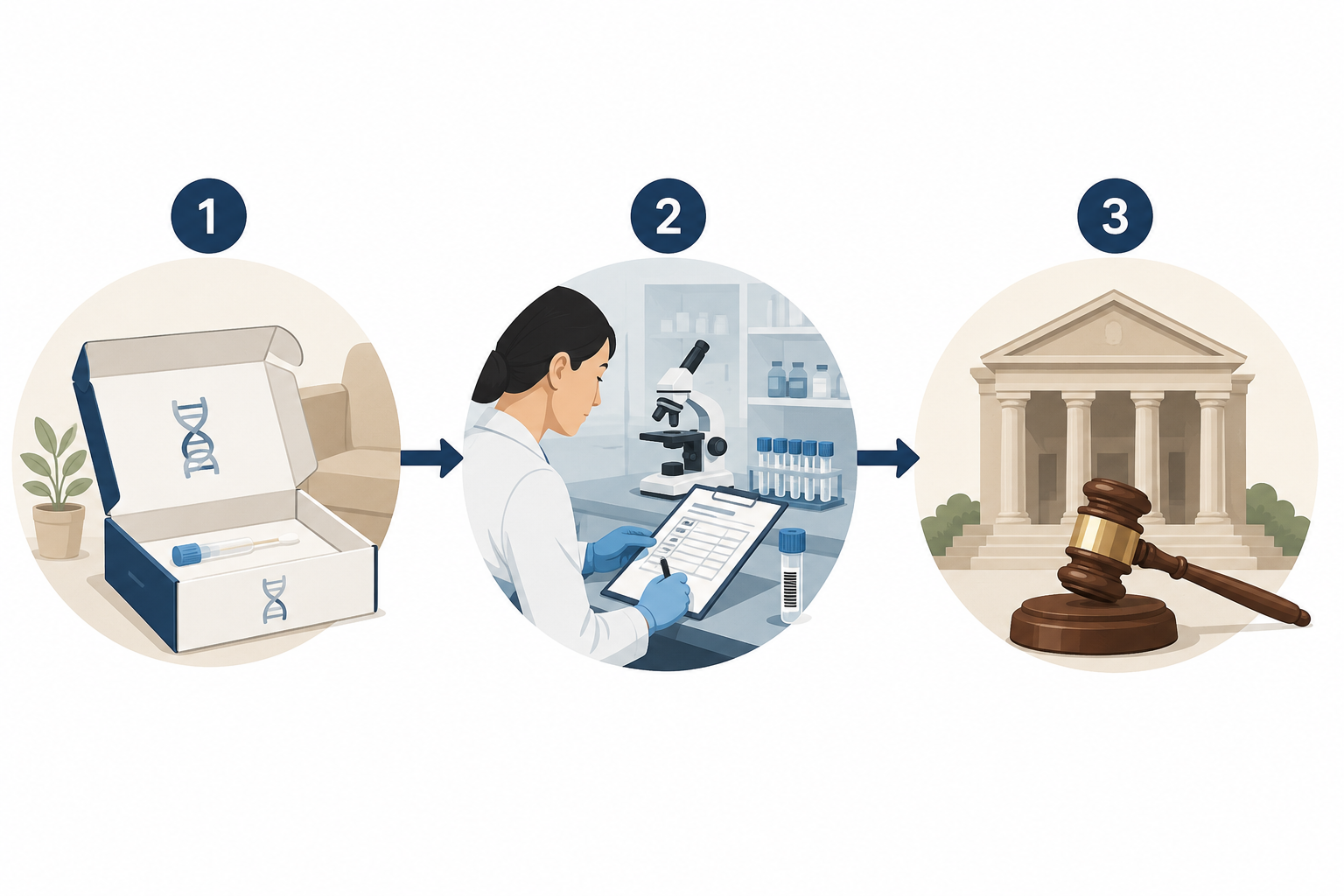
That is likely to become the template in similar cases. The consumer platform functions as a discovery trigger. The formal test supplies the evidentiary foundation. The complaint then asks a court to decide whether a decades-old medical error can still be litigated after the ordinary paper trail has deteriorated or disappeared.
For plaintiffs, the consumer result can be powerful because it reveals an injury that was previously unknowable. For defendants, the same fact can be deeply inconvenient but not dispositive. Hospitals and their insurers will not concede liability because a genealogy database produced an unexpected relative. They will ask who collected each sample, how identity was verified, whether the subsequent testing was properly documented, and whether the claim is time-barred even if the biology is now clear.
| Stage | What It Can Do | What It Does Not Do |
|---|---|---|
| At-home DNA test | Reveal a biological mismatch or unexpected relative | Establish forensic chain of custody |
| Professional DNA testing | Confirm biological relationships through documented procedures | Resolve negligence, damages, or limitations defenses |
| Civil lawsuit | Put the alleged medical error before a court | Guarantee that a decades-old claim survives procedural bars |
Why These Cases Are Appearing Now
Switched-at-birth claims are not new. What is new is the probability that ordinary adults, with no reason to suspect a hospital error, will submit DNA samples for ancestry or family-history purposes and receive a result that points outside the life they have lived.
Reported cases suggest a pattern, though not one that can yet be measured with much confidence. Since 2018, at least five documented U.S. switched-at-birth lawsuits have resulted from consumer DNA testing, including matters reported in West Virginia and Pennsylvania; older and comparable switched-at-birth matters have also been reported in connection with births at the University of Virginia hospital, Norway, and Manitoba.[1][7]
The temptation is to turn that into a clean national estimate. The available material does not justify that. A 2017 blog post from DNA Diagnostics Center, a testing company, estimated that up to 18 babies per year go home with the wrong families in the United States and noted that only eight cases were documented between 1995 and 2008.[6] That is useful as a sign of possible under-discovery, not as an authoritative incidence rate.
The stronger conclusion is more modest: consumer DNA testing is making some previously hidden hospital errors discoverable. Whether it is revealing a large reservoir of undiscovered claims or only a small number of extraordinary cases remains uncertain.
The Legal Problem Is Not the Biology Alone
Once professional testing confirms the biological relationship, the fight does not become simple. In an ordinary malpractice case, the plaintiff still has to connect the injury to a breach of duty, establish damages, and survive procedural defenses. In a birth-switch case, the negligence theory may feel intuitively obvious, but intuition is not a substitute for proof of what happened inside the hospital.
That is where old records matter. Unity Medical Center has acknowledged that its 1988 delivery team records no longer exist and that no staff from that period remain employed, according to local reporting. The hospital also underwent a $20 million expansion and renovation from 2019 to 2021.[3]
Record loss in a decades-old case creates pressure in both directions. Plaintiffs may argue that the absence of records should not defeat a claim they had no way to discover earlier. Defendants may answer that the delay has stripped them of the very evidence they would need to reconstruct staffing, nursery procedures, identification protocols, and contemporaneous events. A court looking at spoliation, prejudice, or equitable tolling questions will have to separate ordinary archival loss from conduct that legally warrants an adverse inference or other remedy.
That distinction is easy to blur in public discussion. A missing record feels suspicious when the underlying allegation is emotionally grave. But litigation does not treat every missing document as sanctionable spoliation. Timing, duty to preserve, notice, institutional policy, and prejudice all matter. In a case involving births from 1988, the defense problem may be real even if no one did anything improper by failing to preserve delivery records for nearly four decades.
Repose May Be the Hardest Issue
The North Dakota procedural backdrop shows why these lawsuits are not merely human-interest stories with legal captions attached. North Dakota has a six-year statute of repose for medical malpractice claims, a rule that can operate as an outside limit measured from the alleged act or omission rather than from later discovery.[4] If applied strictly, that kind of provision can bar a claim long before a plaintiff could reasonably know it existed.
The Bylin and Morrison complaint seeks damages exceeding $50,000, and North Dakota law caps noneconomic damages in medical malpractice cases at $500,000 while leaving economic damages uncapped.[2][4][5] Those numbers matter, but they are not the center of the case at this stage. The more consequential question is whether the plaintiffs can get past repose and related timeliness defenses at all.
The plaintiffs’ most natural argument is that a discovery rule should matter because the injury was hidden by its nature. A baby switched at birth cannot investigate the error as an infant, and the families may have no reason to suspect anything for decades. The defendant’s most natural answer is that a statute of repose exists precisely to create finality even when later discovery would otherwise make a claim sympathetic.
As of July 19, 2026, no reported substantive rulings, motion-practice outcomes, or trial dates have resolved that fight in the Bylin-Morrison matter. The case is still in its preliminary posture. Predicting the result would overstate what is known.
What Courts Will Have to Sort
The next wave of consumer-DNA malpractice claims will likely turn less on whether the first test was interesting and more on whether the follow-up work was disciplined. Lawyers will need to treat the genealogy result as a lead source, not as the evidentiary endpoint. That means preserving platform data, identifying the biological matches that triggered inquiry, obtaining formal testing, documenting custody, and pleading the discovery timeline with care.
Hospitals and health systems will face a different burden. The alleged act may be older than current personnel, current electronic systems, and current retention policies. Defense counsel will have to show what records reasonably existed, what retention rules applied, when records were destroyed or lost, and how the absence of those records prejudices the defense. A bare statement that the events are old may not be enough. Neither will moral shock, standing alone, carry the plaintiff through every procedural gate.
The most important question is not whether consumer DNA platforms were designed for civil discovery. They were not. The question is whether courts will treat them as practical discovery triggers when they expose an injury that traditional records, family memory, and ordinary medical follow-up never revealed.
That is why the Bylin-Morrison lawsuit is worth watching even before any ruling on liability. It shows the mechanism with unusual clarity: a casual consumer test, a biological inconsistency, a chain-of-custody confirmation, and then a malpractice complaint filed decades after the hospital event. The consumer test does not prove negligence. It changes what can be known. Once that happens, the legal system has to decide whether finality still closes the courthouse door, or whether discovery can reopen a claim that no one could have brought while the error remained hidden.
References
- Men sue hospital after DNA tests showed they were switched at birth 38 years ago, AP News
- Men Born on the Same Day at Same Hospital Allege They Were Switched at Birth in Complaint Filed 38 Years Later, People
- Grafton hospital sued over alleged 1988 baby switch discovered 36 years later, Valley News Live, July 14, 2026
- North Dakota Medical Malpractice Laws, Nolo
- Medical Malpractice Cases: Information About the Cap on Damages, O'Keeffe Attorneys
- Babies Switched at Birth: Should You Be Concerned?, DNA Diagnostics Center
- Babies switched at birth, Wikipedia
Chronological incident history
No sanction cases have named this tool in the tracked record set to date. This does not imply the tool is safe — see Risk Digest for ongoing monitoring.
← Compare peer toolsReport a correction or tip
Spotted an outdated figure, a misstated fact, or a ruling this tool profile should reflect? Public comments are disabled for this content given the professional cost of a misreported case outcome, penalty amount, or rule text — use the structured correction channel instead.
Report a correction or tip for this record →