
Coca-Cola's Fairlife Breach Tests the SEC Materiality Clock
Coca-Cola's Fairlife ransomware 8-K offers a real-time case study of the SEC's cybersecurity disclosure timing dilemma. This analysis provides a framework for legal teams to evaluate their own disclosure readiness under the four-business-day clock and the materiality deferral option.
- Hallucination rate
- Not measured / undisclosed
Coca-Cola’s July 16, 2026 Fairlife disclosure is not a clean teaching example. That is why it is useful. The company said an unauthorized third party accessed production systems connected with Fairlife, that the incident had a ransomware nexus, that U.S. Fairlife operations were suspended, and that Canadian operations were isolated and unaffected. It also said product quality and safety were not impacted, that it had not confirmed whether personal data of employees, customers, or suppliers was accessed, and that it had not yet determined whether the incident was reasonably likely to materially affect the company. For lawyers tracking the Coca-Cola Fairlife network breach investigation, those last two uncertainties are not footnotes. They are the legal problem. [1]
The uncomfortable part is not that Coca-Cola lacked a final answer on day one. In many serious cyber incidents, no one has a final answer when the business disruption becomes public. The uncomfortable part is that securities disclosure does not wait for the incident-response team to finish its work when operations are already visibly affected and the market has a reasonable basis to ask what happened.
What Coca-Cola Actually Put On The Record
The filing language matters because it does three things at once. It confirms enough facts to prevent a silence problem. It limits those facts to what the company was prepared to stand behind. And it preserves the materiality analysis rather than pretending that the analysis had already reached a conclusion.
That kind of interim language is easy to criticize after the fact and hard to draft during the call. “Unauthorized access to production systems” is more precise than “cybersecurity incident.” “Ransomware nexus” tells investors why the interruption is not merely a routine outage. “U.S. Fairlife operations suspended” gives the market an operational fact. “Canadian operations isolated and unaffected” narrows the scope. “Product quality and safety not impacted” addresses a question that would be especially acute for a food and beverage business. “Data access not yet confirmed” and “materiality not yet determined” keep the disclosure from overclaiming.
That last phrase should not be treated as a confession that the incident is material, or as a magic formula that makes materiality disappear. It is a status statement. ComplianceHub’s analysis of the Fairlife disclosure treats the “not yet determined” language as the central signal to investors: the company has chosen to speak while the legal conclusion remains open. [2]
The SEC Clock Starts Later Than The Market Clock
The SEC’s cybersecurity disclosure rule does not start the four-business-day Item 1.05 clock when the company discovers an incident. The clock runs after the registrant determines that the incident is material. The Item 1.05 disclosure must describe the material aspects of the nature, scope, and timing of the incident and its material impact or reasonably likely material impact. The adopting release also makes room for voluntary disclosure of immaterial or not-yet-material incidents under Item 8.01, and Regulation S-K Item 106 separately requires annual disclosure about cybersecurity risk-management, strategy, and governance. [3]
That architecture is sensible on paper. It avoids forcing companies to disclose every intrusion merely because an alert fired. It also recognizes that materiality is a securities-law judgment, not a forensic label. But the Fairlife fact pattern shows the weak seam: a production halt at a wholly owned subsidiary can become investor-relevant before the company has enough facts to determine materiality with confidence.
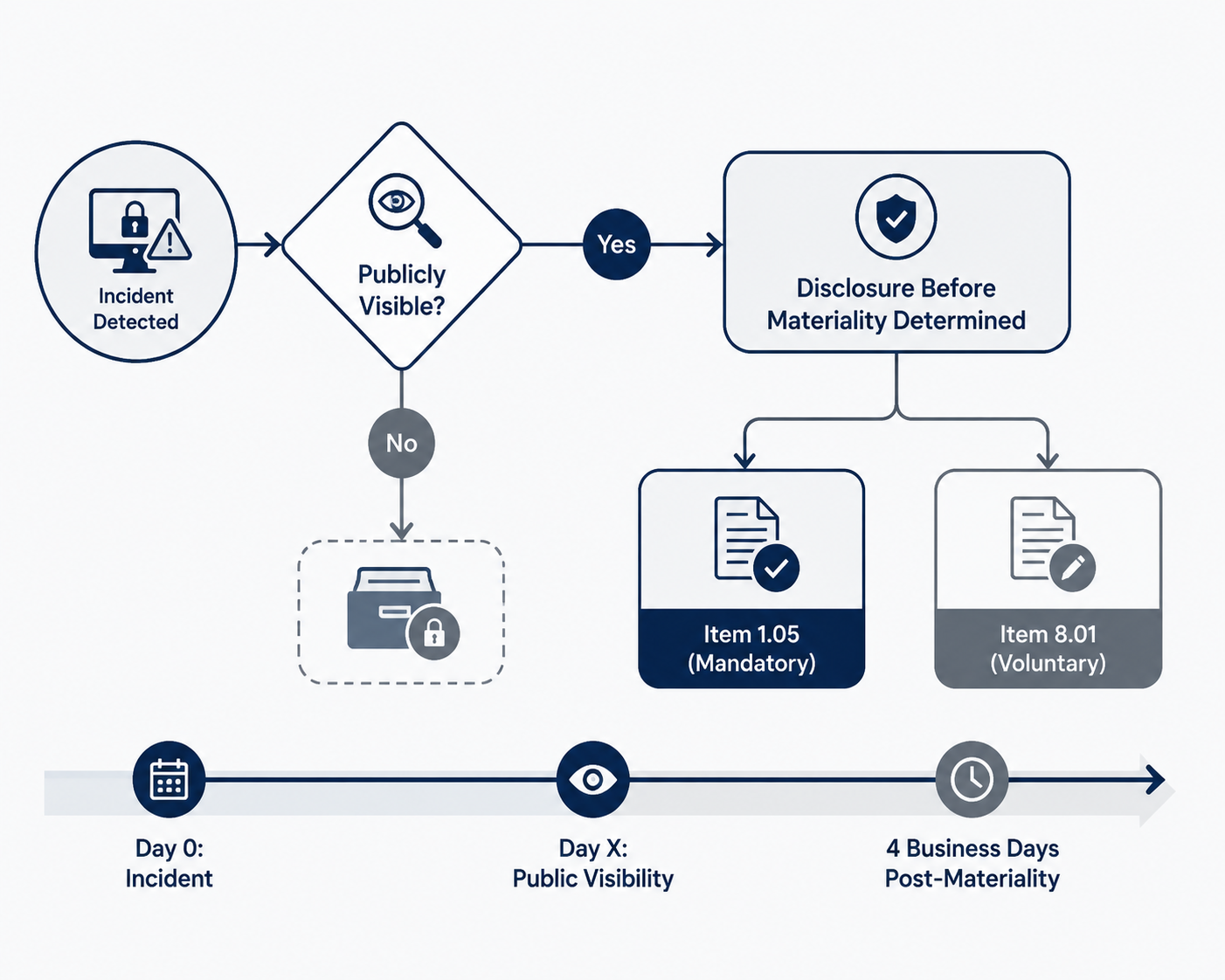
The practical clock therefore has two hands. One is the SEC’s formal four-business-day period, keyed to the materiality determination. The other is the market clock, keyed to public visibility, customer concern, employee rumors, supplier disruption, media attention, and trading sensitivity. A company can be technically before the Item 1.05 deadline and still need to say something because silence has become its own disclosure choice.
Practitioner summaries of the 2026 rule environment emphasize this same distinction: companies need escalation processes that identify when a cybersecurity event may become disclosure-relevant before the materiality conclusion is final, and they need a separate path for deciding whether early voluntary disclosure is appropriate. [4]
Why Item 1.05 Versus Item 8.01 Is Not Just Labeling
The Fairlife filing is especially interesting because the public analysis has focused on whether Coca-Cola’s disclosure should be understood as an Item 1.05 mandatory cyber disclosure or an Item 8.01 voluntary disclosure made before materiality was determined. The company’s Form 8-K does not, based on the available materials, explicitly resolve that framing in the way lawyers would like for a classroom hypothetical. Any conclusion about the item choice is therefore an inference from the language and structure of the filing, not a reported company statement. [2]
The distinction still matters. If a company files under Item 1.05, it is telling the market that materiality has been determined and that the rule’s mandatory disclosure framework has been triggered. If it files under Item 8.01, it may be saying: this incident is important enough to disclose now, but the company has not yet reached the materiality determination that would trigger Item 1.05. That is not wordplay. It affects later amendment analysis, internal documentation, board reporting, and how plaintiff lawyers and regulators read the company’s timeline.
The market may not care about the caption. Investors read an 8-K about ransomware, production systems, and suspended operations as cyber disclosure regardless of item number. But the legal file cares. The minutes, disclosure committee notes, outside counsel advice, forensic updates, and investor-relations talking points all need to show whether the company made a materiality determination, deferred that determination, or disclosed voluntarily while reserving it.
This is where ad hoc process becomes dangerous. A company that first debates the difference between Item 1.05 and Item 8.01 after ransomware has already interrupted production is asking the filing language to do too much. The better question is not, “Which item can we fit this into tonight?” It is, “What decision path did we approve before tonight, and does the record show we followed it?”
Visibility Before Materiality
A ransomware event that suspends U.S. production is not the same disclosure problem as a contained intrusion on a noncritical system. The Fairlife disclosure had an operational center of gravity. Even without confirmed data access, the incident involved production systems and a business interruption visible enough to require a public statement. [1]
That does not mean the incident was necessarily material to The Coca-Cola Company. Materiality for a major issuer turns on the total mix of information available to a reasonable investor, including quantitative and qualitative factors. A production suspension at a subsidiary may be highly visible and still require more analysis before counsel can characterize company-level materiality. The filing’s careful phrasing sits exactly in that gap.
The food and agriculture sector context explains why the company could not assume the event would be treated as routine background noise. Food and Ag-ISAC reported 265 ransomware attacks against the sector in 2025 and approximately 205 in the first half of 2026, according to Cybersecurity Dive. [5] Those figures do not prove anything about the severity of the Fairlife incident. They do make clear that ransomware-driven operational disruption in this sector is now a board-level risk environment, not an exotic scenario.
The Data Question Opens A Second Front
As of July 18, 2026, the available materials said no ransomware gang had publicly claimed responsibility and Coca-Cola had not confirmed whether personal data of employees, customers, or suppliers was accessed. That uncertainty should discipline the analysis. It is too early to write as if there was confirmed data exfiltration, too early to assume notification duties have crystallized, and too early to evaluate the merits of any privacy claims. [1]
It is not too early, however, for litigation pressure to begin. ClassAction.org and Class Action U both documented plaintiff-firm investigations into the Fairlife incident within 24 hours, despite the absence of confirmed data compromise in the company’s public statement. [6][7] That is a familiar sequencing problem: the securities disclosure team is trying to avoid overstatement, the privacy team is waiting on forensics, and outside plaintiffs’ firms are already testing intake channels.
This is another reason interim wording matters. “Not yet confirmed” is different from “no data was accessed.” “No stated product safety impact” is different from “no operational impact.” The company’s first public language can become the template for later investor questions, customer notices, insurance submissions, regulator communications, and complaints. Precision is not cosmetic at that stage; it is load-bearing.
Prior Coca-Cola Ecosystem Incidents Matter, But Only Carefully
There is a temptation to describe Fairlife as part of a simple repeat-breach story for Coca-Cola. That would be too loose. Gurucul has described a May 2025 Everest ransomware breach involving Gulf Coca-Cola Beverages, in which 959 employee records were leaked after a ransom refusal, and a separate Gehenna Salesforce breach involving Coca-Cola Europacific Partners with 23 million records. [8]
Those incidents involved different legal entities: a Middle East distributor and an independent bottler. They should not be collapsed into the Fairlife event, which involves a wholly owned subsidiary directly operated by The Coca-Cola Company. The distinction matters because securities disclosure is not a brand-association exercise. Entity structure, operational control, reporting lines, and board oversight responsibilities all matter.
Still, prior ecosystem incidents can become relevant to governance sensitivity. Under Item 106, annual cybersecurity disclosures require companies to address risk-management, strategy, and governance. [3] A board that has seen cyber incidents touch affiliated, bottling, distribution, or subsidiary environments will reasonably be expected to understand how management distinguishes those environments, escalates incident information, and evaluates whether a subsidiary-level event changes enterprise risk.
A Disclosure Workflow That Should Already Exist
The Fairlife incident is a useful audit prompt because it exposes the questions a company cannot afford to invent under pressure. A good process does not guarantee the right answer; it makes the answer traceable. That is what matters when the first 8-K is no longer the only document in the file.
| Pressure point | Question the file should answer before the incident | Why it matters once operations are visible |
|---|---|---|
| Materiality authority | Who can determine materiality, and who advises that person or committee? | The four-business-day clock turns on the determination, not on discovery. |
| Voluntary disclosure path | Who approves an Item 8.01-style disclosure before materiality is determined? | The company may need to speak before the Item 1.05 trigger is reached. |
| Interim language | Who is authorized to characterize ransomware, production impact, safety, and data access? | Early wording can constrain later amendments, notices, and litigation positions. |
| Forensic updates | Which facts are reported to legal, and at what cadence? | Disclosure counsel needs current facts without turning every technical lead into a securities-law decision maker. |
| Amendment triggers | What later facts require reconsideration of the 8-K? | Materiality, data access, duration, financial impact, and business recovery may develop after the first filing. |
| Governance record | How does the board receive and document cyber-risk information? | Item 106 disclosures may later be read against the incident record. |
The first question is authority. In many companies, cyber incidents are initially owned by security, IT, privacy, or crisis management. That is appropriate for containment. It is insufficient for securities disclosure. The company needs a defined point at which operational facts are escalated to the disclosure committee or another authorized materiality decision maker. The file should show who had the authority to decide that materiality had been determined, who had authority to decide it had not, and who could approve a public statement in the meantime.
The second question is vocabulary. Drafting by committee is painful in ordinary circumstances and hazardous during a ransomware call. Companies should have pre-cleared drafting conventions for common interim facts: unauthorized access, disruption, containment, isolation, restoration, ransom demand, data access, customer impact, product safety, and materiality status. Those conventions should not be scripts. They should be guardrails that prevent confident language from outrunning the evidence.
The third question is separation. A voluntary disclosure before materiality is determined should be documented as such if that is the company’s judgment. The record should not blur “we are disclosing because the event is public and operationally significant” with “we have determined the incident is material.” In the Fairlife situation, that distinction is the center of the analysis. It is also the distinction most likely to be lost when business leaders, lawyers, forensics, and communications teams are trying to get language cleared before market questions intensify.
The fourth question is amendment discipline. An interim filing should come with a watch list. Not every new fact requires an amended 8-K, but the company should know which facts will force the issue back to the disclosure committee: confirmed personal-data access, an extended production outage, a material financial effect, a material customer or supplier consequence, a ransom payment decision, a material recovery cost, or a change in the company’s understanding of scope. The point is not to predict Coca-Cola’s next filing. The point is to avoid discovering the amendment standard only after the next forensic update arrives.
The fifth question is board oversight. Item 106 does not turn every incident into an annual-report crisis, but it does make governance statements testable against actual practice. If the annual disclosure says management has structured processes for assessing, identifying, and managing material cybersecurity risks, the incident record should reflect those processes operating under stress. If the board or a committee is described as overseeing cyber risk, the escalation record should not look improvised. [3]
What Fairlife Does And Does Not Prove
The Fairlife incident does not prove that the SEC’s cybersecurity disclosure regime is unworkable. The rule’s formal clock is tied to materiality determination for a reason, and the availability of voluntary disclosure gives companies a way to address public incidents without pretending that the materiality analysis is finished. The problem is not the existence of judgment. The problem is asking people to invent the judgment process while the incident is already moving.
Coca-Cola’s disclosure is notable because it lives in the hard middle: enough known facts to require careful public language, not enough settled facts to close the securities-law analysis. That is the space legal teams should prepare for. In a public cyber incident, the question is not only whether materiality has been determined. It is whether the company already has a disciplined way to speak before it can know everything.
References
- The Coca-Cola Company press release and Form 8-K, The Coca-Cola Company, July 16, 2026, link
- Coca-Cola Fairlife Ransomware Production Halt 2026, ComplianceHub.wiki, link
- SEC Adopts Rules on Cybersecurity Risk Management, Strategy, Governance, and Incident Disclosure by Public Companies, U.S. Securities and Exchange Commission, 2023, link
- SEC Cybersecurity Disclosure Rules in 2026, V-Comply, link
- Ransomware attack hits food sectors, Cybersecurity Dive, link
- Fairlife Data Breach Lawsuit Investigation, ClassAction.org, July 2026, link
- Fairlife, Class Action U, link
- Coca-Cola Gulf & CCEP Data Leak, Gurucul, link
Chronological incident history
No sanction cases have named this tool in the tracked record set to date. This does not imply the tool is safe — see Risk Digest for ongoing monitoring.
← Compare peer toolsReport a correction or tip
Spotted an outdated figure, a misstated fact, or a ruling this tool profile should reflect? Public comments are disabled for this content given the professional cost of a misreported case outcome, penalty amount, or rule text — use the structured correction channel instead.
Report a correction or tip for this record →