
FSMA Compliance and Legal Liability for Cyclospora in Produce
This article examines how FSMA's Produce Safety and Preventive Controls rules establish evidence of the standard of care in Cyclospora contamination litigation, using the 2026 Taylor Farms/Taco Bell outbreak as a case study, and explains what documented compliance—or documented gaps—mean for legal liability exposure.
- Hallucination rate
- Not measured / undisclosed
The legal implications of Cyclospora contamination in produce are clearest once the outbreak file is lined up against the compliance file. The CDC's HAN-00531 advisory reported about 1,645 confirmed cases, about 7,000 projected total, across 34 states, with 141 hospitalizations, and linked the illness cluster to iceberg lettuce served at Taco Bell and traced to Taylor Farms de Mexico.[1] That kind of spread does not just expand the public-health response; it invites document review of irrigation water, wash water, supplier verification, hazard analysis, and corrective action records before the first complaint is even answered.

FSMA's regulatory baseline
For produce farms, the first rule in the file is the Produce Safety Rule, 21 CFR Part 112. FDA says it sets science-based minimum standards for growing, harvesting, packing, and holding produce, with staggered compliance dates running through 2027.[2] The Cyclospora-relevant pieces are the agricultural water provisions, biological soil amendments, worker health and hygiene controls, and the written food safety plan framework that forces the operation to show how it identified and managed hazards.[2]
For processors, importers, and other covered facilities, the Preventive Controls for Human Food Rule, 21 CFR Part 117, asks a different but overlapping question: does the written food safety plan actually identify known or reasonably foreseeable hazards, including Cyclospora, and pair that analysis with risk-based preventive controls, monitoring, corrective actions, and verification?[3] In a leafy-greens case, that is where sanitation, supplier approval, and follow-up testing stop being abstract compliance words and become the evidentiary record.
Why compliance does not equal immunity
The boundary that keeps the FSMA story from being oversold is simple: FSMA does not create a private right of action. The Vermont Law School/NECAFS fact sheet puts the uncomfortable middle position plainly: FSMA compliance does not preempt or shield producers from tort liability, but compliance may still help mitigate financial or criminal responsibility.[4] So a defendant can be sued under state-law theories even when FDA never brings an enforcement action, and a plaintiff can try to use the same compliance file to argue either care or carelessness depending on what the file actually shows.
That does not mean every court will treat FSMA evidence the same way. Admissibility and weight still turn on the jurisdiction, the pleadings, and the claim theory, which is why counsel usually end up arguing about the paper trail rather than about FSMA in the abstract.
Where agricultural water becomes the case
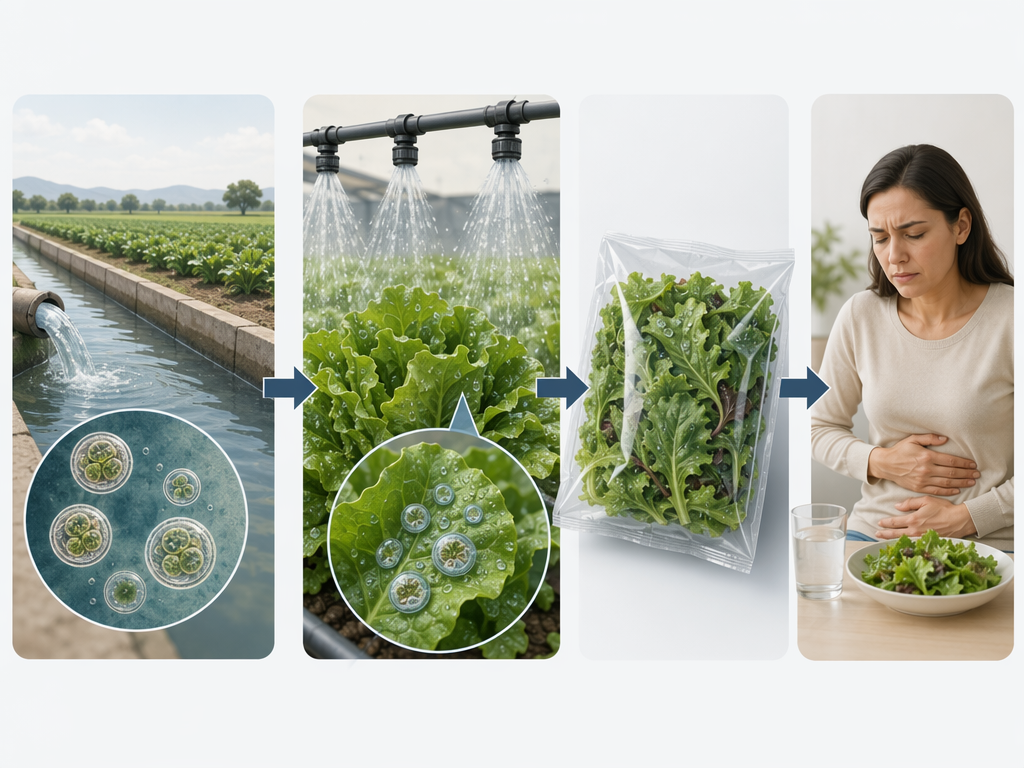
Cyclospora litigation usually narrows quickly to agricultural water because that is the most plausible pathway into leafy greens. If a farm can show routine water testing, defined response thresholds, documented corrective action, and a clean handoff from farm to packhouse, the plaintiff's theory gets harder to write. If those records are missing, inconsistent, or too late, the same gap can read as a failure to exercise reasonable care.
That is also where the FDA's Cyclospora Prevention, Response and Research Action Plan matters. In its updated form, FDA was already pressing the industry toward grower education on C. cayetanensis prevention, root-cause analysis after outbreaks, genotyping methods, and farm-investigation questionnaires.[5] None of that creates automatic civil liability, but it does make it harder to argue that Cyclospora was an unknowable surprise when a litigation file is missing the very steps the agency has been telling the industry to document.
Plaintiffs will also reach for notice evidence. Public reporting has tied Taylor Farms to a 2013 Cyclospora outbreak, a 2015 E. coli celery-onion mix recall, and a 2024 E. coli outbreak linked to McDonald's Quarter Pounder onions; taken together, those events are likely to be framed as a pattern of prior contamination problems and incomplete remediation.[6] That does not prove the 2026 outbreak by itself, but it gives a plaintiff a cleaner argument that the risk was foreseeable and that the standard-of-care question should be judged against prior experience, not a one-off incident.
Traceability points forward, not backward
The Food Traceability Rule belongs in this discussion only as future context. FDA has delayed enforcement until July 2028 and says the agency is presently prohibited from enforcing it; when the rule does apply, leafy greens on the Food Traceability List will need key data elements and critical tracking events that should make outbreak source identification faster.[7] For the 2026 litigation, though, it is not the rule that sets present exposure. It is more useful as a preview of where the documentation standard is heading than as a shortcut to liability now.
What remains in the 2026 case is a disciplined liability question, not a regulatory slogan. Documented FSMA compliance is not a safe harbor, but it can be a defense asset; documented gaps, especially around agricultural water and other foreseeable Cyclospora controls, can become plaintiff evidence that reasonable care was not exercised. That is the part of the paper trail that will matter long after the outbreak headlines fade.
References
- HAN-00531 — CDC, July 2026
- FSMA Final Rule on Produce Safety — FDA
- FSMA Final Rule for Preventive Controls for Human Food — FDA
- Produce Farms, Foodborne Illness, and Legal Liability — Vermont Law School Center for Agriculture and Food Systems, 2020
- Cyclospora Prevention, Response and Research Action Plan — FDA, 2021
- The Cyclospora outbreak now has two names on it: Taylor Farms and Taco Bell. Both have been here before, and so have I — Marler Blog
- FSMA Final Rule on Requirements for Additional Traceability Records for Certain Foods — FDA
Chronological incident history
No sanction cases have named this tool in the tracked record set to date. This does not imply the tool is safe — see Risk Digest for ongoing monitoring.
← Compare peer toolsReport a correction or tip
Spotted an outdated figure, a misstated fact, or a ruling this tool profile should reflect? Public comments are disabled for this content given the professional cost of a misreported case outcome, penalty amount, or rule text — use the structured correction channel instead.
Report a correction or tip for this record →