
How Lot Numbers Determine the Legal Scope of a Food Recall
The granularity of lot codes in a food company's traceability system directly determines how much product must be recalled, how severe the regulatory penalties can be, and how large a class-action plaintiff pool can form. This makes lot-code design a de facto liability policy for in-house counsel and compliance officers.
- Hallucination rate
- Not measured / undisclosed
The legal work of a food recall often begins with a boundary. Which product is inside the recall, which product is outside it, and what proof supports that line? On a public notice, the boundary usually appears as a lot code, product code, sell-by date, or use-by date. The FDA tells companies that recall notices should include those product codes because consumers and retailers need to know what to return, discard, or remove from sale.[1] That is the point at which a lot number stops being a packaging convention and becomes a legal instrument.
For in-house counsel assessing the legal implications of lot numbers in a food recall, the first question is not whether the company has codes. Most do. The harder question is whether the codes are narrow enough, and documented well enough, to survive the first serious challenge from a regulator after a positive test, outbreak signal, or supplier notification.
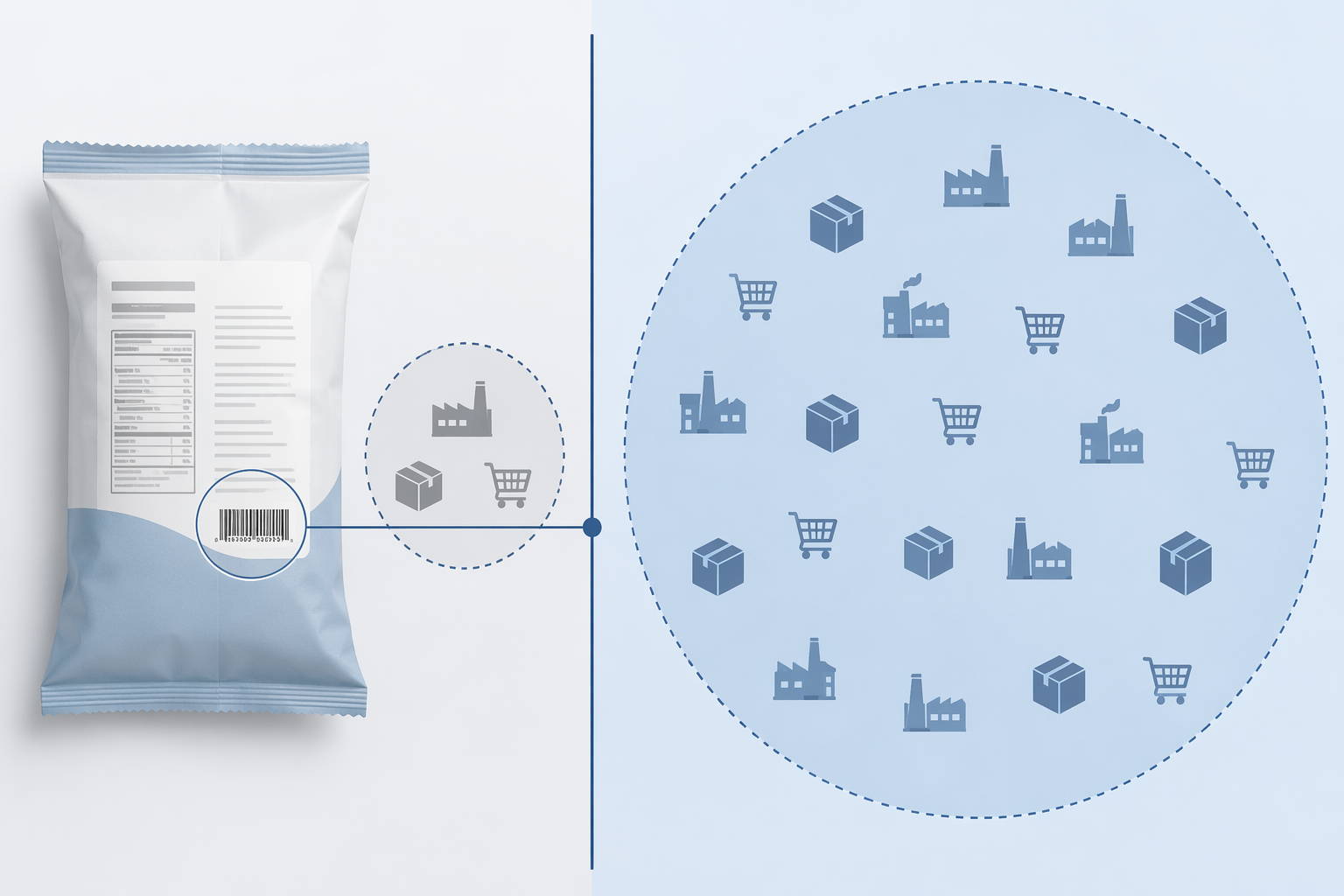
The FDA is unusually direct on this point. Its Traceability Lot Code page says that “smaller traceability lots might lead to less food being affected in the event of a recall.”[2] That sentence matters because it does not treat traceability as a vague modernization project. It links lot granularity to the amount of food affected when something has already gone wrong.
The agency’s broader FSMA traceability rule is framed around additional traceability records for certain foods, which is another way of saying that a company’s ability to draw and defend recall boundaries depends on records created before the crisis, not explanations drafted after it.[3] A recall room can produce arguments. It cannot retroactively create a credible production history.
The Boundary Has to Be Proven
A narrow lot code is useful only if the company can show what it means. The code has to connect to production records, ingredient use, sanitation or process-control records where relevant, distribution records, and the company’s explanation of why adjacent product is not affected. A regulator does not have to accept a neat label if the supporting file is thin.
That distinction is easy to miss in system-design meetings. Operations may define a lot by shift, by day, by production run, by packaging configuration, by ingredient changeover, or by a broader commercial batch. Each choice may make sense for throughput or inventory management. But during a recall, that same choice becomes evidence. If the company says the suspect product is limited to one run, someone will ask why the next run is clean, where the break occurred, and which record proves it.
This is also where recall classification and recall volume should not be confused. A Class I, Class II, or Class III assessment turns on health risk. Lot-code granularity does not make a dangerous pathogen less dangerous. What it can change is the volume of product the company must pull, the number of customers and consumers swept into the notice, and the regulatory exposure created when the company cannot substantiate a narrow scope.
| Issue | What drives it | Why lot numbers matter |
|---|---|---|
| Health-risk classification | The nature and severity of the hazard | Lot numbers do not change the biological or chemical risk |
| Recall scope | Records showing which product is affected | Lot numbers define the product boundary the company asks regulators, retailers, and consumers to follow |
| Regulatory exposure | Risk plus the credibility of the company’s control and traceability records | Weak lot support can force broader assumptions about affected product |
| Class-action exposure | The population of purchasers included in the public recall and pleadings | Published lot codes can become the architecture of the plaintiff class |
When One Day Becomes Thirty
The cleanest example in the available materials is the Colorado beef processor discussed in OFW Law’s USDA Recall Guide. The guide describes an E. coli contamination detected in product from a single production day. The company wanted to limit the recall to that day. FSIS did not accept that limit because it found inadequate lot-level traceability and process-control documentation. The recall expanded to 30 days of production and more than 100,000 pounds of beef.[4]
The point is not that every positive E. coli result should be limited to one day, or that a company can always win a narrower scope by improving its coding. Contamination can be process-wide. It can come from an ingredient used across multiple runs. It can sit in the environment long enough that a one-day theory is not credible. Regulators are not required to gamble on a company’s preferred boundary.
The point is more practical: if the company cannot prove where the suspect product starts and stops, the regulator’s assumption will move outward. In the Colorado example, the missing proof did not produce a theoretical compliance concern. It changed the recall from one day to 30 days. That is the kind of expansion that changes customer notifications, public statements, logistics costs, insurance conversations, and the litigation file.
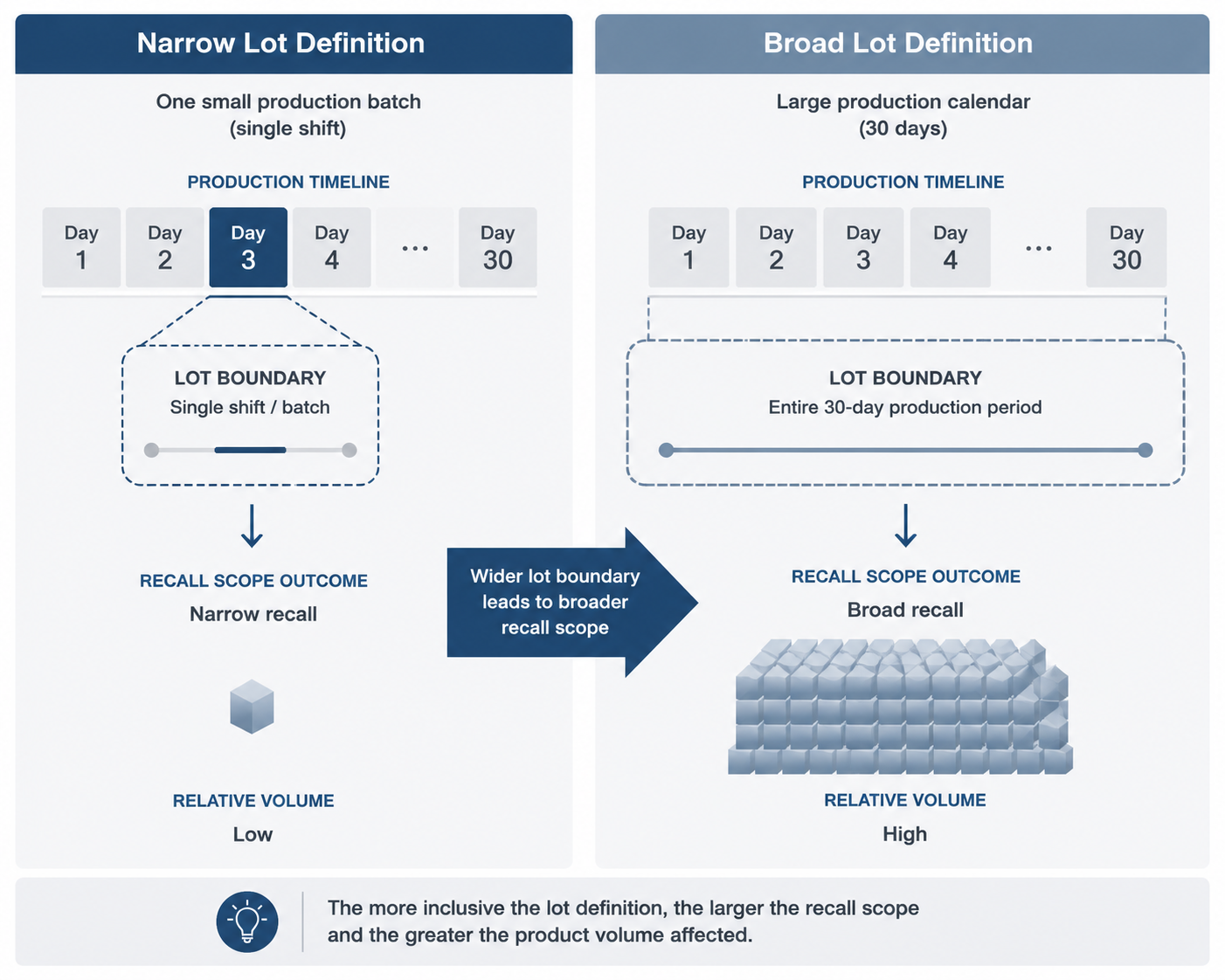
It also changes the internal burden at exactly the wrong hour. The QA lead is no longer just pulling a certificate, a batch sheet, or a distribution list. The recall coordinator is now explaining why product made before or after the positive day should stay in commerce. Counsel is evaluating whether that position is defensible if the agency, a retailer, a state official, or a plaintiff’s lawyer asks for the underlying records.
Granularity Is Not Just Smaller Codes
There is a tempting but incomplete answer here: make every lot smaller. Smaller traceability lots can reduce affected food in a recall, as FDA says, but only if the company’s operations can keep the boundaries real.[2] A code that claims to represent a short interval is not much help if rework, shared ingredients, commingled packaging, undocumented hold-and-release decisions, or weak distribution records blur the line.
A defensible lot architecture has at least two dimensions. The first is the production unit: what period, run, ingredient lot, line, or control point the code actually captures. The second is the evidentiary unit: what records the company can produce to show that the production unit is meaningful. A company can have a narrow code and still lose the argument if its records cannot show why the next code is outside the hazard.
That is why traceability design belongs in legal and compliance risk discussions, not only ERP implementation meetings. The person configuring the code structure may be deciding whether a future recall notice identifies a few hours of production, a shift, a day, a week, or a much larger commercial interval. Those decisions will be judged later under pressure, with incomplete facts and a regulator focused on public health.
Volume Turns a Records Problem Into a Liability Problem
Recall volume is already large enough without avoidable expansion. Food Safety News, reporting Sedgwick data, stated that FDA-regulated food recalls averaged 985,658 units per event in 2022, up from 125,796 in 2021.[5] Those figures are dated, and they should not be treated as a current average for every company or commodity. They are still useful because they show how quickly recall scope can become a scale problem.
The more recent trend is not comforting. Food Logistics reported in February 2026, based on Sedgwick data, that product recalls experienced an uptick in 2025.[6] No newer per-event average comparable to the 2022 figure is provided, so the careful conclusion is directional: recall activity continued to rise, and broad lot definitions operate in an environment where the base volume of recalled product is already a serious business and legal risk.
For counsel, the compounding effect matters more than the headline number. If a suspect interval is one run and the records prove it, the company has one kind of matter. If the same hazard is presumed to affect a month because the company cannot defend a narrower boundary, the public notice, the customer universe, the refund population, the regulator communications, and the document hold all expand with it.
The Public Notice Also Builds the Plaintiff Pool
Once the recall notice is public, the lot codes do a second job. They tell consumers what to do, but they also tell plaintiffs’ lawyers who might belong in a proposed class. That is not a criticism of clear notices. Public identification is necessary. It is also why the recall boundary deserves legal attention before it appears on an FDA, USDA, company, or retailer page.
Hollingsworth LLP’s 2026 litigation forecast describes at least seven economic-loss class actions filed within ten days of a November 2025 infant formula recall expansion. The forecast states that the class definitions in those complaints were built around the lot codes published in FDA recall notices.[7] That is a law firm forecast, not a neutral academic study, so it should be used for what it is: a concrete description of how plaintiffs can translate published recall architecture into pleadings.
The litigation consequence follows the same boundary logic as the regulatory consequence. A narrow, supportable lot code may limit the group of purchasers who can plausibly say they bought recalled product. A broad notice gives plaintiffs a larger population to identify, contact, and define. The merits of any economic-loss claim will still depend on product facts, state law, purchase proof, injury theory, and defenses. But the outer shape of the case often starts with the lot codes the company and regulator published.
The Decision Is Made Before the Positive Result
It is fair to be careful here. Lot-code granularity is not magic. It does not override pathogen behavior, environmental findings, supplier uncertainty, or regulator risk tolerance. It does not guarantee a lower recall classification. It does not turn a weak food-safety system into a defensible one.
But it is still one of the most important structural choices a food company makes before a recall. The company that can rapidly produce coherent records for a narrow lot boundary has a different conversation with the regulator than the company asking everyone to trust an undocumented line. The company with a broad commercial lot may have chosen administrative simplicity years earlier, but during a recall that simplicity can become pounds, units, refunds, notices, and class allegations.
That is the uncomfortable part for legal and compliance teams. By the time a positive result arrives, the company is largely living inside the boundaries its systems can prove. The lot-code architecture already exists. The production records are either there or they are not. The recall scope will be negotiated, but not on a blank page.
References
- Food Recalls: What You Need to Know, FDA.
- Traceability Lot Code, FDA.
- FSMA Final Rule on Requirements for Additional Traceability Records for Certain Foods, FDA.
- USDA Recall Guide: Process Requirements, Company Obligations, and Enforcement Consequences, OFW Law.
- Volumes of recalled food at both the FDA and FSIS have increased dramatically, Food Safety News, December 2025.
- Product Recalls Experienced Uptick in 2025: Sedgwick Data, Food Logistics, February 2026.
- What We're Watching in 2026: Increasing Recalls of Food and Supplement Products in 2026 Will Drive Consumer Class Action Litigation, Hollingsworth LLP, 2026.
Chronological incident history
No sanction cases have named this tool in the tracked record set to date. This does not imply the tool is safe — see Risk Digest for ongoing monitoring.
← Compare peer toolsReport a correction or tip
Spotted an outdated figure, a misstated fact, or a ruling this tool profile should reflect? Public comments are disabled for this content given the professional cost of a misreported case outcome, penalty amount, or rule text — use the structured correction channel instead.
Report a correction or tip for this record →