
Three Legal Exposure Channels After a Supply Chain Cyberattack
When a vendor's cyberattack cascades to your company, legal liability attaches through three distinct channels—regulatory enforcement, contractual gaps, and private litigation—and standard vendor agreements leave the customer bearing over 95% of total breach costs. This analysis provides a cross-functional audit framework to map exposure before the next incident hits.
- Hallucination rate
- Not measured / undisclosed
The hard part of a vendor-originated cyber incident usually arrives after the containment call, when the company realizes the work was outsourced but the loss was not. The contract may say the vendor had to protect the environment, notify the customer, and indemnify certain claims. It may also cap that same vendor’s financial responsibility at annual contract value, often in the $10,000 to $50,000 range, while excluding consequential damages—the category where much of the customer’s real incident cost tends to live.[1]
That mismatch matters because breach remediation is not priced like a software subscription. IBM and Ponemon’s 2025 report put the average U.S. data breach cost at $10.22 million, and third-party-originated breaches at an average of $4.8 million to remediate.[2] Kelley Kronenberg’s analysis draws the uncomfortable conclusion for standard vendor contracts: if recovery is limited to a small annual fee cap and consequential damages are excluded, the customer can be left bearing more than 95% of the total cost.[1]

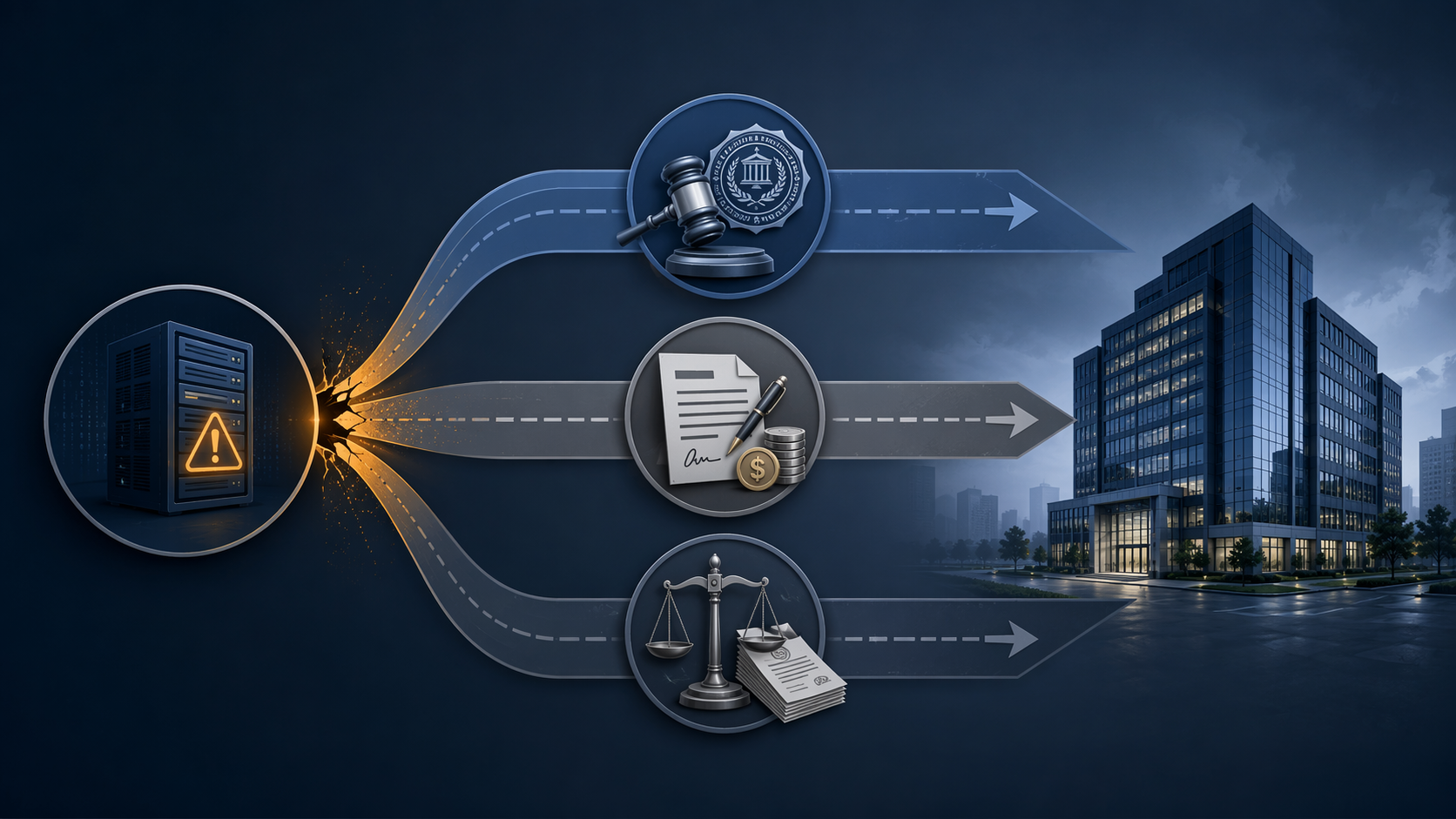
This is the central legal risk in a supply chain cyberattack: not that the vendor disappears from the story, but that the customer remains visible in three places at once. Regulators ask what the company knew and disclosed. Contracts determine how little may be recoverable from the vendor. Plaintiffs test whether affected customers, employees, shareholders, or business partners can turn the incident into claims.
The scale of the problem is no longer a corner case. Cowbell Cyber and Foley & Lardner reported in 2025 that supply chain cyberattacks had surged 431% since 2021 and represented 15% of all breaches, making them the second most prevalent attack vector.[3] That figure is attention-grabbing. The more legally useful question is narrower: when one vendor is breached, how many customer organizations are pulled into the consequences, and how long are they operating without confirmed facts?
The Vendor Breach Does Not Stay in the Vendor File
Black Kite’s 2026 Third-Party Breach Report found an average of 5.28 downstream victims per breached vendor, 719 named victims, roughly 26,000 estimated “shadow victims,” and an average 117-day disclosure delay.[4] The report reflects one vendor’s methodology, so it should not be treated as a universal census of all incidents. Still, the legal significance is plain: downstream organizations may have to evaluate disclosure, customer notice, privilege, board reporting, contractual rights, and litigation exposure while the primary vendor is still reconstructing what happened.
Those 117 days are where clean governance diagrams tend to fail. Security wants technical confirmation. Legal wants a defensible record. Finance wants to know whether costs are recoverable or insured. Communications wants a statement that will not age badly. The board wants to know whether the company has a material incident. Meanwhile, the contract may give the vendor time to investigate before providing the facts the customer needs for its own obligations.
The legal exposure therefore should be mapped as simultaneous channels, not sequential handoffs. A company can be under pressure to disclose to investors, preserve claims against the vendor, notify affected individuals, coordinate with insurers, and prepare for putative class claims before it has a final forensic report.
Contractual Exposure: The Assignment of Work Is Not the Transfer of Loss
Vendor contracts are often written as if the main legal question is who had the operational duty. That matters, but it is not the whole question. After a breach, the sharper question is whether the agreement gives the customer a practical path to recover investigation costs, notification expenses, credit monitoring, business interruption, regulatory defense, settlement amounts, and internal response costs.
The answer may be no even when the vendor clearly caused the incident. Kelley Kronenberg’s analysis identifies the recurring mechanism: a liability cap tied to annual contract value, often $10,000 to $50,000, combined with exclusions for consequential damages.[1] If the customer’s total remediation cost is measured against IBM/Ponemon’s $4.8 million average for third-party-originated breaches, the economics are not close.[2]
| Contract Term | Why It Matters After a Vendor Breach |
|---|---|
| Annual contract value liability cap | May limit recovery to a small service fee amount even when breach costs reach millions. |
| Consequential-damages exclusion | Can block recovery for categories where downstream breach losses often appear, including interruption, customer claims, and response costs. |
| Narrow indemnity | May cover third-party IP or confidentiality claims but not first-party incident response, regulatory defense, or notification costs. |
| Notification timing language | May require prompt notice in theory while leaving enough ambiguity for the vendor to delay meaningful confirmation. |
| Insurance requirement | May require the vendor to carry coverage without giving the customer direct access, adequate limits, or alignment with the customer’s actual loss profile. |
The practical failure is rarely one clause in isolation. A contract can contain security obligations, audit rights, cyber insurance requirements, and an indemnity, while the limitation-of-liability section quietly controls the outcome. If the cap applies to “all claims arising out of the agreement,” and no carveout exists for data security incidents, confidentiality breaches, regulatory penalties, or indemnified claims, the customer may have purchased a detailed set of duties with a very small remedy.
Consequential-damages exclusions deserve special attention because they are often treated as boilerplate until an incident gives them a job. The vendor may argue that lost revenue, reputational harm, customer concessions, interruption costs, and some downstream claims fall outside recoverable direct damages. The customer may argue that breach-response expenses are direct, foreseeable, or expressly recoverable. The outcome depends on governing law and contract language, but the negotiation should happen before the breach, not during the privilege fight.
Indemnities can be equally misleading. A broad-sounding promise to indemnify for “third-party claims” may not reimburse first-party forensic work, legal advice, call-center costs, mailing, credit monitoring, business disruption, or the labor of internal teams. If regulatory defense costs are not expressly included, the company may be paying lawyers to respond to a regulator about an incident caused by a vendor while arguing separately that the vendor should contribute.
This is not an argument that every vendor should accept uncapped liability for every cyber incident. Some vendors would price the risk differently, refuse the business, or pass costs back to customers. The legal point is narrower and more useful: counsel should know whether the company’s retained exposure is an intentional commercial decision or an unexamined byproduct of standard procurement paper.
Regulatory Exposure: The Customer Still Owns Its Oversight Story
The regulatory channel is where the “it was our vendor” explanation loses force quickly. For public companies, the SEC’s 2023 cybersecurity disclosure rule requires annual-report disclosure of processes to oversee and identify cybersecurity risks associated with the company’s use of any third-party service provider.[5] That is not a requirement that every vendor breach be disclosed as a material incident. It is a requirement that third-party cyber risk oversight be part of the company’s governance story when the rule applies.
The timing pressure is separate. Form 8-K Item 1.05 requires disclosure of material cybersecurity incidents within four business days after the company determines the incident is material; smaller reporting companies received an extended compliance deadline to June 3, 2026.[6] A vendor-originated incident creates a familiar problem: the company may need to decide materiality while key facts sit with a third party whose own investigation is incomplete.
That timing gap is not theoretical when read beside Black Kite’s 117-day average disclosure delay.[4] The legal exposure is not simply late notice. It is the quality of the company’s escalation record: when the company first learned of suspicious activity, what it asked the vendor, how it assessed customer and business impact, who reviewed materiality, and whether public statements were calibrated to what was actually known.
SolarWinds-related SEC enforcement remains a cautionary example, though it should be used carefully. In October 2024, the SEC announced penalties ranging from $990,000 to $4 million in actions involving allegedly misleading disclosures about nation-state attribution and code exfiltration.[7] The lesson is not that every incomplete cyber disclosure will become an enforcement action. It is that disclosure quality, internal knowledge, and the precision of public statements can become the case.
The SEC’s February 2025 restructuring of its cyber and emerging technologies enforcement unit adds another reason to avoid overstatement. The unit was reduced to about 30 staff, while “public issuer fraudulent disclosure relating to cybersecurity” remained a stated priority area.[8] That supports a cautious conclusion: enforcement volume and focus may shift, but public-company disclosure about cyber incidents and cyber risk has not become irrelevant.
Other regulators may matter more than the SEC depending on the data and industry. The FTC, HIPAA regulators, and state attorneys general can all become relevant where consumer data, health information, unfair or deceptive practices, or state breach-notification duties are implicated. The vendor’s role may affect fault allocation, but it does not eliminate the customer’s need to show reasonable oversight, accurate notices, and disciplined internal decision-making.
The in-house problem is that these obligations do not wait politely for contract interpretation. A legal team may be preserving indemnity claims, evaluating 8-K materiality, drafting consumer notices, and preparing board updates from the same uncertain fact set. If those workstreams do not share a chronology, the company can create inconsistency without anyone intending to mislead.
Private Litigation: The Vendor Incident Becomes the Customer’s Caption
Private litigation is the third channel, and it should be kept in proportion. Not every vendor breach becomes a viable class action, and filed complaints are allegations, not findings. Still, recent filings show how quickly plaintiffs can name the customer-facing company when a third-party incident exposes personal data or disrupts service.
The Mercor/LiteLLM class action filed in April 2026 and the Qantas class action filed in June 2025 are examples of claims forming around vendor-originated or third-party-linked incidents.[9][10] Their broader significance is procedural as much as substantive: once a complaint is filed, the company must defend its vendor oversight, notice timing, security representations, harm theories, and preservation record in a forum that is not controlled by the incident-response team.
Settlement mechanics can also outlive the immediate breach cycle. Fidelity’s data breach settlement process illustrates how breach claims can move from incident response into defined settlement classes, claim forms, payment eligibility, and court-supervised administration.[11] That machinery matters for counsel evaluating the true cost of a vendor incident because litigation spend and settlement administration may sit outside the neat categories contemplated by the vendor agreement.
For public companies, securities litigation should be understood as adjacent to the regulatory channel rather than wholly separate. A cyber incident disclosure, an allegedly corrective disclosure, a stock drop, and later regulatory findings can become ingredients in securities claims. The best defense record is usually built earlier, in the same materiality analysis, board reporting, and statement-review process used for regulatory purposes.
Safe Harbors Help Only If the Record Exists Before the Breach
State cybersecurity safe harbor laws are worth watching, but they should not be mistaken for a universal shield. As of the research snapshot, nine states had enacted safe harbor laws from Ohio through Oklahoma’s 2026 law, generally offering partial protection for organizations that maintain cybersecurity programs aligned with recognized frameworks.[12] The details vary by state, and the trend is active rather than settled.
The limitation is practical. A safe harbor is only useful if the company can show more than policy architecture. Gartner reported in 2025 that only about half of organizations that see vendor red flags escalate them to compliance.[12] If a vendor risk signal sat in a security review, procurement file, or business-owner email without escalation, the company may have a documentation problem even if its written program names a recognized framework.
That is why safe harbor analysis belongs with escalation discipline. Counsel should be able to trace how vendor red flags move from technical reviewers to legal, compliance, risk, finance, and business leadership. If the answer depends on informal relationships or a single security leader’s memory, the organization may not be able to prove the program it believes it has.
A Cross-Functional Audit Should Test the Same Scenario Across All Three Channels
A useful audit does not start with another generic vendor questionnaire. It starts with a realistic vendor scenario and asks whether the company’s regulatory duties, contract rights, insurance assumptions, escalation paths, and litigation posture line up against the same facts. The point is not to predict the next breach. It is to find the places where the organization’s documents contradict each other before an adversary or regulator finds them first.
| Audit Question | What Counsel Is Testing |
|---|---|
| If this vendor is unavailable or breached, which business processes and regulated data sets are affected? | Whether legal materiality, customer notice, operational continuity, and contract remedies are being evaluated from the same impact map. |
| What must the vendor tell us, in what time frame, and with what supporting evidence? | Whether notification language gives the customer enough facts to meet its own regulatory, contractual, and board-reporting obligations. |
| Does the liability cap apply to data security, confidentiality, indemnity, regulatory defense, and first-party response costs? | Whether expected recovery is real or blocked by the limitation-of-liability structure. |
| Do our public statements, customer commitments, and vendor contract standards describe the same level of oversight? | Whether plaintiffs or regulators could use inconsistencies to challenge disclosure quality or reasonable reliance. |
| Who decides materiality, who preserves privilege, and who updates the board while vendor facts are incomplete? | Whether escalation works during the disclosure-delay window, not only after final forensic confirmation. |
| Do insurance assumptions match the contract and the likely loss categories? | Whether cyber insurance, vendor insurance, indemnity, and exclusions leave an uncovered gap. |
The contract review should be tied to actual exposure. For a low-cost vendor handling noncritical data, a modest cap may be a rational business decision. For a vendor embedded in payment flows, health data, authentication, customer communications, or core operations, the same cap may be a deferred loss. The audit should force that distinction into the approval record.
The regulatory review should produce a chronology template before the incident. Public companies need a way to document when facts became known, when materiality was assessed, who participated, and why a disclosure decision was made. Regulated private companies need the same discipline for consumer notices, HIPAA analysis where applicable, state AG engagement, and customer contract notices. The template should be short enough to use during a live event.
The litigation review should identify the statements plaintiffs are likely to quote back. Privacy notices, security pages, vendor due diligence representations, customer contracts, SEC filings, incident notices, and call-center scripts should not tell different stories about the company’s control over vendors. Precision is not only a regulatory virtue; it is a pleading-stage defense asset.
Insurance belongs in the audit, but only as part of the exposure map. Counsel should not assume that the vendor’s cyber policy, the customer’s cyber policy, and the indemnity will stack neatly. Notice requirements, consent-to-settle provisions, exclusions, retention amounts, sublimits, and additional-insured status can all change the practical recovery position.
The most revealing exercise is often a tabletop built around incomplete vendor information. The vendor confirms suspicious access but not scope. A customer asks whether its data is involved. The board asks whether the company has a material incident. The insurer asks for notice. Communications wants holding language. Procurement finds a $25,000 liability cap. No one needs a dramatic scenario; the ordinary timing conflict is enough.
What a Defensible Posture Looks Like
A company cannot eliminate legal risk from supply chain cyber disruption by contract alone. It also cannot regulate or litigate its way out of a vendor’s technical failure after the fact. What it can do is know, in advance, which vendor scenarios create retained economic exposure, which disclosures may be triggered, which contractual remedies are meaningful, and which documents will be used to judge the company’s response.
The defensible position is not a promise that the vendor will not be breached. It is a record showing that the company understood the dependency, negotiated or accepted the economic risk deliberately, escalated red flags through the right functions, made disclosure decisions from a documented chronology, and preserved the evidence it would need when regulators, plaintiffs, insurers, customers, or the board asked what it knew and when.
This analysis is a legal risk framework, not legal advice. Specific obligations and defenses depend on jurisdiction, industry, contract language, data type, insurance terms, and incident facts, and organizations should consult counsel for their circumstances.
References
- Your Vendor’s Data Breach Just Cost You $4.8 Million: Why Your Business Bears Full Legal Liability, Kelley Kronenberg
- Cost of a Data Breach Report 2025, IBM
- Cowbell Cyber / Foley & Lardner 2025 supply chain cyberattack analysis, Cowbell Cyber / Foley & Lardner, 2025
- Third-Party Breach Report 2026, Black Kite
- New SEC Cybersecurity Final Rule: Reporting Hits Third-Party Risk, Bitsight
- New SEC Cybersecurity Disclosure Rules: What Employers Need to Know, Fisher Phillips
- Recent SEC Cyber-Related Enforcement Actions, Skadden, November 2024
- SEC Cyber Unit Restructuring and Enforcement Priorities, Troutman Pepper Locke / Law360, February 2025
- Mercor/LiteLLM Class Action, ClaimDepot, April 2026
- Qantas Class Action, Mealey’s, June 2025
- Who Qualifies for Fidelity Data Breach Settlement Payouts
- Reducing Your Exposure: Liability Limitations for Cybersecurity-Compliant Organizations, Crowell & Moring
Chronological incident history
No sanction cases have named this tool in the tracked record set to date. This does not imply the tool is safe — see Risk Digest for ongoing monitoring.
← Compare peer toolsReport a correction or tip
Spotted an outdated figure, a misstated fact, or a ruling this tool profile should reflect? Public comments are disabled for this content given the professional cost of a misreported case outcome, penalty amount, or rule text — use the structured correction channel instead.
Report a correction or tip for this record →