
Why the US airstrikes on Iran violated international law
This article examines whether the February 2026 US-Israeli airstrikes on Iran complied with the UN Charter's prohibition on the use of force. It concludes, based on the weight of expert legal opinion and the failure of self-defense justifications, that the strikes were manifestly illegal under international law.
- Hallucination rate
- Not measured / undisclosed
As of July 19, 2026, the war remains ongoing, and any legal assessment has to leave room for later evidence. On the record now available, however, the question raised by the February 2026 US-Israeli airstrikes on Iran is not whether Iran’s nuclear program posed a serious policy problem. It is whether the United States identified a legally cognizable armed attack, or an imminent one, sufficient to move the strikes from Article 2(4)’s prohibition on force into Article 51’s exception for self-defense.
That is the point at which the legal justification begins to fail. The United States submitted an Article 51 letter to the UN Security Council on March 10, 2026, but the letter did not specify the Iranian armed attack that supposedly triggered the right of self-defense; former State Department attorney-advisers writing at Just Security identified that omission as a central defect in the US position.[1]
The Charter question comes first
Article 2(4) of the UN Charter is not a balancing test in which states may use force whenever the threat feels grave enough. It prohibits the use of force against another state. Article 51 preserves the inherent right of individual or collective self-defense if an armed attack occurs. The structure matters: the state using force bears the burden of explaining why it fits within the exception.
The United States therefore needed more than institutional authority, strategic anxiety, or a familiar recital of Iran’s hostile conduct. It needed a predicate. If the theory was actual self-defense, the predicate was an armed attack. If the theory was anticipatory self-defense, the predicate was an imminent armed attack. If the theory was collective self-defense, the predicate was an armed attack against Israel and a legally adequate request or basis for US action. If the theory was authorization, the predicate was Security Council action. None of those routes is made out on the record described in the public legal materials.
| Possible legal route | What it needed | Problem in the public record |
|---|---|---|
| Individual self-defense | A demonstrated armed attack against the United States | The US Article 51 letter did not identify a specific Iranian armed attack. |
| Anticipatory self-defense | A credible imminent armed attack, not a speculative future danger | Public intelligence analysis described no active weaponization and no Iranian ICBM capability until at least 2035. |
| Necessity | Force as necessary because lawful alternatives could not address the threat | Diplomatic channels had not been exhausted. |
| Collective self-defense | A legally sufficient predicate involving Israel | The public justification did not cure the same armed-attack and imminence defects. |
| Security Council authorization | Council authorization to use force | No authorization was sought or obtained. |
The Article 51 letter did not identify the armed attack
The most important feature of the US Article 51 letter is not what it says but what it avoids saying. It reports a claim of self-defense after the use of force, yet it does not identify a concrete Iranian armed attack against the United States. That omission is not a pleading technicality. In the Charter system, the armed attack is the legal hinge.
Just Security’s analysis of the letter is valuable precisely because it reads the US submission on its own terms. The defect is internal: the letter invokes Article 51 without supplying the event that Article 51 requires. A state may describe a hostile security environment, a pattern of proxy violence, or a feared future capability, but those descriptions do not automatically become an armed attack by Iran against the United States.[1]
That gap also matters for later legal arguments. Once the armed-attack predicate is missing, necessity and proportionality cannot do their usual work. They are not free-floating policy virtues; they are limits on a right of self-defense that must first exist. The United States could not repair the absence of a triggering attack by asserting that the targets were important or that the military operation was calibrated.
Imminence cannot mean dangerous someday
The harder version of the US argument is anticipatory self-defense. Some governments and scholars accept a narrow doctrine permitting force before an armed attack has occurred, usually under a demanding concept of imminence associated with necessity. That contested doctrine does not help much if “imminent” is made to cover a threat that is severe in strategic terms but not immediate in legal terms.
Allen Weiner’s Stanford analysis described an intelligence record in which Iran lacked intercontinental ballistic missile capability until at least 2035 and was not actively pursuing weaponization.[2] Those facts do not make Iran benign. They do make it difficult to describe the February 2026 strikes as a response to an imminent Iranian armed attack against the United States.
The leadership-targeting element makes the imminence theory still harder to sustain. Lawfare’s analysis treated the targeting of Supreme Leader Ali Khamenei as an assassination operation and explained why that feature sits uneasily with a legal theory centered on stopping an imminent armed attack.[3] A strike aimed at leadership may be argued to have coercive or strategic value. That is different from showing that the target was the necessary means of preventing an attack about to occur.
EJIL Talk’s discussion of the Caroline Doctrine usefully frames the point. The doctrine’s traditional language is not an invitation to convert long-running proliferation fears into an open-ended permission to attack. It asks whether the necessity of self-defense is instant, overwhelming, and leaves no choice of means. On the facts described in the public record, the Iranian nuclear threat was treated as grave, but not shown to be legally imminent.[4]
Necessity fails when diplomacy is still open
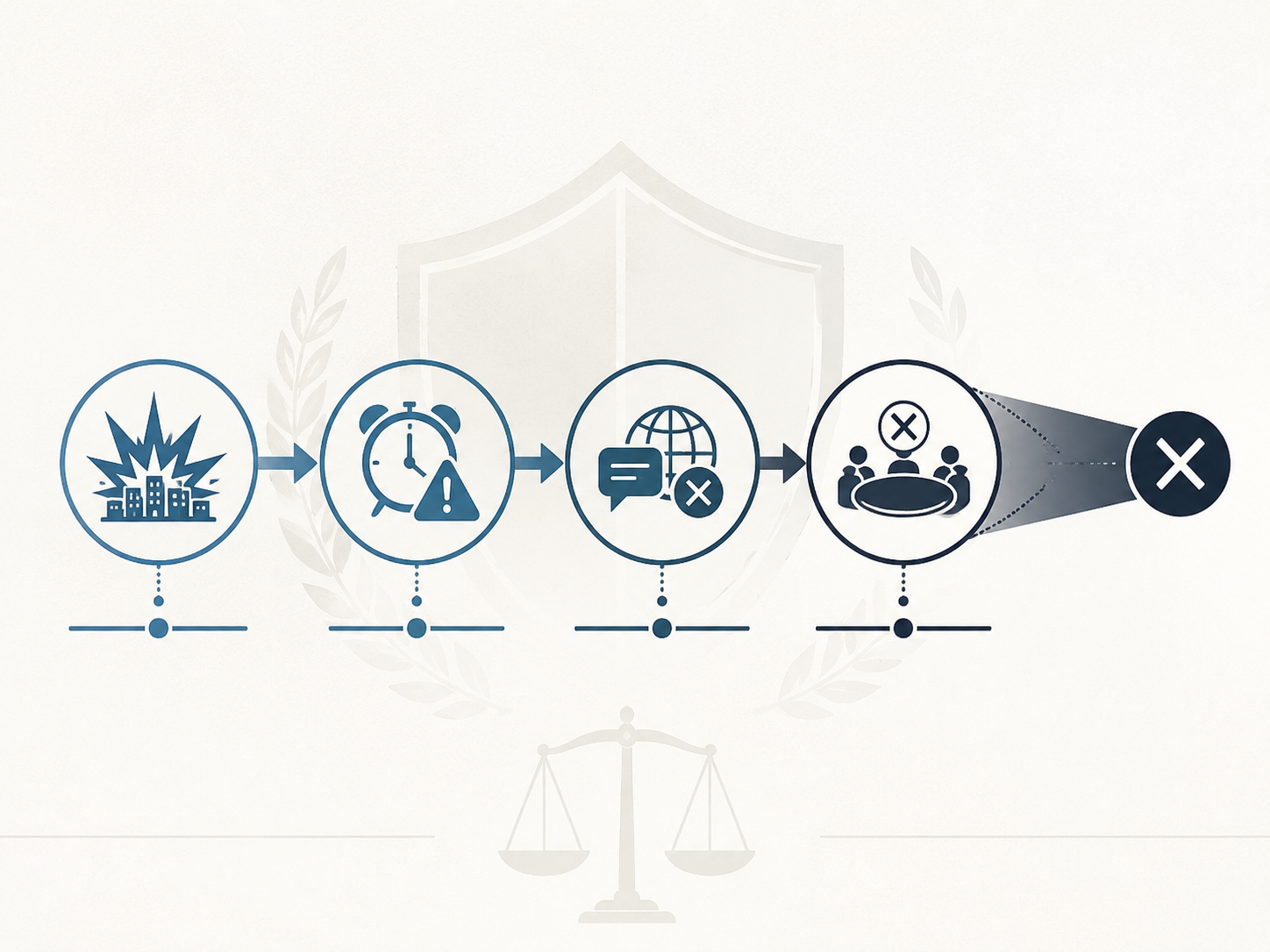
Necessity is often the place where legal argument becomes least disciplined. It is tempting to treat necessity as a judgment that force was useful, prudent, or faster than negotiation. In the law of self-defense, necessity asks something narrower: whether force was required because no adequate non-forcible alternative remained.
The available diplomatic record cuts against that showing. EJIL Talk notes that nuclear negotiations through Oman were ongoing, with a sixth round scheduled for June 15, 2025, before being derailed by Israel’s prior strikes.[4] If that is the relevant diplomatic setting, then the necessity argument has to explain why the channel was legally exhausted rather than merely frustrating, slow, or politically unattractive.
This does not mean diplomacy must continue forever, or that negotiations automatically bar self-defense. It means that a state claiming a right to use force before an armed attack must show why the threshold for force had been reached. On the record available, the United States and Israel did not supply that explanation with the precision the Charter demands.
Collective self-defense does not cure the predicate problem
A collective self-defense theory can sometimes change the identity of the victim state. It cannot eliminate the requirement that an armed attack occurred, or that an imminent attack met the strict conditions asserted for anticipatory force. If the United States acted for Israel, the legal inquiry shifts to whether Israel had a valid self-defense claim that the United States could lawfully join.
That theory encounters the same two barriers. The public materials do not establish an Iranian armed attack sufficient to justify the initiation of the February 2026 strikes, and the imminence record remains weak. Collective self-defense is not a doctrinal laundering mechanism; it depends on the underlying right of the state being defended.
The point is especially important because the US and Israeli narratives can otherwise blur into one another. Israel’s security fears may be acute, and Iran’s regional conduct may be hostile, but neither fact removes the need to identify the relevant armed attack or imminent attack with legal specificity.
There was no Security Council authorization
The other recognized Charter route for using force is Security Council authorization. The United States did not obtain it, and the public record described in the research materials indicates that the United States bypassed the Council rather than seeking authorization.
That absence does not require elaborate treatment because it is not a close point. Without Council authorization, the legality of the strikes depends on self-defense. Once the self-defense theory fails, there is no remaining Charter exception to carry the operation.
The expert consensus is evidence of legal defect, not just a headcount
Expert consensus can be overused in legal writing, especially when it substitutes authority for analysis. Here, the significance of the public statements is that they converge on the same structural defects: no demonstrated armed attack, no credible imminence, no exhausted diplomacy, and no Security Council authorization.
A Just Security letter signed by more than 100 US-based international law experts concluded that the strikes violated the UN Charter and stated that they may constitute war crimes.[5] The latter possibility should not be overstated. International criminal accountability depends on jurisdiction, charges, evidence, and forum; the United States is not a party to the Rome Statute. But the letter’s Charter analysis is directly relevant to the legality of initiating force.
Institutional statements reached the same conclusion. The New York City Bar Association stated that the US military action against Iran violated international law and US constitutional law.[6] The President of the American Branch of the International Law Association likewise concluded that the United States attack violated the prohibition on the use of force under the UN Charter.[7] These statements matter because they do not rest on a single disputed factual inference; they identify failures in the legal architecture of the justification.
The breadth of condemnation is therefore not the argument. The argument is that lawyers working from different institutional positions found the same missing predicates in the same places. That is why the consensus is difficult to dismiss as partisan reaction to an unpopular military operation.
The US counterargument deserves a fairer statement than it can survive
The strongest US position would not be that international law is irrelevant. It would be that Iran’s conduct, nuclear trajectory, regional proxy activity, and threats to Israel created a defensive necessity; that the United States may use force to prevent catastrophic attacks before they fully materialize; and that executive assessments of imminence deserve substantial weight in a fast-moving security environment.
That position is familiar. It is also exactly why the Charter test must be kept distinct from strategic intuition. An executive branch may be better positioned than outsiders to assess classified risks, but Article 51 still requires a legal explanation capable of being stated to the Security Council. The United States did not publicly identify the relevant armed attack, and the public intelligence analysis available does not establish imminence.[1][2]
Public statements dismissing international law are relevant context, but they are not necessary to the conclusion. The legal failure does not depend on proving bad faith. It follows from the mismatch between the Charter’s required predicates and the explanation actually offered.
What this conclusion does and does not decide
This analysis concerns jus ad bellum: the legality of resorting to force. It does not resolve the separate conduct-of-hostilities questions raised by particular targets, civilian harm, proportionality under international humanitarian law, or attacks on critical infrastructure. Those issues require target-specific facts and casualty verification, much of which remains difficult in an ongoing conflict. For that separate inquiry, the related analysis of whether the Iran critical infrastructure strikes were lawful under international law addresses a different legal frame.
Nor does the conclusion depend on a broad analogy to Russia’s invasion of Ukraine. The factual settings differ, and legal comparisons can become lazy when they are used as shortcuts. The narrower point is sufficient: unilateral force justified by expansive, poorly evidenced self-defense claims is precisely what Article 2(4) was designed to restrain.
The legal assessment may require revision if the United States later discloses facts that establish an armed attack, a genuinely imminent attack, or another lawful basis for force. As of the public record available on July 19, 2026, every plausible Charter path narrows and then closes. The February 2026 US-Israeli airstrikes on Iran violated Article 2(4), and the asserted Article 51 self-defense justification does not carry them into legality.
References
- Assessing the U.S. Article 51 Letter for the Attack on Iran, Just Security
- Stanford’s Allen Weiner on the Constitutional and International Law Questions Raised by the Iran Attack, Stanford Law School, March 3, 2026
- The Law of Going to War With Iran, Lawfare
- The American-Israeli Strikes on Iran are (Again) Manifestly Illegal, EJIL Talk
- Professors’ Letter on International Law and the Iran War, Just Security
- On the U.S. Military Action Against Iran, New York City Bar Association
- Statement of the President Regarding the United States Attack on Iran, American Branch of the International Law Association
Chronological incident history
No sanction cases have named this tool in the tracked record set to date. This does not imply the tool is safe — see Risk Digest for ongoing monitoring.
← Compare peer toolsReport a correction or tip
Spotted an outdated figure, a misstated fact, or a ruling this tool profile should reflect? Public comments are disabled for this content given the professional cost of a misreported case outcome, penalty amount, or rule text — use the structured correction channel instead.
Report a correction or tip for this record →