
Accidentally Crossed the Canada-US Border? What Happens Now
An accidental Canada-US border crossing carries sharply different legal consequences depending on which country's officers you encounter first. This verification workflow covers the CBSA and CBP positions, detention and removal risk by immigration status, and the first-minute response steps that can change the outcome.
Last verified: August 1, 2026. This is general legal-risk information, not legal advice for a specific person. If someone is being detained, has an existing immigration case, has prior removal history, or is asked to sign paperwork they do not understand, the practical next step is to contact qualified immigration counsel as soon as possible.
The legal consequences after an accidental Canada-US border crossing turn on a blunt distinction: which country’s officers encounter the traveler first. Canada’s border agency has stated that arriving at a Canadian port of entry unintentionally does not, by itself, make a traveler inadmissible or provide grounds for enforcement action, and that the traveler may be permitted to withdraw the application to enter Canada and leave voluntarily.[1] U.S. Customs and Border Protection has taken the harder position that people who violate immigration laws may be subject to detention and removal, even when the crossing began as a wrong turn.[2]
That is the rule most travelers do not intuit in the first minute. “Accidental” matters for explaining the record. It may matter to officer discretion. It does not reliably erase statutory consequences, especially on the U.S. side, where improper entry under 8 U.S.C. § 1325 can carry criminal penalties for covered noncitizens when the statutory elements are met.[3]
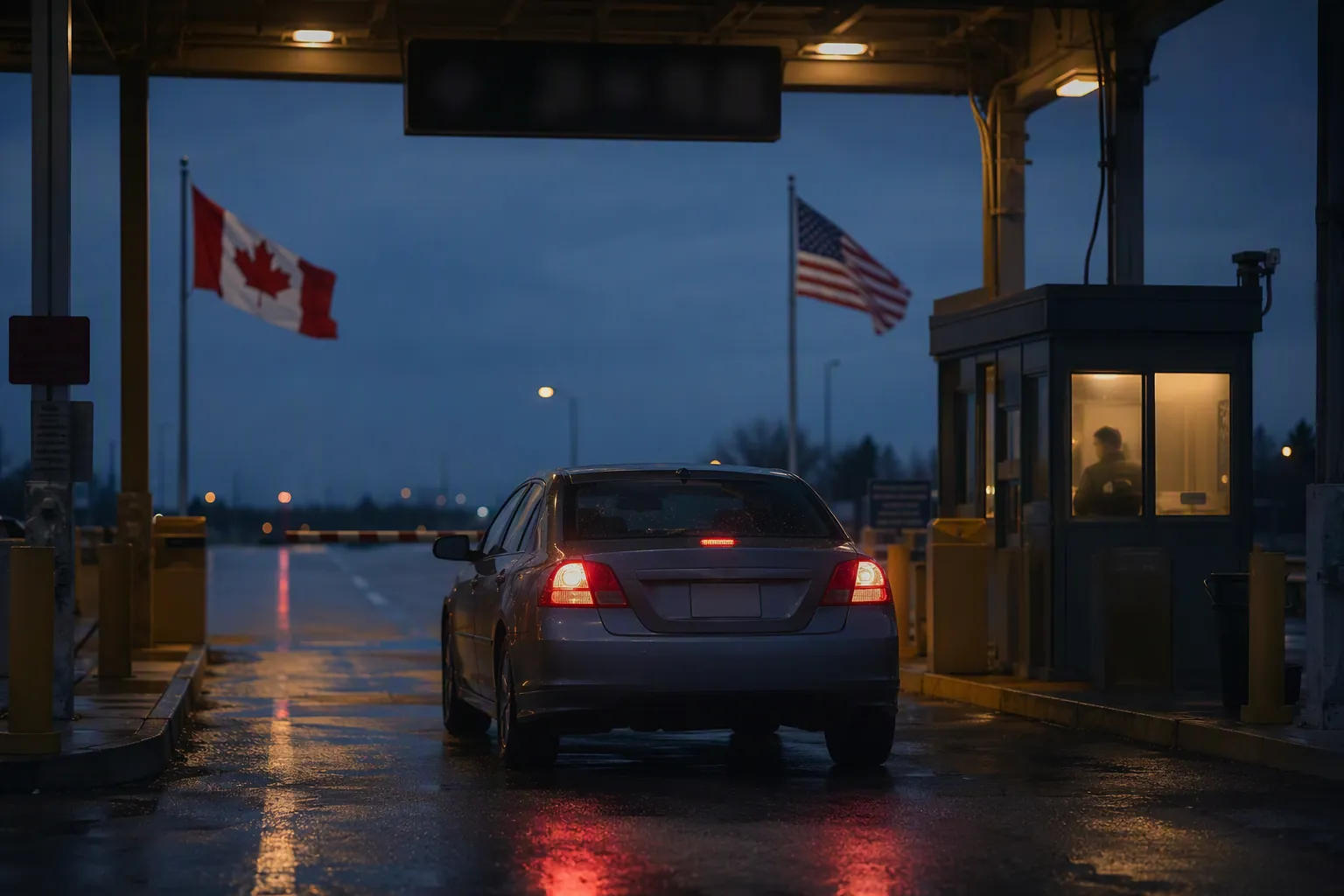
The first minute: stop creating facts
The first mistake after the wrong turn is usually an attempted self-correction: backing up, turning around between booths, driving away from a lane, or trying to explain too much while still moving. Do not make the event look like flight. Stop where directed. Keep hands visible. Identify yourself. Then make the mistake clear in one plain sentence.
- Stop safely and follow lane or officer instructions. Do not reverse out of a controlled approach unless an officer tells you to.
- Identify yourself and everyone in the vehicle. Use the documents you have; do not guess at status, dates, or visa categories.
- State the mistake briefly: “I followed GPS / missed the turn / did not intend to enter. I am asking how to correct this.”
- If you are before Canadian officers, ask whether you may withdraw your application to enter Canada and return voluntarily.
- If you are before U.S. officers and detention, removal, or signing paperwork is raised, ask to speak with an immigration lawyer and do not sign documents you do not understand.
- As soon as it is safe and permitted, record the time, location, lane or bridge, officer names or badge numbers if visible, documents taken, forms issued, and exact words used to describe the mistake.
The sentence should be short because the first record may be made by someone else. A tired driver can ramble into contradictions: “I was entering,” “I was trying to go home,” “I came here by accident,” “I do not know where I am.” Those may all be emotionally consistent. In a border file, they are not equally useful.
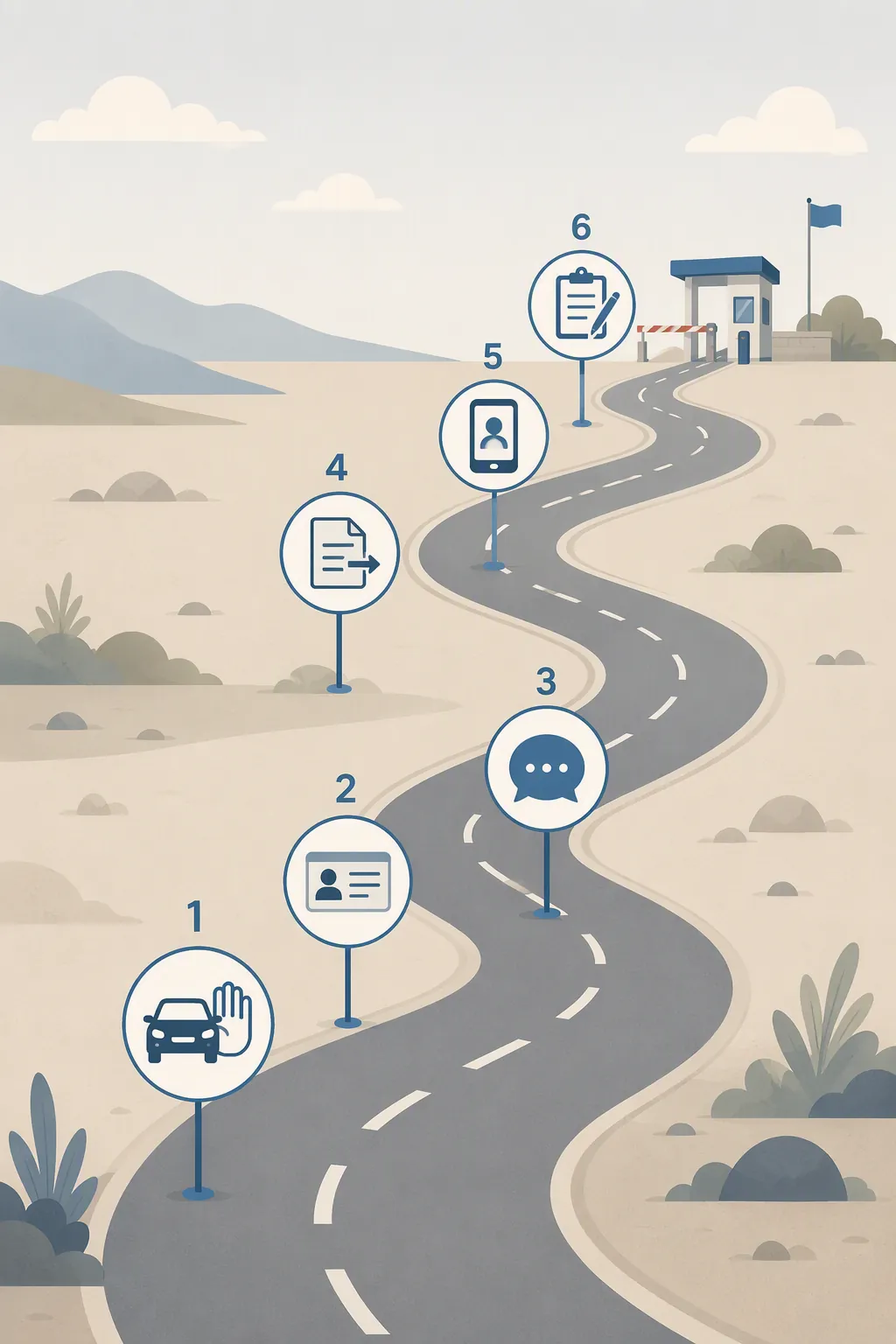
Canada first and U.S. first are not the same event
The same wrong turn can create different legal postures within minutes. A driver who reaches a Canadian port of entry by mistake is dealing with an application to enter Canada that may be withdrawn. A noncitizen who is treated by U.S. officers as having violated U.S. immigration law is in a detention-and-removal framework, not merely a navigation problem.
| First officers encountered | Immediate legal frame | What to request or say | What not to assume |
|---|---|---|---|
| CBSA at a Canadian port of entry | CBSA has said unintentional arrival does not itself make a traveler inadmissible or automatically justify enforcement action.[1] | Ask whether you may withdraw the application to enter Canada and leave voluntarily. | Do not assume withdrawal is guaranteed. Officer discretion, documents, warrants, prior immigration history, or admissibility issues can still matter. |
| CBP or other U.S. officers | CBP has stated that immigration-law violations can make people subject to detention and removal regardless of the traveler’s explanation.[2] | State the mistake, provide identity documents, ask to contact counsel if detention or removal is discussed, and avoid signing unclear paperwork. | Do not assume intent controls the outcome. U.S. improper-entry law can carry penalties when its elements are met.[3] |
| A mixed bridge or port sequence | The file may contain notes from both sides, lane cameras, booth records, and statements made before the traveler understood what was happening. | Keep the explanation consistent: wrong turn, no intent to enter, request to correct the crossing, request for counsel if detained. | Do not try to solve the problem by leaving the controlled area without permission. |
The Canadian-side statement is useful because it gives a correct phrase to use: withdrawal of the application to enter. It is not a magic word. It is a procedure to request when the traveler is actually before Canadian officers and the facts are consistent with an unintentional arrival.
The U.S. side is less forgiving because the question can shift from “Did you mean to cross?” to “Are you a noncitizen who entered, attempted to enter, eluded inspection, lacked documents, violated status, or had an existing order?” Section 1325 is one statutory anchor, but it is not the only risk. Detention, expedited processing, removal proceedings, or transfer to ICE custody can become the immediate consequence before any court has sorted out the driver’s intent.[3]
What status changes
A border officer does not evaluate every traveler from the same starting point. Status decides which questions become dangerous, which documents matter, and how quickly the problem may move from correction to custody.
| Traveler status | Typical documents to have ready | Main consequence risk after an accidental crossing | Practical record point |
|---|---|---|---|
| U.S. citizen | U.S. passport, passport card, enhanced driver’s license where accepted, or other proof of citizenship and identity. | A U.S. citizen is not removable from the United States as an alien, but can still be stopped, questioned, checked for warrants, or arrested for unrelated matters. CBP reported a 2017 Peace Bridge wrong-turn case in which a U.S. citizen was arrested on a Georgia probation-violation warrant.[5] | Do not treat citizenship as a reason to drive away from inspection. Establish identity and the wrong-turn facts. |
| Lawful permanent resident | Permanent resident card and passport if available. Immigration explainers commonly flag the green card as the key document for LPRs in this situation.[4] | Risk depends on identity confirmation, admissibility concerns, prior criminal or immigration history, and whether officers view the conduct as inspection-related noncompliance. | State permanent-resident status precisely. Do not describe yourself as a visitor or visa holder if you are an LPR. |
| Visa holder or other documented noncitizen | Passport, visa, I-94 record where applicable, employment or school documents if relevant, and proof of current itinerary. | Risk increases if the traveler lacks proper entry documents, has status issues, or is suspected of misrepresentation. Visa holders may still be detained while status is checked. | Keep the explanation tied to route error and intended destination. Avoid inventing a purpose of entry to fit the booth. |
| Undocumented traveler or person with prior removal process | Any identity documents, prior immigration papers, court notices, A-numbers, counsel contact information, and proof of pending cases if any. | Highest risk of detention, removal processing, or transfer to ICE custody. Immigration-law explanations consistently treat lack of lawful status as the most dangerous posture after a border mistake.[4] | Ask for counsel early. Do not sign voluntary return, withdrawal, stipulated removal, or other documents unless you understand the legal effect. |
The documents are not there to win an argument at the booth. They reduce ambiguity. A passport proves identity and citizenship. A green card changes the legal frame. An I-94 may show authorized admission or a status problem. A court notice may reveal that the person is already in proceedings. None of those facts becomes safer because the driver is embarrassed and tries to compress the story.
The counsel problem starts before formal detention feels formal
Bridge offices and port holding rooms are where the traveler is most likely to think the event is still informal. That is also where the first written version may be created. Reporting on wrong-turn detentions at the Detroit–Canada border described lawyers saying CBP bridge offices were treated as temporary holding areas where counsel access was denied; separate reporting described ACLU of Michigan and Michigan Immigrant Rights Center records requests concerning families allegedly held in windowless rooms.[2][6]
The useful move is not to debate constitutional doctrine through the booth window. It is to make the request cleanly and repeatably: “I want to speak with an immigration lawyer before I sign anything or answer questions beyond identity and the route mistake.” If officers continue questioning, the traveler should remember the questions, the answers, and whether the request was acknowledged or refused.
Counsel-facing teams should prepare employees for this gap before travel near border infrastructure. The person at the wheel may not have internet access, may not have their phone, and may not know whether they are in CBP custody, ICE custody, or a port holding process. A wallet card or phone note with counsel contact information, immigration status, emergency contact, and “do not sign without legal review” is more useful than a long policy memo no one can reach.
Failure modes from reported cases
The reported cases are not a statistical map of every wrong turn. They are warnings about specific failure modes: GPS routing, bridge geometry, undemarcated beaches, prior immigration process, and the false comfort of asking to turn back.
- GPS and a bridge lane can turn a shopping trip into custody. NPR reported that Sarahi, traveling with her two U.S.-citizen daughters, was routed by GPS toward a Windsor Costco via the Ambassador Bridge and was held for about five days after the wrong turn. Her case illustrates why the first request for counsel and the first route explanation matter, especially when children are waiting and the driver expects the problem to be quickly corrected.[2]
- Asking to turn back does not ensure a turnback. WBUR reported that Dmitrii Georgiev asked to return at a Vermont port of entry after coming from Stanstead, Quebec, and was held nearly three months across 10 ICE facilities. The failure mode is procedural: once U.S. officers treat the person as subject to immigration custody, the traveler’s request to reverse course may not control the file.[7]
- A pedestrian crossing can be treated as an immigration event even without a bridge or booth mistake. CBC reported that Cedella Roman was detained for two weeks in 2018 after accidentally crossing from British Columbia into the United States while jogging near the beach border by White Rock and Peace Arch.[8] CNN reported CBP’s position in that matter as emphasizing a person’s responsibility to maintain awareness of surroundings when crossing the border.[9]
- A wrong turn can end in removal when the traveler’s status and prior process collide. Global News reported that Ricardo Prada Vásquez made a wrong turn onto the Ambassador Bridge in January 2025 and was removed to El Salvador on March 15, 2025, after a removal order.[10]
- The Buffalo-area bridge pattern is not limited to one driver. Investigative Post reported that Shovgi Huseynov, a J-1 University at Buffalo researcher, made a wrong turn onto the Peace Bridge on January 7, 2026 and was detained in Batavia, and that there had been at least five other Buffalo-area wrong-turn detentions in the prior year.[11]
Those facts do not prove that every accidental crossing will end in detention. They prove something narrower and more useful: the traveler cannot count on obvious innocence, family circumstances, professional status, or a request to turn around to keep the event out of immigration machinery.
What to document before memory gets rewritten
Documentation should begin once it is safe and lawful to make notes. Do not record secretly where recording is prohibited. Do not resist if a phone is taken. The goal is to preserve a timeline for counsel, an employer, a consulate, or a later filing.
- Route facts: intended destination, GPS destination, missed exit or lane, bridge or port name, direction of travel, and whether signage or barriers made correction impossible.
- Time facts: when the wrong turn happened, when the traveler stopped, when officers first spoke, when documents were taken, when phone access was denied or allowed, and when custody status changed.
- Officer and agency facts: CBSA, CBP, ICE, local police, or another agency; officer names or badge numbers if visible; vehicle number; booth lane; holding-room location.
- Statement facts: the exact first explanation given, any request to withdraw entry into Canada, any request to turn back, any request for counsel, and any officer response.
- Paper facts: receipts, seizure forms, notices to appear, expedited-removal papers, voluntary-return or withdrawal forms, parole documents, bond papers, and any document the traveler was asked to sign.
- Family and employer facts: who was present, who was separated, children’s citizenship or custody needs if relevant, medical needs, work travel purpose, and emergency contacts notified.
For organizations sending employees near border crossings, the verification packet should be short enough to use under stress: ID checklist, immigration-status checklist, counsel phone number, emergency contact, and a one-page incident log. The worst packet is the one that explains doctrine beautifully and cannot be opened when the employee’s phone is in a property bag.
The practical limit
A correct first response can materially improve the record: it prevents apparent flight, preserves the accidental-route explanation, asks for the Canadian withdrawal mechanism when Canada is the first point of contact, and raises counsel before U.S. paperwork hardens. It cannot erase lack of status, prior orders, officer discretion, or the statutory consequences the United States may attach to improper entry.
The safest assumption is procedural, not emotional: the mistake is real, but the file will be built from documents, status, officer notes, and the first sentences spoken.
References
- Ontario border crossings, deportations — Global News
- Wrong turn onto bridge leads to detention ordeal — NPR, March 26, 2025
- 8 U.S. Code § 1325 - Improper entry by alien — Cornell Legal Information Institute
- What Happens If You Accidentally Cross The Border Into Canada? — Kingwell Immigration Law
- CBP Arrests Parole Violator After Wrong Turn to Canada at Peace Bridge — U.S. Customs and Border Protection
- Wrong turn leads to hundreds of immigrant arrests at the Detroit-Canada border bridge — WUFT, April 24, 2025
- Plymouth man detained by ICE after mistaken border crossing in Vermont — WBUR, January 20, 2026
- Jogger who accidentally crossed U.S. border from B.C. detained for 2 weeks — CBC
- Jogger detained for 2 weeks after accidentally crossing US border — CNN, June 23, 2018
- Ricardo Prada Vásquez deported to El Salvador after Ambassador Bridge wrong turn — Global News
- Wrong turn lands UB scientist in ICE detention — Investigative Post, January 14, 2026
Grounded in
This procedure is grounded in the cited rule or opinion, independent of any single documented case. See the Regulation tracker for the governing text.
Cases this step would have prevented
No cases have been explicitly linked to this checklist yet. See Risk Digest for documented incidents generally.
← Back to WorkflowsReport a correction or tip
Spotted an outdated figure, a misstated fact, or a ruling this workflow checklist should reflect? Public comments are disabled for this content given the professional cost of a misreported case outcome, penalty amount, or rule text — use the structured correction channel instead.
Report a correction or tip for this record →