
Legal Risks in AI Phone Monitoring of North Korean Defectors
South Korea's AI phone monitoring pilot for North Korean defectors raises compliance questions under the new AI Basic Act and PIPA. This checklist identifies the specific legal exposures and consent issues practitioners must evaluate.
- Applicable role
- attorney
- Workflow stage
- review
- Primary source
- AI Basic Act (South Korea, Jan 22, 2026)
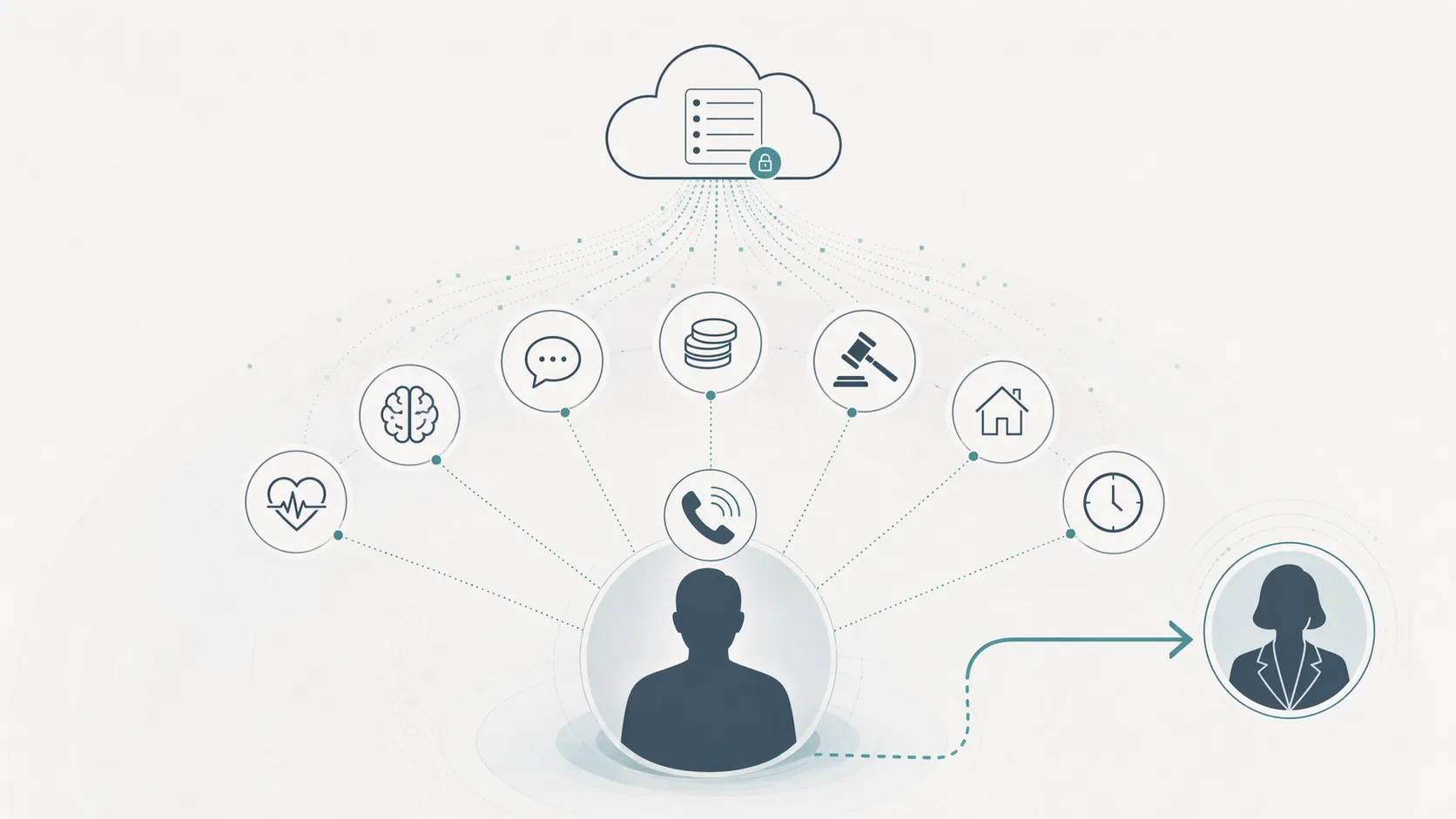
The legal problem in South Korea’s AI phone monitoring of North Korean defectors begins with the call record, not with the branding. The pilot launched on July 24, 2026, for roughly 200 defectors, using twice-weekly AI calls operated by AIWORKX with Testworks and backed by the Korea Hana Foundation and the Unification Ministry. The calls monitor seven areas: physical health, psychological state, social isolation, economic hardship, legal issues, family safety, and daily inconvenience. When the system detects risk signals, counselors are expected to follow up.[1]
That design creates a specific processing chain. A dependent beneficiary receives a call; the system asks about health, mental state, finances, legal trouble, family safety, and isolation; the service can remember prior conversations; and a risk signal can move the person from automated welfare contact into human review. The vendor description of an AI Care Phone service with a conversation-memory feature matters because memory turns each call from a transient welfare check into an accumulating profile.[2]
There is no public evidence, as of July 25, 2026, that the pilot has already caused harm, triggered an enforcement action, or been found unlawful. It launched only one day before that date. The risk assessment is therefore narrower: whether the announced data path appears to fall inside South Korea’s high-impact AI and privacy compliance regimes, and whether the public record shows the documents practitioners would expect before deployment.
The High-Impact AI Question Is the Center of the File
South Korea’s AI Basic Act took effect on January 22, 2026, and published commentary on the Act identifies high-impact AI obligations including risk management, human oversight, transparency, documentation, and notification duties for systems used in sensitive areas.[3][4] The exact sub-regulatory thresholds remain partly dependent on Presidential Decrees, so the classification cannot be treated as finally resolved from public materials alone. But the announced facts push the pilot toward the high-impact side of the ledger.
| Announced feature | Why it matters legally |
|---|---|
| Government-linked welfare deployment | The Korea Hana Foundation and Unification Ministry connection places the system in a public-benefit and settlement-support setting, not an ordinary consumer service. |
| Health and psychological monitoring | Physical and mental-health fields are sensitive-data categories and raise the compliance burden before any predictive or triage use is added. |
| Family safety and legal-issue questions | These fields can expose third parties, cross-border risk, protection concerns, and legal vulnerability. |
| Conversation memory | Remembered calls can create longitudinal profiles rather than isolated check-ins. |
| Counselor escalation | Automated risk signals can affect who receives human attention, follow-up, referral, or administrative scrutiny. |
The strongest classification argument is not that the system uses AI. It is that AI is being used by or for public welfare actors to process sensitive information and route people toward human intervention. Article 33 analysis should therefore start with the combined effect of the setting, the data fields, and the consequence of the system’s output. A welfare call that merely reminds a person of appointment times would present a different file. This pilot, as announced, asks about conditions that can trigger protection, counseling, legal, or social-service responses.
The unresolved Presidential Decree details still matter. Counsel should not overstate the point by declaring the classification legally settled before the implementing thresholds are public and applied. The practical position is stronger and more useful: if the operators did not treat the pilot as at least potentially high-impact before launch, they need a documented classification memo explaining why social welfare, health and psychological monitoring, and counselor escalation fall outside the Act’s high-impact framework.
What the Public Record Does Not Yet Show
For a pilot with this data path, the missing public artifacts are not cosmetic. A defensible file would normally include a pre-deployment AI impact or risk assessment, the high-impact classification analysis, a human oversight plan, training-data and model documentation, user notification language, escalation criteria, and a record of who can access remembered conversations. The public announcements describe the service function; they do not show the governance file.
That absence does not prove noncompliance. Agencies and vendors often keep operating documents off press pages. But for practitioners evaluating exposure, “not publicly shown” is still meaningful when the system is being tested on a population whose relationship with the state is already administrative, protective, and economically important.
Consent Cannot Be Read Like an App Permission
PIPA Article 23 treatment of sensitive information makes the consent question unavoidable. The pilot’s fields include health and psychological state, and the surrounding context can reveal vulnerability, settlement status, family exposure, economic hardship, and legal problems. Separate, explicit consent is the baseline question. The harder question is whether consent can be freely given when the caller is linked to the same public-support environment that controls settlement assistance.
North Korean defectors in South Korea receive structured government support under the North Korean Defectors Protection and Settlement Support Act framework, including settlement-support administration, employment-related support, housing-related support, and protection measures under the Enforcement Decree.[5] In that setting, a refusal mechanism has to be more than a button or a sentence in a notice. The person needs to know whether declining calls affects counseling, housing support, employment help, protection services, caseworker relations, or future risk classification.
A consent form that says participation is voluntary would not answer the operational question. The file needs to show what happens after refusal, who sees the refusal, whether refusal is logged as a risk factor, whether alternative human check-ins are available, and how withdrawal works after prior conversations have already been stored. Without those mechanics, consent may look formally clean while remaining practically compromised.
The Penalty Environment Is Changing
The February 2026 PIPA amendments raise the financial stakes. Published analysis describes amendments authorizing the Personal Information Protection Commission to impose fines of up to 10% of total revenue for severe or repeated violations, and assigning ultimate responsibility to the business owner or representative. The amendments are expected to take effect roughly six months after promulgation, around late Q3 2026.[6]
That timing matters. As of July 25, 2026, the enhanced penalty regime should not be written as if it has already matured into an enforcement case against this pilot. It should be treated as near-term exposure for operators and public partners who are deploying sensitive-data systems now and may still be operating them when the amended sanctions framework becomes enforceable.
For AIWORKX and Testworks, the immediate question is whether they are processors, controllers, joint controllers, or service providers under the actual contract and data-processing arrangement. For Korea Hana Foundation and the Unification Ministry, the question is whether public sponsorship, beneficiary selection, and counselor escalation make them decision-makers over purpose and means. The answer cannot be inferred from a press release. It belongs in the contract, data-processing register, delegation instruments, and incident-response plan.
Remembered Conversations Are the Most Sensitive Asset
The conversation-memory feature is useful if the goal is humane continuity. A counselor who already knows that a person recently reported isolation or financial stress may respond faster and ask better questions. That benefit is real enough to be taken seriously. It is also exactly why retention, access, and deletion rules matter.
A remembered call record may combine mental-health indicators, physical symptoms, debt or job instability, family location clues, legal problems, and domestic safety concerns. If the system stores transcripts, summaries, embeddings, risk labels, or call metadata, each layer needs its own retention rule. A deletion policy for audio alone would not be enough if derived summaries or risk signals remain searchable.
Counsel should ask for the access matrix before reading the privacy notice. Who at AIWORKX can view call content? What can Testworks access during operation, debugging, labeling, or model improvement? What can Korea Hana Foundation counselors see? Can the Unification Ministry access identifiable records? Are family-safety fields masked, segmented, or restricted? Are audit logs immutable enough to reconstruct access after a complaint or breach?
Civil society concerns about South Korea’s public-sector AI deployments make this more than an academic checklist. Reporting on Korean public-sector AI has already criticized opaque welfare and child-protection AI systems for insufficient transparency and impact assessment practices.[7] Korean civil society groups have also warned that AI governance can lag behind deployment when public institutions adopt systems before accountability mechanisms are visible.[8] Those concerns do not prove this pilot is defective. They do mean that a regulator, claimant, or court would not be looking at the issue on a blank institutional record.
Family-Safety Data Changes the Human Rights Analysis
The international human rights lens should be applied after the domestic compliance questions, not instead of them. ICCPR Article 17 protects against arbitrary or unlawful interference with privacy, family, home, or correspondence. In this pilot, the family-safety category is unusually sensitive because it can connect a person in South Korea to relatives, intermediaries, or communication patterns outside South Korea.
Public reporting has described North Korean authorities escalating the targeting of families of defectors, including through mobile surveillance and pressure on relatives.[9] Advocacy material on defectors in the AI age also emphasizes that exposed information can create danger along cross-border escape and support networks.[10] Those sources do not establish that this pilot will leak data. They establish why the harm model is not limited to embarrassment, spam, or ordinary identity fraud.
Human Rights Watch’s 2026 North Korea reporting describes a broader environment of severe repression and punishment for perceived disloyalty or unauthorized contact.[11] In that environment, a family-safety field in a South Korean welfare database is not merely a welfare note. If mishandled, it may help identify relatives or networks that cannot meaningfully consent, cannot correct the record, and cannot use South Korean remedies.
This is where a standard domestic privacy impact assessment can be too small. The assessment should ask whether any data element could reveal family names, locations, brokers, remittance routes, communication channels, or travel plans; whether that information is necessary for the welfare purpose; and whether safer alternatives exist. Amnesty International’s 2024 work on AI and new technology at borders warned that such technologies can deepen rights risks for migrants and people in movement contexts when deployed without adequate safeguards.[12] The defector pilot is not a border-screening system, but the warning is relevant to the vulnerability of people whose data can create consequences beyond the jurisdiction where it is collected.
What to Verify Before Calling the Pilot Defensible
The pilot may be defensible as welfare outreach. Twice-weekly calls could reach people who are isolated, ill, frightened, or unable to navigate ordinary casework channels. The legal exposure arises because the same design that makes the service useful also makes it sensitive: remembered conversations, health and psychological monitoring, family-safety questions, and AI-triggered escalation inside a government-linked settlement-support system.
- High-impact AI classification: obtain the Article 33 analysis, including any reliance on pending or draft Presidential Decree thresholds.
- Pre-deployment assessment: confirm whether an AI risk or impact assessment was completed before July 24, 2026, and whether it covers welfare dependency, family-safety data, and counselor escalation.
- Human oversight plan: identify who reviews AI risk signals, what discretion counselors have, and whether automated outputs can be challenged or corrected.
- Transparency and notification: confirm that recipients are told they are speaking with AI, what fields are collected, what memory means, and who receives escalations.
- Sensitive-data consent: separate health, psychological, family-safety, legal, and economic-hardship consent from general participation language.
- Refusal and withdrawal: document that declining or stopping calls does not reduce settlement support, protection services, counseling access, or administrative standing.
- Retention and access controls: map transcripts, summaries, embeddings, call metadata, risk labels, and counselor notes separately.
- Vendor responsibility: determine whether AIWORKX, Testworks, Korea Hana Foundation, and the Unification Ministry are controllers, processors, joint controllers, or public decision-makers for each processing purpose.
- Escalation documentation: preserve the criteria for risk detection, counselor action, referral, non-action, override, and error correction.
- Cross-border and family-safety safeguards: minimize collection of identifiable family details, restrict access, and test breach scenarios involving relatives outside South Korea.
The exposure is therefore documentary before it is dramatic. A public-benefit purpose does not lower the governance burden for AI phone monitoring of North Korean defectors; it raises it. As announced, the pilot likely falls within or near the high-impact AI line, processes sensitive personal information, and operates in a consent environment shaped by administrative dependence. Until the classification memo, impact assessment, consent protocol, retention schedule, access matrix, and escalation rules are visible or otherwise verifiable, the legal risk remains material.
References
- North Korean defectors begin receiving AI phone calls to monitor well-being, NK News
- AI Checks on the Well-being of North Korean Defectors… AI Works Pilots AI Care Phone Service, VentureSquare
- South Korea's New AI Framework Act: A Balancing Act Between Innovation and Regulation, Future of Privacy Forum
- South Korean law to regulate AI takes effect in world first, Courthouse News
- Enforcement Decree of the North Korean Defector Protection and Settlement Support Act
- South Korea Amends Privacy Law to Authorize Fines of Up to 10% of Total Revenue, Hunton Andrews Kurth
- South Korea Faces Human Rights Concerns Over Expanding Public Sector Use of AI, Babl.ai
- The risks of artificial intelligence and the response of Korean civil society, Association for Progressive Communications
- North Korea: Escalation in targeting of families of defectors, CIVICUS Monitor
- North Korean Defectors in the AI Age: The Modern Day Underground Railroad, Crossing Borders NK
- World Report 2026: North Korea | Human Rights Watch, Human Rights Watch
- Global: New technology and AI used at borders increases inequalities, Amnesty International, 2024
Grounded in
This procedure is grounded in AI Basic Act (South Korea, Jan 22, 2026), independent of any single documented case. See the Regulation tracker for the governing text.
Cases this step would have prevented
No cases have been explicitly linked to this checklist yet. See Risk Digest for documented incidents generally.
← Back to WorkflowsReport a correction or tip
Spotted an outdated figure, a misstated fact, or a ruling this workflow checklist should reflect? Public comments are disabled for this content given the professional cost of a misreported case outcome, penalty amount, or rule text — use the structured correction channel instead.
Report a correction or tip for this record →