
Can AI Legal Databases Confirm an Arrest Warrant?
There is no national public registry for active arrest warrants, and AI legal databases retrieve case law, not live warrant records. This workflow explains how to confirm a warrant by name and state through the issuing court or sheriff's office — and how to tell a verified record from an AI or paid-broker lead.
- Applicable role
- attorney, paralegal, law-firm intake staff
- Workflow stage
- pre-filing
Legal-background review: Mara Voss. Last verified: August 26, 2026, 15:00 UTC. This article is for verification and risk-control information, not legal advice. If a warrant may exist for you or a client, do not treat any search result as permission to ignore, confront, detain, accuse, pay, or walk into a law-enforcement office without understanding the practical consequences.
The short answer to “arrest warrant search by name and state AI legal databases” is no. An AI legal database cannot confirm an active arrest warrant, and neither can a generic national name-and-state search. At most, those tools can create a lead: a possible court, county, case number, or name match that still has to be checked against the issuing court or sheriff’s office.
That distinction matters because warrant status is not a law-review citation. It is an operational record. It may be entered, served, recalled, quashed, sealed from public view, delayed in a public portal, or maintained at the county level. A page that looks polished enough to sell you a “warrant found” result is not the same thing as a source with authority to maintain the warrant.
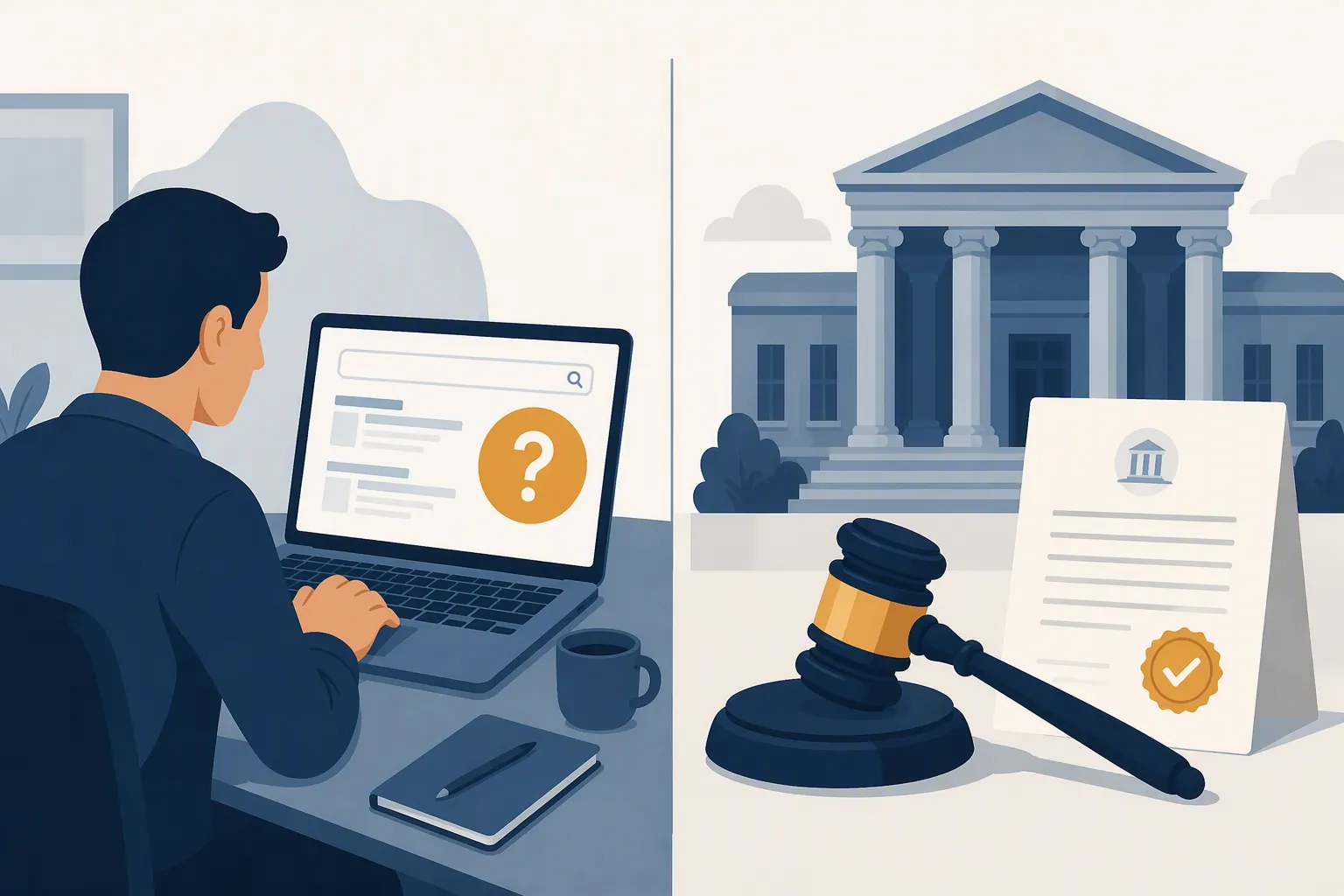
The official portals themselves do not support the paid-search promise
The strongest reason to distrust a national AI or broker-style warrant search is not that AI is fashionable or unreliable in the abstract. It is that official record systems warn users not to treat even government-facing portals as complete, real-time active-warrant databases.
| Official source | What the caveat means for a name-and-state search |
|---|---|
| Arizona Department of Public Safety warrant search | The site says the search is not updated in real time, warns that multiple people can share a name and date of birth, and says law enforcement should not detain or arrest someone based only on the website result. [1] |
| Washington Courts case-record search guidance | The Administrative Office of the Courts says Search Case Records does not provide active warrant information because of upload delay and directs warrant questions to the court where the case was filed. [2] |
| Utah Statewide Warrants Search | The site warns that accuracy depends on timely court entry and removal, which makes the portal a useful routing tool but not a reason to stop verification. [3] |
| Georgia official warrant guidance | Georgia tells users to search with first name, last name, and birth date; directs them to the county sheriff’s office; says no payment is required; and warns that some offices require an in-person appearance where a person with an active warrant may be taken into custody immediately. [4] |
Those caveats are not fine print. They are the verification rule. If an official statewide page says it is delayed, incomplete, county-dependent, or not an active-warrant source, a commercial result or AI answer sitting farther away from the record cannot cure that defect.
The federal layer does not create a public national answer either. PACER is a system for finding federal case records, not a public active-warrant registry. [5] The U.S. Marshals Service Warrant Information System tracks federal warrants, but that system is restricted to authorized users. [6] For public verification, the path still runs back to the court or law-enforcement office that can speak for the specific record.
A defensible warrant check starts with jurisdiction, not a database brand
A responsible warrant check by name and state does not begin with “which AI tool is best?” It begins with “which court or sheriff could have issued or maintained this record?” The state matters, but the county, municipality, court division, and case type often matter more.
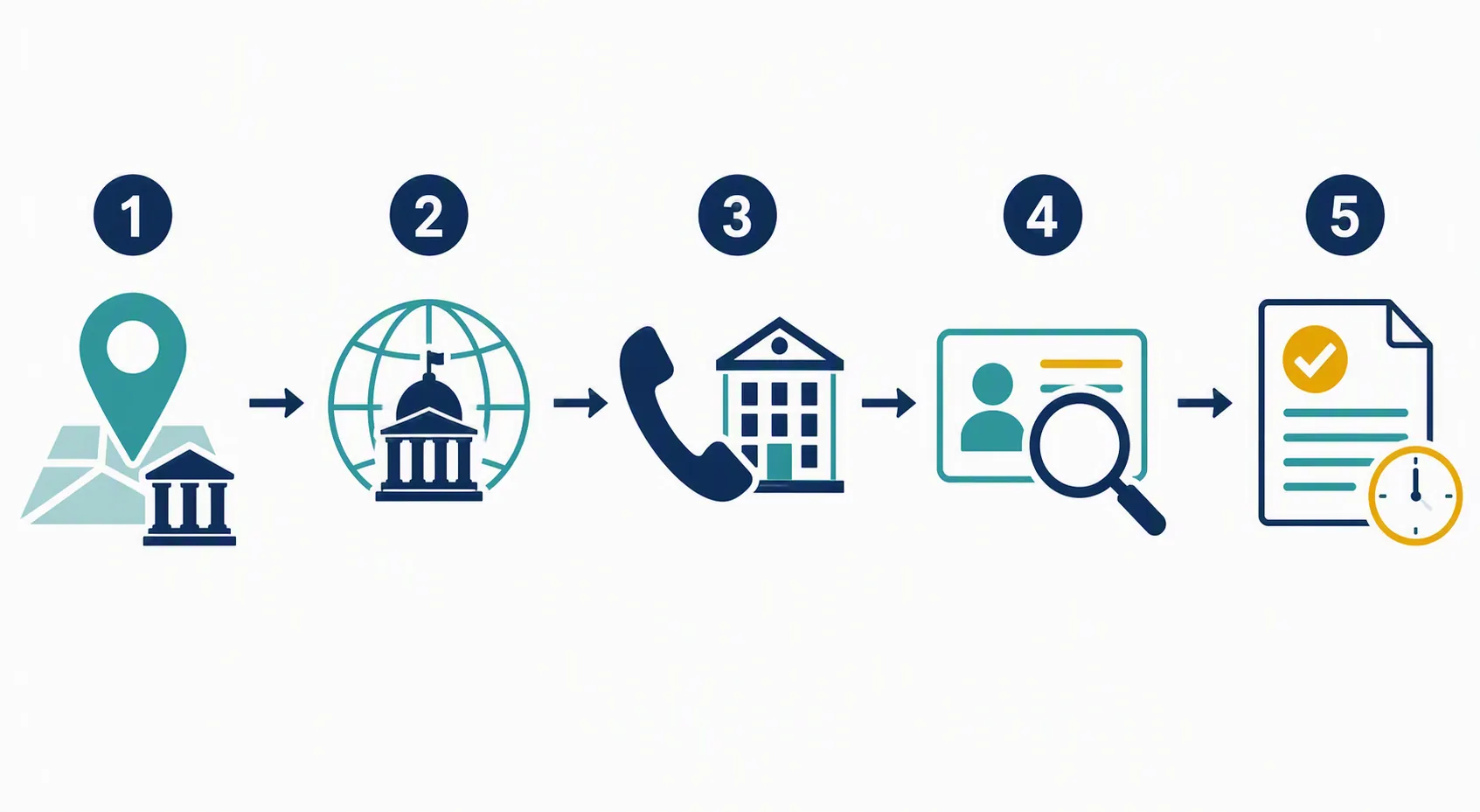
| Step | Action | Do not rely until |
|---|---|---|
| 1. Identify the likely jurisdiction | Use the person’s known residence, alleged incident location, ticket or case location, agency name, court notice, or broker/AI clue to narrow the possible county and court. | You can name a court, county sheriff, municipal court, or other issuing authority that could maintain the record. |
| 2. Check whether the state has an official portal | Use only official government pages when available, and read the caveat before searching. | You know whether the portal claims active-warrant coverage, delayed case-record coverage, county-level routing only, or no active-warrant information. |
| 3. Go to the issuing court or county sheriff | Search the official county/court site or contact the clerk, warrant division, or sheriff’s office using contact information obtained from the official website. | The response comes from the office that can maintain, recall, quash, or confirm the warrant record. |
| 4. Match more than a name | Compare first and last name, date of birth when lawfully available, case number, warrant number, issuing authority, alleged offense or case type, and status language. | The identifiers point to the same person and the same record, not merely a similar name. |
| 5. Record the source and time | Document the portal or office checked, the date and time, the person or unit contacted if applicable, and any caveat given. | The file can distinguish verified, unresolved, and lead-only results. |
The most dangerous shortcut is the bare name match. Names collide. Dates of birth can be missing, wrong, or unavailable. A broker result may merge records. A court portal may show a case without showing whether an associated warrant is still active. If the result will affect intake, representation, employment screening, safety planning, or a client instruction, a name alone is not enough to carry the conclusion.
For professional use, keep the conclusion narrow. “A search result suggests a possible warrant-related record in Maricopa County” is very different from “this person has an active arrest warrant.” The first sentence can be a lead. The second sentence needs a current, source-attributed confirmation from the issuing court or sheriff.
Calling an office is not the same thing as sending someone in
Some official paths are not risk-free. Georgia’s public guidance is unusually plain on this point: some sheriff’s offices require an in-person appearance to verify or resolve a warrant, and a person with an active warrant may be taken into custody immediately. [4] That does not mean verification should stop. It means the next step may require counsel, careful planning, and a distinction between contacting an office, confirming procedure, and physically appearing.
For a law-firm intake team, this is where scripts help. Staff can collect the source of the claim, the claimed jurisdiction, and the identifiers without advising the caller to appear, flee, pay, or contact an alleged officer from a suspicious notice. The verification task is to identify the real office and the real record status, then route the matter to someone authorized to advise.
Verified record, AI lead, or scam: keep the labels separate
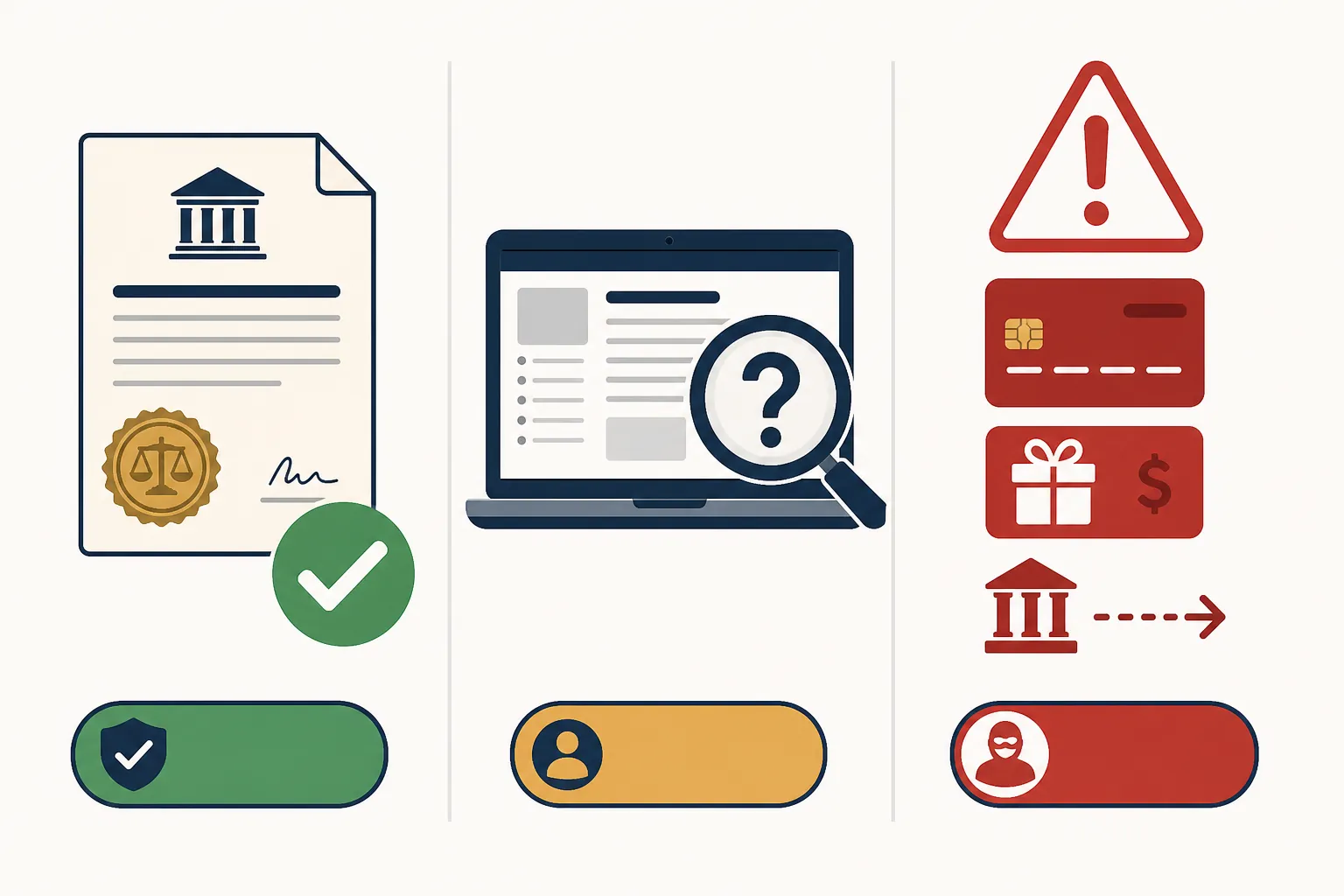
Three things often arrive in the same intake folder: a court-looking document, a paid-search result, and a frightened caller who was told to pay immediately. They should not be treated as the same category of information.
| Label | What it looks like | How to treat it |
|---|---|---|
| Verified record | A current response or official portal result from the issuing court or sheriff, matched to specific identifiers and accompanied by the source caveat. | Usable for a narrow statement of status, with the date, time, office, and identifiers preserved. |
| Lead | An AI answer, search-engine snippet, paid-broker result, old case docket, media mention, or state portal result that does not claim active-warrant status. | Use it only to route the next check. Do not accuse, detain, advise appearance, or make a final intake decision from it. |
| Scam signal | A demand to pay immediately by prepaid card, gift card, wire transfer, crypto, or payment app, especially with threats of arrest or a fake official document. | Do not pay through the demanded channel. Authenticate the document or claim with the clerk of court or official agency contact information obtained independently. [7][8] |
The U.S. Marshals Service has warned that scammers use fake arrest warrants and payment demands, and says the Marshals Service will never ask for prepaid cards. Its guidance tells recipients to authenticate any warrant document with the clerk of court. [7] The FTC’s broader scam guidance treats demands for gift cards, wire transfers, cryptocurrency, and payment apps as core warning signs. [8]
A real warrant problem and a fake-warrant scam can both create urgency. That is why the first move is not payment and not panic. It is source authentication: identify the claimed court, use an official website or independently obtained phone number, and ask what record, if any, the office can verify.
Where AI legal databases fit—and where they do not
Legal AI tools can be useful in the parts of this task that do not require live warrant status. They can help find a state court website, explain the difference between a bench warrant and an arrest warrant at a general level, draft a cautious intake checklist, or summarize a court’s public instructions. Those are routing and comprehension tasks.
They are not confirmation tasks. Legal research systems are built around legal materials such as cases, statutes, regulations, secondary sources, and litigation documents available to the platform. Active warrant status is maintained by courts and law-enforcement offices, often in systems that are not public, not statewide, not real-time, or not indexed by legal research platforms.
The AI reliability data reinforces that practical boundary. A Stanford RegLab/HAI preregistered evaluation reported that Lexis+ AI and Ask Practical Law AI hallucinated more than 17% of the time, while Westlaw AI-Assisted Research hallucinated more than 34% of the time on the benchmark queries. [9] The National Center for State Courts’ practitioner guide reduces the operational lesson to “Never trust, always verify,” with human review in the loop. [10] A 2026 AI Law Librarians synthesis reported that leading legal AI tools still hallucinate roughly 15% to 25% of responses, with particular sensitivity around state and local law, lower courts, multi-jurisdictional questions, and false-premise queries. [11]
Those figures are not a reason to ban AI from the workflow. They are a reason to put AI in the right chair. It may help you locate where to verify. It should not be allowed to answer the status question itself.
For tool-level reliability analysis, see the site’s AI legal research accuracy workflow and legal AI accuracy benchmarks guide. For a warrant check, the more immediate rule is simpler: the database is not the custodian of the warrant.
A practical script for documenting the check
A clean file note prevents a lead from hardening into a false fact. The note does not need to be elaborate, but it should preserve enough detail that another person can see exactly what was checked and what was not.
- Person searched: full name used, any known aliases, and date of birth or other identifier if lawfully available.
- Jurisdiction theory: why this county, court, or sheriff’s office was selected.
- Source checked: official portal URL, clerk’s office, warrant division, sheriff’s office, or other issuing authority.
- Caveat recorded: delayed data, no active-warrant coverage, county-only coverage, in-person requirement, or no public confirmation available.
- Identifiers matched: date of birth, case number, warrant number, issuing authority, status language, and timestamp where available.
- Outcome label: verified, unresolved, no public result found, or lead only.
- Next action owner: attorney review, client follow-up, court contact, sheriff contact, or no further action based on the limited purpose of the check.
“No result found” also needs careful wording. It may mean no active public record appeared in that portal at that time. It may not mean no warrant exists anywhere. The safest file language ties the conclusion to the source actually checked.
The final rule is the same for lawyers, paralegals, investigators, and non-lawyers trying to avoid a bad next step: an AI answer or paid-broker result can be a routing clue, but it cannot bear the sentence “this person has an active warrant.” Only the issuing court or sheriff’s office can support that statement, and only when the match is specific, current, and source-attributed.
References
- Warrant Search, Arizona Department of Public Safety.
- Find outstanding traffic tickets, arrest warrants, and criminal history, Washington Courts.
- Statewide Warrants Search, Utah.
- Search for Existing Warrant, Georgia.gov.
- Find a Case (PACER), United States Courts.
- Warrant Information System, U.S. Marshals Service.
- U.S. Marshals Warn of Scammers Using Fake Arrest Warrants and Payment by Prepaid Cards, U.S. Marshals Service, July 11, 2024.
- Scams, Federal Trade Commission.
- Hallucination-Free? Assessing the Reliability of Leading AI Legal Research Tools, Stanford Law School, 2025.
- Legal Practitioners' Guide to AI Hallucinations, National Center for State Courts.
- What the Science Says About Hallucinations in Legal Research, AI Law Librarians, February 19, 2026.
Grounded in
This procedure is grounded in the cited rule or opinion, independent of any single documented case. See the Regulation tracker for the governing text.
Cases this step would have prevented
No cases have been explicitly linked to this checklist yet. See Risk Digest for documented incidents generally.
← Back to WorkflowsReport a correction or tip
Spotted an outdated figure, a misstated fact, or a ruling this workflow checklist should reflect? Public comments are disabled for this content given the professional cost of a misreported case outcome, penalty amount, or rule text — use the structured correction channel instead.
Report a correction or tip for this record →