
Four Verification Gates for Bodycam Footage in OWI Cases
This workflow outlines four verification gates—chain of custody, metadata integrity, AI enhancement detection, and admissibility challenge—for defense counsel to authenticate bodycam footage of field sobriety tests in OWI cases, with supporting case law and procedural steps.
- Applicable role
- defense attorney
- Workflow stage
- review
- Primary source
- FRE 901/902
When the State previews field sobriety test bodycam footage in an OWI case, the first mistake is to argue over what the clip appears to show before identifying what the clip actually is. A recording, an exported file, a compressed courtroom exhibit, and an AI-enhanced version are not the same evidentiary object. The defense review should therefore start before interpretation: verify custody, audit metadata, detect enhancement, and then choose the admissibility challenge that the jurisdiction will recognize.
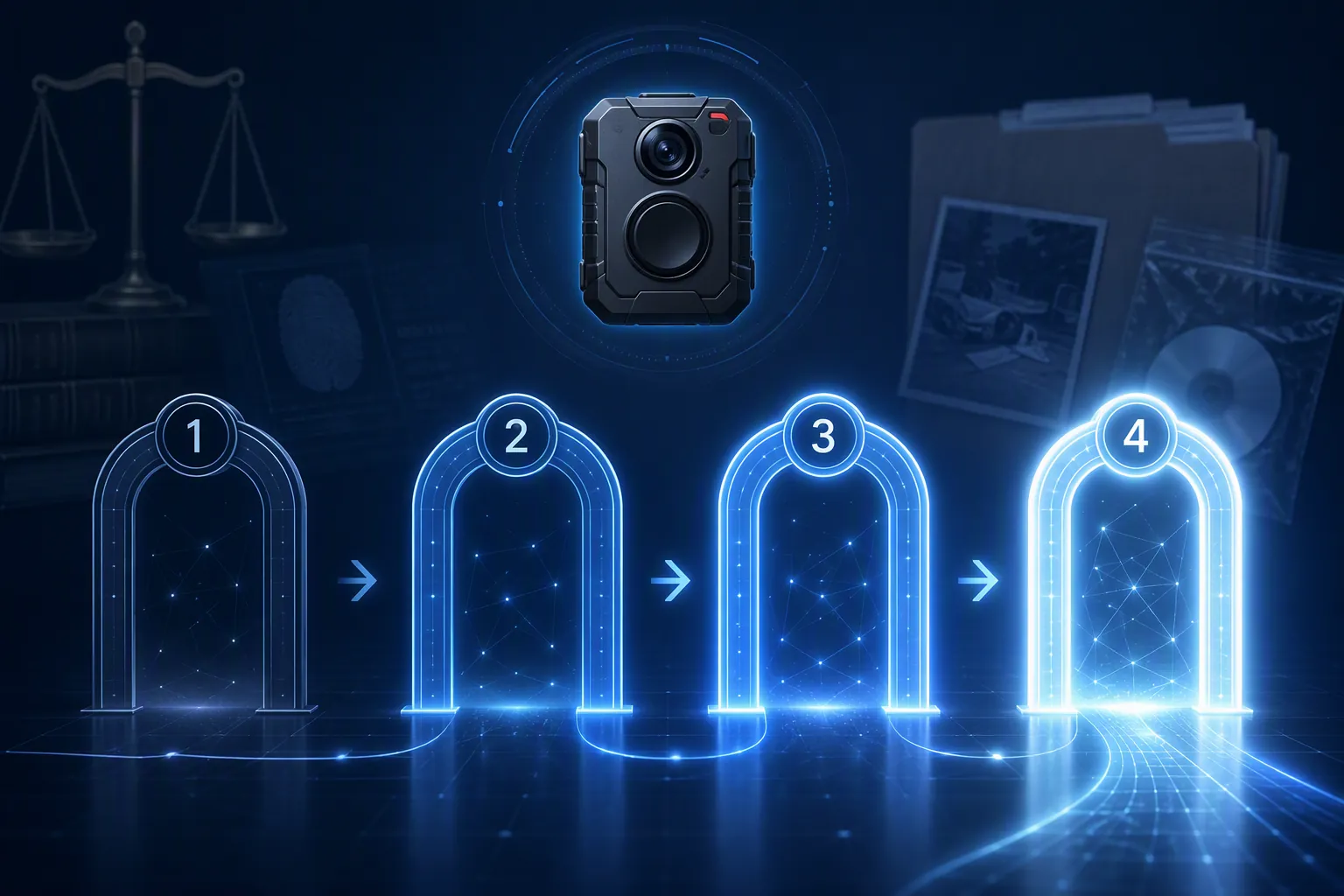
Those gates are sequential, but they are not equal. Chain-of-custody hashing is the baseline control. Metadata integrity and AI enhancement deserve heavier attention because they are where the defense most often loses the ability to reconstruct what happened to the evidence before trial pressure sets in. Jurisdiction matters at every gate: a Massachusetts wiretap ruling, a North Carolina access ruling, a Virginia authentication ruling, and a Washington trial-court AI-exclusion order do not create one national rule for OWI bodycam footage of field sobriety tests.
| Gate | What counsel is testing | Records to demand early | Likely litigation use |
|---|---|---|---|
| Chain of custody | Whether the file offered in court matches the file collected from the device or evidence platform | Ingestion record, SHA-256 hash, transfer logs, export logs, re-verification records | Foundation, authenticity, best-evidence objections, cross-examination |
| Metadata integrity | Whether capture, file, and system metadata survived agency processing | Native file, audit logs, retention policy, device assignment logs, export history | Discovery motions, preservation motions, suppression/exclusion record |
| AI enhancement detection | Whether pixels, frames, or apparent clarity were algorithmically generated or interpolated | Original file, enhanced file, tool name and version, settings, operator notes, expert report | Daubert/Frye challenge, Rule 403, best-evidence argument |
| Admissibility challenge | Which doctrinal hook fits the defect and the jurisdiction | Witness foundation, certification, agency policy, processing history, notice of recording | FRE 901/902 or state equivalent, confrontation, wiretap, illustrative or silent-witness theory |
Gate 1: Fix the Chain of Custody Before the Clip Becomes the Evidence
The chain-of-custody gate asks a narrow question: can the proponent show that the courtroom file is the same digital evidence collected from the body-worn camera system, or a verified derivative of it? Practitioner guidance on video evidence authentication describes SHA-256 hash logging at ingestion and re-verification at custody checkpoints as a core control, while warning that manual handling creates gaps counsel can exploit.[1]
For OWI bodycam footage, the useful demand is not just “produce the video.” It is the native file or the earliest available export, the ingestion hash, the transfer history inside the evidence platform, the export log for the prosecutor’s copy, and a fresh hash calculated on the exhibit the State intends to offer. If the agency cannot produce a hash from ingestion, the issue is not automatically exclusion. It is a foundation problem that should be made specific: who accessed the file, when it left the platform, what software touched it, and whether the version in court can be tied back to the original recording.
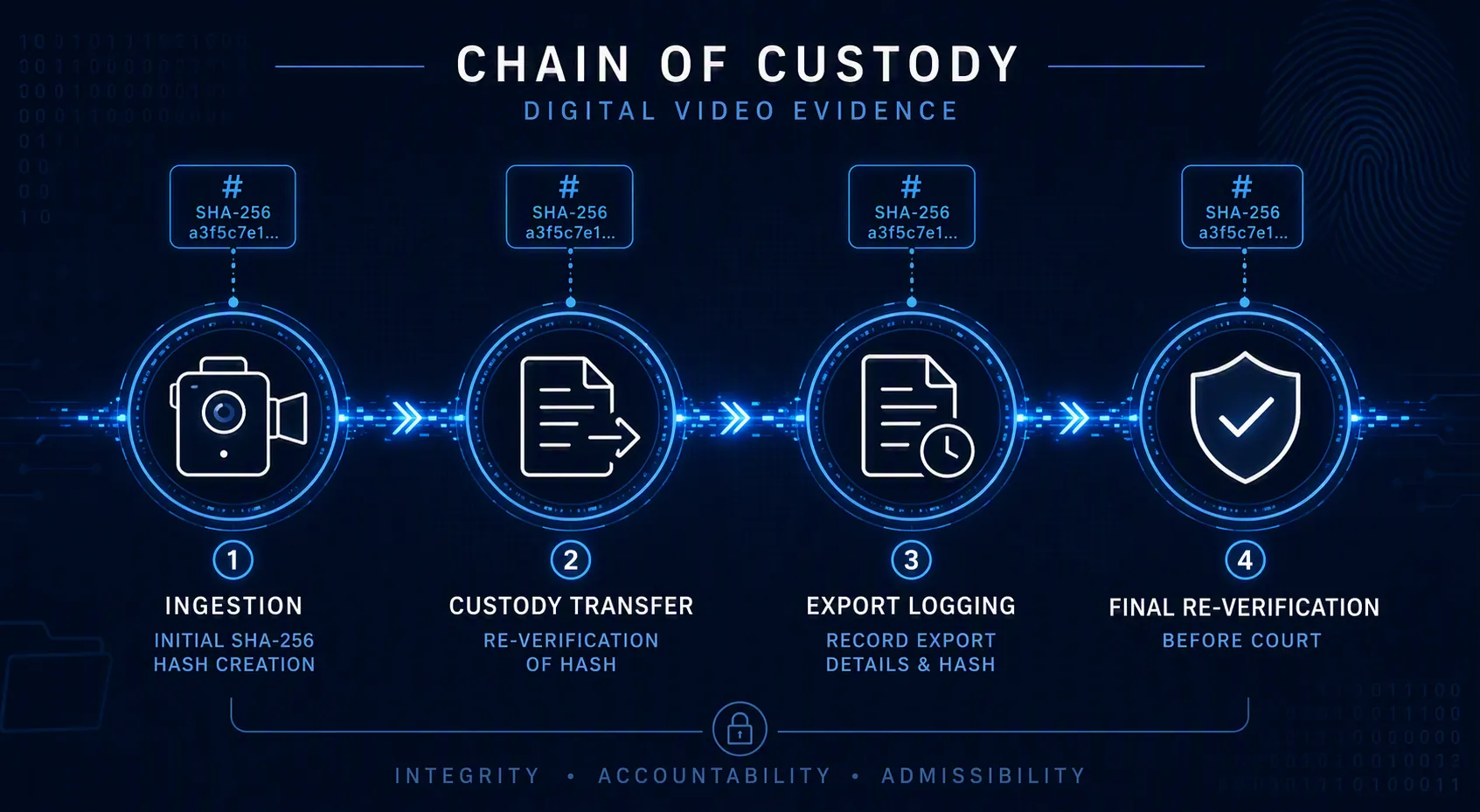
This gate should be run quickly and without drama. Chain of custody is the baseline that keeps the conversation from drifting into “everyone watched the same thing.” If a later metadata or AI issue emerges, the hash history helps identify whether the problem began at capture, upload, export, compression, or courtroom preparation.
Gate 2: Separate Capture Metadata From File Metadata and System Logs
Metadata disputes are often lost by asking too generally and too late. In bodycam evidence, “metadata” can mean at least three different things: capture metadata created by the device, file metadata created or changed when a file is exported or copied, and system audit logs maintained by the evidence platform. Those categories answer different questions. The timestamp displayed on a clip may not prove when the original file was captured. An export date may prove only when someone prepared a copy for litigation. An audit log may show access, redaction, sharing, or retention events that are invisible from the video itself.
The preservation letter should therefore identify the body-worn camera system, the officer, the approximate incident time, the device assignment record, the native or earliest available file, the platform audit trail, the export history, any redaction history, and the agency’s retention schedule. If the letter asks only for “the bodycam video,” the defense may receive a playable clip while the platform records that explain its history continue aging toward deletion.
State v. Chemuti shows why this is not merely a technical concern. In North Carolina, the state supreme court’s 2025 decision is described by practitioners as barring defendants from using Rule 45 subpoenas to compel bodycam video and requiring a petition under § 132-1.4A in superior court, with notice to the custodial agency and all persons depicted. The same account emphasizes the access problem this creates in district court, where statutory discovery is unavailable under N.C.G.S. § 15A-901.[2]
Chemuti matters beyond North Carolina because it illustrates the procedural trap: the defense may know exactly what metadata it needs and still lack the ordinary discovery vehicle to obtain it. In those jurisdictions, the verification process has to become a calendar problem. Preservation, petition practice, notice, and hearing dates are part of authentication strategy, not administrative chores.
- Request the native file or earliest system export, not only the prosecutor’s trial clip.
- Demand device assignment records tying the officer, camera, and incident time together.
- Demand platform audit logs showing access, export, redaction, sharing, and deletion events.
- Ask for the agency retention policy and any litigation hold applied to the incident.
- Preserve the distinction between capture time, upload time, export time, and courtroom exhibit creation time.
Gate 3: Treat AI Enhancement as a Separate Evidentiary Event
Ordinary playback is not enhancement. Compression is not necessarily enhancement. Brightness adjustment, slowing playback, stabilization, interpolation, and generative upscaling are not interchangeable. The litigation problem begins when a party presents an altered file as though it simply reveals what the camera recorded, even though the display now includes information supplied by software.
Puloka is the warning case. In the Washington trial-court proceeding described by Criminal Legal News, the prosecution’s own expert testified that Topaz Video AI increased the pixel count by roughly a factor of 16, meaning most displayed pixels were algorithmically generated rather than directly recorded. The court excluded the enhanced video under Frye because generative AI upscaling had not been accepted by the forensic video analysis community; as of July 2026, no appellate court had reversed that ruling, and no published decision had approved that type of enhancement at trial.[3]
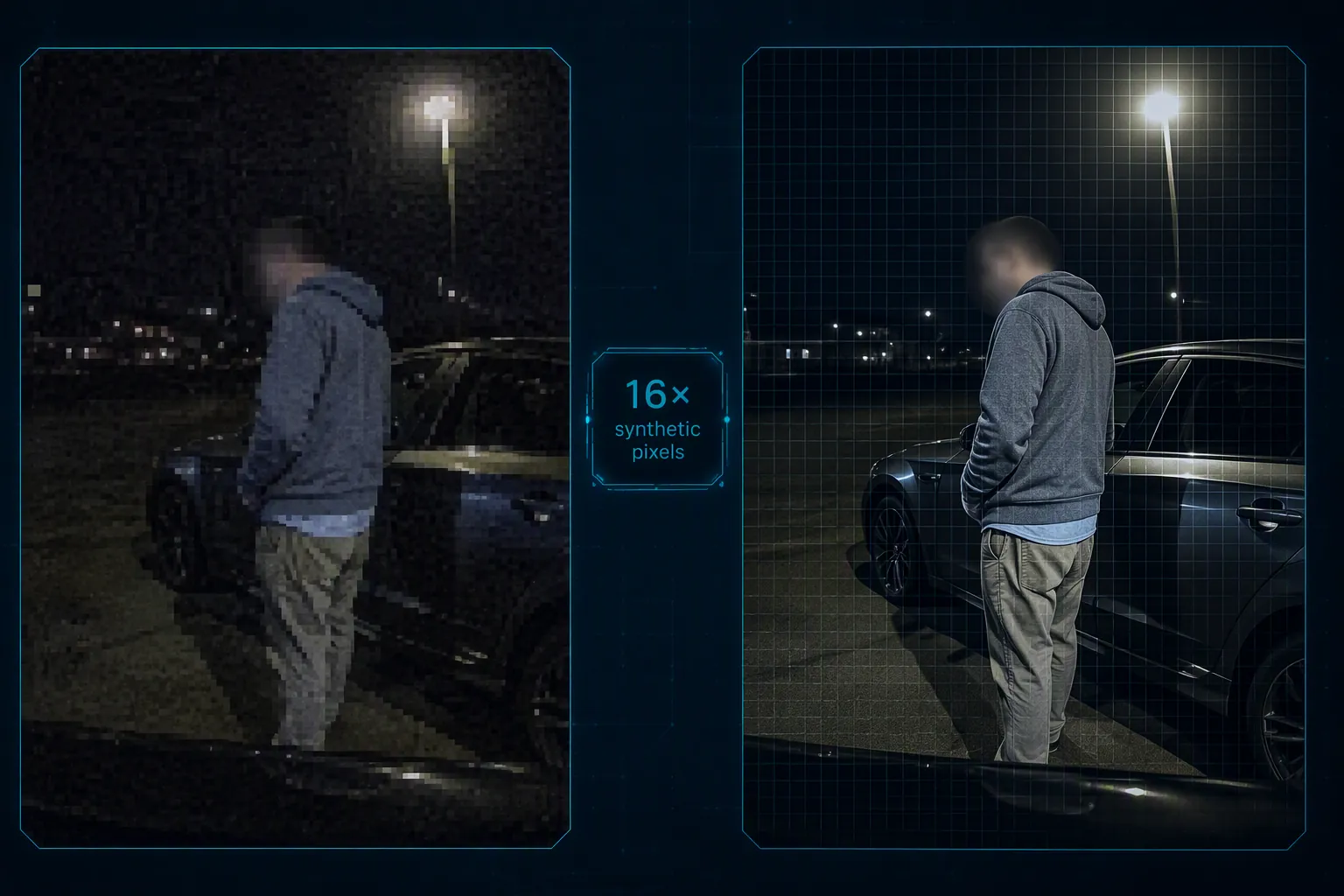
Puloka should not be overstated. It is trial-court, persuasive authority, not a national exclusion rule. Its value is more practical than precedential: it gives defense counsel a concrete way to explain why an AI-upscaled exhibit may be a reconstruction dressed as observation. In a field sobriety case, that distinction can matter when the disputed facts are small physical cues: foot placement, sway, eye movement, hand position, timing, or the officer’s demonstrations.
The forensic standards environment supports caution rather than blanket exclusion. SWGDE’s 2024 best-practices document for digital video authentication does not endorse generative AI upscaling for forensic use, and SWGDE warns that machine-learning-based interpolation can make it “challenging to identify what processes were applied to the imagery and replicate those steps with accuracy.”[4] SWGDE’s 2026 body-worn-camera considerations add BWC-specific guidance, reinforcing that these systems require attention to device, platform, policy, and processing context.[5]
The Department of Justice’s 2024 report on AI and criminal justice points in the same direction for forensic tools: AI-based tools should undergo demographic bias assessment and should document training data sources.[6] That recommendation does not by itself decide whether an enhanced OWI video is admissible. It does make a thin foundation look thinner when the proponent cannot identify the tool version, training-data disclosures, settings, validation studies, error behavior, or whether the enhancement has been tested on bodycam footage captured under roadside lighting conditions.
What to Ask When an Enhanced Clip Appears
- Identify every version: original recording, platform export, redacted copy, compressed copy, clarified clip, and enhanced exhibit.
- Demand the enhancement tool name, version, settings, operator, date of processing, and all intermediate files.
- Ask whether the tool interpolated frames, generated pixels, stabilized motion, sharpened edges, denoised, changed frame rate, or altered color.
- Require the proponent to state whether the enhanced exhibit is offered as substantive proof, demonstrative aid, or expert-assisted interpretation.
- Prepare separate objections under reliability, unfair prejudice, authentication, and best-evidence principles rather than relying on one global “AI” objection.
The best-evidence argument is promising but still developing. FRE 1001(e) treats a duplicate as a counterpart that accurately reproduces the original. An AI-upscaled video that adds synthetic pixels may not comfortably fit that definition. As of July 2026, however, the research materials do not identify a published ruling adopting that theory for AI-enhanced bodycam evidence. It should be preserved as an argument, not described as settled law.
Gate 4: Match the Objection to the Jurisdiction’s Admissibility Path
Once custody, metadata, and processing history are pinned down, the final gate is doctrinal. The defense has to decide whether the fight is about illegal recording, authentication, confrontation, expert reliability, unfair prejudice, or the best-evidence rule. Those arguments overlap in ordinary speech, but judges usually need a familiar hook.
Grimaldi is a caution against overbroad wiretap arguments. In June 2026, the Massachusetts Supreme Judicial Court reversed suppression of bodycam footage of field sobriety tests where cameras were openly worn, visible red recording lights were present, and a reflective checkpoint warning sign gave notice. Reports of the decision emphasize that the court rejected suppression under the Massachusetts wiretap statute on those facts.[7][8]
That does not make all OWI bodycam footage admissible in two-party-consent jurisdictions. Grimaldi’s force depends on visible recording indicators, notice, and the checkpoint context. If a case lacks comparable notice, or if state law treats roadside recording differently, counsel still has room to litigate. But after Grimaldi, a defense motion that treats every bodycam recording as covert simply because the defendant did not verbally consent will invite a narrow loss.
Baez points in the opposite direction on authentication. The Virginia Supreme Court’s December 2024 decision is reported as holding that bodycam footage is not inherently testimonial under the Confrontation Clause and may be authenticated by a witness present at the scene under either an illustrative theory or a silent-witness theory, even if that witness did not personally observe every detail captured on the video.[9]
For prosecutors, Baez lowers the practical burden: the authenticating witness does not always need to be the camera-wearing officer or a technician who can narrate every system function. For the defense, the answer is not to pretend Baez does not exist. The better move is to separate basic authentication from the stronger objections. A scene witness may be enough to say the clip fairly depicts the stop, while still being unable to establish that the offered exhibit is the original, that metadata is intact, that no redaction or enhancement changed the relevant portion, or that an AI-processed version is reliable enough for substantive use.
| If the record shows | Do not stop at | Build toward |
|---|---|---|
| No ingestion hash or incomplete transfer history | A generic authenticity objection | Specific foundation questions about access, export, and re-verification |
| Missing capture metadata or unavailable audit logs | A complaint that discovery was incomplete | Preservation record, discovery motion, or jurisdiction-specific access petition |
| Compressed or redacted file only | Argument about image quality alone | Demand for native file, export chain, and processing history |
| AI-upscaled or interpolated exhibit | A general objection to technology | Daubert/Frye challenge, Rule 403 objection, best-evidence argument, and expert cross |
| Open bodycam recording with visible notice | Broad wiretap theory | Fact-specific statutory argument, if local law and notice facts support it |
A Defensible Pretrial Record
A usable challenge to field sobriety bodycam footage is built in layers. First, identify the exact file the State will offer. Second, tie that file to the original recording through hashes, logs, and custody records. Third, obtain metadata and audit trails before retention rules or platform practices make them unavailable. Fourth, isolate any processing that changed the image, timing, frame rate, or apparent clarity. Only then should counsel decide whether the motion is really about authentication, access, wiretap notice, expert reliability, unfair prejudice, or best evidence.
This process does not promise exclusion. A clean original file with ordinary playback, intact custody records, and a competent witness may come in. A weak hash history may supply cross-examination rather than suppression. A metadata gap may support a discovery remedy rather than a trial bar. And Puloka, while important, remains persuasive trial-court authority unless and until appellate courts adopt or reject its reasoning.
The defensible posture is narrower and stronger: make the State prove which version it is offering, how that version was created, what metadata still exists, what processing occurred, and whether any enhanced image remains a recording or has become an AI-assisted reconstruction.
References
- Video Evidence Authentication: Legal Standards for 2026, digitalevidence.ai
- North Carolina Video Evidence: Chemuti, Carolina Attorneys
- When AI Invents the Pixels: Challenging AI-Enhanced Video Evidence in Criminal Cases, Criminal Legal News, Dec. 15, 2025
- SWGDE Best Practices for Digital Video Authentication 23-V-001-1.2, Scientific Working Group on Digital Evidence, Mar. 7, 2024
- SWGDE Considerations for Body Worn Camera Systems 23-V-002-1.0, Scientific Working Group on Digital Evidence, Feb. 25, 2026
- Final BWC Report, Bureau of Justice Assistance, Dec. 2024
- Mass. State Police win appeal after court reverses suppression of bodycam footage, Police1
- Massachusetts SJC body cam OUI wiretap ruling, Massachusetts Lawyers Weekly, June 11, 2026
- The Supreme Court Determines the Admissibility of an Officer’s Body-Worn Camera Footage, Blankingship & Keith
Grounded in
This procedure is grounded in FRE 901/902, independent of any single documented case. See the Regulation tracker for the governing text.
Cases this step would have prevented
No cases have been explicitly linked to this checklist yet. See Risk Digest for documented incidents generally.
← Back to WorkflowsReport a correction or tip
Spotted an outdated figure, a misstated fact, or a ruling this workflow checklist should reflect? Public comments are disabled for this content given the professional cost of a misreported case outcome, penalty amount, or rule text — use the structured correction channel instead.
Report a correction or tip for this record →