
Connecticut's AI Verification Rules Create Sanction Exposure for PI Lawyers
This article explains how Connecticut Practice Book §4-9's independent verification duty applies to personal injury workflows, what sanction exposure PI attorneys face from AI-generated filings, and how documented AI-hallucination cases in Connecticut state and federal courts set precedent for an emerging risk frontier in PI litigation.
- Applicable role
- attorney
- Workflow stage
- pre-filing
- Primary source
- Connecticut Practice Book §4-9
The risky moment is not when a lawyer opens an AI tool. It is later, when a sentence from that tool lands in a Superior Court filing and no one can say who checked the citation, who read the case, who compared the medical-record summary to the chart, or who confirmed that the quoted evidence exists.
Connecticut Practice Book §4-9 now makes that gap a filing-level problem. Effective June 23, 2026, the rule requires attorneys and self-represented parties in Connecticut Superior Court to independently verify AI-generated citations, legal authority, and evidence before filing. The sanction range is not cosmetic: the court may impose sanctions up to nonsuit or default judgment.[1]
This is not legal advice, and it is not a prediction that Connecticut personal-injury lawyers are about to be sanctioned in bulk. As of Q3 2026, the available Connecticut AI-sanction record does not include a reported personal-injury or auto-accident sanction ruling. The point is narrower and more immediate: PI firms already have several places where AI can enter the work, and Connecticut now has a rule that asks whether the lawyer can prove independent verification before that work reaches the docket.
Where the car-accident timeline question actually matters
Searchers asking how long a car accident lawsuit takes in Connecticut usually want a consumer answer: settlement negotiations, medical treatment, pleadings, discovery, mediation, trial scheduling. Public PI-firm materials commonly describe ordinary Connecticut car-accident matters in broad bands such as several months for a settlement-focused claim, longer for contested litigation, and still longer when discovery, experts, or trial calendars take over.[2][3][4]
Those ranges are useful only as a baseline here. They come from law-firm marketing content, not court-wide adjudicated data. But they show why §4-9 matters in a car-accident case: an AI-verification failure does not merely embarrass counsel. It can interrupt mediation preparation, force a show-cause cycle, require corrected filings, invite fee shifting, narrow pleadings, or, in the outer sanction range, end the plaintiff’s claim before anyone reaches the merits.
The new Connecticut duty is broader than a fake-case rule
A narrow office policy that says “check AI case citations” is not enough for §4-9. The rule reaches AI-generated citations, legal authority, and evidence in Superior Court filings.[1] For a PI practice, that language reaches farther than appellate-style legal research. It reaches the factual spine of the case.
| PI workflow point | AI output that may enter the file | Verification duty before filing |
|---|---|---|
| Medical-record review | Chronology, treatment summary, causation language, permanency references | Compare each material statement to the source record, date, provider, and page before using it in a pleading, motion, exhibit summary, or mediation-facing court submission |
| Demand-letter drafting | Liability narrative, injury description, damages summary, treatment totals | Verify any factual statement later repurposed for a complaint, affidavit, motion, or evidentiary filing |
| Case valuation support | Comparable-case discussion, claimed damages categories, settlement positioning | Confirm any cited authority, verdict reference, or evidentiary assertion before it appears in a filed memorandum or court submission |
| Pleadings | Allegations about collision mechanics, injuries, defendants, agency, notice, or damages | Check that AI-assisted allegations are supported by client intake, police materials, medical records, insurance documents, or other admissible sources |
| Motions and objections | Case citations, standards of review, quotations, procedural history, evidentiary arguments | Read the authority, verify quotations, Shepardize or KeyCite as appropriate, and confirm that the proposition actually supports the argument |
| Exhibit and evidence summaries | Descriptions of records, photographs, bills, expert materials, or deposition testimony | Match the summary to the actual exhibit and remove any inference the source does not support |
The uncomfortable part is that the first two rows are where PI lawyers may feel safest. Medical chronology and demand-letter work are often treated as pre-litigation drafting, not court-facing advocacy. But summaries travel. A paragraph written for an insurer can become the basis for an offer-of-compromise discussion, a mediation statement, a motion to preclude, or an affidavit. Once that AI-assisted factual account crosses into a Superior Court filing, §4-9 asks whether it was independently verified.
What independent verification should mean in a PI file
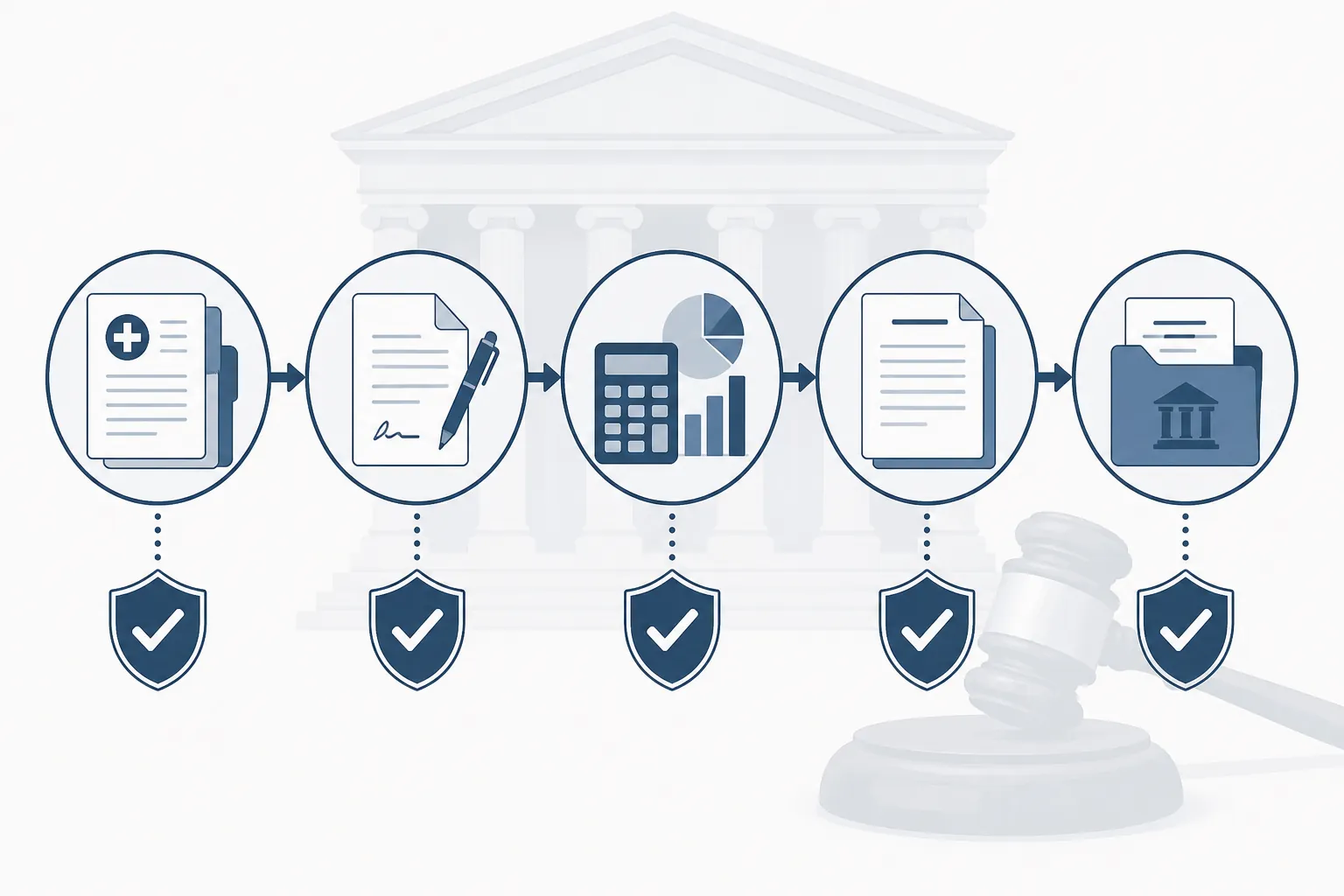
Independent verification has to be more than a partner asking whether the associate “ran it through Westlaw.” In a PI file, the verification record should identify the source checked, the person who checked it, and the filed proposition that depended on it. That is not bureaucracy for its own sake. It is the difference between correcting a draft and reconstructing a defense after the court has issued an order to show cause.
- For legal authority: read the case or rule, confirm the citation, confirm the quoted language, and confirm that the case has not been reversed, superseded, or mischaracterized.
- For medical facts: tie each material injury, treatment date, diagnosis, impairment statement, and billing reference to a record location.
- For evidence summaries: compare the AI-generated description against the exhibit actually being filed, not against another summary.
- For damages narratives: separate verified medical charges, client-reported symptoms, expert opinions, and attorney argument.
- For delegated review: record whether the associate, paralegal, nurse consultant, or lawyer of record performed the check, and preserve that note in the file.
That last point is where many AI policies fail. A shared-drive memo may say that lawyers must verify AI output. It usually does not tell the trial lawyer, two days before a motion deadline, where in the file the verification note belongs or whether the medical-record summary was checked after the last supplement arrived. §4-9 turns that missing habit into sanction exposure.
Medical summaries need page-level discipline
Medical-record AI can be genuinely useful. In a serious crash case, counsel may be dealing with ambulance records, emergency-department notes, imaging, orthopedic follow-up, physical therapy, pain management, prior treatment, billing ledgers, and expert review. A tool that organizes that material can help a lawyer prepare for mediation without losing a week to clerical sorting.
The filing risk appears when the summary becomes a representation. If an AI-generated chronology says the plaintiff first reported radiating pain on a certain visit, counsel needs to know whether that is in the provider’s note, in the intake form, in a later narrative report, or nowhere at all. If the summary turns “rule out fracture” into “fracture,” or treats a preexisting complaint as crash-related without support, the problem is no longer technological. It is evidentiary.
Demand letters are not immune just because they are not pleadings
A demand package may never be filed. But PI lawyers routinely reuse its narrative. The liability section becomes a complaint paragraph. The treatment summary becomes a mediation statement. The damages theory becomes a memorandum supporting a discovery dispute. If AI helped draft the demand, the safer practice is to verify reusable assertions when the demand is built, not when the motion is due.
Case valuation tools should not become authority
Vendor materials and PI commentary describe AI use in personal-injury practice for tasks such as document review, demand generation, intake support, and case analysis.[5][6] That adoption pressure is real enough. It does not mean a valuation output is admissible, that a comparable case exists, or that a damages theory can be filed without source review.
The distinction matters because valuation work is often persuasive rather than formal. A lawyer may not think of it as legal research. But if a filing cites a verdict, settlement, medical study, life-care number, or legal proposition that originated in an AI-assisted valuation workflow, §4-9 still points back to independent verification before filing.
Connecticut already has warning cases, even if PI is not one of them
The Connecticut record should be read carefully. It does not support the claim that auto-accident lawyers are already being sanctioned for AI filings. It does support a more useful conclusion: Connecticut state and federal courts have already seen enough AI-generated legal error to develop a visible enforcement posture before the first reported PI sanction appears.
In Cojom v. Roblen, LLC, the District of Connecticut imposed a $500 Rule 11 sanction after AI-hallucinated cases generated through Descrybe.AI appeared in federal litigation.[7] The amount was modest. The signal was not. A Connecticut federal judge treated the filing problem as sanctionable, not as a harmless drafting mishap.
Braica v. Frankowski matters less for its procedural posture than for its vocabulary. The court struck pleadings, admonished the filer, threatened dismissal with prejudice, and used a three-category hallucination taxonomy later relied on by other courts.[8] For PI lawyers, the taxonomy point is practical: AI errors are not limited to wholly invented cases. They can include real cases used for false propositions or language that does not appear where the brief says it appears.
Jesse Andre v. Warden, FCI Danbury added another federal signal: a 22-page Rule 11 analysis involving ghostwriting and AI issues, including reasoning that looked to archived web material through the Wayback Machine.[9] Davila v. Roblen, LLC then showed a different species of error: fake quotations attached to real cases, resulting in a CLE-order sanction.[10] That is the sort of error a tired reviewer can miss because the citation itself looks ordinary.
The state-court warning arrived in Hussain v. Quraishi, where a Connecticut Superior Court show-cause order required detailed AI-use disclosure by counsel.[11] A show-cause order is not the same thing as a monetary sanction, but it is still a litigation event. Someone has to answer it. Someone has to explain the workflow. Someone has to account for the filing that put the issue before the court.
The GLG Law matter brought the issue to the Connecticut Supreme Court in a landlord-tenant appeal involving AI-generated case citations. Reporting in March 2026 described the hallucination issue reaching the high court, and June 2026 reporting described the court seeking answers as it considered potential sanctions against the firm.[12][13] The matter is important here because the show-cause pressure helped catalyze Practice Book §4-9; it is not a PI case, but it is part of the rule’s immediate Connecticut backdrop.
The Legal AI Governance tracker identifies at least 10 Connecticut state and federal AI-hallucination sanction or show-cause matters as of Q3 2026.[14] That count should not be inflated into something it is not. Some matters involve self-represented litigants. Some are show-cause orders rather than monetary sanctions. Some arise outside the civil PI world. Still, for a filing lawyer, the pattern is enough to end the argument that Connecticut courts are waiting for a perfect test case before reacting.
Federal court is already less forgiving than many office policies
A Connecticut PI practice that files only in Superior Court still has to care about the federal posture, because cases move. Removal, diversity disputes, federal defendants, civil-rights overlays, Medicare or ERISA-adjacent fights, and related proceedings can pull an injury file into federal court or federal-court habits. The District of Connecticut’s AI approach has been described as a no-tolerance policy for AI-generated filings in federal litigation.[15]
That federal posture and §4-9 now point in the same operational direction: the lawyer whose name is on the filing cannot outsource accuracy to a model, a vendor, a paralegal, or an associate without maintaining a verification process that can be explained after the fact. The Connecticut Appellate Rule 85-2 development also aligns with that broader court-system movement, according to Connecticut AI-governance tracking materials.[14]
The sanction consequence in a PI case is different
A commercial case can absorb some procedural punishment as a cost event. A personal-injury plaintiff often cannot. The plaintiff may be waiting on treatment reimbursement, wage-loss recovery, replacement transportation, housing stability, or simply the end of a litigation process that already moves more slowly than the injury did.
That is why the sanction range in §4-9 deserves more attention than abstract discussions of hallucination risk. Nonsuit or default judgment is a case-ending possibility.[1] In a plaintiff-side car-accident case, nonsuit can convert a verification failure into a lost claim pathway. In a defense-side filing, default judgment can create the mirror-image catastrophe. Either way, the sanction does not wait for the underlying negligence facts to become weak.
A sanction detour can also add delay. Available materials support a practical estimate of 3 to 6 months of added litigation time for sanction proceedings, depending on briefing, hearing, correction, and court response. That estimate should be treated as a workflow-risk range, not as a Connecticut court statistic. In a case already headed toward mediation or expert disclosure, three months can be the difference between a live negotiation and a calendar reset.
The limitations issue is sharp but unresolved
Connecticut’s personal-injury limitations statute, CGS §52-584, is the background pressure in any auto case. The current AI-sanction materials do not establish whether a §4-9 sanction detour affects tolling, saving statutes, refiling rights, or claim preservation after dismissal. That question remains unlitigated in the reported Connecticut AI materials available as of Q3 2026.
The safe conclusion is therefore cautious: dismissal or sanction proceedings may create serious claim-preservation consequences, especially if the case is already close to a limitations edge or if refiling depends on a separate procedural doctrine. No PI firm should tell itself that the merits will rescue the file from a verification failure.
A filing-control checklist for PI lawyers
The useful policy is the one that works at 4:30 p.m. before filing. It should sit close to the motion, not in a training deck.
- Identify whether generative AI touched the filing, including summaries, citations, quotations, factual chronology, exhibit descriptions, and damages language.
- Separate legal propositions from factual propositions, because each requires a different verification source.
- For every cited authority, confirm the citation, holding, quoted language, procedural status, and current validity through a reliable legal research source.
- For every medical or evidentiary assertion, record the source document, date, provider or witness, and page or exhibit location.
- Require the reviewing lawyer to sign off on the verification record before filing, even if a paralegal or associate performed the first pass.
- Preserve the verification note in the case file with the filed version, not only with an earlier draft.
- If an AI-originated error is discovered after filing, correct it promptly and document the discovery, scope review, client impact, and notice strategy.
This checklist is deliberately unglamorous. It does not evaluate which AI product is best, and it does not assume that all AI-assisted work is suspect. It treats AI like any other source of filing risk: useful only if the lawyer can prove the filed statement was checked against something real.
The absence of a PI sanction case is not a safe harbor
Connecticut personal-injury lawyers do not yet have a reported auto-accident AI-sanction ruling to study. That absence should keep the analysis honest. It should not make the risk feel remote.
Practice Book §4-9 changes AI use from an efficiency choice into a documented filing-control problem. The rule does not ask whether the tool was popular, whether the deadline was tight, or whether the hallucinated case looked plausible. It asks whether AI-generated citations, legal authority, and evidence were independently verified before they were filed, and it gives the court sanctions up to nonsuit or default judgment when they were not.[1]
In a PI case, the worst AI error is not professional embarrassment over a fake citation. It is a sanction path that delays, narrows, or ends a meritorious injury claim because the lawyer could not prove the verification that should have happened before filing.
References
- Connecticut Judicial Branch News Log, Connecticut Judicial Branch, link
- How Long Does a Car Accident Settlement Take?, Ganim Legal, link
- How Long Do CT Car Accident Claims Take?, Brown Paindiris & Scott, link
- What Is the Timeline for Personal Injury Cases in Connecticut?, Jacobs & Jacobs, link
- AI in Personal Injury Law, EvenUp Law, link
- How Artificial Intelligence Is Changing Personal Injury Cases, Rittgers Rittgers & Nakajima, April 2026, link
- Cojom v. Roblen, Legal AI Governance, link
- Braica v. Frankowski, Legal AI Governance, link
- Andre v. Warden, Legal AI Governance, link
- Davila v. Roblen, Legal AI Governance, link
- Hussain v. Quraishi, Legal AI Governance, link
- AI hallucinations case lands in hands of CT high court, Hartford Courant, March 2026, link
- CT court wants answers as it looks at potential legal sanctions against firm, Hartford Courant, June 2026, link
- Connecticut AI Ethics Guidance for Law Firms, Legal AI Governance, link
- Navigating the New Frontier: How Federal Courts Are Regulating Generative AI in Litigation, Husch Blackwell, link
Grounded in
This procedure is grounded in Connecticut Practice Book §4-9, independent of any single documented case. See the Regulation tracker for the governing text.
Cases this step would have prevented
No cases have been explicitly linked to this checklist yet. See Risk Digest for documented incidents generally.
← Back to WorkflowsReport a correction or tip
Spotted an outdated figure, a misstated fact, or a ruling this workflow checklist should reflect? Public comments are disabled for this content given the professional cost of a misreported case outcome, penalty amount, or rule text — use the structured correction channel instead.
Report a correction or tip for this record →