
How Law Firms Verify a DeepSeek V4 Flash Local Setup
Local hosting keeps client data on firm-owned hardware, but it does not reduce the citation-verification burden courts enforce. For law firms weighing a DeepSeek V4 Flash local deployment, a defensible rollout needs a defined control list: the ethics duties local hosting satisfies, the accuracy duties it does not, and the pre-filing verification pass that still has to run.
- Applicable role
- attorney
- Workflow stage
- pre-filing
- Primary source
- ABA Model Rule 1.6
For law firms, the practical question is not whether a DeepSeek V4 Flash local setup is technically attractive. It is. The question is what the firm must be able to prove before lawyers put client material into it, and again before any AI-assisted legal citation reaches a court filing.
The procurement appeal is easy to see: DeepSeek-V4-Flash is published as an MIT-licensed, open-weight model with 284 billion total parameters, 13 billion active parameters, 64 experts per layer, a 1 million-token context window, and mixed FP4/FP8 precision, with release materials dated April 24, 2026.[1][2] Those facts matter because they make local deployment plausible for firms that do not want client data routed through a hosted API. They do not make a draft brief fileable.

The rollout decision starts with a control list, not an install guide
A law-firm risk review should separate the local-hosting benefit from the filing-risk question at the first meeting. Local hosting can reduce third-party data exposure. It cannot certify that a case exists, that a quotation is accurate, or that a cited statute is current.
| Control point | What the local setup can satisfy | What still needs a separate control |
|---|---|---|
| Client-data location | Model weights and prompts can run on firm-owned or firm-controlled hardware, reducing hosted-vendor processing concerns. | The firm still needs access controls, logging, retention limits, and matter-level use rules before client data enters the system. |
| Confidentiality review | A local deployment can support the Rule 1.6 confidentiality analysis by keeping client information inside the firm environment.[3] | Confidentiality approval does not approve legal accuracy, citation reliability, or courtroom use. |
| Model identification | The firm can freeze a specific model artifact, precision setting, inference configuration, and deployment path. | The firm must document exactly which version was used; do not let an informal “GA” or “preview” label substitute for a deployment record. |
| Legal research quality | The model can assist with drafting, summarizing, issue spotting, and internal work product when supervised. | A local open-weight run does not include the citator, updating, negative-treatment checking, or authoritative retrieval layer of a legal research platform. |
| Filing readiness | The model may produce language that becomes the starting point for a filing. | Every cited authority, quotation, pincite, procedural statement, and characterization must be checked against authoritative legal sources before filing. |
Version labels are part of the risk record
DeepSeek and Hugging Face materials support a precise statement about the April 24, 2026 DeepSeek-V4-Flash release and its published architecture and license characteristics.[1][2] The official DeepSeek API materials also use “Preview” language for V4.[2] That matters for a law-firm file because a risk committee should not approve “DeepSeek V4 Flash” as a loose product name. It should approve a documented artifact.
The deployment memo should record the model source, checksum or equivalent integrity control, quantization or precision setting, inference server, system prompt, retrieval configuration if any, logging rules, and the date the firm approved that configuration. If the IT team later swaps in a different checkpoint, changes precision, enables a reasoning mode, or adds retrieval, that is not housekeeping. It is a new controlled configuration.
This is not paperwork for its own sake. DeepSeek’s own published materials describe a mixed FP4/FP8 precision approach, and the firm’s local run may involve additional serving choices.[1][2] In a legal workflow, those choices belong in the audit trail because model behavior is not assessed in the abstract; it is assessed as deployed.
What local hosting actually answers under the confidentiality duty
ABA Model Rule 1.6 frames the lawyer’s duty to protect information relating to the representation of a client, including the obligation to make reasonable efforts to prevent unauthorized disclosure or access.[3] A local DeepSeek V4 Flash deployment can be a serious answer to one recurring AI objection: client material need not be sent to a hosted model provider for processing.
That is a real advantage. For many firms, the most uncomfortable part of a hosted generative-AI workflow is not the text generation itself; it is the movement of privileged, confidential, or commercially sensitive information into another entity’s systems. Running an open-weight model on firm-controlled hardware can narrow that concern, provided the surrounding controls are also real.
- Matter access should follow existing need-to-know permissions, not a new firmwide AI exception.
- Prompts, uploaded documents, generated outputs, logs, and embeddings should have retention rules before use begins.
- Administrative access to the model server should be separated from lawyer access to matter content.
- The firm should decide whether prompts and outputs are stored by default, suppressed by default, or retained only for approved matters.
- The approval record should state whether the system may be used for privileged documents, confidential deal materials, sealed filings, regulated client data, or only lower-sensitivity internal drafting.
A local model does not become safe merely because it is local. If every lawyer can paste every client document into an unlogged internal chat interface, the firm has changed the location of the risk without disciplining the workflow.
What local hosting does not answer: competence, candor, and citation accuracy
The common procurement error is to treat confidentiality approval as practice approval. They are different questions. A model can keep client information inside the firm and still invent authority, misquote a real case, miss negative treatment, or state an obsolete rule as current law.
That distinction is sharper for a local open-weight model than it is for a purpose-built legal research product. A locally deployed DeepSeek V4 Flash instance is not, by that fact alone, connected to an authoritative legal database, a citator, a docket source, or a verified retrieval layer. If the firm adds retrieval, it must validate that retrieval system separately: source coverage, currency, permissions, ranking behavior, chunking, and the way retrieved text is shown to the lawyer.
The 1 million-token context window is useful for long records, contracts, deposition excerpts, and internal knowledge materials.[1][2] It is not a citator. A large context window lets more text sit inside the prompt; it does not tell the lawyer whether a case was overruled, whether a quotation came from the majority opinion, or whether a state rule changed after the model’s training data.
Before client data enters the system
The pre-deployment review should be short enough that lawyers will recognize it, but concrete enough that IT cannot answer it with a screenshot of a successful local inference call. The firm is approving a workflow, not admiring a model card.
- Identify the approved model artifact. Record the source location, release materials, license, model size, active-parameter design, context length, and precision configuration relied on for approval.
- Define permitted matters and data classes. Decide whether the tool may receive all client data, only internal work product, only public materials, or only test materials during a pilot.
- Set access controls. Tie use to firm identity, matter permissions, role, and practice-group approval where needed.
- Decide what is logged. A firm needs enough information to reconstruct use when a question arises, without casually creating unnecessary stores of privileged prompts and outputs.
- Write the prohibited-use rules. The clearest rules usually involve court filings, client advice, legal research conclusions, and unsupervised citation generation.
- Name the reviewers. Someone in KM, risk, litigation support, or practice leadership must own configuration changes and exceptions.
The prohibited-use rule should not be buried in training slides. If the system is approved for drafting but not for verified legal research, the interface should say so where the lawyer actually works.
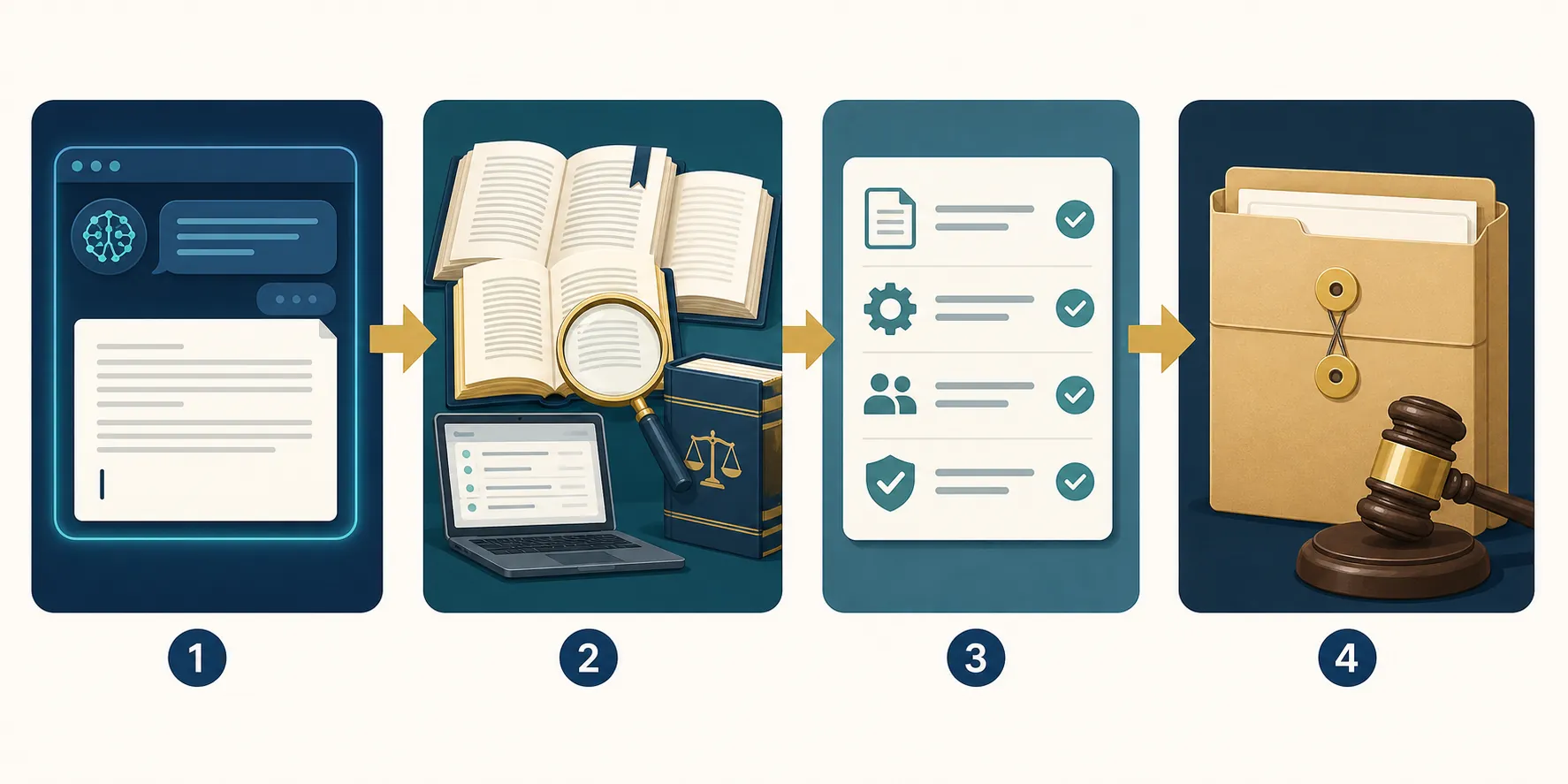
The pre-filing verification pass
The most important control comes after drafting. Any AI-assisted filing should go through a verification pass that treats the model’s legal authorities as untrusted until checked. That rule should apply whether the text came from a hosted model, a local DeepSeek V4 Flash instance, a retrieval-augmented prototype, or a lawyer’s own earlier draft that may have absorbed AI output. Courts punish the failure to verify authorities, not the selection of one model over another.
A defensible pass is not a quick scan for familiar case names. It is a source-by-source review against authoritative legal materials.
| Item in the draft | Required verification |
|---|---|
| Case citation | Confirm the case exists, the citation is correct, the court and date are correct, and the proposition matches the cited portion. |
| Quotation | Compare the quoted language to the authoritative source; check ellipses, brackets, emphasis, and whether the quotation is from a majority, concurrence, dissent, order, or syllabus. |
| Pincite | Open the cited page, paragraph, or section and confirm it supports the sentence in the brief. |
| Negative or subsequent treatment | Use an authoritative citator or equivalent legal-research process to check whether the authority remains good law for the stated point. |
| Statute or rule | Confirm current text, effective date, jurisdiction, amendments, and any local-rule overlay. |
| Procedural statement | Verify against the docket, order, transcript, rule, or record cite rather than relying on the model’s summary. |
| Record citation | Confirm the cited exhibit, deposition page, declaration paragraph, appendix page, or ECF number supports the statement. |
| Parenthetical | Check that the parenthetical does not overstate the holding, procedural posture, or factual similarity. |
The verification pass should leave evidence that it happened. That does not require an elaborate new system. It can be a filing checklist, a document-management note, a litigation-support signoff, or a brief bank workflow. What matters is that the firm can later identify who checked the authorities, what source was used, and whether any AI-generated citations were removed or corrected.
Do not let retrieval blur the responsibility
Some firms will connect a local model to an internal brief bank, a document repository, or licensed legal content. That may improve usefulness. It also creates a second system to validate. The firm should know what corpus is searched, how current it is, whether it includes unpublished or superseded material, and whether the model is required to quote retrieved text or merely use it as context.
A retrieval layer can reduce some hallucination risk, but it does not transfer professional responsibility from the lawyer to the pipeline. If the system retrieves the wrong case, retrieves an outdated version, or summarizes the right authority incorrectly, the filing problem still lands on the legal team.
Reasoning mode and quantization belong in the matter record when they affect output
Law firms often discuss model configuration as an engineering detail until a bad output appears in a document. Then it becomes a governance issue. If the deployment permits different reasoning settings, temperatures, context-management rules, or quantized variants, the firm should decide which settings are approved for legal drafting and whether lawyers may change them.
For court-facing work, the safest administrative rule is simple: the filing record should identify the approved configuration used for AI-assisted drafting, and the lawyer should not rely on any configuration to validate law. Verification happens outside the model, in authoritative legal sources.
The approval boundary
A firm can defensibly approve a DeepSeek V4 Flash local setup for controlled internal drafting if the approval is limited and documented. The approval should say, in operational terms, what the system is allowed to do.
- Approved: summarizing firm-provided materials for internal review, drafting first-pass language, generating checklists, comparing versions of documents, and helping lawyers organize issues.
- Conditionally approved: work involving confidential client information, if access controls, logging, retention, and matter permissions have been approved.
- Not approved without separate verification: legal citations, quotations, case descriptions, statutory statements, procedural histories, and any text that will be represented to a court or client as legal authority.
That boundary is the difference between a useful internal drafting system and an unmanaged legal-research engine. DeepSeek V4 Flash may be local, open-weight, and attractive to infrastructure teams. Before it touches client data, the firm needs confidentiality controls. Before its output touches a filing, the firm needs a documented authority-by-authority verification pass.
References
- deepseek-ai/DeepSeek-V4-Flash, Hugging Face, April 24, 2026.
- DeepSeek-V4-Flash, DeepSeek API Docs, April 24, 2026.
- Rule 1.6: Confidentiality of Information, American Bar Association.
Grounded in
This procedure is grounded in ABA Model Rule 1.6, independent of any single documented case. See the Regulation tracker for the governing text.
Cases this step would have prevented
No cases have been explicitly linked to this checklist yet. See Risk Digest for documented incidents generally.
← Back to WorkflowsReport a correction or tip
Spotted an outdated figure, a misstated fact, or a ruling this workflow checklist should reflect? Public comments are disabled for this content given the professional cost of a misreported case outcome, penalty amount, or rule text — use the structured correction channel instead.
Report a correction or tip for this record →