
Gemini Spark's Agentic Features Test Legal AI Safeguards
This article evaluates how Gemini Spark's always-on, agentic architecture creates confidentiality, supervision, and verification risks that standard AI policies do not cover, and what law firms must configure before allowing it on client matters.
- Applicable role
- attorney
- Workflow stage
- pre-filing
- Primary source
- ABA Model Rules of Professional Conduct
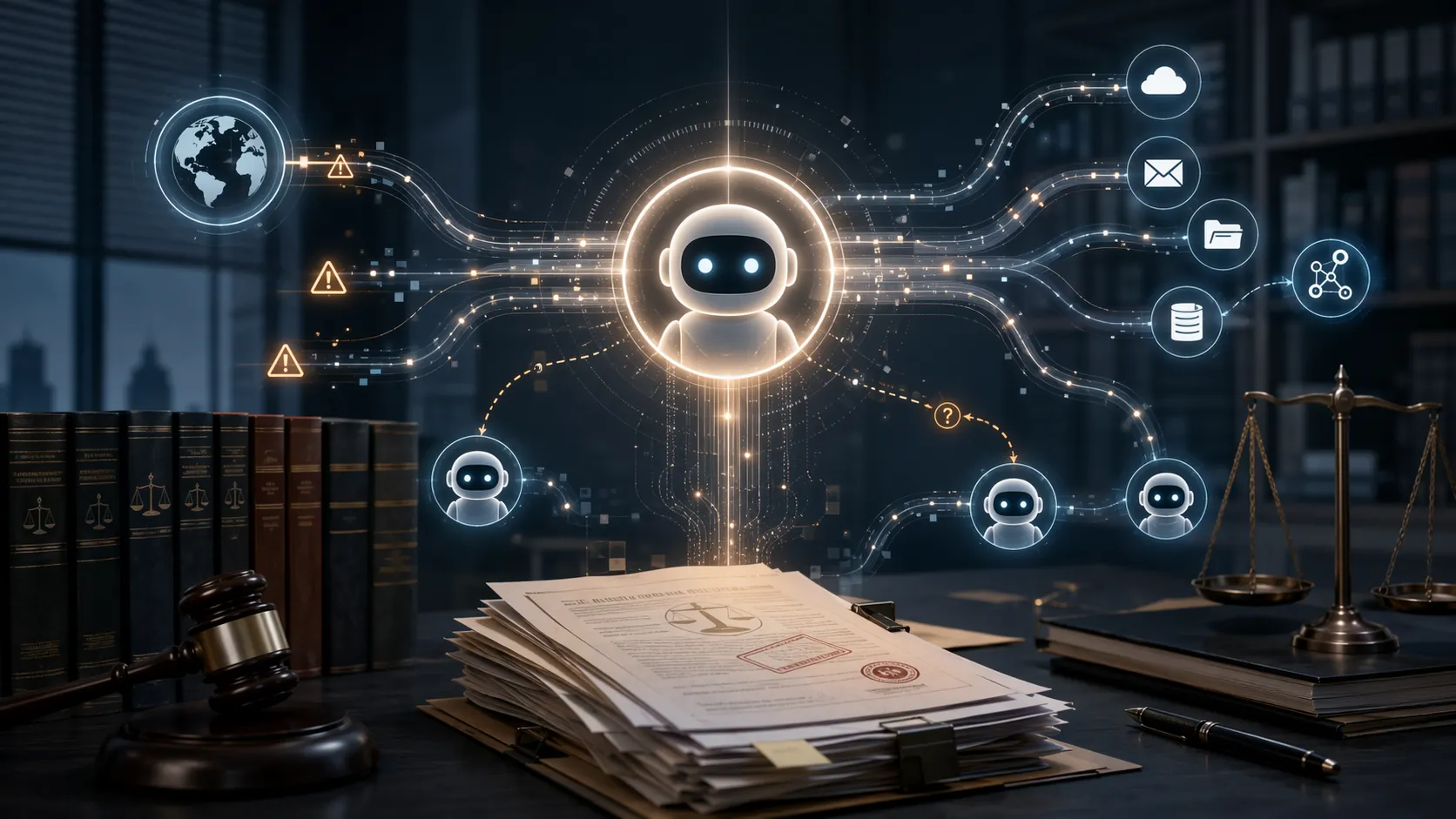
For approval purposes, Gemini Spark belongs in verification-workflows, not in the same bucket as a lawyer opening a chatbot and asking for a draft. The legal-risk question is not whether Spark can produce a bad answer. Courts already know what to do with fabricated citations. The harder question is whether a lawyer can supervise and confine an always-on agent that can schedule work, move through connected Google apps, use a remote browser, coordinate sub-agents, and continue after the lawyer has stopped watching.
This assessment is a Q3 2026 snapshot. Spark is described here from Google’s own public materials and support documentation; the sanction cases discussed later involved Google Gemini generally, not a confirmed Spark deployment. Nothing here is legal advice. It is a procurement and professional-responsibility risk assessment for firms deciding whether to approve, restrict, or block Spark in a legal-work environment.
The feature that changes the legal analysis is agency
Google positions Spark as an agentic assistant rather than a simple response box. Its public overview describes an assistant that can plan and carry out work across tasks, with agentic features that support more than a single prompt-and-answer exchange.[1] Google’s support page is more important for legal review than the product copy because it describes the operational risks: remote browsing, prompt injection, unintended purchases, unintended email sends, and information sharing with websites while the remote browser is in use.[2]
That is why a standard firm instruction such as “do not paste confidential information into public AI tools” is too narrow. A lawyer may not paste a client memo into a chat window at all. Spark may still draw from connected apps or personal intelligence, carry context into a browser session, interact with a third-party site, and produce or prepare an outbound result. The risk begins in the workflow, not just in the prompt.
| Spark capability | Why it matters for legal work |
|---|---|
| Scheduled or background execution | The lawyer may not see intermediate reasoning, source selection, browser interactions, or failed branches before an output appears. |
| Persistent access to connected Google apps | Matter information can be pulled from documents, email, calendar context, or other connected sources rather than only from text intentionally pasted into a prompt. |
| Remote browser use | Google warns that information from the chat and other available sources may be shared with websites during remote browsing. |
| Multi-agent coordination | Work can be divided among specialized agents, complicating logging, review, and privilege-boundary analysis. |
| Autonomous outward action | Unintended email sends, purchases, or other external actions become supervision issues, not merely drafting errors. |
A plausible Spark matter workflow has more leakage points than a chatbot session
Start with an ordinary legal task: an associate asks Spark to prepare a chronology, check hearing dates, or assemble first-pass correspondence. In a chat tool, the main governance question is usually what the lawyer typed, what the model retained, and whether the output was verified. Spark adds a chain of execution.
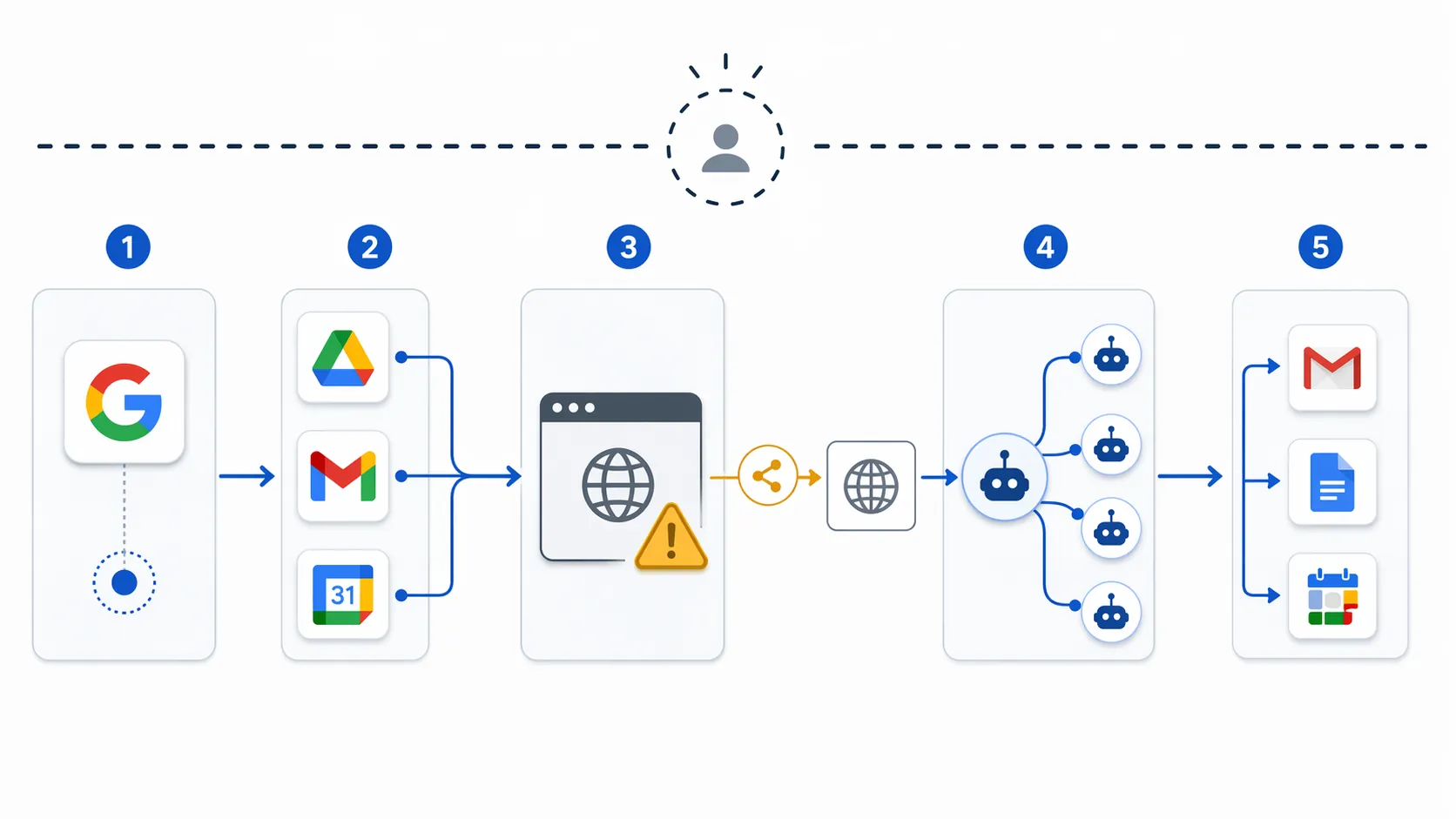
First, the task may begin inside Google Workspace context rather than as a clean, isolated prompt. If Spark has access to connected apps, the information it uses may include material the lawyer did not consciously select for that task. A calendar entry, an email thread, or a draft document can become part of the assistant’s working context. That is convenient for ordinary productivity. In a law firm, it is also where matter boundaries start to blur.
Second, Spark may use a remote browser. Google’s support documentation states that, while using the remote browser, Spark can “share information from your chat and other available sources, like your Connected Apps and Personal Intelligence, with websites.”[2] For legal work, that sentence is doing a great deal of work. It means the confidentiality question is not limited to Google’s handling of prompt data. It also includes what a third-party website receives during an agent-run browsing session.
Third, the website itself may not be passive. Google warns about prompt injection in the same support materials.[2] A malicious or compromised page does not need to “hack” the firm in the old sense to create a professional-responsibility problem. It may only need to influence the agent’s instructions, redirect the task, request more context, or cause an action that the lawyer would not have approved if watching the screen.
Fourth, multi-agent coordination changes who, or what, is doing the work. If one agent gathers documents, another browses, another drafts, and another schedules or prepares communication, the reviewing lawyer may receive a polished artifact without an obvious record of which source was used, which site received data, or which intermediate step introduced an error. That is not a measured claim that Spark hallucinates more often than ordinary Gemini. No source in the current record supports a Spark-specific hallucination rate. It is a structural supervision problem.
Finally, Spark’s output may be action-adjacent. Google’s warnings include unintended purchases and unintended email sends.[2] A bad research paragraph is one thing; an agent preparing or sending a message to a client, opposing counsel, court staff, or a third-party service is another. The consequence shifts from “verify before filing” to “prevent the system from acting before verification occurs.”
The ethics map is short, but it is not optional
Model Rule 1.6 is implicated most directly by remote-browser sharing and by any consumer-tier handling of client-confidential data. Secondary legal-tech analyses have warned that consumer Gemini tiers may involve retention and human review practices that are not appropriate for confidential legal work, including a 36-month retention period discussed in lawyer-focused privacy guidance.[3][4][5] Those sources are not Spark-specific enterprise contracts, and they should not be treated as a substitute for reviewing Google’s current agreement. They do support the narrower point: consumer-grade Gemini availability is not an acceptable home for client secrets.
Model Rule 1.1 turns on competence with the system actually being used. A lawyer does not need to become an AI engineer. But a lawyer approving Spark for matter work needs to understand that a remote-browser, connected-app, multi-agent assistant is not supervised in the same way as a blank chat box. Competence includes knowing where the tool can act, where it can retrieve information, and where human review is mandatory.
Model Rule 3.3 enters when Spark-generated research, citations, quotations, or procedural representations move toward a court filing. The duty of candor is not relaxed because an AI system produced a plausible-looking citation. Model Rules 5.1 and 5.3 matter because partners and supervising lawyers cannot delegate the mechanics of review to the same system whose work needs review. An always-on agent can be useful only if its boundaries are defined before it starts working.
The sanctions record is not Spark evidence, but it is the enforcement climate
The recent sanction cases do not prove that Gemini Spark causes defective legal filings. Spark launched after several of the well-known Gemini-named incidents, and the public trackers identify Google Gemini generally, not Spark’s agentic configuration. That distinction matters. A risk assessment loses credibility when it treats every Gemini sanction as if it were a Spark case.
The cases still matter because they show what courts are already punishing. The GC AI sanctions tracker lists Lacey v. State Farm in the Central District of California, with approximately $31,000 in sanctions in May 2025, and identifies CoCounsel, Westlaw Precision, and Google Gemini as tools associated with fabricated citations in that matter.[6] The same tracker identifies Coomer v. Lindell in the District of Colorado, involving Microsoft Copilot, Google Gemini, and Grok, with $3,000 sanctions per attorney reflected in the tracker’s description.[6]
The broader 2026 enforcement environment is no longer forgiving. EDRM, republishing ComplexDiscovery coverage that cites the Charlotin database, reported more than $145,000 in AI-hallucination sanctions in Q1 2026 alone, more than 1,490 documented hallucination cases worldwide, more than 1,000 in the United States, and 17 court decisions on March 31, 2026 that flagged suspected AI hallucinations.[7] The same coverage described an April 2026 Sullivan & Cromwell incident involving approximately 28 to 40 AI hallucinations in a single filing.[7]
Those numbers do not establish a Spark-specific failure rate. They establish that judges and opposing parties no longer treat AI-generated legal errors as charming experiments. If an agentic assistant makes the source trail harder to reconstruct, the verification burden rises rather than falls.
Controls that would have to exist before client-matter use is even arguable
The current hard boundary is tier and contract. The research record indicates that Spark is not yet available for work or school Google Accounts as of the research date, leaving current use in consumer-grade territory. On that basis, consumer or Pro use should be treated as categorically unsuitable for client-confidential work. A lawyer experimenting with personal productivity is one thing; routing privileged or confidential matter data through a consumer-grade agent is another.
If Google later makes Spark available in an enterprise setting, approval should still not be inherited from a general Gemini or Workspace approval. The minimum threshold would be an enterprise-grade agreement, a data-processing arrangement, and a training-restriction commitment appropriate for legal confidentiality. Even then, the contract is only the floor. The configuration has to match the work.
- Disable remote browser access by default for legal-matter work, and allow it only for approved use cases where the destination domain and data category are known.
- Restrict remote browsing to pre-approved domains where the firm has reviewed the site, the task, and the information that may be transmitted.
- Set outbound communications to draft-only so Spark cannot send client, court, opposing-counsel, or third-party messages without human review.
- Use confirmation prompts and take-control mode for actions that affect calendars, communications, purchases, filings, or external systems.
- Apply DLP rules before Spark can access sensitive repositories, including rules for SSNs, PII, PHI, privileged material, and matter-specific terms.
- Maintain prohibited-task rules: no final legal research validation, no citation authority, no filing-ready drafting, no privilege calls, and no client advice without lawyer verification.
A legalGPTs implementation guide describes several configurable controls relevant to this kind of deployment, including confirmation prompts, prohibited-task recognition, take-control mode, approved-domain restrictions for remote browser access, draft-only outbound communications, and DLP rules for sensitive data.[8] That guide is not a law-firm ethics opinion and should not be treated as proof that Spark is safe. It is useful because it identifies the control surface a firm would need to inspect before any pilot moves beyond nonconfidential testing.
The verification rule has to attach to the output and the path
For chat-based legal AI, a firm can often write a verification rule around the final answer: check the citations, read the cases, confirm the quoted language, and do not file anything the lawyer has not independently validated. Spark needs that, but it also needs path verification. Who approved the connected-app access? Did the agent browse? Which site received information? Did a sub-agent handle research, scheduling, or communication? Was anything prepared for transmission?
A usable Spark log for legal work would need to show at least the task instruction, data sources accessed, remote-browser domains visited, external information shared, agents or sub-agents invoked, draft communications prepared, confirmations requested, confirmations granted, and final human reviewer. If the firm cannot obtain that audit trail, it cannot meaningfully supervise the workflow. The absence of a log does not become harmless because the final draft looks ordinary.
Small-firm convenience does not change the confidentiality boundary
Solo and small-firm lawyers will feel Spark’s appeal sharply because the product promises help with the administrative work that consumes evenings: scheduling, email triage, document cleanup, web tasks, and first-pass drafting. That practical reality deserves acknowledgment. A medium-size firm may have a risk committee, DLP tooling, and Workspace administrators; a solo may have a credit card, a laptop, and court deadlines.
But the confidentiality boundary is not scaled down by firm size. If the available version is consumer-grade, the safe use cases are nonconfidential: personal productivity, public-law research prompts without client facts, generic drafting exercises, or administrative testing with dummy data. The moment a real client name, matter strategy, medical fact, employment record, settlement posture, or privileged communication enters the workflow, the same remote-browser and connected-app questions apply.
The procurement answer for Q3 2026
Gemini Spark should not be approved for unrestricted legal-matter use. Current consumer-grade availability is a hard boundary for confidential work. Lawyers and staff should not use it with client-confidential, privileged, sealed, regulated, or matter-sensitive information unless and until the firm has an enterprise deployment with appropriate contractual protections and a separately approved agentic-workflow policy.
Even a future enterprise version should not be folded into an existing chatbot policy. Spark’s risk is not limited to text generation. It comes from persistent access, background execution, remote browsing, coordinated agents, and outward action. A firm that wants to use it for legal work must govern it as an agentic system: restricted by domain, constrained by task, logged by path, blocked from unsupervised communications, screened by DLP, and verified by a human lawyer before anything reaches a client, court, adversary, or external service.
References
- Gemini Spark, Google
- Use Gemini Spark in the Gemini app, Google Help
- Is Gemini Safe for Legal Work?, Spellbook
- Gemini and Privacy, JLE
- Gemini for Lawyers: Comparing Free, Pro and Ultra AI Tools for Legal Practice, Maryland State Bar Association
- AI Hallucination Legal Cases, GC AI
- The AI Sanction Wave: $145K in Q1 Penalties Signals Courts Have Lost Patience with GenAI Filing Failures, EDRM, April 2026
- Boost Small Business Productivity With Gemini Spark AI Assistant, legalGPTs
Grounded in
This procedure is grounded in ABA Model Rules of Professional Conduct, independent of any single documented case. See the Regulation tracker for the governing text.
Cases this step would have prevented
No cases have been explicitly linked to this checklist yet. See Risk Digest for documented incidents generally.
← Back to WorkflowsReport a correction or tip
Spotted an outdated figure, a misstated fact, or a ruling this workflow checklist should reflect? Public comments are disabled for this content given the professional cost of a misreported case outcome, penalty amount, or rule text — use the structured correction channel instead.
Report a correction or tip for this record →