
What Counsel Must Do After a Bathroom Hidden Camera Discovery
This workflow provides attorneys with a defensible, court-ready protocol for preserving digital evidence, establishing chain of custody, and identifying all liable parties within the first 48 hours after a client discovers a hidden camera in a private space, based on documented case law and federal statutes.
- Applicable role
- attorney
- Workflow stage
- pre-filing
- Primary source
- 18 U.S.C. § 1801
The first instruction is not to “look for the camera.” It is to stop the client, facilities staff, security, HR, or a well-meaning manager from changing the scene. A suspected hidden camera in a bathroom, changing room, bedroom, or comparable private space is a legal emergency because the physical device, local storage, router activity, access-control records, maintenance logs, and notification timeline can all start degrading before counsel has even opened a file.
For counsel handling the legal consequences of hidden cameras in bathrooms and other private spaces, the useful question in the first call is brutally practical: what can still be preserved, who has touched it, and who can delete it remotely? Civil damages, criminal exposure, insurance notice, employment theories, platform liability, and premises liability all matter. None of them improves if the camera is pulled from the ceiling by a maintenance employee, passed around an office, powered on by security, or allowed to sit connected to a network overnight.
This is a verification workflow, not legal advice. Counsel still has to check the governing jurisdiction, criminal statutes, civil deadlines, privilege rules, evidence rules, and reporting obligations. But the first 24 to 48 hours should follow a defensible sequence.
| Immediate task | Instruction counsel should give | Record to create |
|---|---|---|
| Preserve the scene | Do not remove, unplug, open, test, wipe, or reposition the suspected device unless safety or law enforcement requires it. | Timestamped scene log, photographs, video walkthrough, access restrictions |
| Stop informal handling | Identify everyone who has touched the device or entered the room since discovery. | Initial witness list and contamination note |
| Document before seizure | Photograph the device in place, surrounding fixtures, room layout, entrances, locks, signage, and network equipment if visible. | Photo index with creator, time, location, and storage path |
| Secure custody | Move physical evidence only through a named custodian, law enforcement officer, or forensic vendor. | Chain-of-custody form and sealed evidence packaging |
| Preserve digital systems | Issue holds for SD cards, cloud accounts, routers, building access systems, maintenance records, HR complaints, platform messages, and surveillance tickets. | Litigation hold list with recipients and send times |
| Map defendants and deadlines | Do not stop at the suspected installer; identify property, employer, contractor, platform, and institutional actors. | Defendant matrix, legal-theory chart, civil and criminal deadline calendar |
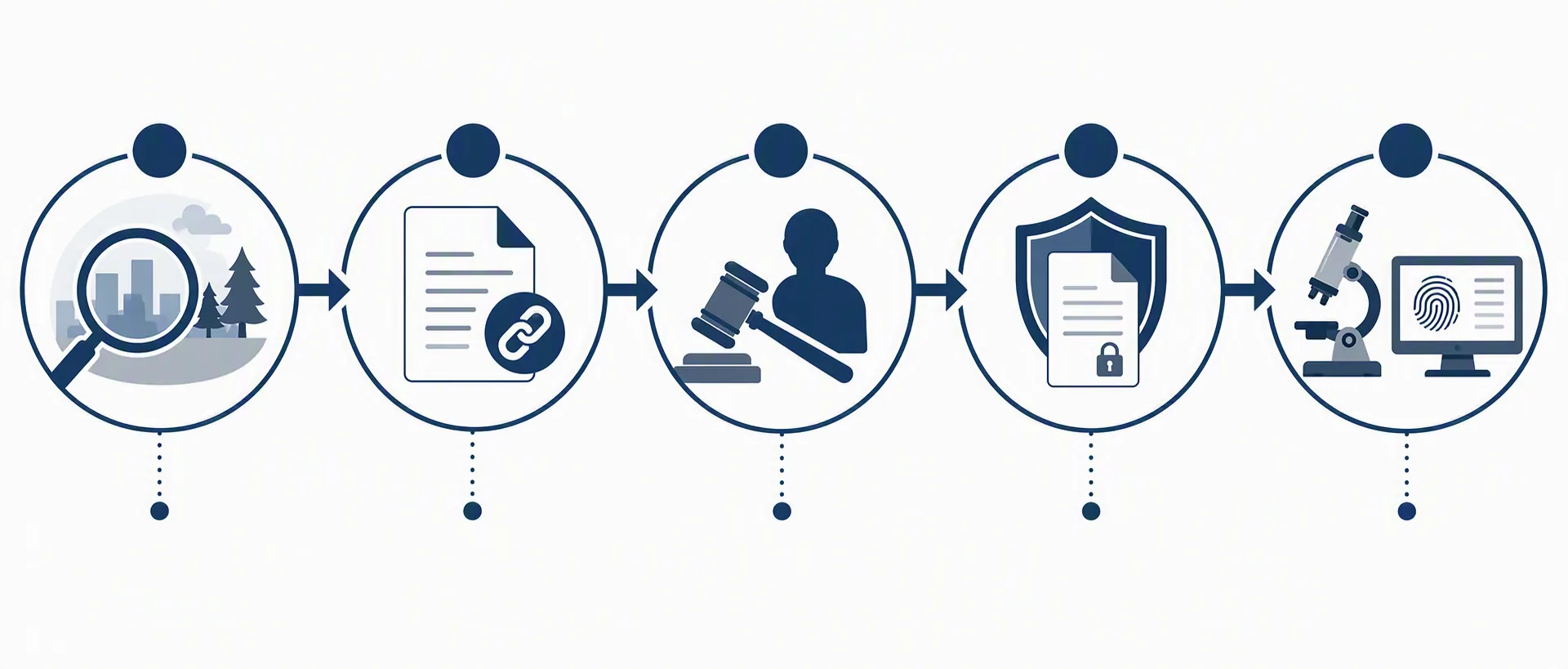
The first call: freeze the scene before anyone improves it
The client’s first instinct is often the worst evidentiary move. They may want to remove the device, press buttons, check whether it is recording, see whether it has an SD card, scan the room for more devices, or ask building security to “confirm” the problem. Counsel’s instruction should be narrower: leave it where it is, keep people out, and document what exists before anyone tries to solve it.
That instruction should be delivered in operational language. Lock the bathroom or private space if it can be done without touching the suspected device. Post a neutral access restriction if needed. Do not describe the suspected camera to unnecessary employees or guests. Preserve any sign-in sheet, keycard record, cleaning schedule, maintenance ticket, work order, complaint email, text message, platform message, or prior incident report. If the device is connected to power or Wi-Fi, do not disconnect it casually; remote deletion is one of the reasons the evidence window is so narrow.
There is a difference between protecting people and disturbing evidence. If the room is still in use, take it out of service. If there is an immediate safety issue, prioritize safety and record why an intervention occurred. But do not let a facilities employee become the first forensic examiner. A later court, insurer, prosecutor, or opposing counsel will ask who had custody, what changed, whether data was overwritten, and whether the plaintiff’s side created the evidentiary gap it is now asking the court to fill.
Photograph what was found, not what someone thinks it means
Before the device moves, the record should show the room as discovered. Counsel should direct a responsible person to photograph or video the area without touching the suspected camera. The first set should include the door, room number or identifying location, locks, sight lines, fixtures, smoke detectors, vents, outlets, mirrors, shelves, ceiling tiles, trash receptacles, and the suspected device in context. Close-up images come after context images. The camera roll should not become an edited presentation deck; preserve originals with metadata where possible.
The log matters as much as the images. Record who took each photo or video, on what device, at what time, where the files were stored, and whether any automatic cloud sync is active. If the client already took photographs before calling counsel, preserve those too. Do not overwrite the messy first record with a cleaner second record. The sequence of discovery is itself evidence.
The same approach applies to associated systems. A hidden camera may not be only a plastic shell in a smoke detector or charger. It may involve removable media, a companion app, a nearby router, Bluetooth pairing, a cloud account, a building network, platform messages, maintenance access, or door-entry logs. Counsel does not need to prove the whole architecture on the first call. Counsel does need to stop the client from destroying the architecture before a forensic examiner can map it.
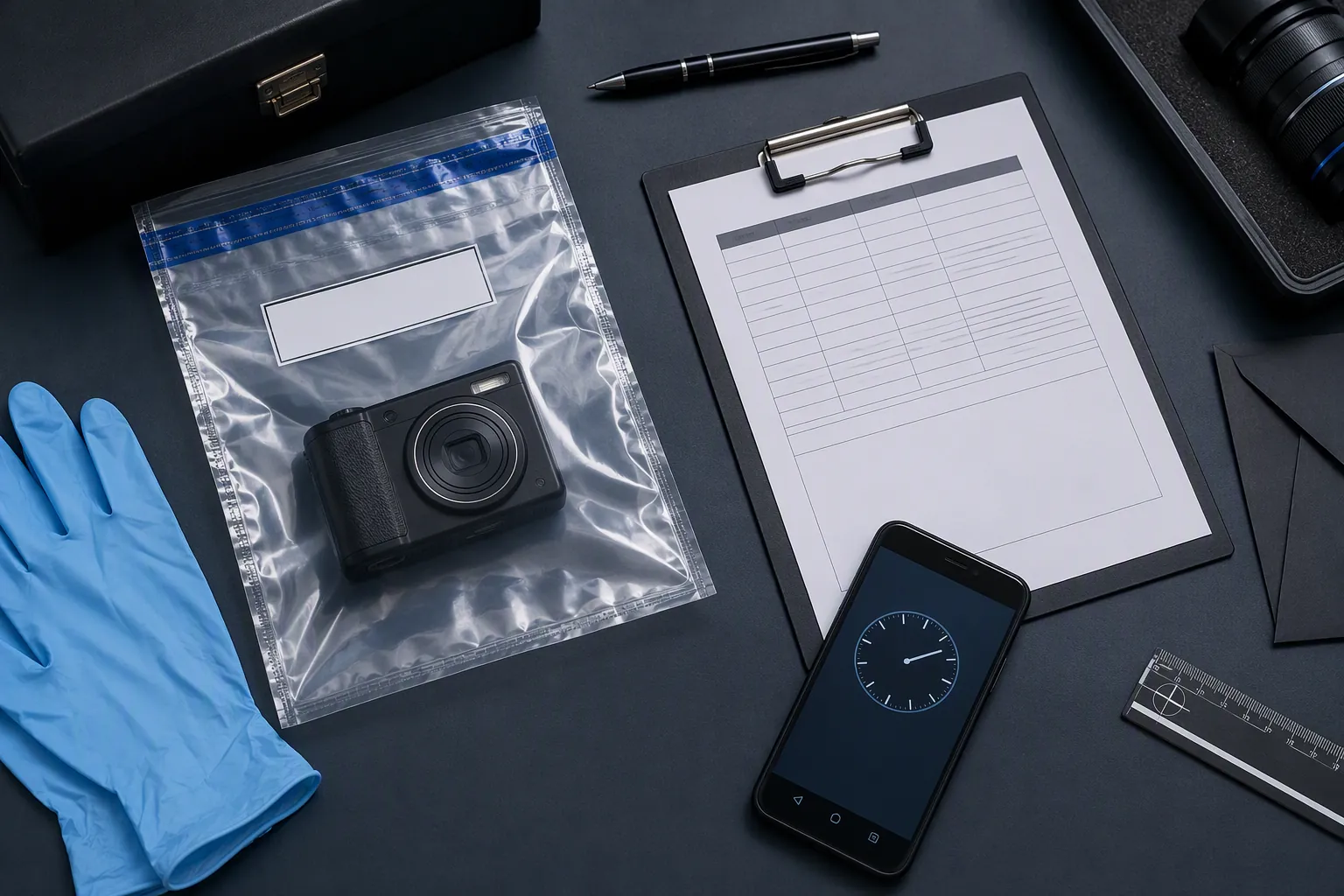
Custody has to be assigned, not assumed
A hidden-camera case can survive a great deal of factual ugliness. It does not survive well when no one can say who had the device between discovery and forensic imaging. The device should move through a named custodian: law enforcement, a forensic vendor, outside counsel, or another person designated in writing. If local law enforcement is involved, counsel should document the handoff without obstructing the criminal investigation. If a private forensic vendor is retained, the vendor should receive the device sealed, labeled, and accompanied by a chain-of-custody form.
The chain-of-custody form should capture the item description, location found, date and time collected, collector identity, condition, packaging, seal number if used, each transfer, each person receiving custody, purpose of transfer, and storage location. It should also identify what was not done: not powered on, not opened, not connected to a computer, not searched by a non-forensic employee. Those negatives can matter later because a device that appears simple may contain volatile data, removable storage, saved network credentials, or artifacts showing pairing and access.
If the device has already been removed, counsel should not pretend the chain starts cleanly. Create a contamination history. Who found it? Who removed it? With what tool? Was it unplugged? Was an SD card removed? Was it inserted into a laptop or phone? Was any file opened, copied, deleted, renamed, or forwarded? Was the device shown to a supervisor, security guard, property manager, platform representative, or police officer? The point is not to make the file look perfect. The point is to make it reconstructable.
Do not let forensic curiosity become spoliation
Clients and employers often want immediate answers: who installed it, whether it recorded, who was recorded, and whether files can be seen. Those are forensic questions, not hallway questions. Opening files on an SD card can alter metadata. Powering a device can trigger sync, deletion, overwriting, or app notifications. Connecting it to a network can create new artifacts and destroy old ones. Even if forensic recovery is later possible, counsel has made the examiner’s job harder and the opposing expert’s cross-examination easier.
Use a qualified forensic examiner early enough that preservation is designed rather than repaired. The examiner’s scope should include the physical device, removable media, paired phones or accounts if lawfully accessible, cloud or app records, local network logs, router configuration, nearby computers, building systems, and any employer- or platform-controlled communications. Counsel should define privilege and reporting lines before imaging begins, especially where criminal referral is likely.
Law enforcement contact should be deliberate and documented
Bathroom and private-space recording can implicate criminal video-voyeurism statutes. At the federal level, 18 U.S.C. § 1801 criminalizes video voyeurism in circumstances involving a reasonable expectation of privacy, including private areas such as bathrooms, and may support civil negligence per se theories where the jurisdiction recognizes them.[1] State law still controls much of the classification, penalty, limitations period, and reporting path.
Counsel should decide who contacts law enforcement, when, and with what evidence package. A rushed call by a manager who cannot identify what has been preserved can create confusion. A delayed referral can look worse if institutional actors already knew of a camera, continued operating the space, or failed to notify possible victims. The file should show the reason for the timing, the agency contacted, the person contacted, the case or incident number, and what was transferred or withheld.
Coordination also protects victims. If recordings may depict multiple people, counsel must avoid unnecessary viewing, copying, or circulating of intimate images. The urge to identify every victim immediately can conflict with privacy, criminal procedure, and trauma-informed handling. A forensic and legal protocol should determine who may review material, for what purpose, in what environment, and how the review is logged.
The litigation hold must reach beyond the camera
A litigation hold that says only “preserve the hidden camera” is too small. The useful hold identifies the records that will prove access, control, notice, opportunity, and delay. In a workplace matter, that may include HR complaints, restroom maintenance logs, employee schedules, contractor rosters, badge records, cleaning logs, prior incident reports, internal messages, security reports, and device procurement records. In a rental or hospitality matter, it may include host messages, guest complaints, platform tickets, listing history, cleaning records, smart-lock logs, Wi-Fi router data, contractor access, and prior reviews.
The hold should be targeted enough to be credible and broad enough to stop foreseeable deletion. Send it to the entity controlling the premises, relevant supervisors, IT or network administrators, HR, facilities, security, contractors, platform operators, and any individual suspected of possession or control. If counsel represents an institution rather than a victim, the hold has the additional function of proving that the institution did not compound the violation once it learned of the discovery.
Notification timing belongs in the same file. Northwell Health is the obvious warning. Lawsuits and public filings described cameras hidden in bathroom smoke detectors over nearly two years, about 13,000 potential victims notified, more than 400 plaintiffs represented in later filings, and an alleged 13-month delay before victims were notified.[2][3] The important lesson is not just scale. It is that delayed institutional action can become its own liability story, separate from the person who placed the device.
Do not stop at the installer
The person who installed the camera is the most obvious defendant. Often that is not enough. A defensible complaint or claim evaluation should ask who controlled the private space, who had authority to inspect or maintain it, who had access when the device was installed, who received warnings, who delayed action, who controlled relevant records, and who benefited from the environment in which the violation occurred.
| Potential defendant or actor | Records to identify early | Possible theory to evaluate |
|---|---|---|
| Individual installer or viewer | Device artifacts, access logs, schedules, messages, account records | Intrusion, statutory privacy claims, intentional infliction theories, criminal referral |
| Employer | HR files, workplace complaints, restroom maintenance, supervision records, prior discipline | Negligent hiring, retention, supervision, workplace harassment, premises control |
| Property owner or operator | Inspection records, leases, repair logs, contractor access, prior complaints | Premises liability, negligent security, failure to warn, negligent maintenance |
| Contractor or vendor | Work orders, access credentials, service dates, device installation opportunities | Negligent acts, respondeat superior where available, contribution claims |
| Rental platform or host | Listing terms, platform messages, surveillance-device complaints, trust-and-safety tickets | Premises, notice, consumer-protection, and platform-specific theories depending on facts |
| Institutional leadership | Notice timeline, internal escalation, victim notification, preservation decisions | Delay, concealment, punitive exposure, spoliation-related consequences |
Recent matters show why this defendant map matters. A 2025 California lawsuit alleges a hidden camera in a Comerica Bank women’s restroom that was accessible to the public, making the premises and institutional response part of the claim architecture rather than a private dispute between two individuals.[4] In the Northwell allegations, the placement in bathroom smoke detectors, the duration, and the notification delay are what turn a hidden-camera discovery into a mass institutional case.[2][3]
Rental-platform matters require the same discipline. One law-firm discussion cites CNN reporting that Airbnb had received 35,000 customer-service tickets concerning surveillance devices since 2013.[5] That figure should not be treated as a bathroom-camera statistic, an annual rate, or an independent verdict measure. It is a bounded signal that platform records and prior complaints may matter when a guest discovers a recording device in a private space.
Damages benchmarks help only after the evidence is usable
Verdicts and settlements are useful for evaluation, mediation posture, insurance discussions, and client expectations. They should not drive the first day’s work. The first day’s work is preservation. Still, counsel needs anchors that are tied to published matters rather than inflated folklore.
In 2024, a Cook County Chancery workplace-restroom hidden-camera case resulted in a $4 million judgment, described as $500,000 in compensatory damages per plaintiff plus $2 million in punitive damages.[6] Also in 2024, a Brooklyn federal jury awarded $2.78 million to an au pair in a hidden-camera bedroom case, including $780,000 for emotional distress and $2 million in punitive damages.[7] The bedroom verdict is not a bathroom case, but it is a close privacy comparator because it involves recording in a space where privacy expectations are at their strongest.
At the lower published end, a California workplace-restroom matter involving an uninsured employer settled for $80,000 for a single plaintiff.[8] That number is not a ceiling; it is a reminder that collectability, insurance, number of victims, duration, employer knowledge, dissemination, and punitive facts can move the case more than the label “hidden camera” does.
Be cautious with unsupported high-water figures. Some commentary reports very large vacation-rental verdicts, including a $45 million figure, but the research set available here does not include a linked primary order or independent news report sufficient to use that number as a reliable benchmark. If counsel uses such a figure at all, it should be labeled as reported and unverified, not presented as a stable valuation point.
State-law variation is a routing problem, not a footnote
Federal video-voyeurism law may be part of the analysis, but hidden-camera cases are usually routed through state criminal statutes, state privacy torts, workplace statutes, premises law, negligence principles, and jurisdiction-specific limitations periods. Florida’s digital-voyeurism statute, for example, defines prohibited conduct and classifications under Florida law; other states classify voyeurism offenses differently, with penalties described in survey materials as ranging from misdemeanor treatment to felony exposure that can reach 15 years depending on jurisdiction and facts.[9][10]
The practical response is not to write a fifty-state memo before preserving evidence. It is to calendar the statutes and deadlines immediately: criminal reporting considerations, civil limitations periods, notice requirements, employment charge deadlines if applicable, preservation obligations, insurance notice, governmental-entity notice if a public actor is involved, and any protective-order needs for intimate recordings. The calendar should be created while evidence is being secured, not after valuation discussions begin.
A defensible first-48-hour file
By the end of the first 48 hours, the file should be able to answer basic questions without improvisation: when the suspected device was found, who found it, who entered the room, who touched the device, what was photographed, where original images are stored, who has custody, whether law enforcement was contacted, what systems are on hold, which possible victims are known, what records may identify additional victims, and which institutional actors had control or notice.
The core deliverables are concrete: a preserved scene record; a contamination history if the scene was disturbed; a chain-of-custody log; forensic retention terms; issued litigation holds; a record-source list; a defendant and legal-theory matrix; law-enforcement contact documentation; victim-notification analysis; and a jurisdiction-specific deadline calendar. That is the point at which counsel can begin evaluating damages, insurance, criminal coordination, civil filing strategy, and settlement posture without having to explain why the evidence disappeared first.
References
- 18 U.S. Code § 1801 — Video Voyeurism — egattorneys.com
- Northwell Health Hidden Camera Lawsuit Attorneys — SSKB Law
- Slater Slater Schulman LLP Files Lawsuits on Behalf of Over 400 Victims of Hidden Camera Surveillance at Northwell Health Facilities — PR Newswire
- Workplace Harassment Lawsuit Claims Hidden Camera in Bank Restroom — Wenzel Law
- Hidden Cameras in Hotels and Airbnb Rentals — Chicago Injury Lawyer
- $4 Million Judgment Sends Strong Message in Hidden Camera Privacy Invasion Case — Jeffrey Kulwin Law
- Jury awards $2.78 million to nanny over hidden camera in bedroom — AP News
- Secure $80,000 in Hidden Camera Workplace Privacy Violation Case — Labor Champ
- Florida Statutes § 810.145 — Florida Legislature
- Voyeurism Crime: Meaning, Laws & Penalties — Mainor Wirth
Grounded in
This procedure is grounded in 18 U.S.C. § 1801, independent of any single documented case. See the Regulation tracker for the governing text.
Cases this step would have prevented
No cases have been explicitly linked to this checklist yet. See Risk Digest for documented incidents generally.
← Back to WorkflowsReport a correction or tip
Spotted an outdated figure, a misstated fact, or a ruling this workflow checklist should reflect? Public comments are disabled for this content given the professional cost of a misreported case outcome, penalty amount, or rule text — use the structured correction channel instead.
Report a correction or tip for this record →