
How to Verify a Top-Rated CPS Defense Lawyer in California
When a California CPS defense law firm advertises 'top rated,' independent verification is critical before paying a retainer. This step-by-step checklist shows how to confirm ratings, disciplinary history, and dependency-panel eligibility using free public databases.
- Applicable role
- pro se litigant
- Workflow stage
- pre-filing
- Primary source
- California Rule of Court 5.660
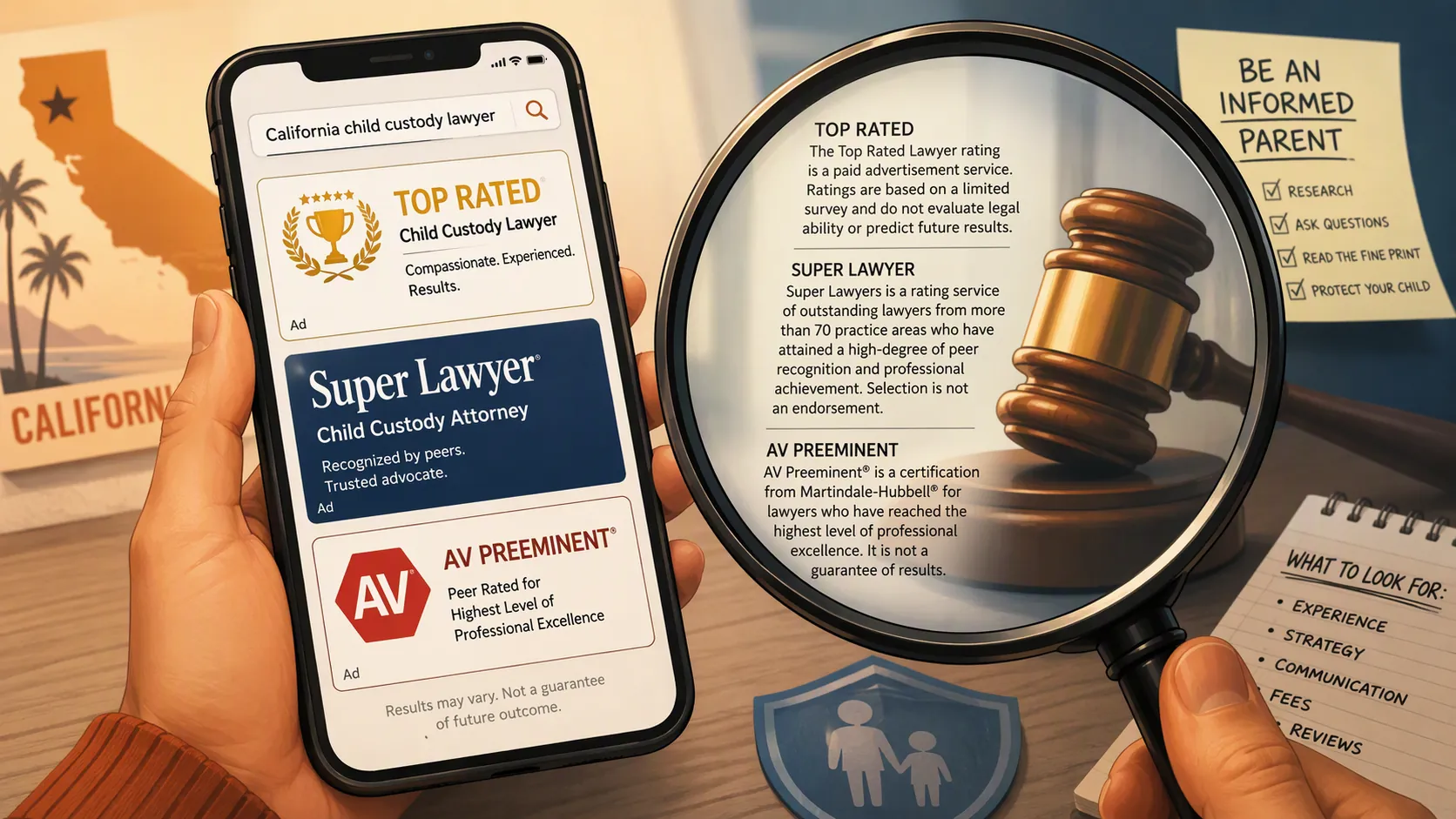
The retainer moment is a bad time to decode lawyer advertising. A California parent may be holding a dependency petition, fielding calls, and trying to decide whether a California CPS defense firm advertising itself as “top rated” is worth money they cannot afford to waste. The phrase “top rated” may sound like a public credential. In California, it is not one.
Treat the badge the way a careful lawyer should treat an AI-generated citation: useful only after it leads back to a source you can open and verify. On this site, that same primary-source habit appears in verification workflows for high-stakes legal decisions. A polished label is not proof until the underlying record checks out.
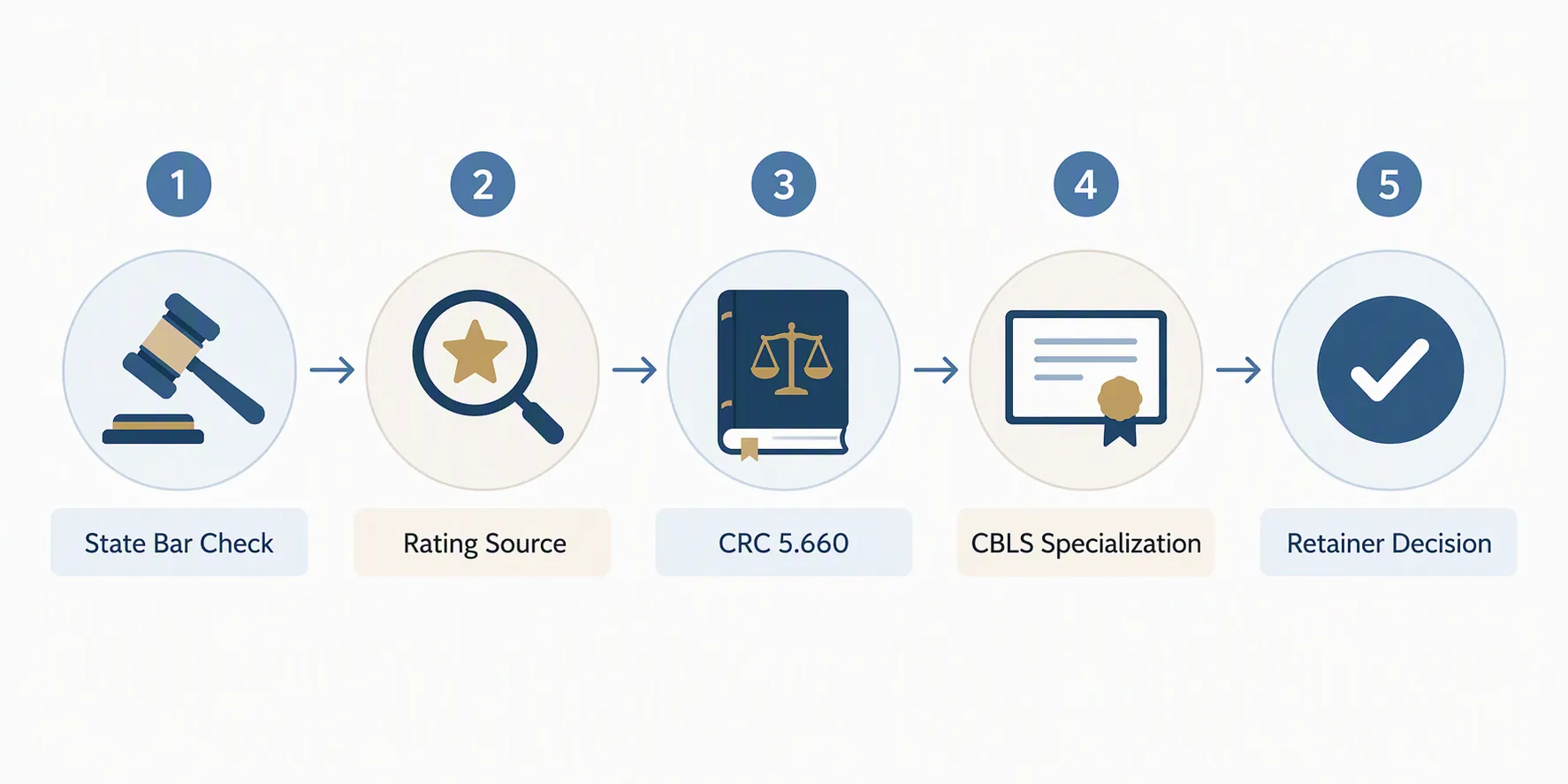
Before paying a retainer, verify four things in this order: the attorney’s California State Bar record, the original source for any rating claim, dependency-court competency under California Rule of Court 5.660, and any claimed specialization. Only then decide whether “top rated” means anything for the case in front of you.
Start With The State Bar Record, Not The Badge
The first check is not whether the firm’s website looks serious. It is whether the individual lawyer you would hire is licensed, active, and free of public discipline that would change your risk calculation. Use the State Bar of California’s attorney search tool, which is the public portal for finding California legal professionals and checking license information.[1]
- Search the exact lawyer name, not only the firm name.
- Confirm the attorney is active and eligible to practice law in California.
- Read the public profile for discipline history rather than stopping at the license status.
- Check whether the lawyer appears in recent disciplinary actions if anything on the profile is unclear.
A clean license record does not prove dependency-court skill. It does remove one category of immediate concern. That distinction matters. The State Bar reported that in FY2025 it opened more than 21,000 cases against attorneys and non-attorneys, recommended 69 disbarments, and reimbursed $6.2 million to 355 victims of attorney misconduct.[2] Those figures do not mean most lawyers are unsafe. They do mean “licensed” is not the same as “safe enough to skip the record check.”
If a firm advertises one lawyer but assigns another, repeat the search for the lawyer who will actually appear in court, handle hearings, or supervise your matter. In dependency cases, the name on the pleading and the person standing next to the parent are not details to leave vague.
The State Bar also maintains a recent disciplinary actions page.[3] Use it as a second look, especially if the attorney profile references public discipline or if the firm’s advertising leans heavily on trust language. Because it is Q3 2026 and 2026 data is still partial, FY2025 is the cleaner statewide context; do not overread incomplete current-year tables as if they describe a full year.
Your practical judgment after this step is simple: if the lawyer is not active, the record shows public discipline you do not understand, or the firm will not name the attorney who will represent you, the “top rated” claim has not earned your trust.
Then Verify What The Rating Actually Measures
A commercial rating can be real and still be limited. The point is not to sneer at the badge. The point is to stop it from doing work it was never designed to do.
| Claim on lawyer website | What to verify at the source | What it does not prove |
|---|---|---|
| Super Lawyers | Whether the lawyer appears in the Super Lawyers directory and whether the claimed year, practice area, and location match. | Legal skill, dependency-court outcomes, CRC 5.660 compliance, or a promise that the lawyer is right for your case. |
| Avvo 10.0 or Avvo rating | Whether the lawyer’s Avvo profile shows the claimed rating and whether the profile information is current. | Actual legal skill, strategy, case results, communication style, or personal fit. |
| AV Preeminent or Martindale-Hubbell rating | Whether Martindale-Hubbell lists the lawyer with the claimed peer-review rating. | Juvenile dependency specialization, local CPS practice experience, or dependency-panel qualification. |
Super Lawyers says it selects the top 5% of attorneys in each state through a patented multiphase process using 12 indicators, including peer nominations and professional achievement. Its own selection-process page also says the process does not evaluate legal skill or case outcomes.[4] That makes the badge a directory-and-recognition signal, not a dependency defense credential.
Avvo describes its rating as a 1-to-10 mathematical model generated from public records and attorney profile information. Avvo’s own support page says the rating does not directly measure actual legal skill or strategy in a specific case, case outcomes or likelihood of success, personality or communication style, or the personal fit between lawyer and client.[5] Those are not small exclusions for a parent facing CPS deadlines; they are exactly the areas a parent is trying to understand.
Martindale-Hubbell describes its ratings as peer-review ratings based on surveys, including reviews from self-nominated peers, with minimum years in practice required for the top tier.[6] Peer respect may matter, but it is not the same as a county dependency panel qualification, recent juvenile court work, or familiarity with local child welfare agency practice.
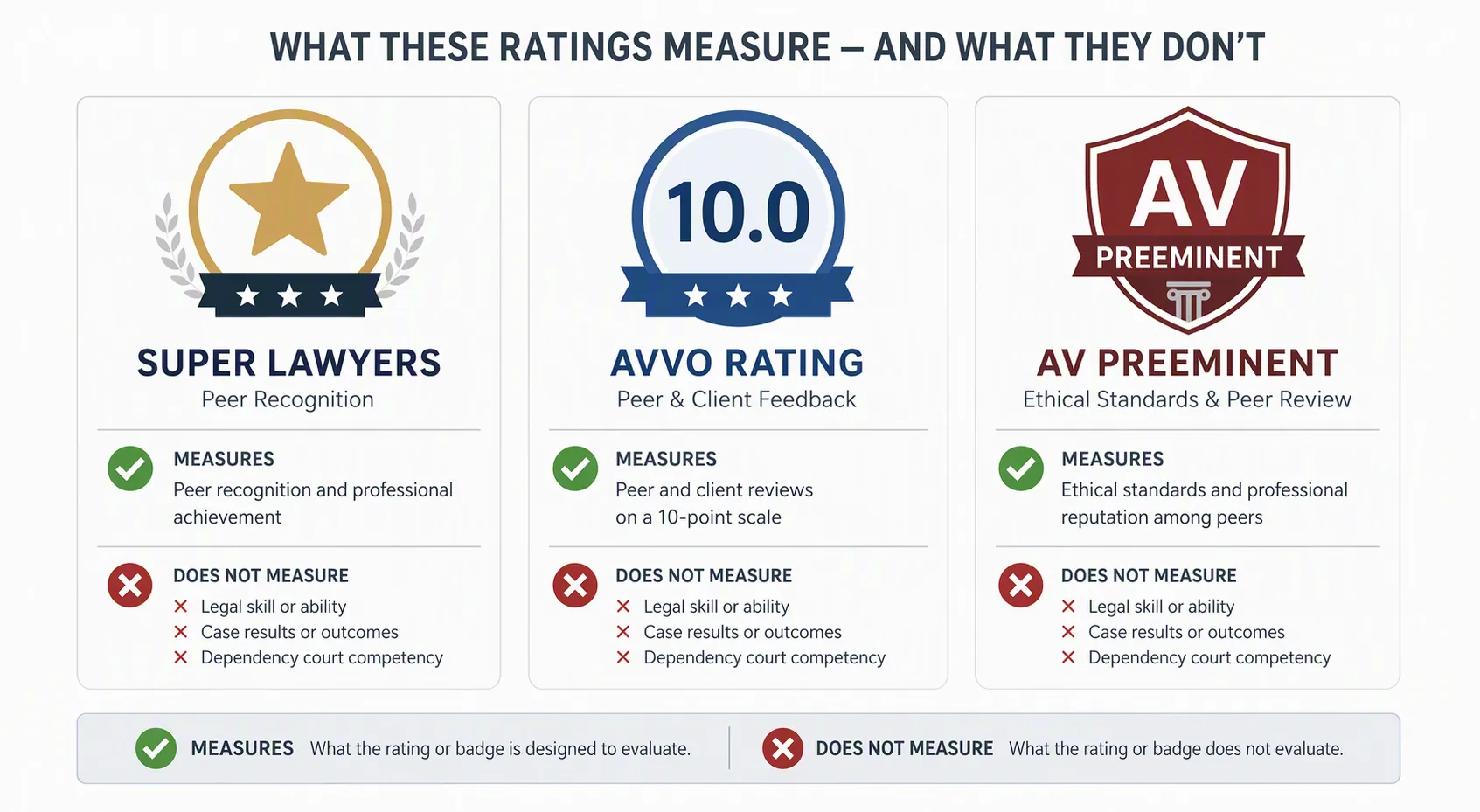
If the rating cannot be found at the rating source, mark it unverifiable. If it appears but relates to a broad practice area or an old year, mark it verified but limited. If the firm uses the badge to imply dependency-court competence without more, mark it irrelevant to the specific question you need answered.
Dependency Court Has Its Own Competency Floor
A CPS defense case in California may move through juvenile dependency court, not ordinary family court. That changes what you should verify. California Rule of Court 5.660 defines competent counsel for dependency proceedings as counsel with “adequate forensic skills, knowledge and comprehension of the statutory scheme,” and it sets training requirements for appointed dependency counsel.[7]
The rule requires 8 hours of initial dependency training and 8 hours of continuing education every 3 years for attorneys appointed in dependency matters.[7] That is a floor, not a trophy. It does not tell you that the lawyer is brilliant, warm, aggressive, strategic, or right for your facts. It tells you the court system has a minimum competency structure for this kind of representation.
This is where “I handle family law” is not enough. Dependency practice has different statutes, hearings, timelines, county practices, and consequences. A lawyer may be excellent in custody litigation and still not be the right person for a petition under the dependency system. If the lawyer advertises CPS defense, ask directly how they satisfy dependency-court competency expectations and whether they are on, or have been on, a local juvenile dependency appointment panel.
- Ask: “Have you represented parents in California juvenile dependency proceedings?”
- Ask: “Are you currently on any county dependency counsel panel, or have you previously been accepted onto one?”
- Ask: “What dependency-specific training have you completed in the last 3 years?”
- Ask: “Will you personally appear in juvenile court, or will another lawyer handle hearings?”
- Ask: “If I am appointed counsel by the court, what is the court’s complaint process for inadequate representation?”
Rule 5.660 also requires each superior court to establish a complaint procedure for inadequate appointed representation, and it says each party must be informed of the procedure for lodging a complaint.[7] That duty matters because a parent may not know the procedure exists. It is not a substitute for choosing carefully before hiring private counsel, but it is another sign that dependency representation is treated as a distinct competency problem.
Some of this verification may require a direct call, because county panel status and training records may not be searchable in one statewide public database. If a lawyer gives a clear answer and can identify the county, panel, training provider, or court rule basis, you have something to test. If the answer collapses into “we are top rated” or “we do CPS cases,” you still do not have dependency-court verification.
Check Specialization Claims Separately
A specialization claim deserves its own check because it sounds more official than a rating badge. The California Board of Legal Specialization program requires specialty education, a written examination, and favorable evaluations from judges and peers for certified specialists.[8] It is searchable and more formal than a marketing award.
But precision matters. California Bar specialization is not the same thing as a private or national child-welfare credential. The California specialization program does not list juvenile dependency law as a separate specialty; family law is the closest related California specialty listed in the State Bar specialization framework.[8] If a firm implies “California-certified juvenile dependency specialist,” do not assume that phrase means CBLS certification.
A lawyer may be referring instead to another issuer, such as a child welfare law specialist credential outside the California Bar system. That may be meaningful, but it must be verified at the issuing organization and described accurately. Ask for the exact credential name, issuing body, year, and public verification page. If the lawyer cannot separate a California Bar certified specialty from a non-CBLS credential, the claim needs correction before it can support a hiring decision.
A Short Retainer-Readiness Checklist
Parents are often under pressure before they ever speak to a lawyer. The ACLU of Southern California’s child welfare guide describes the practical reality of California child welfare investigations and the kinds of contacts parents may face.[9] That pressure is real. It is also why the verification has to be short enough to execute.
| Question before paying | Where to verify | Decision |
|---|---|---|
| Is the named attorney active and eligible to practice? | State Bar attorney search | Proceed only if the record is clear enough for you to understand. |
| Is there public discipline or a recent disciplinary action? | State Bar profile and recent disciplinary actions page | Pause and ask for an explanation; do not let a rating badge answer for the record. |
| Does the advertised rating exist at the source? | Super Lawyers, Avvo, or Martindale-Hubbell source page | Treat it as limited even when verified. |
| Does the lawyer have dependency-court experience and CRC 5.660-relevant training or panel status? | Attorney’s direct answer, county panel administrator, or court appointment information where available | Require a concrete answer; family-law experience alone is not the same thing. |
| Is any specialization claim accurately described? | California Board of Legal Specialization or the named credential issuer | Reject vague “certified” language until the issuing body is clear. |
The same discipline that prevents AI citation hallucination prevents bad hiring decisions here: trace the claim to the original source, read what the source actually says, and do not let a polished summary replace the record. If a lawyer’s website says “top rated,” the next sentence in your head should be “rated by whom, for what, and where can I verify it?”
Before paying, you should have a clean State Bar record check you understand, a confirmed source for every rating badge, a clear answer on dependency-panel experience or CRC 5.660-relevant competency, and verified support for any specialization claim. Anything less leaves “top rated” where it started: marketing, not proof.
References
- Find Legal Professionals, State Bar of California.
- Discipline Statistics, State Bar of California.
- Recent Disciplinary Actions, State Bar of California.
- Super Lawyers Selection Process, Super Lawyers.
- Attorneys: What is the Avvo Rating?, Avvo.
- Ratings and Reviews, Martindale-Hubbell.
- Rule 5.660. Attorneys for parties in dependency proceedings, California Courts.
- Becoming a Certified Specialist, State Bar of California.
- California Child Welfare Investigations 101, ACLU of Southern California.
Grounded in
This procedure is grounded in California Rule of Court 5.660, independent of any single documented case. See the Regulation tracker for the governing text.
Cases this step would have prevented
No cases have been explicitly linked to this checklist yet. See Risk Digest for documented incidents generally.
← Back to WorkflowsReport a correction or tip
Spotted an outdated figure, a misstated fact, or a ruling this workflow checklist should reflect? Public comments are disabled for this content given the professional cost of a misreported case outcome, penalty amount, or rule text — use the structured correction channel instead.
Report a correction or tip for this record →