
How Truck Accident Lawyers Obtain Logs That Prove Liability
Step-by-step procedure for truck-accident counsel to obtain driver logs through a preservation-to-compel escalation ladder, timed against the FMCSA six-month retention clock and ELD retrieval routes. Includes the spoliation arguments and cross-source verification steps that turn raw ELD exports and edit trails into proof of liability.
- Applicable role
- plaintiff attorney
- Workflow stage
- pre-filing
- Primary source
- 49 CFR § 395.8(k)
After a serious truck crash, a lawyer trying to obtain driver logs that prove liability is already working against a clock. The central clock is not dramatic: motor carriers must retain records of duty status, including supporting documents, for six months under 49 CFR § 395.8(k).[1] For ELDs, the FMCSA also says a motor carrier using a separate device must maintain a back-up copy of ELD records on a separate device from the device where the original data is stored.[2]
That six-month rule is the spine of the log fight. A plaintiff lawyer who sends one broad request for “driver logs” and waits for the carrier’s ordinary discovery calendar has already given away leverage. The practical sequence is preservation notice, targeted retrieval, formal discovery, vendor subpoenas, and, when production stalls, motion practice backed by a record showing exactly when the carrier was told what to preserve.

Start with the retention deadline, then build the record of notice
Driver logs can still be paper records in some settings, but most interstate commercial motor-vehicle cases now involve ELD data. For litigation purposes, the difference matters less than the production demand: counsel needs the original or exportable record, the edit history, and the supporting documents that allow the log to be tested against the trip.
The preservation letter is not a courtesy letter. It is the first exhibit in the later motion. It should identify the crash, the driver, the tractor, the trailer if known, the date range, and the categories of records to be preserved. A useful letter does not stop at “logs.” It names RODS, ELD raw data, ELD edit histories, unassigned driving events, supporting documents, dispatch communications, GPS or telematics records, fuel purchases, toll data, inspection records, driver qualification and hours-of-service materials, and any vendor-hosted data related to the route.
Law-firm practice guides commonly describe this first move as the beginning of a staged recovery process: send a preservation demand, identify the carrier and driver records, pursue formal discovery, and seek court intervention if the carrier does not produce.[3] That is a fair high-level sequence, but the important litigation point is narrower: the letter gives the carrier actual notice before the retention window expires. Without that notice record, the sanctions argument later becomes harder and more fact-dependent.
| Evidence target | Why it is requested | Timing pressure |
|---|---|---|
| RODS / ELD logs | Shows recorded driving, on-duty, off-duty, and sleeper-berth status | FMCSA six-month retention rule for RODS and supporting documents |
| ELD raw export and edit history | Shows underlying event data and later changes rather than a carrier-selected summary | Should be demanded before routine retention and system practices narrow the available data |
| Telematics / GPS route data | Tests whether the duty-status entries match the actual route and stops | May sit with a third-party vendor, so carrier-only requests may be incomplete |
| ECM and dashcam evidence | Adjacent crash and movement evidence, not a substitute for log production | Reported overwrite windows vary by source and system |
The escalation ladder that makes production more likely
A carrier that wants to avoid producing logs rarely says that in writing. More often, the response is partial: a PDF printout, a compliance summary, a driver-facing screen, or a claim that the responsive material is no longer available. The answer is not to send the same request again with sharper adjectives. The answer is to climb the ladder while the dates are still useful.

1. Preservation letter with formats, custodians, and vendors
The first letter should be specific enough that the carrier cannot later pretend it thought a printed hours-of-service summary satisfied the demand. It should name both data categories and custodians: the motor carrier, driver, safety department, dispatch, ELD administrator, maintenance personnel if inspection records are implicated, and any telematics vendor that stores route or device data.
If the case later moves into eDiscovery, the same discipline applies: preserve the native record, the export metadata, and the human review trail. For a broader discussion of review checkpoints after records are collected, see the site’s AI-assisted document review workflow.
2. Emergency preservation order or forensic download when the data may disappear
Some evidence adjacent to driver logs is more fragile than the six-month RODS rule suggests. One California law-firm source describes ECM data as potentially overwritten in an 8-to-30-day range, while another trucking-evidence explainer describes ECM buffers as rolling and dashcam footage as subject to auto-delete windows ranging from 7 to 90 days.[4][5] Those figures should not be treated as universal technical law. They are still enough to justify operational urgency: if the tractor, device, or video system may overwrite data, counsel should consider an emergency preservation order, inspection protocol, or forensic download rather than waiting for the ordinary discovery track.
This step should stay in its lane. ECM and dashcam evidence can corroborate speed, braking, movement, or route. They do not replace the driver-log demand. The log case still needs RODS, ELD exports, edit history, and supporting documents.
3. Formal discovery that asks for the native record, not the carrier’s summary
The request for production should separate the categories the carrier may try to blur. Ask for the ELD data export, the RODS, the driver’s certifications, edit histories, annotations, unidentified or unassigned driving events, malfunction records, supporting documents, dispatch records, trip documents, fuel and toll records, and policies governing ELD administration. If paper logs exist for any period, ask for the originals or complete copies plus the documents that would verify them.
One trucking-discovery discussion cites 49 CFR § 390.40 for the proposition that certain records must be available within 48 hours after a request by an authorized safety official.[6] That regulatory point is not the same thing as civil discovery compliance, but it is useful for drafting: it shows that these records are not exotic documents that a carrier should need months to identify.
4. Telematics-vendor subpoena when the carrier is not the whole data map
ELD and telematics data may be reachable through different routes: USB download, wireless transfer, or a carrier portal, depending on the system and access rights.[4] The lawyer should not assume the carrier’s litigation contact controls every copy. The vendor may hold route history, device events, administrative records, or export logs that show what the carrier accessed and when.
The subpoena should match the preservation letter rather than start over. It should seek the same trip window, vehicle and driver identifiers, raw exports where available, audit logs, account-administration records, and any records showing edits, annotations, malfunctions, transfers, or deletions. If the carrier has produced only a static report, the vendor subpoena is often the fastest way to learn whether that report omitted fields that matter.
5. Motion to compel or sanctions request, using the calendar as the exhibit
By the time counsel moves to compel, the record should show more than nonproduction. It should show the crash date, the preservation date, the regulatory retention deadline, the specific formats demanded, each deficient response, and the reason a summary printout is not equivalent to raw ELD data and edit history.
Defense-side commentary on ELD litigation describes the sanctions exposure created when electronically stored trucking records are lost or not preserved, including adverse inference, evidence preclusion, and default judgment.[7] That same commentary quotes West v. Goodyear as defining spoliation as the destruction or significant alteration of evidence, or the failure to preserve property for another’s use as evidence in pending or reasonably foreseeable litigation.[7] Any article, brief, or motion relying on the listed cases from that commentary should verify the primary opinions before quoting them; the useful point here is the sanctions menu and the preservation logic, not a shortcut around primary legal research.
State practice can change the test and remedy. A Georgia-focused trucking-spoliation source describes a five-factor sanctions analysis and lists retention periods including logs at six months, pre- and post-trip inspections at three months, and maintenance records at one year.[8] A California-focused source discusses ex parte preservation practice, sanctions under California Code of Civil Procedure § 2023.030, and CACI No. 204 on willful suppression of evidence.[5] Those are jurisdiction-specific pressure points, not a substitute for the local rule, statute, or controlling opinion in the forum.
For a separate example of how preservation demands and later destruction can shape a sanctions analysis, see the site’s discussion of a preservation-demand-then-destruction dispute.
What counsel should demand from an ELD production
A printed log summary answers the carrier’s chosen question. A raw export and edit history answer litigation questions. Who entered the event? Was an automatically recorded driving segment later reclassified? Did a driver annotate an exception? Did an administrator accept, reject, or modify an edit? Was an unidentified driving event assigned after the crash?
The edit trail is where ELD evidence becomes more than a compliance chart. One trucking-evidence explainer states that ELD edits are tracked with information such as timestamp, editor identity, original entry, and changed entry.[4] Those fields do not automatically prove liability, but they show where human intervention touched the record. That is the portion counsel should not allow to be flattened into a PDF.
- Native or exportable ELD data for the relevant pre-crash and post-crash window.
- Complete RODS, including duty-status changes, certifications, annotations, and malfunction entries.
- Edit history showing original entries, changed entries, timestamps, editor identity, and any driver acceptance or rejection where applicable.
- Unassigned or unidentified driving events and later assignment records.
- Supporting documents, including fuel, toll, dispatch, trip, inspection, and communication records.
- Vendor portal exports, transfer records, and account-administration logs when a third-party system stores the data.
This is also where careless technology use creates its own risk. If counsel uses AI or automated review tools to sort log exports and supporting documents, the output still has to be checked against the source files and audit trail. The site’s AI eDiscovery failure and sanction case discussion is a useful reminder that a generated summary is not proof.
Turning logs into liability evidence
Obtaining the logs is only the production fight. Proving liability requires comparison. The log says the driver was off duty, on duty, driving, or in sleeper berth. The trip documents, phone records, toll data, fuel purchases, inspections, and dispatch messages test whether that entry fits the physical trip and the communications around it.
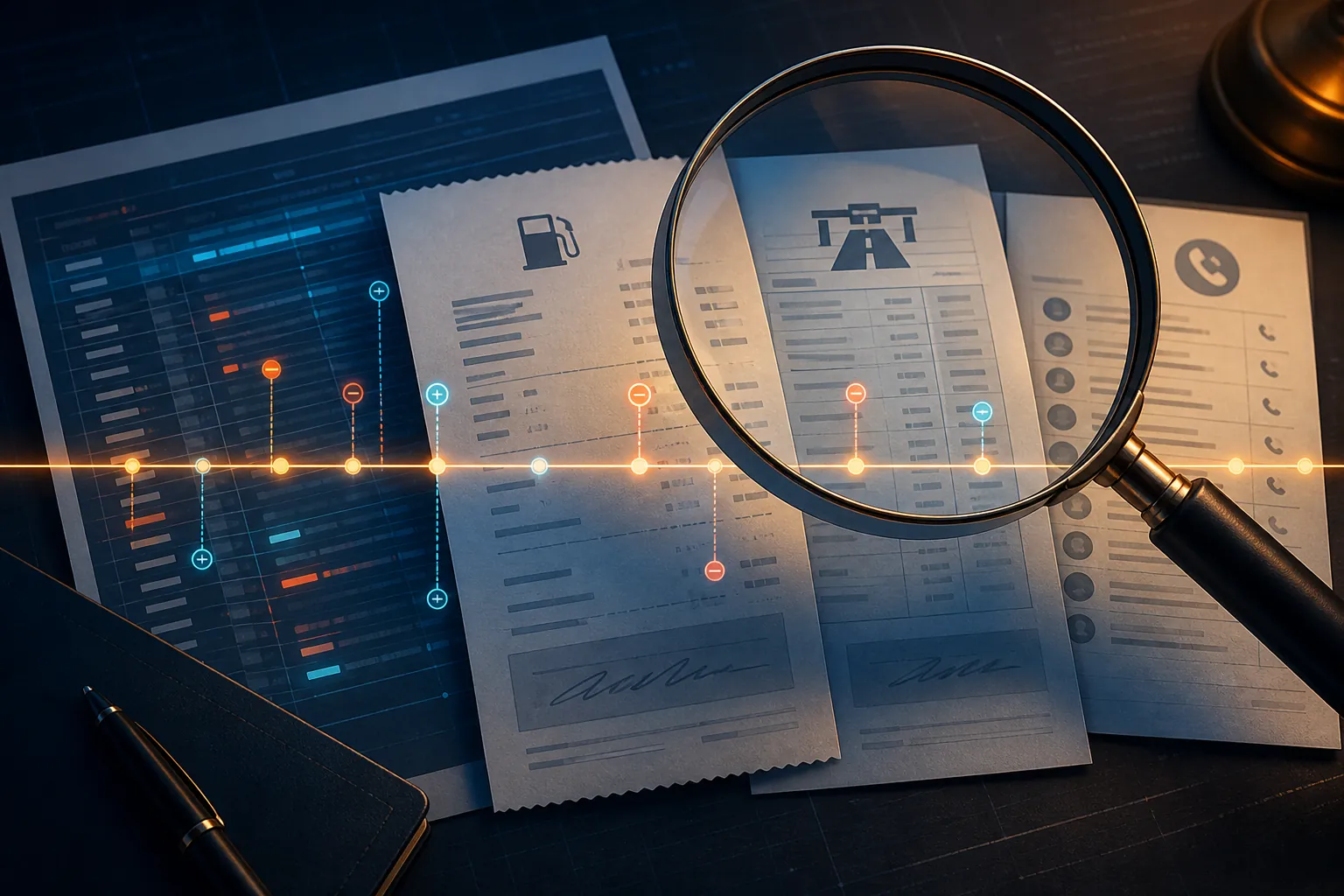
A useful review sequence moves across sources rather than down one carrier report:
- Build the ELD timeline first, preserving the source file, export metadata, and edit history.
- Mark every edit, annotation, unidentified driving event, malfunction, and late certification.
- Place fuel purchases and toll records on the same timeline to confirm location and movement.
- Add dispatch messages and trip instructions to show what the carrier expected the driver to do and when.
- Compare phone records to duty status, movement, and communications. The point is not simply phone use; it is whether the records conflict with the claimed status or reveal pressure, delay, or distraction.
- Use inspection and maintenance records only for the questions they actually answer: vehicle condition, reported defects, repairs, and timing. Do not make them carry an hours-of-service argument they do not support.
The HOV Law trucking-evidence discussion expressly identifies cross-verification against fuel, toll, dispatch, and phone data as part of testing ELD records.[4] The point is modest and important: a log entry is evidence, not a conclusion. A mismatch between a claimed off-duty period and a toll transaction may matter. A late edit that merely corrects a clerical error may not. The workflow has to distinguish contradiction from context.
| If the log shows | Compare it against | What the comparison may prove |
|---|---|---|
| Long off-duty or sleeper period | Fuel, toll, GPS, dispatch, and phone records | Whether the truck or driver appears to have been moving or communicating during the claimed rest period |
| Edit after the crash or after notice | ELD audit trail, vendor access logs, preservation letter date | Who changed the record, when, and whether the change followed litigation notice |
| Unassigned driving event | Driver assignment records, route records, dispatch, and vehicle identifiers | Whether driving time was left unattributed or later assigned |
| Malfunction or missing period | Inspection records, device records, supporting documents, and paper backup records if any | Whether the gap has a technical explanation or conceals a trip segment |
When records are missing
Missing records should be handled as a chronology, not an accusation first. The chronology should answer: when did the crash occur, when did counsel send notice, what exactly was identified for preservation, what retention or overwrite period applied, what did the carrier produce, what did the carrier omit, what did the vendor have, and what explanation was given for the gap?
That record supports two different requests. One is a production request: compel the carrier or vendor to produce the native data, export, audit trail, or account record still available. The other is a remedial request: if the evidence is gone after a duty to preserve attached, seek the remedy allowed by the forum’s spoliation law. The remedy may range from another production order to an adverse inference, evidentiary preclusion, or more severe sanctions, depending on the facts and governing law.[7]
The lawyer who wins the log fight is not the one who merely asks early. It is the one who documents notice, names the right formats and custodians, escalates before retention and overwrite practices do the carrier’s work for it, and refuses to treat a carrier-generated summary as the end of the proof.
References
- How long must a motor carrier retain electronic logging device (ELD) record of duty status (RODS) data? — FMCSA
- General Information about the ELD Rule — FMCSA
- How do I obtain a copy of the truck driver’s logbook after an accident in Houston, Texas? — Abraham, Watkins, Nichols, Agosto, Aziz & Stogner
- Truck Accident Black Box Evidence — HOV Law
- California Truck Accident Black Box & ELD Spoliation — LBAT Law
- What Documents Can You Legally Force Trucking Companies to Produce During Discovery in New York Semi-Truck Injury Cases? — Napoli Shkolnik
- A Double-Edged Sword: The Defense of Trucking Claims in the Aftermath of the ELD Mandate — FMG Law
- Spoliation in Commercial Trucking Litigation — Beasley Allen
Grounded in
This procedure is grounded in 49 CFR § 395.8(k), independent of any single documented case. See the Regulation tracker for the governing text.
Cases this step would have prevented
No cases have been explicitly linked to this checklist yet. See Risk Digest for documented incidents generally.
← Back to WorkflowsReport a correction or tip
Spotted an outdated figure, a misstated fact, or a ruling this workflow checklist should reflect? Public comments are disabled for this content given the professional cost of a misreported case outcome, penalty amount, or rule text — use the structured correction channel instead.
Report a correction or tip for this record →