
What AI knows before an ICE airport arrest
Airport immigration enforcement now depends on automated matching systems — TSA passenger-list screening, CBP biometric entry/exit, and facial-recognition tools like Mobile Fortify and ELITE — whose documented failures, including ELITE leads behind warrantless arrests, are verifiable risk signals. The record supports a practical check for litigators, legal-tech buyers, and travelers: verify what the government already holds and matches before an ICE airport arrest.
- Applicable role
- attorney
- Workflow stage
- review

An ICE airport arrest rarely begins with an officer seeing a traveler for the first time at the gate. By then, a name may already have been compared against passenger-list data, a travel document may have been connected to an immigration record, and a face may have passed through a biometric environment built for entry, exit, identity verification, or enforcement support. The question behind airport “know your rights” guidance therefore starts earlier than the terminal encounter: what automated claim already exists, where did it come from, and what record can later be tested?
This is not a substitute for legal advice about what to say to an officer, whether to sign a document, or when to ask for counsel. The narrower problem here is evidentiary. Airport enforcement now sits inside a layered matching environment, and several of the relevant layers are named in public government materials: passenger-list screening, CBP biometric entry and exit operations, and facial-recognition lead tools such as Mobile Fortify and ELITE. When those systems return a match, a “not found,” or an investigative lead, the output should be treated as a machine-assisted assertion, not as a fact that became true because it appeared in an agency workflow.
CBP’s own airport biometrics page describes biometric environments across 238 airports, 14 Preclearance locations, and 66 international departure locations, a footprint large enough to make airport AI enforcement a matter of infrastructure rather than occasional experimentation.[1]
The arrest before the arrest
A traveler experiences the airport as a sequence: check in, security, boarding, arrival, inspection, baggage, exit. The enforcement record is assembled differently. It is built out of identifiers. A name, date of birth, passport number, alien registration number, photograph, itinerary, prior immigration encounter, visa record, or watchlist-related hit may appear at different points in different systems.
That distinction matters after an arrest. The officer’s report may describe a stop, an encounter, or a confirmation step. But the useful verification questions often sit one layer behind the narrative: what triggered attention to this person, what system produced the lead, what database was queried, what biometric or biographic identifier was used, and what did the system actually return?
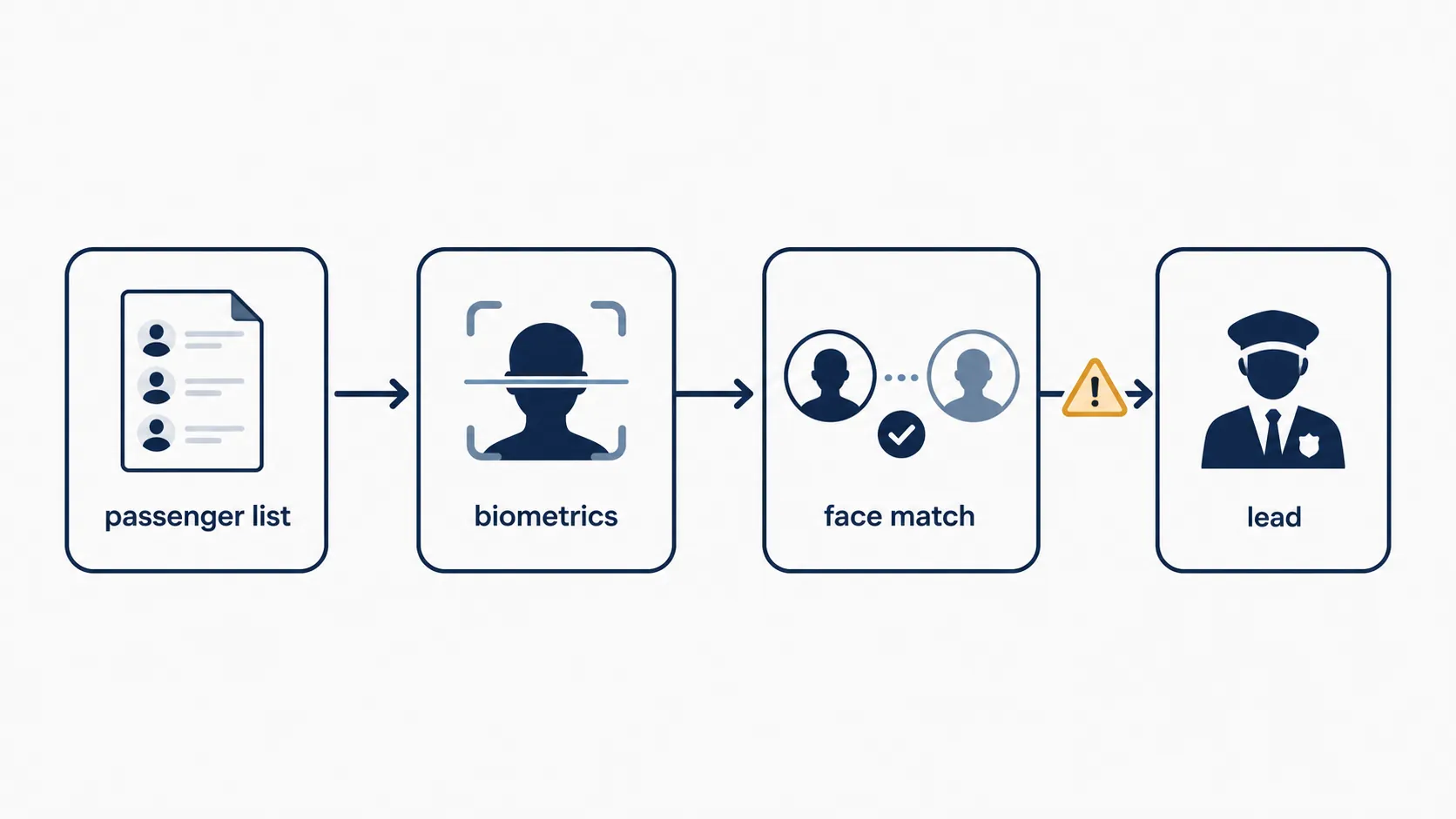
For lawyers and legal-technology buyers, the useful mental model is not “AI surveillance” in the abstract. It is a chain of custody for claims:
- Passenger-list screening can identify a traveler or itinerary before the person reaches an officer.
- CBP biometric environments can connect a live traveler, travel document, or stored image to government-held identity records.
- Facial-recognition tools can return a match, a failed match, a “not found” result, or a lead.
- An officer or enforcement team can then treat that output as part of the basis for questioning, detention, arrest, or a handoff.
Those are different functions. A passenger-list hit is not the same thing as a biometric confirmation. A biometric comparison is not the same thing as probable cause. A facial-recognition lead is not the same thing as a warrant. Collapsing those distinctions is how machine output becomes enforcement confidence without leaving the reader, the family, or the defense with a clean way to test it.
What each layer appears to contribute
The systems implicated in an airport arrest do not all answer the same question. That is the first sorting move for anyone reconstructing the record.
| Layer | Practical question it answers | Verification issue |
|---|---|---|
| Passenger-list screening | Is this traveler or itinerary already of interest before travel or during travel processing? | What list, identifier, or record produced the attention? |
| CBP biometric entry/exit | Does this face, document, or traveler correspond to a stored identity record in the airport biometric environment? | What image or identifier was compared, and what did the system return? |
| Mobile Fortify | Can a mobile facial-recognition query return an identity result or fail to find one? | Was the result correct, wrong, incomplete, or “not found”? |
| ELITE | Did a facial-recognition lead contribute to an enforcement action? | Was the lead legally sufficient for the action taken, and how did a court evaluate reliance on it? |
This table is deliberately modest. It does not say that any one layer causes every airport arrest. It says that, once an airport arrest occurs, these are the categories of automated or machine-assisted claims worth separating. If a record says only that an officer “identified” a traveler, the next question is whether identification means document review, database return, biometric comparison, facial-recognition lead, human recognition, or some combination.
That is also where vendor-style accuracy language becomes least useful. A system can perform well in aggregate and still be wrong in the case that matters. A tool can be designed for lead generation and then be treated too heavily in an arrest workflow. A “not found” result can be operationally meaningful even though it is not a positive match. The legal problem is usually not whether a technology has any legitimate use. It is whether the government can show what was queried, what was returned, who reviewed it, and what legal weight the output was given.
CBP biometrics are the infrastructure layer, not the whole story
The CBP airport biometrics footprint is the reason the analysis has to start before the officer encounter. A biometric environment across 238 airports, 14 Preclearance locations, and 66 international departure locations means the airport is already a place where identity is routinely mediated through stored records and automated comparison.[1]
That does not prove that CBP biometrics caused a particular ICE arrest. It does prove something narrower and more useful: there are identifiable system surfaces where the government may have compared a person’s face, document, or travel record before a visible enforcement action occurred. For a litigator, that changes the discovery and records strategy. For a buyer evaluating facial-recognition or identity-verification claims, it changes the question from “is the model accurate?” to “can the organization reconstruct the comparison when the output is challenged?”
The operational risk sits in the gap between identity management and enforcement. Biometric entry and exit programs can be described as travel-processing or identity-verification infrastructure. But when an immigration arrest follows an identity hit, the record needs to show more than the existence of a biometric program. It needs to show the relevant query, result, reviewer, downstream action, and legal basis for that action.
Mobile Fortify errors are not just technical errors
Mobile Fortify matters because documented wrong results and “not found” results put pressure on the easiest assumption in an enforcement file: that a system return is a neutral identity fact. A wrong match can point officers toward the wrong person. A “not found” result can be overread as proof that someone is concealing identity, lacks status, or is absent from expected records. Neither inference follows automatically.
The important point is not that Mobile Fortify always fails. The record described here supports the narrower conclusion that the tool has documented failure modes, including wrong or “not found” outputs, and those outputs are legally relevant when they are folded into an enforcement narrative. A downstream reviewer should ask whether the officer treated the output as a lead, a confirmation, an exclusion, or a reason to escalate.
This is the same class of problem legal AI reviewers see when a system fabricates a citation and a lawyer later launders it into a filed brief. The first error is bad. The second error is worse: a human process grants institutional authority to an output that should have remained provisional. In an airport arrest file, that laundering can happen when a facial-recognition result is summarized as “identified,” “confirmed,” or “matched” without preserving the underlying query details and confidence limits.
ELITE is the legal stress test
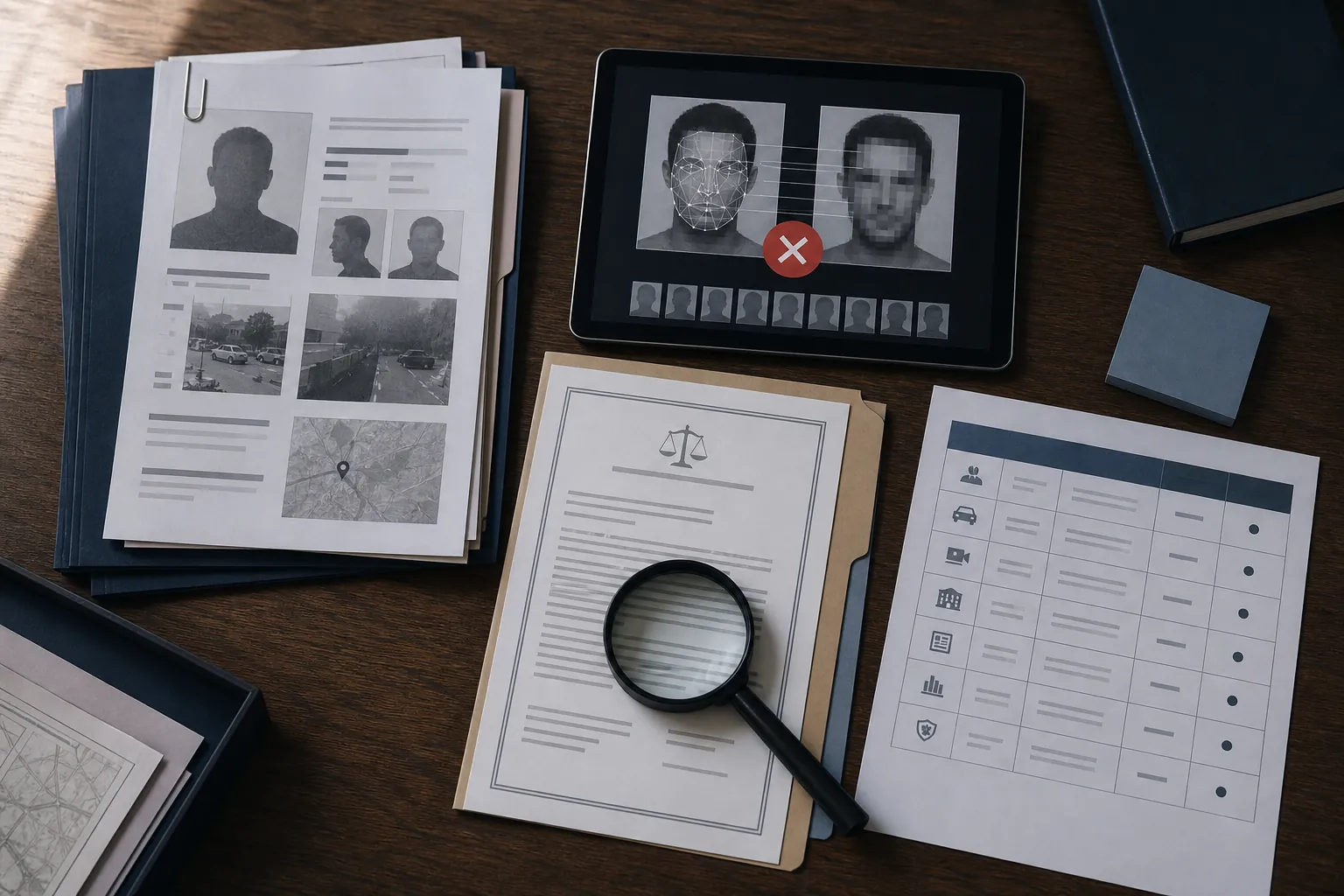
ELITE deserves the most attention because it connects the matching layer to judicially reviewable harm. The documented concern is not merely that a facial-recognition tool generated leads. It is that ELITE-generated leads sat behind warrantless arrests that a federal judge called unlawful. That is a different order of risk from a speculative privacy objection.
A lead tool can have a legitimate investigative role and still be legally overread in a particular workflow. The verification question is whether the lead was treated as an invitation to investigate, as an identity confirmation, or as a practical substitute for the legal showing needed to arrest. When a court later says the arrests were unlawful, the technology does not remain in a procurement deck or a privacy impact statement. It becomes part of the evidentiary record that explains how government confidence formed.
That is why ELITE is more than a brand name in this analysis. It is a test of whether an agency workflow keeps lead generation, human review, and legal authority separate. If those boundaries blur, a facial-recognition output can become the practical engine of a warrantless arrest while the file describes the result in ordinary enforcement language.
For a defense lawyer or KM attorney building a post-arrest checklist, the ELITE lesson is concrete. Do not stop at the officer’s final statement of probable cause or removability. Ask what lead system first surfaced the person, what input image or record was used, what databases were searched, what the system returned, whether a human reviewer rejected or confirmed anything, and whether the legal basis for the arrest existed independently of the automated lead.
What “know your rights” misses when it starts at the terminal
Standard airport rights guidance has its place. Travelers still need to know that immigration status, citizenship, inspection posture, and location in the airport can affect the encounter. They need actual legal advice for their facts. Repeating that guidance here would miss the harder evidentiary problem this record raises.
By the time a traveler is approached, the government may already be acting on a compiled identity picture. Some pieces may be reliable. Some may be stale, ambiguous, mismatched, or legally insufficient. A family member trying to reconstruct the arrest may hear only that “ICE was waiting” or that the traveler “was flagged.” Those phrases are not enough. “Flagged” by what? A passenger list? A visa or removal record? A biometric comparison? A facial-recognition lead? A manual review? A separate warrant or administrative record?
The right to challenge the arrest depends on that detail. So does the ability to evaluate the technology. Accuracy claims about facial recognition are thin comfort if the operational file cannot show which image was used, which system returned the result, what the result meant, and whether an officer treated it as more certain than the system documentation allowed.
The records worth checking
The practical verification path is not a full traveler checklist. It is a document path. Start with the government’s own system descriptions and use-case materials, then compare them with the arrest record, officer declarations, court filings, and any available discovery. The point is to force each automated claim back into a named system and a reviewable output.
- If the file says the traveler was identified before arrival, look for the passenger-list, itinerary, or record-matching basis.
- If the file refers to biometric verification, identify the biometric environment, the input image or document, and the returned result.
- If a mobile facial-recognition tool was used, separate a positive match from a “not found” result and from a human officer’s later interpretation.
- If ELITE or another lead tool appears, ask whether the lead merely initiated investigation or became the practical basis for detention or arrest.
- If the government relies on an officer’s summary, ask for the underlying query, return, timestamp, reviewer, and policy governing use of the output.
That last item is where many records become thin. The enforcement narrative may be written in human terms even when the trigger was automated. A court reviewing an arrest does not need a lecture about artificial intelligence; it needs to know whether the facts supporting the government’s action were reliable, lawfully obtained, and legally sufficient. The same is true for a legal-tech buyer evaluating whether identity or facial-recognition products are fit for high-stakes legal workflows.
Reliability is a workflow property
Airport enforcement systems are often discussed as if reliability lives inside the model. That is too narrow. Reliability also depends on which database was searched, whether the image quality was usable, how stale the underlying record was, whether the system was designed for identification or lead generation, how the result was displayed, what training the officer had, and what the policy allowed the officer to do next.
Mobile Fortify’s wrong or “not found” outputs matter for that reason. ELITE-generated leads behind unlawful warrantless arrests matter for the same reason. The issue is not only model performance in a lab or aggregate program success in an agency report. It is whether a specific output moved through a specific workflow without being checked against its documented limits.
A procurement deck may call a tool accurate. A DHS inventory may list the use case. A CBP page may describe the biometric environment. A court order may later show what happened when a lead became an arrest. Those materials should be read together, not because they prove the same thing, but because each one answers a different verification question.
| Document type | What it can prove | What it usually cannot prove by itself |
|---|---|---|
| Agency use-case inventory | That a system or AI use case exists and how the agency describes it | That the system was used correctly in a specific arrest |
| CBP biometric program material | Where biometric environments operate and what the program says it does | That a particular match supplied legal authority to arrest |
| Officer report or declaration | How the government narrates the encounter and basis for action | The full technical path behind the lead unless the underlying system output is attached or described |
| Court order | How a judge evaluated the legality of the government’s reliance on the record | General failure rates for every use of the technology |
Where the verification line should be drawn
The record does not support saying that every airport arrest involving automated systems is unlawful, or that every biometric match is suspect. It does support a stricter rule for reading the file: do not let a match, lead, or “not found” result disappear into a generic statement that the traveler was identified.
For airport ICE arrests, “know your rights” now begins earlier than the encounter itself. It begins with knowing what automated claims may already exist about the traveler, then checking those claims against DHS’s own system descriptions, CBP’s biometric footprint, the tool’s documented failure modes, and the court record when an automated lead becomes an arrest.
References
- Biometrics Environments: Airports, CBP.gov, modified Jul. 17, 2026.
Grounded in
This procedure is grounded in the cited rule or opinion, independent of any single documented case. See the Regulation tracker for the governing text.
Cases this step would have prevented
No cases have been explicitly linked to this checklist yet. See Risk Digest for documented incidents generally.
← Back to WorkflowsReport a correction or tip
Spotted an outdated figure, a misstated fact, or a ruling this workflow checklist should reflect? Public comments are disabled for this content given the professional cost of a misreported case outcome, penalty amount, or rule text — use the structured correction channel instead.
Report a correction or tip for this record →