
Know Your Rights if ICE Arrests You at the Airport for an Expired Visa
Noncitizens with expired visas face ICE airport arrests under 8 U.S.C. § 1226(a) but retain Fifth Amendment due-process rights and habeas corpus options. This workflow explains how to preserve those rights through documented pre-travel preparation, encounter scripts, and post-arrest procedural steps.
- Applicable role
- attorney
- Workflow stage
- pre-filing
- Primary source
- 8 U.S.C. § 1226(a)
Last verified: July 29, 2026. This article is for legal information and risk-preparation purposes, not legal advice for any specific traveler, client, or case.
The hard question in an airport arrest involving an expired visa is not whether the expired visa matters. It does. ICE may use 8 U.S.C. § 1226(a) to arrest and detain a noncitizen pending removal proceedings, and a Form I-200 is the administrative warrant usually sitting behind that arrest authority.[1][2] The more useful question is whether the traveler, family, and counsel can later prove what happened: when the right to silence was asserted, whether counsel was requested, what document ICE showed, where the client was taken, and what custody theory ICE used after booking.
An expired visa does not cancel due process. The Fifth Amendment protects “persons” in the United States, including noncitizens, and the Supreme Court has treated immigration detention as subject to constitutional limits even though removal proceedings are civil rather than criminal.[3][4] That distinction matters at the airport: there is no automatic Sixth Amendment appointed-counsel right, but there is a right to remain silent, a right to seek counsel at the traveler’s own expense, and a right to challenge unlawful or prolonged detention through habeas corpus where the facts support it.[5]
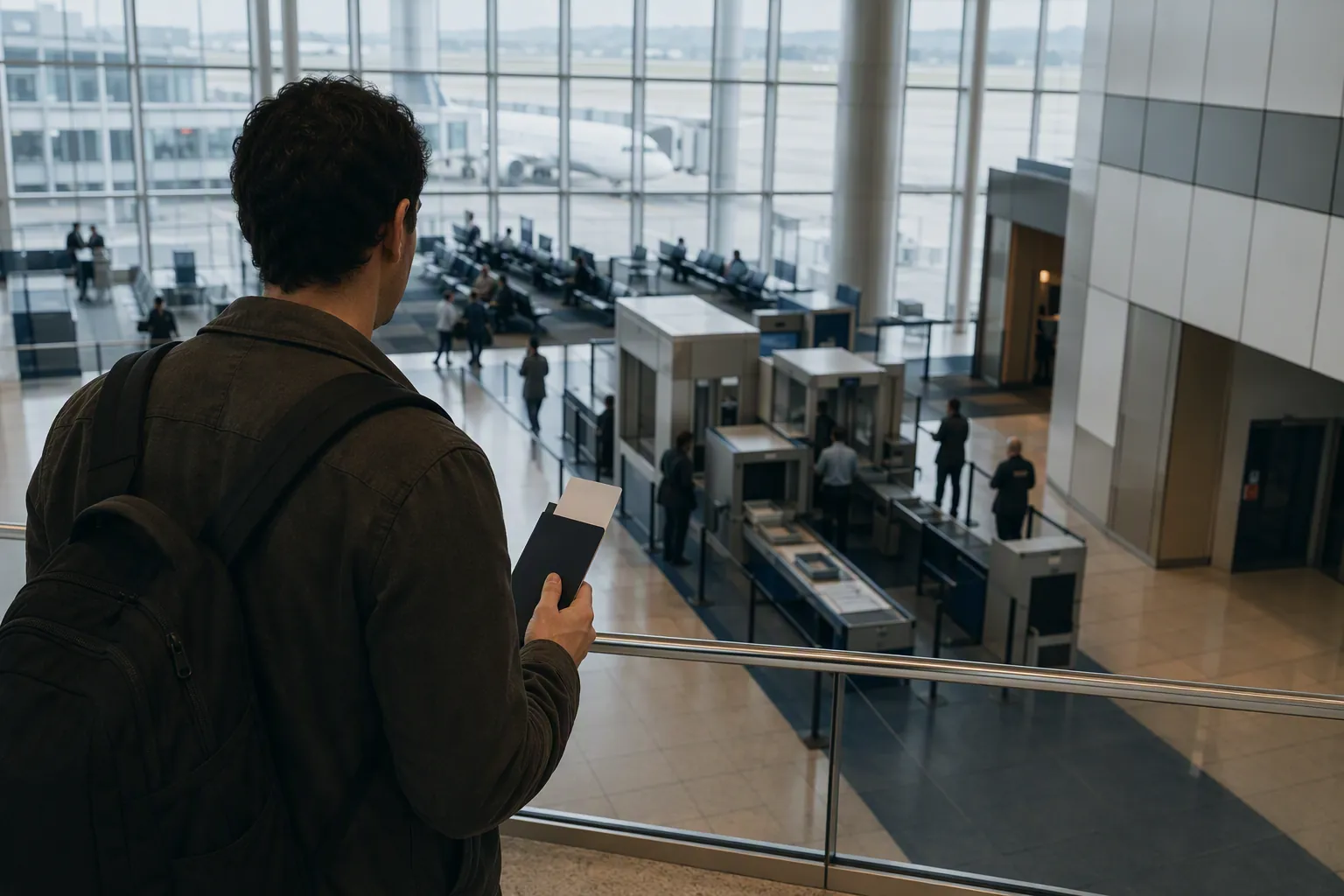
That legal split is why a rights plan cannot begin at the boarding gate. By then, TSA has already run the passenger identity check, the airline has already associated the person with a flight, and any ICE response may already be in motion. Reuters reported that TSA’s Secure Flight Program transmitted more than 31,000 passenger records to ICE since January 2025, leading to more than 800 arrests through February 2026; the same reporting cited a former ICE official describing a 75% hit rate in that official’s region.[6] DHS confirmation of those exact figures is not in the materials reviewed here, so the numbers should be treated as best-available reporting rather than a government-verified total.
Before Travel, Verify the Case File, Not the Client’s Memory
The pre-travel conversation should be documentary. “My visa expired but my case is pending” is not enough. Counsel needs to know which document expired, which status was last granted, whether the I-94 period ended, whether any application or petition is pending, whether a prior removal order exists, and whether the client has ever entered without inspection. Those facts move the traveler between very different risk categories, including some that affect bond eligibility after arrest.
For a fuller screening template, route the client through How to Verify Air Travel Safety for Noncitizen Clients before the ticket is purchased. The purpose is not to promise safe travel. It is to decide whether travel should be delayed, whether counsel should be on standby, and what record must be ready if the client is stopped.
| Pre-travel question | Why it matters if ICE appears at the airport |
|---|---|
| What is the last lawful status and expiration date? | A visa stamp, I-94 admission period, and employment authorization document can expire on different dates; ICE may rely on the overstay theory, while counsel may need to show pending relief or a different custody posture. |
| Is there a pending I-797 receipt, renewal, asylum filing, adjustment filing, or work authorization renewal? | Pending filings do not automatically prevent arrest, but they can affect equities, bond arguments, and the first call counsel makes after location is confirmed. |
| Is there any prior removal order, missed hearing, voluntary departure issue, or reinstatement risk? | A prior order can change the case from a routine bond posture to a much narrower challenge. |
| Did the client enter with inspection, enter without inspection, or arrive as an applicant for admission? | Bond eligibility and detention statutes may turn on entry history, especially under current litigation over entry-without-inspection detention. |
| Is there any criminal history, open charge, warrant, or workplace-linked investigation? | The issue is not moral character in the abstract; it is whether ICE or the immigration court will treat the case as a public-safety, flight-risk, or mandatory-detention matter. |
| Who will answer the phone if the client disappears into processing? | A rights assertion that no one can document is weak evidence. Counsel and family need a call tree before the checkpoint. |
The client should travel with copies, not a suitcase archive. A useful packet usually includes the passport biographic page, visa page, most recent I-94, current and prior I-797 notices, work authorization card or renewal receipt if relevant, immigration-court notices, attorney contact information, and a signed Form G-28 if representation is already established. Originals may be necessary for travel, but counsel should already have scans. The worst version of the airport call is the one where the detained person has the only copy of the receipt notice in a bag ICE has separated from them.
What the Client Says at the Gate Should Be Short Enough to Remember
The airport script is not a magic phrase. It is a preservation tool. The client should not argue immigration law with officers, guess at dates, explain old filings from memory, or consent to searches because the hallway is embarrassing. The useful language is brief, repeated, and capable of being reconstructed later.
- “I wish to remain silent.”
- “I want to speak with my attorney.”
- “I do not consent to a search of my phone, bags, or papers.”
- “Please show me the warrant or document authorizing this arrest.”
- “Please tell my attorney where I am being taken.”
At an airport or border-adjacent setting, search rules and admission-related questioning can be more limited for the traveler than in an ordinary interior encounter, especially for people treated as applicants for admission. That caveat does not make the script useless. It keeps the client from creating unnecessary statements, and it gives counsel a timestamped event to investigate: the right was asserted before transport, before booking, or before any written statement was signed.
If officers show a Form I-200, the client should understand what it is. It is an ICE administrative warrant, not a judicial warrant signed by a federal judge or magistrate.[2] The distinction is central in workplace and home-entry cases, and it also matters when family members or employers later describe the arrest. For the administrative-versus-judicial warrant issue, see Workplace ICE Arrests and the Judicial Warrant Distinction.
The July Airport Cases Show Different Failure Points
The July 2026 airport matters should not be flattened into one rule. Phu Nguyen was reported arrested at Las Vegas airport on July 13 and at LAX on July 14 after his visa had expired in 2015; the reporting also described an issue involving partial abandonment of handcuffing.[7] That fact pattern is useful because it shows how an old overstay can surface through travel, and how small custody details can later matter if counsel challenges the manner or basis of detention.
Chantal Morales Rojas was reported detained at Denver airport on July 20 while boarding a flight, with a habeas petition filed on July 25.[7] That case is not just an airport anecdote; it tests how far ICE can push warrantless domestic boarding-gate arrests and what record is needed once the client has already been moved. The habeas track is discussed in more detail in Southwest Gate Arrest: Habeas Petition Tests ICE’s Warrantless Power.
Iryna Gorb, a Ukrainian national, was reported detained at SFO on July 22 on an expired visa despite a pending work authorization renewal.[7] Pending employment authorization materials do not immunize a traveler from arrest. They do, however, change what counsel should be ready to prove: the filing history, the receipt date, the agency posture, and why detention should not be treated as if the person simply vanished from the immigration system.
Lorenzo Thompson, a Southwest flight attendant, was reported detained at Nashville on July 14 on an expired C1/D visa.[7] That scenario adds a workplace layer to the travel risk. A crew member may have employer records, scheduling data, badge access, and travel history that become relevant after arrest. The C1/D consequences are covered separately in Flight Attendant C1/D Visa Overstay: Legal Consequences, and the airline-boycott framing is separated from the legal warrant issue in Why the Southwest Boycott Misses the Legal Distinction.
After Arrest, the First Task Is Location and Custody Basis
Once ICE takes the client, the family’s first instinct is usually to ask whether the arrest was legal. Counsel cannot answer that cleanly without the custody chain. The first operational questions are narrower: Which agency has the person? What is the A-number? Where is the person physically held? Was the arrest made under § 1226(a), under an arrival or applicant-for-admission theory, under a reinstated order, or under some other custody basis? Has a Notice to Appear been served? Has ICE made a bond decision? Has the person signed anything?
The family or employer should write down times, not impressions: last text before detention, gate or checkpoint location, officer agency markings if visible, flight number, whether luggage traveled without the client, who called whom, and any statement about destination. If the client calls from custody, the call should be used to confirm location, A-number, documents shown, medical needs, and whether the client invoked silence and counsel. It should not become an unrecorded strategy session about facts the government may later characterize differently.
| Post-arrest item | What counsel needs it for |
|---|---|
| A-number and full legal name used by ICE | To locate the client, enter appearance, request records, and track immigration-court filings. |
| Custody location and transfer history | To determine the proper venue for emergency motions, custody requests, and possible habeas review. |
| Copy or description of Form I-200, Notice to Appear, or other custody paperwork | To identify the asserted arrest authority and any defects in probable cause, service, or charging theory. |
| Exact language used by the client | To preserve silence, counsel request, non-consent, and refusal to sign if those facts later become disputed. |
| Pending immigration receipts and proof of equities | To support custody redetermination, prosecutorial communications, or bond arguments where available. |
| Airport and airline timeline | To reconstruct whether the encounter happened at TSA, gate boarding, jet bridge, arrival, baggage claim, or a workplace-linked travel point. |
Scale matters only because it affects response time. TRAC reported that ICE detained 43,138 people in June 2026, with 39,563 detained by ICE and 3,575 by CBP; the daily detention population peaked above 73,400 in early 2026, and 70.6% of the 65,765 people in ICE detention as of July 11, 2026 had no criminal convictions.[8] Those numbers do not prove anything about a particular airport arrest. They explain why families may not get a clean answer quickly and why counsel should not wait for the system to volunteer paperwork.
Bond Eligibility Is a Jurisdictional Question, Not a Slogan
For many noncitizens detained under § 1226(a), bond is part of the ordinary custody analysis: ICE may make an initial custody determination, and the person may seek review before an immigration judge. But in 2026, no careful lawyer should tell every airport detainee that a bond hearing is guaranteed. The current litigation over entry-without-inspection detainees makes that statement too broad.
NILC’s rapid response materials report that a February 18, 2026 Maldonado Bautista order restored bond hearing rights nationwide for entry-without-inspection detainees, but that order was stayed on March 6, 2026 except in the Central District of California.[9] The same materials identify the Fifth Circuit’s Buenrostro-Mendez posture as blocking bond for entry-without-inspection detainees in Texas, Louisiana, and Mississippi.[9] That means bond analysis must start with entry history, detention location, circuit, and district, not with a generic “qualified right to bond” sentence.
For an expired-visa traveler who was admitted, overstayed, and is detained under § 1226(a), counsel’s first bond questions are usually practical: Is the client subject to mandatory detention for some other reason? Does ICE allege public-safety risk or flight risk? What pending relief, family ties, employment history, medical issues, or compliance history can be documented? For a person ICE treats as an applicant for admission or as covered by an entry-without-inspection theory, the analysis may be narrower and more venue-dependent.
The distinction is not academic. If the person is held in the Central District of California, the Maldonado Bautista carveout may matter. If the person is held in Texas, Louisiana, or Mississippi and classified as entry without inspection, Buenrostro-Mendez may foreclose the bond route described in other jurisdictions.[9] If the person was arrested at LAX but transferred to a detention facility elsewhere, counsel has to track both the arrest facts and the present place of confinement before choosing the procedural path.
When the Government’s Trigger Is Data, Preserve the Evidence Trail
Airport enforcement increasingly depends on records that the traveler never sees: passenger manifests, Secure Flight transmissions, watchlist or immigration database hits, employer travel schedules, and automated flags. The Reuters figures do not prove that any specific case was driven by one system, but they are enough to justify asking how the match occurred when an airport arrest follows domestic travel.[6]
Counsel should separate two questions. First, what did ICE rely on for probable cause to issue or execute the administrative warrant? Second, was any database, AI tool, or matching system wrong, stale, or incomplete? The second question may not defeat detention by itself, but it can change discovery requests, FOIA strategy, bond presentation, or habeas framing. For a deeper evidence track, see How ICE’s AI Tools Found a Southwest Flight Attendant and How to Challenge AI Evidence in ICE Detention Cases.
Habeas Begins When Detention Becomes the Issue
A habeas petition is not a substitute for every immigration-court argument. It is a federal district-court challenge to unlawful custody, commonly brought under 28 U.S.C. § 2241 when detention is allegedly unlawful, prolonged, or unsupported by the required process.[10] The venue, respondent, custody location, and requested relief all have to be handled with care.
Vera Institute materials report that 82 out of 90 federal judicial districts saw habeas filings challenging immigrant detention.[11] That breadth does not mean habeas is easy or always available. It means counsel should preserve the facts that make habeas possible if ordinary custody review fails: the arrest basis, the lack or denial of bond process, transfer history, medical or family urgency, prolonged detention timeline, and any mismatch between the government’s asserted authority and the client’s actual immigration record.
The post-arrest file should be built as if another lawyer may need to read it cold at midnight: travel itinerary, document packet, encounter notes, custody paperwork, call log, A-number, detention locator results, bond request, immigration-court filings, and any federal-court deadline analysis. A habeas complaint drafted from panic usually shows it. A habeas complaint drafted from a preserved chain has something to test.
The Rights Record Is the Product
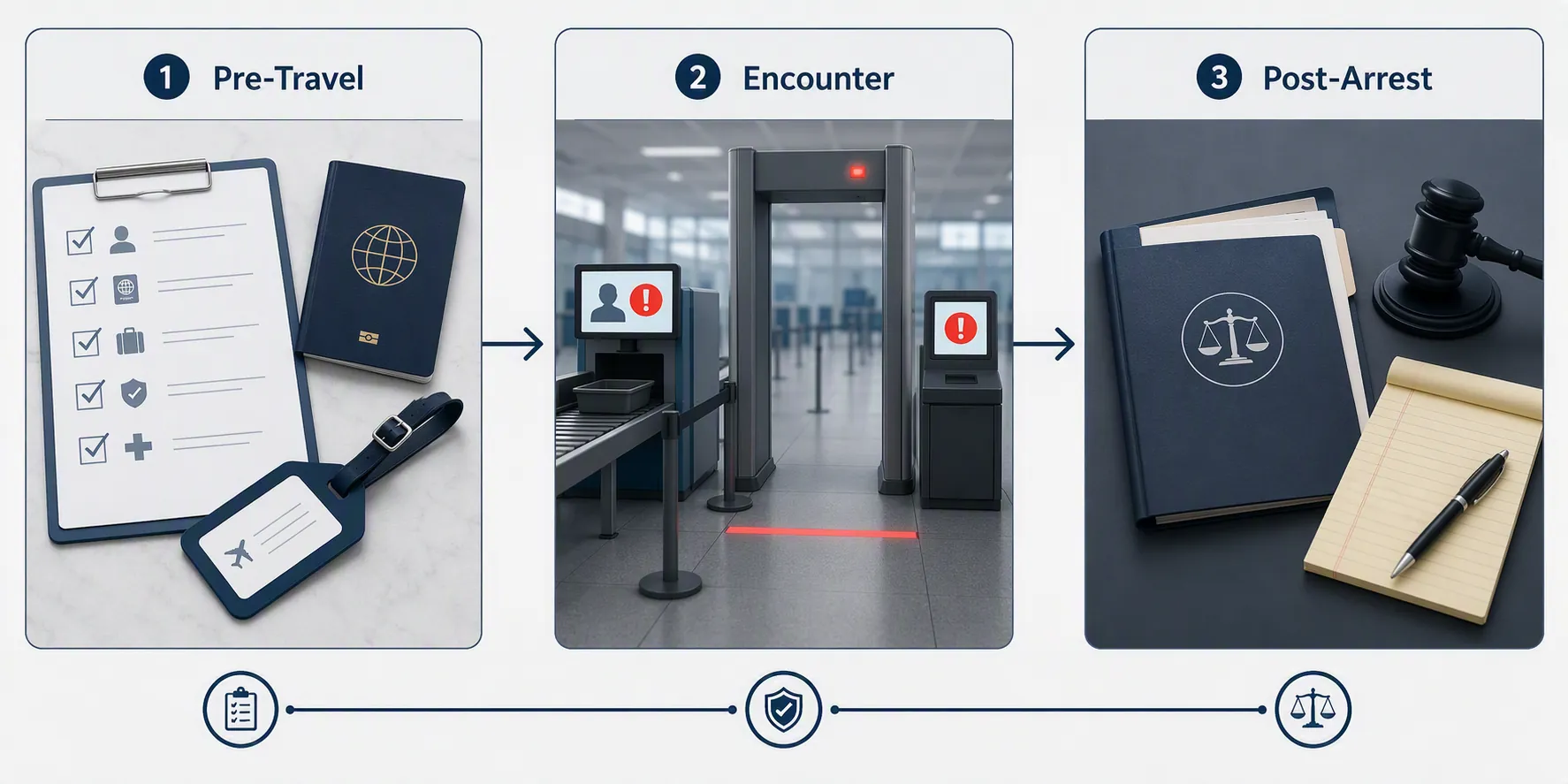
A traveler with an expired visa may be arrested at a U.S. airport under administrative immigration authority. That is the beginning of the analysis, not the end of it. The client still has due-process protections, may have access to bond depending on custody statute and jurisdiction, and may be able to seek habeas review if detention becomes unlawful or prolonged. The difference between a thin arrest story and a usable rights record is the workflow: verified documents before travel, short assertions during the encounter, and a post-arrest file that lets counsel move from “ICE took the client” to custody basis, bond posture, and federal-court review.
References
- 8 U.S.C. § 1226 — Apprehension and Detention of Aliens, Legal Information Institute, https://www.law.cornell.edu/uscode/text/8/1226
- Form I-200, Warrant for Arrest of Alien, U.S. Immigration and Customs Enforcement, https://www.ice.gov/doclib/foia/dro_policy_memos/warrant-for-arrest-of-alien.pdf
- Reno v. Flores, Supreme Court of the United States, May 17, 1993, https://supreme.justia.com/cases/federal/us/507/292/
- Zadvydas v. Davis, Supreme Court of the United States, June 28, 2001, https://supreme.justia.com/cases/federal/us/533/678/
- Know Your Rights: Immigrants’ Rights, American Civil Liberties Union, https://www.aclu.org/know-your-rights/immigrants-rights
- TSA’s Secure Flight Program transmitted passenger records to ICE, Reuters investigation reported via Immigration Policy Tracking Project, April 2026, https://immpolicytracking.org
- Airport ICE arrest reporting on Phu Nguyen, Chantal Morales Rojas, Iryna Gorb, and Lorenzo Thompson, CNN / The New York Times, July 28, 2026, https://www.cnn.com
- Immigration Detention Quick Facts, TRAC Immigration, July 2026, https://tracreports.org/immigration/detentionstats/
- Rapid Response Update on Bond Eligibility, National Immigration Law Center, 2026, https://www.nilc.org
- 28 U.S.C. § 2241 — Power to Grant Writ, Legal Information Institute, https://www.law.cornell.edu/uscode/text/28/2241
- Habeas filings challenging immigrant detention, Vera Institute of Justice, https://www.vera.org
Grounded in
This procedure is grounded in 8 U.S.C. § 1226(a), independent of any single documented case. See the Regulation tracker for the governing text.
Cases this step would have prevented
No cases have been explicitly linked to this checklist yet. See Risk Digest for documented incidents generally.
← Back to WorkflowsReport a correction or tip
Spotted an outdated figure, a misstated fact, or a ruling this workflow checklist should reflect? Public comments are disabled for this content given the professional cost of a misreported case outcome, penalty amount, or rule text — use the structured correction channel instead.
Report a correction or tip for this record →