
What Are Your Rights During ICE Detention at US Airports in 2026?
ICE deployment at US airport checkpoints since March 2026 has created a new risk environment for all travelers. This guide provides a status-specific checklist of legal rights and concrete steps to take when encountered by ICE or CBP at a US airport.
- Applicable role
- pro se litigant
- Workflow stage
- pre-filing
- Primary source
- CBP Directive 3340-049B
Last verified: July 30, 2026, Q3 2026. This guide is legal information, not legal advice for any individual case. It separates primary legal rules from reported enforcement practice, advocacy guidance, and law-firm interpretation where the source base differs. Airport enforcement practice is changing, and the safest answer can turn on facts that are not visible in a checklist: prior orders, criminal history, abandonment questions, visa category, pending applications, travel history, and the exact place where the questioning happens.
The practical question in 2026 is not simply whether you have “rights during ICE detention at an airport.” You do. The harder question is which protocol applies to you at that moment: a U.S. citizen returning from abroad, a green-card holder being handed Form I-407, a visa holder in CBP secondary inspection, a DACA recipient flying domestically, or an undocumented traveler stopped near a checkpoint are not all in the same legal position.
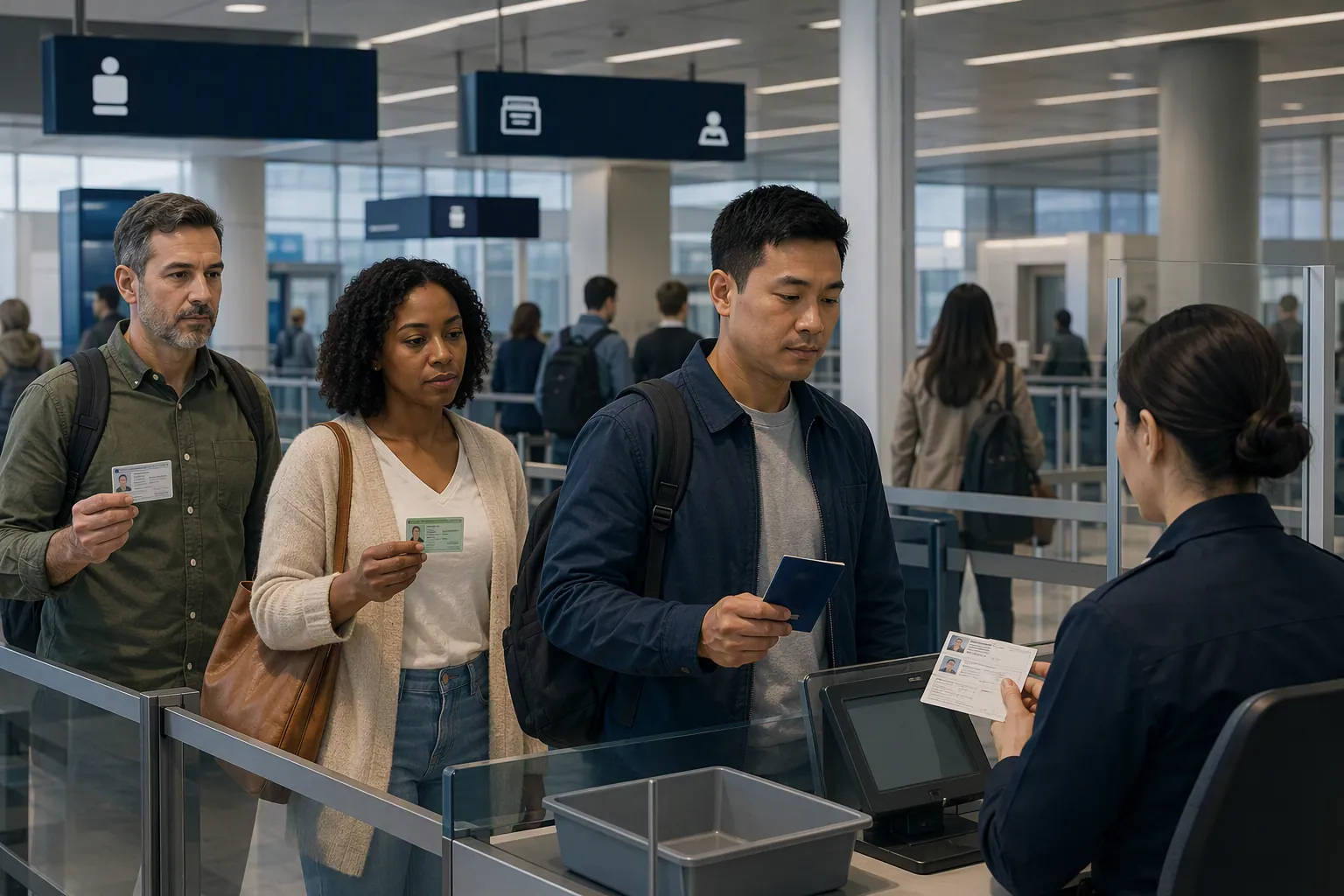
Start here: match your status to the airport protocol
| Traveler status | What to say first | Documents to provide | What not to do | Lawyer and device-search posture |
|---|---|---|---|---|
| U.S. citizen | “I am a U.S. citizen. Am I free to go?” If returning from abroad, answer identity and citizenship questions clearly. | U.S. passport, passport card, birth certificate, naturalization certificate, or other proof of citizenship if available. | Do not falsely claim noncitizenship, argue facts you cannot prove, or sign statements you do not understand. | A U.S. citizen cannot be denied entry to the United States, though officers may detain the person long enough to verify citizenship. At the border, CBP may still inspect baggage and electronic devices; refusal may lead to delay or device seizure, but not denial of entry based only on citizenship status. [1] |
| Lawful permanent resident, or green-card holder | “I am a lawful permanent resident. I want to keep my permanent resident status. I want to speak with an attorney.” | Green card, passport, reentry permit if applicable, and copies of evidence showing continuing U.S. residence when long absences could be questioned. | Do not sign Form I-407, do not agree that you abandoned residence if you disagree, and do not accept “voluntary” paperwork just to leave the room. | Ask for counsel and, if officers allege abandonment or removability, ask to see an immigration judge. Rights groups and immigration lawyers warn that Form I-407 is a voluntary abandonment document, not something an officer can force you to sign at the airport. [2][3] |
| Visa holder, ESTA traveler, student, worker, tourist, or other applicant for admission | “I want to answer questions truthfully. I would like to understand why I am being questioned.” If afraid of return to your country, say so clearly. | Passport, visa or ESTA record, I-20, DS-2019, I-797 approval notice, employment letter, invitation letter, school evidence, or other documents tied to the purpose of travel. | Do not lie, hide travel purpose, delete data during inspection, or assume that refusing all questions has the same consequence at the border that it might inside the country. | At a port of entry, you must establish admissibility. Refusing admissibility questions or a device request can lead to denial of admission and, in some circumstances, expedited removal. CBP’s 2026 device-search framework, as summarized by available immigration-law sources, treats manual border searches differently from advanced forensic searches and includes phones, smartwatches, GPS devices, drones, and vehicle infotainment systems. [1][4] |
| DACA recipient, TPS holder, asylum applicant, parolee, or person with another temporary or pending status | “I have immigration documents. I want to speak with an attorney before answering questions beyond my identity and documents.” | Government ID, EAD, approval notice, advance parole document if traveling internationally, pending-case receipts, and attorney contact information. | Do not assume a work permit equals permission to reenter after international travel. Do not travel abroad without individualized legal review of advance parole, prior orders, unlawful presence, or criminal issues. | For domestic travel, the encounter usually begins with identity screening rather than admission to the United States. For international arrival, CBP admission rules control. If officers ask about status beyond the documents in your hand, ask for a lawyer before explaining complicated history. [2] |
| Undocumented person | “I wish to remain silent. I want to speak with a lawyer.” If asked for identification, provide identity documents only and do not provide false documents. | Valid identity document if you have one. Avoid carrying foreign documents that could be used as proof of alienage unless necessary for travel or identification. | Do not volunteer birthplace, entry history, family status, work history, or immigration history. Do not sign removal papers, stipulated orders, or voluntary departure forms without legal advice. | At a domestic checkpoint, ICE does not have the same border-search authority CBP has at a port of entry and generally needs reasonable suspicion or a warrant to detain. At or near an international arrival area, CBP’s port-of-entry authority is broader. [2] |
The table is intentionally blunt because airport mistakes are often made under pressure. “Remain silent” is a real protection in many encounters, but for a visa holder seeking admission, refusing to answer every admissibility question may create a different danger than it would for a person questioned by ICE at a domestic checkpoint. “Ask for a lawyer” is also real, but the timing and effect differ: a person in removal proceedings has stronger procedural protections than an arriving applicant being inspected at the border.
The first legal fork: domestic checkpoint or port of entry
An airport is not one legal zone. A domestic TSA checkpoint, an international arrivals hall, a CBP booth, secondary inspection, a jet bridge, and an ICE interview room may sit inside the same building, but the government authority being used can be different.
- International arrival or preclearance: CBP is deciding admission to the United States. The border-search exception gives CBP broad authority to question travelers, inspect luggage, and search electronic devices. U.S. citizens must be admitted once citizenship is verified, but noncitizens may be asked to prove admissibility. [1]
- Domestic checkpoint: TSA’s ordinary function is transportation security screening. If ICE is present at a domestic checkpoint, immigration enforcement still needs an immigration basis; rights groups caution that ICE does not get the full border-search exception merely because the encounter occurs inside an airport. [2]
- Secondary inspection: this is not automatically an arrest, but it is a controlled setting. Officers may separate you from your travel party, take your documents, ask repeated questions, inspect bags and devices, and decide whether to admit, release, refer, or transfer you.
Before answering beyond identity and travel basics, identify the officer and the function. “Are you CBP, ICE, or TSA?” and “Am I being questioned for airport security screening, immigration inspection, or another reason?” are not magic words, but they make the setting less blurry. Blurry settings are where travelers sign the wrong document, unlock the wrong device, or explain a complicated immigration history without counsel.
Why airport risk changed in 2026
The 2026 airport environment changed because ICE presence moved closer to ordinary passenger screening. In March 2026, public reporting described armed ICE officers being deployed to airports during a DHS partial shutdown, and the ACLU issued a March 23, 2026 statement objecting to plans to deploy ICE to airport security lines. [5][6]
The exact airport count should be treated carefully. Multiple reports and legal advisories identified at least 13 airports, but the materials available for this guide did not include a single official, current DHS list that could be treated as complete. For a traveler, that uncertainty cuts in one direction: do not assume your airport is outside the enforcement pattern simply because it is not on a list you saw last week.
Passenger data also matters. The National Immigration Law Center reported that TSA sends ICE traveler lists containing names, photos, and other details, citing December 2025 New York Times reporting. NILC also described the arrest of Babson College student Ana Luccía López Belloza at Boston Logan on November 20, 2025 while she waited to board a domestic Thanksgiving flight; the alert says the arrest involved an old deportation order she did not know about. [7]
That example should not be inflated into a claim that every domestic traveler is being checked against every immigration database at every airport. It does show why “I am only flying domestically” is not the same as “there is no immigration risk.” If ICE has data, a prior order, or another enforcement target, the airport can become the place where that information is acted on.
Lawful permanent residents: Form I-407 is the preventable harm
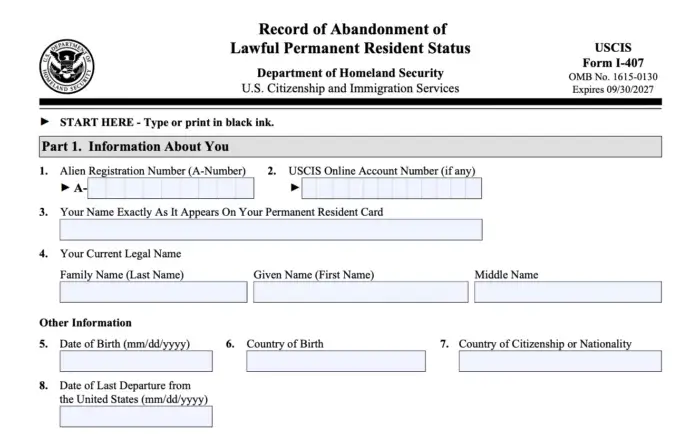
For green-card holders, the airport document to recognize is Form I-407, Record of Abandonment of Lawful Permanent Resident Status. The danger is not subtle: a lawful permanent resident under pressure may sign a form that says the resident is voluntarily giving up permanent residence. Immigration-law guidance and rights materials repeatedly warn LPRs not to sign Form I-407 at the airport if they want to keep their status. [2][3]
A CBP officer can question an LPR about abandonment, long absences, criminal issues, or admissibility concerns. That does not mean the officer can make the resident voluntarily abandon status by force. If the resident disputes abandonment or removal, the protective move is to refuse the form and ask for an immigration judge and a lawyer.
The sentence to practice is plain: “I do not consent to signing Form I-407. I want to keep my lawful permanent resident status. I want to speak with an attorney and, if necessary, an immigration judge.” Similar wording appears across current immigration-law airport guidance because it preserves the core point: no voluntary surrender. [2][3][8]
If an officer says signing will make things easier, faster, or less embarrassing, slow the encounter down. Ask for a copy of any document. Ask what happens if you do not sign. Do not initial blank spaces. Do not write a statement admitting abandonment unless you understand the legal consequences and have chosen that outcome after advice. In an airport interview, “I just wanted to go home” is not a useful defense to a form that says you gave up the status voluntarily.
Visa holders and applicants for admission: silence can carry border consequences
A visa is not a final admission decision. At an airport port of entry, CBP can ask why you are coming, where you will stay, who you will see, whether you intend to work, whether you will study, whether you have the documents your visa category requires, and whether anything has changed since the visa was issued. Answering truthfully is not the same as overexplaining. It is usually safer to give direct, document-supported answers than to narrate every anxiety in the file.
The sharp edge for visa holders is expedited removal. If CBP concludes that a traveler is inadmissible for fraud, misrepresentation, lack of proper documents, or certain other grounds, the person may be removed quickly from the port of entry rather than placed into ordinary immigration court proceedings. Current airport rights guidance warns that refusal to answer admissibility questions or refusal to cooperate with inspection can increase denial and expedited-removal risk for noncitizens seeking admission. [1][8]
This does not mean a visa holder should lie, guess, or unlock everything without understanding the risk. It means the script is narrower than a universal “say nothing.” A better airport script is: “I want to answer truthfully. I do not understand that question. May I have an interpreter?” or “I would like to speak with a lawyer before signing any statement or withdrawing my application for admission.”
If you fear persecution or torture if sent back, say that clearly and early: “I am afraid to return to my country.” Do not wait until after signing withdrawal papers or after agreeing that you are willing to go back. Fear claims at the border are procedural triggers; they are not helped by polite silence.
Phones, laptops, watches, and cloud accounts
Device searches are now a central airport-risk issue, not an afterthought. CBP’s January 2026 Directive 3340-049B is not fully reproduced in the materials reviewed here, so the safest wording is to rely on available summaries rather than pretending to quote the directive. Those summaries describe an expanded “electronic device” category that includes smartwatches, drones, GPS units, and vehicle infotainment systems, not only phones and laptops. They also describe a distinction between a basic manual search, which CBP may conduct at the border without suspicion, and an advanced forensic search, which requires reasonable suspicion. [4]
The same summaries state that CBP may not intentionally access cloud-only data during a border device search and that retained data may be kept for up to 15 years. [4] For travelers, the operational consequence is simple: prepare devices before travel rather than trying to delete, hide, or argue in the inspection room.
The courts are not making manual border phone searches disappear. On July 6, 2026, the Seventh Circuit’s decision in United States v. Eta was summarized by Jackson Lewis as holding that manual cell-phone searches at the border are routine searches that do not require a warrant, probable cause, or individualized suspicion. [9] That is a border-search holding; it should not be casually imported into a domestic checkpoint encounter where CBP admission authority is not the basis for the stop.
- Before travel, remove privileged, confidential, or unnecessary data from the device in a lawful way. Do not delete data in front of an officer.
- Travel with the minimum devices needed. A smartwatch is still a device; a work laptop may contain employer or client data you are not free to expose casually.
- Log out of cloud services before border travel if you do not need them during inspection. CBP’s summarized framework prohibits cloud access, but a device already synced with cloud content creates avoidable ambiguity.
- If asked for a passcode, ask: “Is this a basic search or an advanced search? Are you asking me to provide access to local device contents only?”
- If you are a visa holder or applicant for admission, do not assume refusal has no immigration consequence. Ask for a lawyer before signing anything that withdraws admission or admits misrepresentation.
If questioning moves to secondary inspection
Secondary inspection often begins with ordinary words: “Come with us,” “We need to verify something,” or “There is a problem with your documents.” At that point, the traveler should stop treating the encounter like a customer-service delay. The goal is to preserve status, avoid false statements, avoid accidental abandonment, and make sure someone outside the airport knows what happened.
| Stage | What to do | What to avoid |
|---|---|---|
| Officer asks for identity and travel documents | Provide real identity documents. Ask which agency is questioning you and why. | Do not provide fake documents or someone else’s documents. |
| Officer asks immigration-history questions | Answer only what you understand and can answer truthfully. If the answer involves prior orders, arrests, unlawful presence, work authorization, abandonment, or asylum fear, ask for a lawyer. | Do not guess dates, minimize arrests, or agree to legal conclusions such as “I abandoned residence” or “I lied on my visa” unless you have received legal advice. |
| Officer asks you to sign a statement, withdrawal, I-407, voluntary departure, stipulated removal, or other form | Ask for a copy, an interpreter if needed, and a lawyer. Say you do not want to sign anything you do not understand. | Do not sign because an officer says it is routine, faster, or the only way to leave. |
| Officer takes your phone or laptop | Ask whether this is a border search, whether it is basic or advanced, and whether the request is limited to local device contents. | Do not delete data during the inspection or provide access to accounts unrelated to the local-device search. |
| You are told you will miss your flight | Ask whether you are free to leave, whether you are being detained, and whether you may call a lawyer or family member. | Do not let the missed flight become the reason you sign away status or withdraw admission without understanding the consequence. |
If you need an interpreter, ask for one. Misunderstanding a question about work, residence, marriage, school, or fear of return can become a written statement that follows you into a removal case. “I do not understand” is better than a confident answer to a question you did not actually understand.
If ICE detention follows the airport stop
ICE detention is not rare enough to treat as an edge case. Syracuse TRAC’s immigration detention quick facts reported 65,765 people in ICE detention as of July 11, 2026; 46,436 of them, or 70.6%, had no criminal conviction. [10] Those numbers do not prove what will happen in any individual airport encounter, but they show that detention infrastructure is large enough for a cautious traveler to plan around it.
Do not rely on the so-called “45-minute rule” as if it were a release deadline. Some immigration-law guidance describes a 45-minute ICE detention guideline, but it is not a statute or formal regulation. Airport and port-of-entry rights materials warn that CBP inspection can last much longer, including up to 72 hours before transfer to ICE custody in the port-of-entry context. [8][2]
- Say: “I wish to remain silent. I want to speak with a lawyer.”
- If you are a U.S. citizen, repeat: “I am a U.S. citizen.” Ask for release once citizenship is verified.
- If you are an LPR, repeat that you do not abandon your status and will not sign Form I-407.
- If you fear return to your country, say: “I am afraid to return to my country.”
- Ask to call your attorney or a trusted contact. If denied, remember the officer’s name, agency, badge number if visible, location, time, and exact words used.
- Do not sign removal, departure, abandonment, or withdrawal documents without legal advice.
Family members waiting at the airport should not argue with officers at the checkpoint. They should record the time, flight number, terminal, agency names, and any phone numbers provided; contact counsel; and keep phones available. If the traveler is transferred, the first useful facts for a lawyer are name, date of birth, A-number if known, citizenship, immigration status, airport, agency involved, and whether any form was signed.
Domestic travelers with uncertain status
For undocumented travelers, DACA recipients, TPS holders, asylum applicants, and people with old removal orders, domestic travel is the place where vague advice can become dangerous. A domestic flight does not require admission to the United States, but the airport is still a screened environment where identity, warrants, prior orders, or data-sharing may bring ICE into the encounter.
The domestic script is shorter than the international-arrival script: provide real identity documents if asked, do not carry or present false documents, do not volunteer immigration history, and ask whether you are free to leave. If ICE asks where you were born, how you entered, whether you have papers, or where your family lives, the protective answer is: “I wish to remain silent and speak with a lawyer.”
People with DACA, TPS, asylum applications, pending adjustment, or parole should carry copies of current approval notices or receipts, but they should not explain complicated eligibility history in the checkpoint line. A work permit can prove identity and authorization to work; it does not, by itself, answer every question about removability, reentry, or prior orders.
A readiness checklist before flying in 2026
- Carry status documents that match your situation: U.S. passport, green card, visa documents, I-20, DS-2019, I-797, EAD, TPS or DACA approval, advance parole, pending-case receipts, or reentry permit.
- Carry your attorney’s name, phone number, email, and after-hours number on paper, not only in your phone.
- Give a trusted person your itinerary, copy of key documents, A-number if you have one, and instructions for whom to call if you do not arrive.
- Prepare devices before travel: minimize data, log out of unnecessary cloud accounts, separate work or privileged materials, and avoid carrying extra devices.
- Practice two or three status-specific sentences rather than memorizing a long rights speech.
- If you are an LPR, memorize the Form I-407 refusal sentence before travel.
- If you are a visa holder, review the purpose-of-travel documents you may need to show and make sure your answers match them.
- If you have a prior removal order, criminal history, long absence from the United States, pending asylum-related issue, or any uncertainty about reentry, get individualized legal advice before flying.
Rights at airports are real, but they are status-dependent. The protective move in 2026 is not one universal slogan. It is knowing before the encounter begins whether you are asserting citizenship, preserving lawful permanent residence, proving admissibility, declining to sign away a claim, or staying silent until counsel can intervene.
References
- Enforcement at the Airport — ACLU.
- Know Your Rights at Airports: International and Domestic — Asian Law Caucus.
- ICE Agents at Airports: Know Your Rights in 2026 — Berardi Immigration Law.
- CBP Border Device Searches 2026: CBP Directive 3340-049B Explained — Immigration Fleet.
- ACLU Statement on Trump Administration Plans to Deploy ICE to Airport Security Lines — ACLU, March 23, 2026.
- ICE officers set to deploy to airports as delays mount, border czar Homan confirms — NPR, March 22, 2026.
- Community Alert: Immigration Arrests at Airports — NILC.
- ICE Rights at Airports: What You Should Know in 2026 — Vasquez Law Firm.
- Your Phone Can Be Searched at the Border Without a Warrant: Seventh Circuit Reaffirms CBP Authority (United States v. Eta) — Jackson Lewis, July 2026.
- TRAC Immigration Detention Quick Facts — Syracuse University, as of July 11, 2026.
Grounded in
This procedure is grounded in CBP Directive 3340-049B, independent of any single documented case. See the Regulation tracker for the governing text.
Cases this step would have prevented
No cases have been explicitly linked to this checklist yet. See Risk Digest for documented incidents generally.
← Back to WorkflowsReport a correction or tip
Spotted an outdated figure, a misstated fact, or a ruling this workflow checklist should reflect? Public comments are disabled for this content given the professional cost of a misreported case outcome, penalty amount, or rule text — use the structured correction channel instead.
Report a correction or tip for this record →