
How Counsel Should Verify the Komoroski Bodycam Video
Bodycam video is never self-authenticating, and the August 2026 release of Jamie Komoroski's police and jail-intake footage from the Folly Beach DUI case shows why. This record pairs the verified case facts with the chain-of-custody and authentication workflow counsel should run before relying on, offering, or challenging it.
- Applicable role
- attorney
- Workflow stage
- pre-filing
- Primary source
- Federal Rule of Evidence 901
Last verified: August 25, 2026. This is a verification-workflow record for counsel reviewing the Jamie Komoroski case update bodycam video after the August 2026 release of police and jail-intake footage. It is not legal advice, and it does not treat the released news clips as courtroom exhibits.
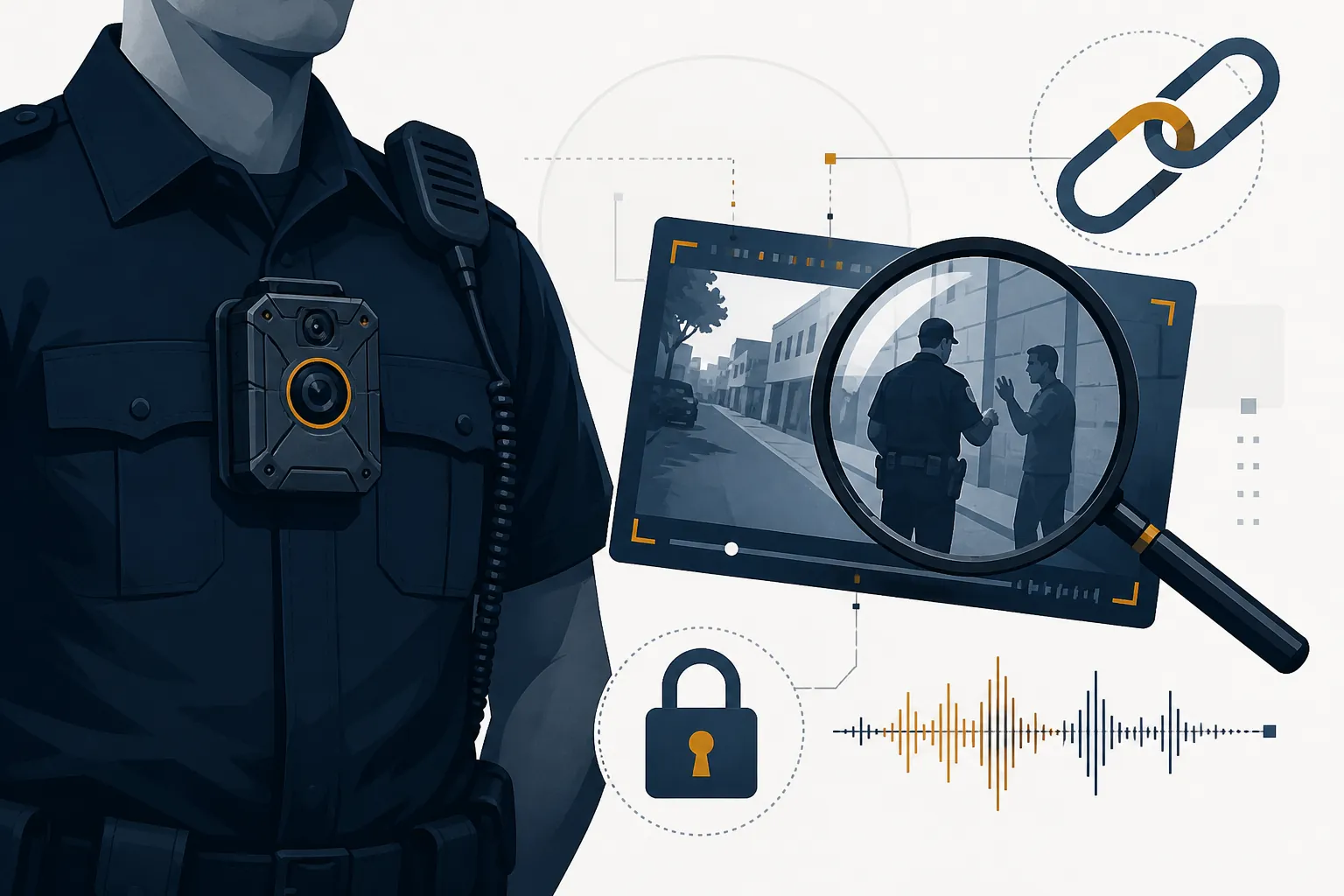
Verification record, not a new AI case
The August 2026 release matters because it is official, emotionally charged, and easy to misuse. WCSC reported that the Ninth Circuit Solicitor’s Office released new video on August 6, 2026 from the fatal 2023 Folly Beach DUI crash case involving Jamie Lee Komoroski; People reported the next day that the footage shows Komoroski repeatedly asking to call her father after the crash and refusing a breathalyzer. [1][2]
No reviewed source for this record documents any AI tool, AI-generated evidence, or AI filing issue inside the Komoroski criminal case itself. This is not an AI-sanctions story. AI enters here for a narrower reason: lawyers now use AI-assisted tools to search, summarize, transcribe, and test police video, while deepfake and manipulation risks have made the authentication record around video more important than the public release itself.
That boundary is not a technicality. If counsel treats a released clip as “the evidence,” the wrong object is being verified. The evidentiary question is not whether a video circulated online or appeared in a news report; it is whether the proponent can show enough about the file’s origin, preservation, integrity, and meaning for a court to allow the factfinder to consider it.
The verified case markers counsel should keep separate from the video file
The case facts give the footage its stakes, but they do not authenticate the footage. The crash occurred on April 28, 2023, at about 10 p.m. on East Ashley Avenue in Folly Beach, South Carolina. Reporting cited a vehicle speed of 65 mph in a 25 mph zone and a South Carolina Law Enforcement Division blood-alcohol result of 0.261%. [1][3]
Komoroski pleaded guilty on December 2, 2024, before Judge Deadre Jefferson. WCIV reported concurrent sentences totaling 25 years in the DUI crash that killed Samantha Miller and injured others. [3]
The bond and civil histories also belong in the verification file, because public articles often compress them into one narrative. Court TV’s case page reported that bond was denied in August 2023 and that a $150,000 surety bond with GPS and SCRAM monitoring was later granted in March 2024. WCSC later reported a final settlement in the 2023 wrongful-death matter on December 9, 2025. [4][5]
| Point in the public record | Why it matters to verification |
|---|---|
| August 6–7, 2026 video release by the Ninth Circuit Solicitor’s Office, covered by WCSC and People. [1][2] | An official release is a source event, not a chain-of-custody record. Counsel still needs the native files or certified production set. |
| WCIV and People report the sentencing as concurrent sentences totaling 25 years; Court TV’s case page uses a different sentencing description. [2][3][4] | Do not paraphrase sentencing from memory. Reconcile against the primary court order before a filing, exhibit list, or public client alert. |
| Some descriptions of the crash and aftermath vary by outlet, including characterizations that should not be imported unless verified against records. [1][2][3] | A video-authentication memo should not become a scrapbook of every published phrase. Conflicting labels should be separated from observed facts. |
| Civil-settlement reporting changed by stage and outlet, including partial and final settlement accounts. [3][4][5] | Settlement figures are not needed to authenticate the video unless they explain production history or a related civil-discovery record. |
The clean working distinction is this: case facts may explain relevance, prejudice, motive to challenge, or the reason the clip attracted attention. They do not prove that the particular file counsel is watching is complete, unaltered, accurately synchronized, or accurately transcribed.
A short workflow before anyone relies on the clip
The workflow should start before anyone builds argument around a dramatic exchange in the footage. In a police-video matter, the review set should answer five questions before counsel offers, relies on, or challenges the file.
- What is the source file? Request the original native bodycam, dashcam, jail-intake, dispatch, and extraction files where available, not a media-embedded clip.
- How was it preserved? Create read-only working copies, calculate hash values, and keep the original production untouched.
- Who handled it? Record dates, custodians, transfers, export steps, software used, and any conversion or redaction event.
- What does the file show technically? Examine metadata, compression artifacts, frame rate, lighting, camera placement, audio-video alignment, and gaps.
- What does the transcript claim? Treat AI-generated transcripts as search aids until a reviewer checks them against the source audio.
Only some of those steps will become courtroom fights. All of them should be documented, because the quiet omissions are the ones that leave a lawyer explaining, under pressure, why the exhibit shown to the court is not the file produced by the agency.
Start with the native file, not the released segment
The most important request is also the least glamorous: get the native file or the closest available export with a documented production path. A public-record release often arrives through a news platform, a streamed player, a social-media repost, or a compressed download. Each step may strip metadata, alter timestamps, change resolution, normalize audio, or introduce a new file-creation date.
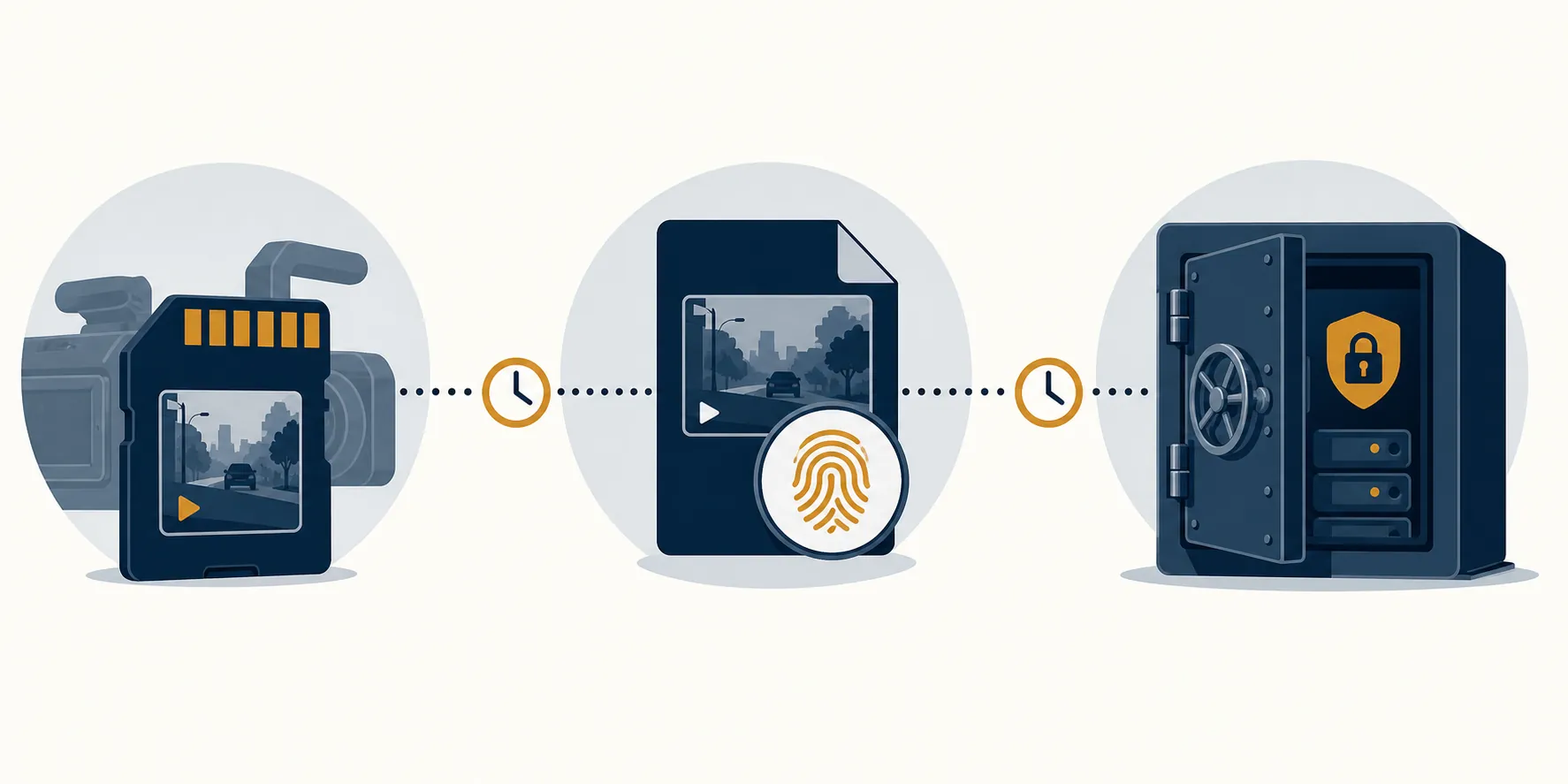
For the Komoroski release, the official source event is clear enough for news purposes: the solicitor’s office released footage in August 2026. [1] For litigation purposes, that still leaves a list of missing pedigree questions: which device captured each segment, who exported it, what platform stored it, whether any redactions were applied, whether the export was recompressed, and whether the clip begins and ends where the native recording begins and ends.
Counsel should ask for the agency’s native body-worn camera file, jail-intake video file, associated audit logs, export logs, redaction logs, and any player required to view proprietary metadata. If the agency cannot produce the native file, the response should identify what was produced instead and why. A statement that a clip came from an official office does not answer whether it is first-generation, second-generation, redacted, transcoded, or edited for public release.
Once received, the file should not become a casual attachment passed through email. Store the received file in a restricted evidence location, calculate hash values, create read-only working copies, and log every person who accesses, copies, converts, annotates, or uploads it. The log should make later testimony boring: file received, hash calculated, copy made, reviewer assigned, no unexplained gap.
FRE 901 is a threshold, not a shortcut
Federal Rule of Evidence 901 requires the proponent to produce evidence “sufficient to support a finding that the item is what the proponent claims it is.” The rule gives examples, including testimony from a witness with knowledge and evidence describing a process or system and showing that it produces an accurate result. [6]
That is a modest admissibility threshold. It is not a forensic blessing. A court may admit a video because the proponent has supplied enough foundation for a reasonable juror to find authenticity, while still leaving room for cross-examination about completeness, angle, timing, audio quality, compression, or interpretation.
That matters in a high-attention case. The public may hear “officially released” and assume “proved.” A trial lawyer cannot stop there. The offering lawyer needs the witness and records that explain what the file is. The challenging lawyer needs the gaps that show why the file may not mean what the proponent says it means. The paralegal or litigation-support analyst needs the unaltered object that either side can point to without apologizing for the download history.
The witness is not the AI output
AI forensic tools can help identify metadata anomalies, compression changes, frame inconsistencies, audio-sync problems, and possible manipulation patterns. A defense-firm discussion of AI-assisted DUI video challenges, citing body-worn-camera limitations and forensic review methods, frames those tools as ways to test video rather than as substitutes for testimony. [7]
That is the right posture. If an AI tool flags a discontinuity, the next step is not to write “AI proves editing” in a brief. The next step is to preserve the tool output, document the tool version and settings, identify what was compared, and decide whether a qualified expert can explain the method in ordinary evidentiary terms. An AI report is not a custodian. It is not a fact witness. It is not a cross-examinable person.
The technical review should ask what the camera could and could not capture
Police video looks more complete than it is. A camera mounted on an officer’s body records from a particular height, angle, lens, and movement pattern. It may miss what the officer sees, capture what the officer does not notice, distort distance, and lose detail in poor lighting. Body-worn camera research concerns summarized in the DUI-video discussion include lighting, camera placement, and frame-rate distortion. [7]
That does not make the Komoroski footage unreliable. It means the review should not confuse emotional clarity with technical completeness. A person asking to call her father, refusing a breath test, or responding to officers may be visible and audible in a released segment. [1][2] The legal question still includes whether the file is complete, whether the audio and video are synchronized, whether other recordings show the same interval, and whether the segment was trimmed for release.
| Review point | What counsel should document |
|---|---|
| Metadata | Device identifier, file-creation data, export data, timestamps, time-zone assumptions, and any proprietary fields visible only in the original player. |
| Compression | Whether the file appears native, transcoded, redacted, resized, platform-compressed, or re-exported after public release. |
| Continuity | Start and stop points, dropped frames, unexplained jumps, separate clips, redaction intervals, and whether dispatch or jail logs explain gaps. |
| Camera limits | Lighting, obstruction, motion blur, field of view, frame rate, and whether the officer’s body position affects what the viewer can infer. |
| Audio sync | Whether visible speech, officer movement, background sound, and timestamped events align with the audio track. |
| Corroboration | Whether dashcam, jail-intake video, dispatch audio, booking records, breath-test records, or officer reports confirm or complicate the segment. |
The testing sequence matters. If counsel begins with a transcript or a viral excerpt, the review naturally chases quotable moments. If counsel begins with native files, hash values, metadata, and continuity, the quotable moment gets placed inside a record that can survive a foundation challenge.
AI transcripts are useful until someone mistakes them for the recording
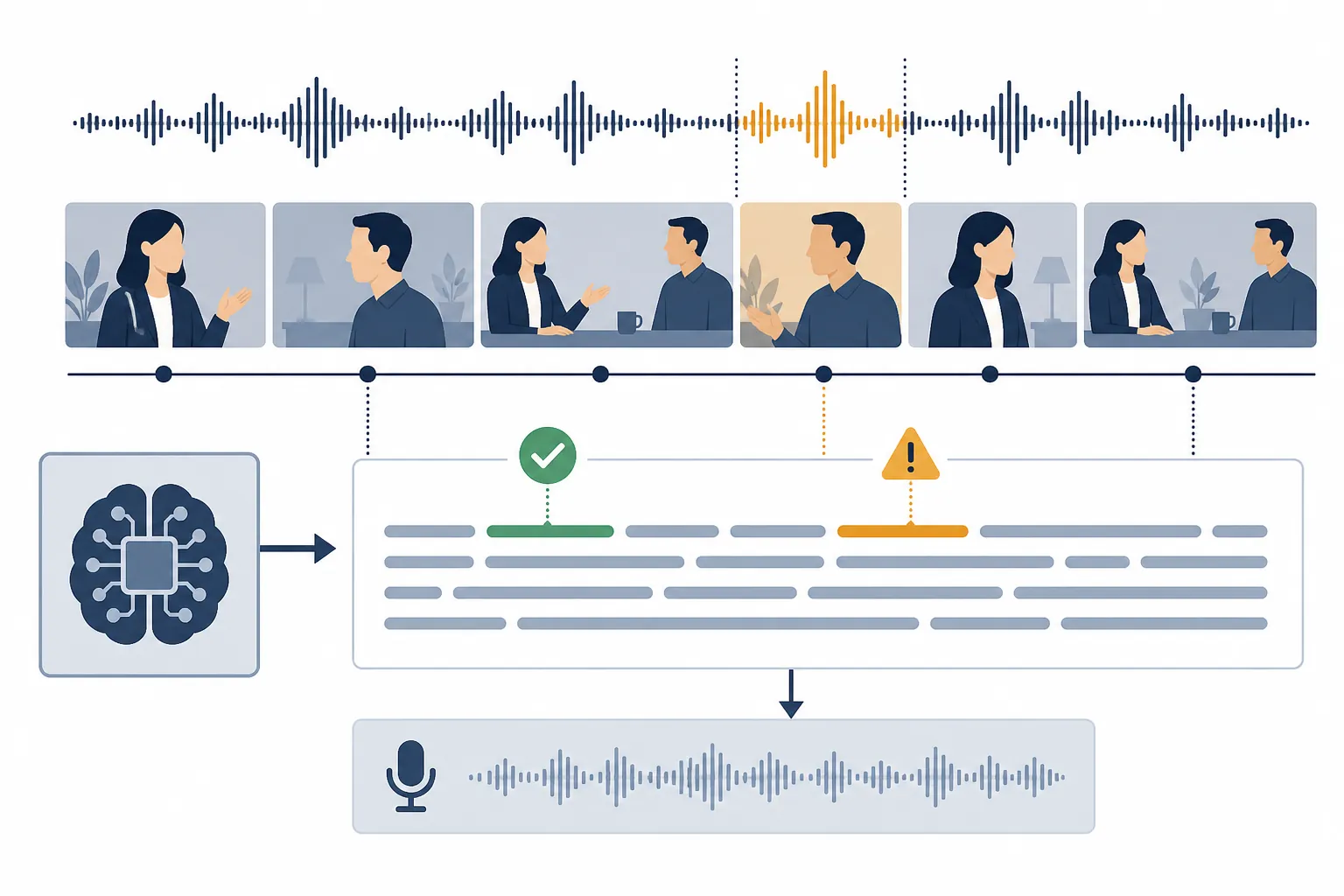
AI transcription is attractive in a police-video review because it helps counsel find names, refusals, warnings, repeated statements, and timing issues quickly. It is also a trap when the transcript becomes the record everyone quotes. A June 2024 Cornell Chronicle report on speech-to-text hallucination described research finding that OpenAI’s Whisper produced hallucinated text in about 1% of audio transcriptions, including hallucinated violent language. [8]
One percent is not a reason to throw away transcription tools. It is a reason to stop treating their output as verbatim until checked. The risk is especially obvious in police footage: stress, overlapping speech, sirens, wind, vehicle noise, crying, intoxication, radio traffic, and jail-intake acoustics can all degrade audio. A transcript that adds, drops, or sharpens a phrase may change how a refusal, admission, question, or officer instruction reads.
The review file should preserve three layers: the source audio, the machine transcript, and the human-verified transcript. Every correction should be traceable to a timestamp. If a passage is unintelligible, mark it as unintelligible rather than forcing certainty. If two reviewers disagree, preserve the disagreement until the audio can be enhanced or the court can hear the source.
- Do not quote an AI transcript in a motion unless the quoted passage has been checked against the source audio.
- Do not let the transcript’s punctuation create tone, interruption, or certainty that the audio does not support.
- Do not use a transcript timestamp unless it has been compared to the video player’s timing and the file metadata.
- Do not bury the tool name, version, settings, or export date if the transcript influenced review decisions.
The deeper AI concern is not that every police video is suspect. It is that the evidentiary record must now be strong enough to answer manipulation questions when they are fairly raised. Legal commentary has warned that deepfakes create courtroom authenticity problems and that existing procedural rules are still catching up to AI-generated evidence risks. [9][10]
What each legal team should be able to say in court
The prosecutor offering police video should be able to identify the recording device, the custodian, the export process, the production copy, the hash-secured working copy, and any redactions. If the state relies on a transcript, the prosecutor should be able to say who verified it against the audio and what remains uncertain.
The defense lawyer challenging the video should separate authenticity, completeness, and interpretation. Authenticity asks whether the item is what the proponent claims. Completeness asks whether the clip omits material context. Interpretation asks whether the viewer is being invited to infer too much from a camera angle, an unclear phrase, a compressed upload, or a transcript that reads cleaner than the audio sounds.
The litigation-support or KM lawyer should protect the firm from a quieter failure: relying on a news clip as if it were a produced exhibit. The internal memo should name the file reviewed, its source, whether it was downloaded from a media page or received through discovery, whether the hash was calculated, and whether any AI transcript or forensic output was used only for triage.
| Role | Minimum defensible statement |
|---|---|
| Proponent | This is the file produced by the agency or custodian; this witness can explain how it was captured, exported, preserved, and displayed. |
| Opponent | The proponent has not shown enough about origin, custody, completeness, synchronization, or transcription accuracy for the claimed use. |
| Reviewer | This is the file we reviewed; this is how we preserved it; these are the tools used; these are the points not yet verified. |
| Expert | This is the methodology used to examine metadata, compression, continuity, or audio alignment, and this is what the method can and cannot conclude. |
In the Komoroski matter, the public record already contains grave, verified facts: a bride killed on her wedding night, a guilty plea, a major sentence, and released footage of the defendant’s post-crash conduct. [1][2][3] Those facts deserve care, not theatrical recycling. They also do not excuse counsel from doing the file work.
Where the verification record stops
The Komoroski footage may be newsworthy, officially released, and painful to watch. None of that makes a circulating clip self-authenticating. Before counsel relies on it, offers it, or challenges it, the file’s origin, custody, integrity, technical characteristics, and transcription accuracy need to be documented.
The remaining issues belong in separate records: deepfake burden and courtroom risk, ethics of AI-assisted evidence review, and reliability testing for transcription and forensic tools. This record stops at the operational line: the viral clip is not the evidentiary file until the verification work is done.
References
- New video released of woman arrested in deadly 2023 Folly Beach DUI crash, WCSC/Live 5 News, August 6, 2026.
- Bodycam Footage Shows Woman Who Killed Bride in DUI Crash Repeatedly Asking to Call Dad, People, August 7, 2026.
- Jamie Lee Komoroski sentenced 25 years for DUI crash that killed Samantha Miller, WCIV/ABC News 4.
- SC v. Jamie Komoroski: Deadly Wedding Night Trial, Court TV.
- Final settlement reached in 2023 wrongful death of Folly Beach bride, WCSC/Live 5 News, December 9, 2025.
- Rule 901. Authenticating or Identifying Evidence, Cornell Legal Information Institute.
- Using AI to Challenge DUI Video Evidence, Davis & Hoss.
- AI speech-to-text can hallucinate violent language, Cornell Chronicle, June 2024.
- Deepfakes in the Courtroom: Problems and Solutions, Illinois State Bar Association, March 2025.
- AI Is Coming, But the Rules Aren't Ready, Georgetown Law Technology Review, January 2025.
Grounded in
This procedure is grounded in Federal Rule of Evidence 901, independent of any single documented case. See the Regulation tracker for the governing text.
Cases this step would have prevented
No cases have been explicitly linked to this checklist yet. See Risk Digest for documented incidents generally.
← Back to WorkflowsReport a correction or tip
Spotted an outdated figure, a misstated fact, or a ruling this workflow checklist should reflect? Public comments are disabled for this content given the professional cost of a misreported case outcome, penalty amount, or rule text — use the structured correction channel instead.
Report a correction or tip for this record →