
How Lawyers Can Enter AI Legal Tech Through Verification
A step-by-step guide for mid-career lawyers to transition into AI legal tech by specializing in verification work, leveraging their legal judgment to meet the growing demand created by high hallucination rates and ethical duties.
- Applicable role
- attorney
- Workflow stage
- review
- Primary source
- ABA Formal Opinion 512
If you are asking how lawyers can break into AI legal tech careers without becoming software engineers, the most practical answer in Q3 2026 is not “learn to code.” It is learning to verify AI legal output in a way a partner, court, regulator, or general counsel can trust.
That does not mean casual proofreading. It means taking an AI-generated answer, checking whether the cited law exists, whether it says what the tool claims, whether it is still good law, whether the quote is in context, and whether the review trail would make sense six months later when someone asks who approved the work.
The demand is not theoretical. Stanford RegLab and HAI reported that purpose-built legal AI research tools hallucinated in benchmark queries at rates above 17% for Lexis+ AI and above 34% for Westlaw AI-Assisted Research, while general-purpose chatbots hallucinated on legal queries at rates between 58% and 82%. [1] Those figures come from a May 2024 benchmark and should be checked against newer evaluations before anyone treats them as a current product score, but the career point survives that caution: legal AI systems need legal review, and the reviewer needs more than a prompt trick.
The other pressure is institutional. ABA Formal Opinion 512 and state-bar guidance in jurisdictions including California, New York, Florida, and Texas have pushed AI use into familiar professional-responsibility territory: competence, supervision, confidentiality, candor, and reasonable fees. Meanwhile, sanction orders have made the cost visible. Our Risk Digest sanctions analysis tracks the escalation from Mata v. Avianca in 2023 through later sanctions orders, including Q1 2026 sanctions exceeding $145,000. The site’s internal Risk Digest count also tracks more than 1,490 documented hallucination and sanction incidents globally; because that is a live internal dataset, the exact count should be checked against the live database before citation.
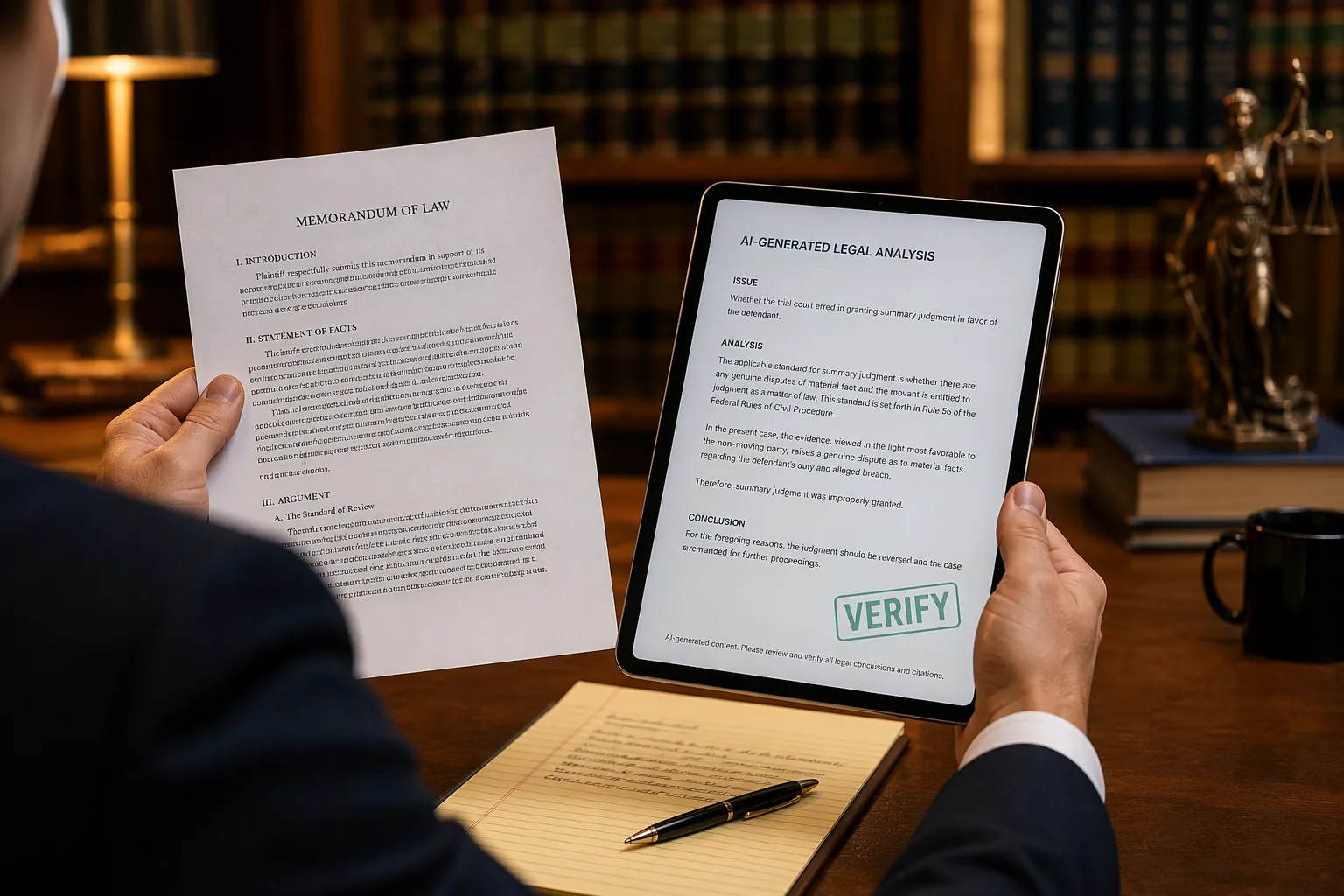
The career opening is the review trail, not the prompt
Prompting has its place. So does basic tool fluency. But the scarce skill inside many firms is the ability to say, with evidence, whether an AI-generated legal answer can move forward. That is ordinary legal judgment under new pressure: citation discipline, procedural awareness, privilege sensitivity, source hierarchy, and the nerve to tell a senior lawyer that a polished answer is not safe yet.
This is why verification is an unusually good bridge for litigators, regulatory lawyers, in-house counsel, and knowledge lawyers. They already know how legal authority fails: an unpublished case gets overstated, a dissent gets treated like a holding, a quotation loses its limitation, a statutory amendment changes the answer, or a case is real but useless in the relevant jurisdiction. The AI layer changes the speed and volume of those failures. It does not make legal judgment obsolete.
For a deeper look at the benchmark side of this risk, see our tool evaluation of legal AI for pro se court filings. The important career move is to translate that risk into a repeatable service: “I can supervise AI-assisted research and drafting so the firm has a defensible record of what was checked, what failed, and who approved the final answer.”
What an AI legal verification specialist actually does
The best starting framework is a citation verification protocol. LeanLaw’s checklist identifies six core moves: verify that the case exists, confirm pinpoint citation accuracy, cross-reference the holding against the original source, check subsequent history, confirm quotation context, and preserve audit-trail documentation. [2] Those six steps sound modest until they are applied to a 20-page AI-assisted research memo, a draft motion, or a regulatory analysis with dozens of authorities.
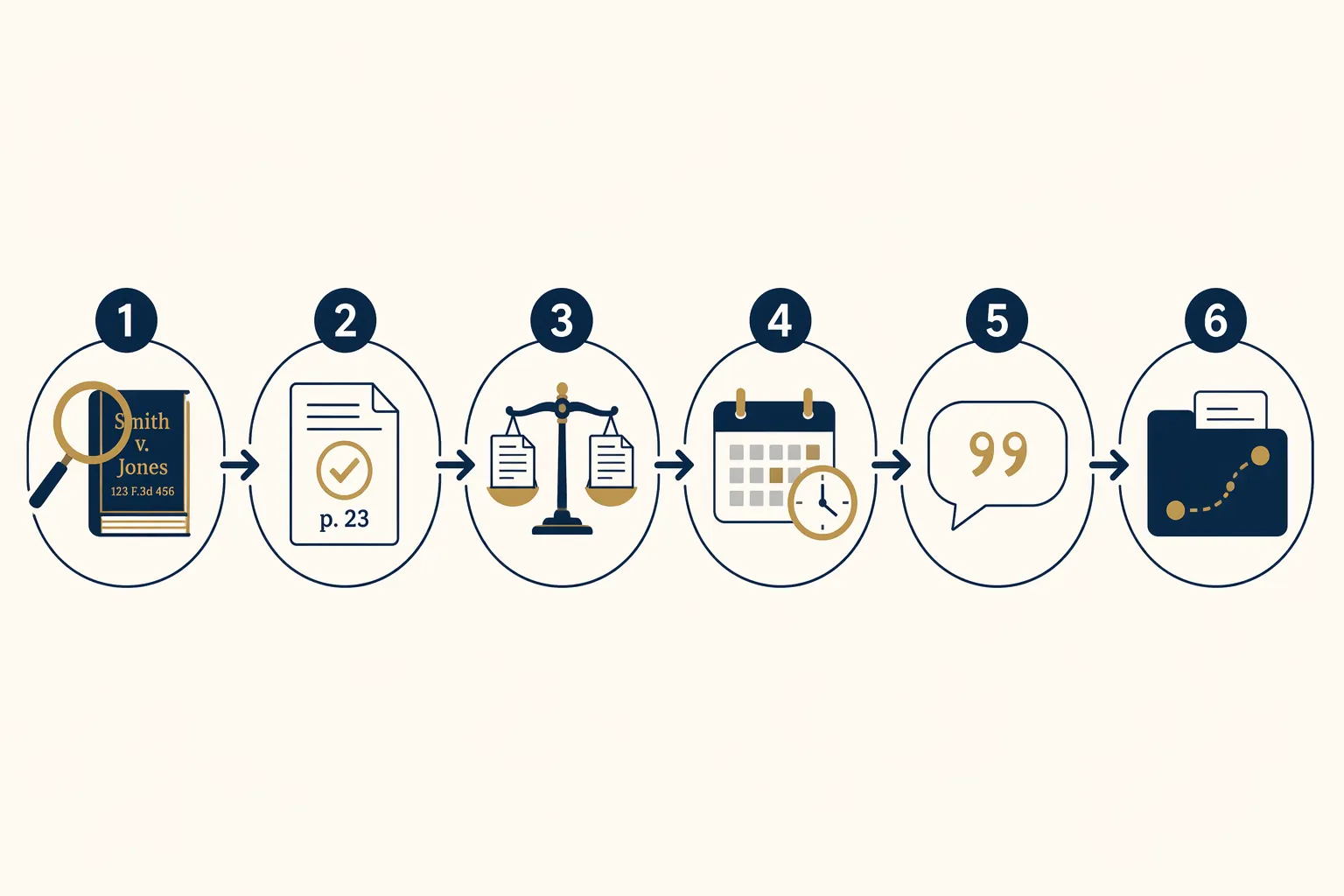
| Verification step | What the lawyer is checking | What gets documented |
|---|---|---|
| Case existence | Whether the cited authority is real and matches the court, date, parties, reporter, docket, or database record | Source searched, result found, and any mismatch |
| Pinpoint citation | Whether the cited page, paragraph, section, or footnote supports the proposition | Correct pinpoint or notation that the pinpoint failed |
| Holding comparison | Whether the AI accurately stated the legal rule, procedural posture, and scope of the holding | Verified proposition, narrowed proposition, or rejected claim |
| Subsequent history | Whether the authority has been reversed, vacated, limited, superseded, distinguished, or negatively treated | Treatment checked and effect on reliance |
| Quotation context | Whether quoted language is exact, complete enough, and not misleading when surrounding text is read | Corrected quote, context note, or removal recommendation |
| Audit trail | Whether the review can be reconstructed later by another lawyer or risk reviewer | Reviewer, date, tool output reviewed, sources checked, disposition |
1. Confirm the authority exists
Start with the unglamorous question: is the case, statute, regulation, rule, or administrative decision real? The answer should come from an original or trusted legal source, not from the AI tool’s own confidence. For a case, that means checking party names, court, date, citation, docket number if relevant, and reporter or database entry. For a statute or regulation, it means checking the current code section and effective version.
This step catches invented cases, blended citations, and authorities that look plausible because they borrow familiar party names or reporter formats. It also catches a quieter problem: a real citation attached to the wrong legal proposition. A lawyer who treats existence as the finish line will miss the more dangerous errors.
2. Check the pinpoint, not just the case name
A real case with a bad pinpoint can be worse than an invented case because it passes the first smell test. The verifying lawyer should go to the cited page, paragraph, footnote, subsection, or headnote-adjacent passage and ask whether that location supports the sentence in the draft. If it does not, the memo should say so plainly: “Case exists; pinpoint does not support proposition.”
Do not repair the AI output silently. If the correct support appears elsewhere, record the corrected pinpoint. If the case supports only a narrower version of the statement, rewrite the proposition and mark the change. The value of the work is not just producing cleaner text; it is making the review path visible.
3. Compare the holding against the original source
This is where lawyers earn their advantage over generic AI operators. The tool may summarize a case as if every useful sentence is a holding. The reviewing lawyer has to separate holding from dicta, majority from concurrence, procedural posture from merits ruling, trial-court reasoning from appellate adoption, and jurisdiction-specific rule from general background principle.
A good verification note does not need to be theatrical. It might say: “AI characterizes case as adopting a categorical rule. Original opinion resolves narrower evidentiary issue on abuse-of-discretion review. Use only for limited proposition.” That single note can prevent a partner from putting an overclaimed rule into a filing.
4. Review subsequent history and treatment
The case may be real, accurately cited, and fairly summarized—and still unsafe. A verification workflow has to include subsequent history and citing treatment. Has the case been reversed, vacated, abrogated, superseded by statute, limited by later authority, or criticized by the relevant court? Is the proposition still good law in the jurisdiction that matters?
For litigation teams, this is not a formality. The lawyer signing the filing is exposed if a brief relies on authority that a reasonable check would have flagged. For in-house teams, the same failure can distort a risk assessment, settlement recommendation, or board-facing compliance memo.
5. Read around the quotation
AI tools can produce quotes that are fabricated, slightly altered, or technically accurate but misleading. The verifying lawyer should compare the quoted language to the source and then read the surrounding passage. Is the quote from the court’s holding or from a party’s argument? Does the next sentence limit it? Has an ellipsis removed a condition that matters? Does the quote apply to a different procedural standard?
This is one of the fastest ways to demonstrate value as a non-technical lawyer in an AI workflow. A paralegal or junior lawyer may be able to match words. A trained legal reviewer can explain why the words should not be used the way the AI used them.
6. Preserve the audit trail
The audit trail is the part firms most often treat as administrative overhead until something goes wrong. It should show the AI output reviewed, the tool or environment used if the firm permits that notation, the date of review, the sources checked, the reviewer, the disposition of each issue, and any escalation to a supervising attorney or subject-matter expert.
A useful notation is short and reconstructable: “Authority exists; pinpoint corrected; holding narrowed; no negative treatment found in controlling jurisdiction as of review date; quote removed because surrounding paragraph limits proposition.” If another lawyer can understand what happened without interviewing the reviewer, the audit trail is doing its job.
For examples of how verification workflows change when tools become more agentic, see our analysis of Gemini Spark’s legal AI safeguard issues. The more a system retrieves, drafts, revises, and chains tasks together, the more important it becomes to preserve where the legal assertion came from and who cleared it.
Turn the workflow into a career asset
A lawyer trying to enter AI legal tech should not wait for a job posting titled “AI Verification Specialist.” Some firms may eventually use that language, but in 2026 the work more often appears inside existing roles: legal technologist, innovation counsel, AI risk analyst, compliance counsel, litigation knowledge lawyer, practice innovation manager, legal operations specialist, research services attorney, or professional responsibility counsel.
The task is to make the function legible. Your materials should show that you can supervise AI-assisted legal work, not merely that you are interested in AI.
Build a sample verification memo
Create a short, sanitized work sample using a hypothetical AI-generated legal research answer. Mark it clearly as hypothetical. Then verify it using the six-step protocol. The memo should include the AI assertion, source checked, verification result, corrected proposition if any, subsequent-history note, quotation note, and final disposition.
| Memo field | What to include |
|---|---|
| AI-generated proposition | The legal statement being tested, separated from your own conclusion |
| Authority cited by AI | Case, statute, regulation, rule, or secondary source the tool relied on |
| Existence and citation check | Whether the authority exists and whether citation details match |
| Pinpoint and holding review | Whether the cited location supports the proposition and whether the holding is overstated |
| Subsequent treatment | Whether later authority changes reliance risk |
| Quote review | Whether quoted language is accurate and fairly contextualized |
| Disposition | Accept, revise, narrow, escalate, or reject |
| Audit note | Reviewer, date, tools or sources checked, and unresolved assumptions |
This kind of sample is more persuasive than a résumé line saying “experienced with generative AI.” It shows the employer what you would actually do on Monday morning when an associate sends around an AI-assisted draft and asks whether it is safe.
Learn the tool environments well enough to supervise them
Verification is not a substitute for tool literacy. A lawyer entering this track should understand the basic behavior of the environments their target employers use: legal research tools, document-review platforms, contract-analysis systems, litigation databases, and general-purpose chatbots permitted under firm policy. Depending on the workplace, that may include tools such as CoCounsel, Harvey, RelativityOne, Lexis+ AI, Westlaw AI-Assisted Research, or internal retrieval systems.
The goal is not to become the engineer who builds the model. It is to know enough to ask the right supervisory questions: What sources did the tool retrieve? Are citations linked to underlying documents? Does the system distinguish uploaded matter files from general legal content? Can outputs be exported for review? Are prompts and responses logged? What happens when the tool cannot find authority? Who has permission to use client data inside the system?
For firm troubleshooting, our piece on law firm fixes for common ChatGPT failure modes is useful because many verification failures begin as ordinary workflow failures: pasted confidential facts, missing source boundaries, unreviewed summaries, or outputs copied into drafts without a reviewer owning the result.
Use training signals, but do not overvalue certificates
A vendor-neutral legal AI course or accelerator can help signal seriousness, especially for a lawyer whose résumé otherwise reads as traditional litigation or in-house practice. Clio’s Legal AI Fundamentals Certification is one example of the kind of low-friction credential that can sit beside a stronger work sample. The certificate is not the credential that matters most. The verification memo, tool notes, and documented workflow are stronger evidence.
If you pursue training, choose programs that force you to evaluate outputs, compare sources, and document risk. A course that teaches only prompting vocabulary may make you more comfortable with the tools, but it will not by itself prove that you can protect a filing, investigation memo, contract review, or regulatory answer from hallucinated authority.
Where the jobs are likely to appear
The market signals are encouraging, but they need careful reading. AI Vortex reports legal technologist compensation around $120,000 to $200,000 at Am Law 200 firms and describes a 20% to 30% premium for JD holders in some legal technologist roles. It also reports broader AI governance officer ranges of $150,000 to $280,000 and AI compliance counsel ranges of $180,000 to $350,000, while Murray Resources separately tracks AI legal job categories across legal and compliance settings. [3][4]
Those numbers should not be read as a promise that a lawyer can take one course and walk into a $200,000 AI role. Salary ranges blend BigLaw, in-house, consulting, legal operations, geography, seniority, and management responsibility. A mid-career litigator moving into a knowledge or risk function will be evaluated differently from a former product counsel joining an AI vendor or a senior compliance lawyer overseeing enterprise governance.
AI Vortex also reports that 78% of Am Law 200 firms created at least one AI-focused position, that legal operations specialist roles have grown 45% since 2022, and that LinkedIn legal AI job postings rose 340% from January 2024 to January 2026. [3] Treat those as demand signals, not as a map of guaranteed openings. The more useful lesson is that firms are naming AI responsibility somewhere, even when verification remains embedded in research, knowledge, litigation support, risk, compliance, or legal ops.
Training gaps create another opening. 8am’s 2026 Legal Industry Report states that more than 54% of surveyed firms still provide no AI training at all. [5] That survey base is primarily small-to-midsize firms using MyCase, so it should not be generalized to every Am Law 200 firm or corporate legal department. Still, it matches what many lawyers see in practice: AI is being used faster than review systems are being built.
How to describe yourself without inventing a title
The strongest positioning is functional. Instead of leading with “AI enthusiast,” write like a lawyer who understands where the risk lands.
- “Developed AI-output verification workflow for legal research, citation review, quotation checking, and audit-trail documentation.”
- “Reviewed AI-assisted draft memoranda for authority validity, pinpoint accuracy, holding scope, and subsequent treatment.”
- “Advised legal teams on defensible use of generative AI tools, including escalation criteria for unsupported or high-risk outputs.”
- “Built sample verification memo and checklist for supervising AI-assisted research in litigation or regulatory matters.”
For a résumé, this belongs under legal technology, knowledge management, litigation support, professional responsibility, research supervision, or legal operations—wherever your actual experience supports it. For interviews, be ready to walk through one verification example in detail. The interviewer should hear how you found the problem, what you checked, what you changed, when you escalated, and how you documented the result.
One useful interview answer is to distinguish three review levels. Low-risk internal brainstorming may need light source awareness. Client-facing legal analysis needs source-level verification. Court filings, regulatory submissions, board materials, or high-stakes advice need documented review, escalation rules, and sign-off. That framing shows judgment. It also avoids the melodrama of treating every AI output as equally dangerous.
A practical entry plan for the next 60 days
A lawyer trying to move into this track does not need to disappear for a year of technical retraining. A better first phase is narrow and demonstrable.
- Pick one practice area you already know well. Verification is easier to sell when it rests on genuine subject-matter judgment.
- Generate or obtain a hypothetical AI-assisted research answer in that area, making sure no client confidential information is used.
- Run the six-step verification protocol and create a two-to-four-page verification memo.
- Create a one-page checklist that another lawyer could use before relying on AI-generated legal authority.
- Test at least two tool environments available to you and write down how each handles citations, source links, export, and review history.
- Add one credible training signal, preferably one that emphasizes governance, supervision, or legal output review rather than only prompt phrasing.
- Revise your résumé and LinkedIn profile around the function: AI-assisted research supervision, verification workflow, citation-risk review, audit-trail documentation.
Inside a firm, the same plan can become a pilot. Offer to review one AI-assisted internal research memo or one draft knowledge-bank entry using the checklist. Keep the scope small. Capture the issues found. If the work prevents even one unsupported citation, misquoted authority, or overbroad holding from reaching a partner or client, the business case becomes easier to explain.
For in-house counsel, the entry point may be different. Start with policy and vendor review: what AI tools are approved, what legal tasks they may support, what outputs require attorney review, what records must be retained, and when outside counsel must disclose AI use. The same verification skills apply, but the deliverable may be a governance checklist instead of a research memo.
What this path will not do
Verification is not a magic title, and it is not legal advice about any particular lawyer’s compliance obligations. It is career guidance informed by risk data. A lawyer still needs the usual assets: sound legal analysis, confidentiality discipline, professional judgment, communication skills, and enough technology literacy to understand the tools being supervised.
It also will not appeal to everyone. Some lawyers want to build products, manage data pipelines, sell legal tech, or advise AI companies on regulation. Those are valid paths. Verification is the clearest path for the competent lawyer who does not want to code, does not want to pretend to be an engineer, and does want a credible role in the legal AI economy.
In Q3 2026, that is the bridge worth taking seriously: not a guarantee of a new job title, not a substitute for broader AI literacy, but a disciplined way to turn existing legal judgment into the work firms already need done before AI-generated legal answers can be safely relied on.
References
- AI on Trial: Legal Models Hallucinate in 1 out of 6 (or More) Benchmarking Queries — Stanford HAI, May 2024
- The Hallucination Problem: A Checklist for Verifying AI-Generated Legal Citations — LeanLaw
- AI Legal Career Paths 2026 — AI Vortex
- 25 Top AI Legal Jobs — Murray Resources
- AI Skills for Lawyers — 8am, 2026
Grounded in
This procedure is grounded in ABA Formal Opinion 512, independent of any single documented case. See the Regulation tracker for the governing text.
Cases this step would have prevented
No cases have been explicitly linked to this checklist yet. See Risk Digest for documented incidents generally.
← Back to WorkflowsReport a correction or tip
Spotted an outdated figure, a misstated fact, or a ruling this workflow checklist should reflect? Public comments are disabled for this content given the professional cost of a misreported case outcome, penalty amount, or rule text — use the structured correction channel instead.
Report a correction or tip for this record →