
McQuaide's Villanova eligibility ruling doesn't settle it
An Ohio judge granted Villanova QB Pat McQuaide a preliminary injunction against the NCAA on August 1, 2026, but the Patriot League—not a party to the case—denied his eligibility twice afterward. The ruling does not settle the eligibility question; here is what the public record still lacks, and how to verify the matter before citing it.
- Applicable role
- attorney
- Workflow stage
- review
Last verified: August 29, 2026. The source record reviewed includes reported developments through August 22, 2026.
Disclosed gaps: The available materials do not include the primary injunction order, a case number, a verified docket caption, or a docket entry confirming a stay, appeal, motion to vacate, or later modification. The binding effect of the reported order on the Patriot League, which was not a party to the Ohio case, therefore remains unverified.
Use and classification: This is a verification record, not legal advice. It fits verification-workflows; it is not a natural Risk Digest incident record because none of the reviewed material contains an AI element.
The contradiction is in the dates
Anyone searching for the Pat McQuaide Villanova football eligibility court ruling will find what looks like a decisive development: secondary reports say that Cuyahoga County Common Pleas Judge Timothy P. McCormick granted McQuaide a preliminary injunction on August 1, 2026. Three days later, however, the Patriot League denied his eligibility. On August 22, a conference committee denied Villanova’s appeal.[1][2][4]
That sequence defines what can safely be said. The injunction is real as a reported preliminary ruling, but it does not by itself settle McQuaide’s eligibility. The operative question is whether and how an order directed at the NCAA controlled the subsequent decisions of a conference that was not a party to the Ohio case. The public record assembled here does not answer that question.
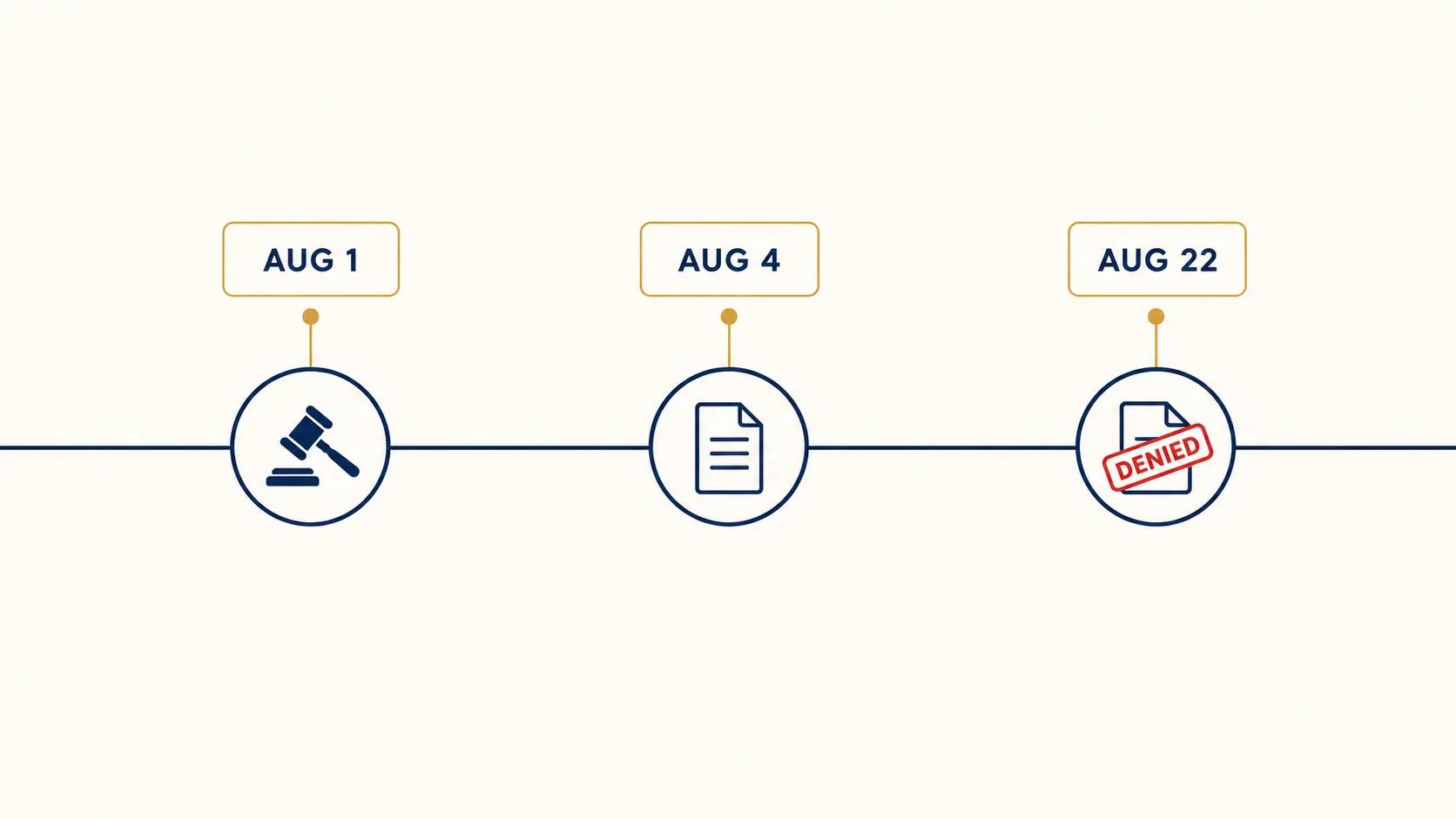
| Date | Reported event | What it establishes |
|---|---|---|
| August 1, 2026 | Judge Timothy P. McCormick reportedly granted a preliminary injunction in Cuyahoga County Common Pleas Court.[1][2] | A preliminary ruling was reported; the underlying order is not available in the reviewed materials. |
| August 4, 2026 | A denial letter from Patriot League executive director Lynn Hughes applied the conference’s eligibility rule.[1] | The conference did not treat the reported injunction as resolving its eligibility decision. |
| August 22, 2026 | A committee of conference presidents denied Villanova’s appeal.[4] | The league’s position remained unchanged after its initial denial. |
What the secondary accounts attribute to the court
An X post summarized the relief as preventing the NCAA from enforcing its eligibility rules against McQuaide, preventing it from punishing Villanova, and making McQuaide immediately eligible for the 2026–27 season.[3] That is a secondary characterization, not quoted language from the order. Its definitive phrasing is also in tension with the other reports’ description of the ruling as a preliminary injunction.
Without the order, a prospective citer cannot inspect its operative language, identify every party and person covered, determine its duration, or see whether the court addressed the Patriot League at all. Nor can the wording “immediately eligible” be elevated from a social-media summary into a judicial holding. A report about what an order did and the filed order itself are different levels of evidence.
The rule dispute and the league’s two denials
The underlying eligibility issue concerns the rule allowing four seasons of competition within five years of initial collegiate enrollment. McQuaide sought to have his COVID-era junior-college season at Mississippi Gulf Coast excluded from that calculation.[1] That is the relevant rule background; it does not establish whether the requested treatment was legally required.
The Patriot League’s August 4 letter, sent by executive director Lynn Hughes, cited the four-seasons rule and the original NCAA determination that the Ohio court reportedly had overruled.[1] Whatever the league’s legal reasoning, its conduct is clear: it issued an ineligibility decision after the preliminary injunction had been reported.
Villanova appealed within the conference. On August 22, a committee of conference presidents chaired by Lafayette president Nicole Hurd denied that appeal.[4] This second denial matters because it prevents the August 4 letter from being dismissed as merely an initial administrative response that was later corrected.
The available reports identify the NCAA as the defendant in the Ohio litigation and the Patriot League as a non-party.[1][4] Nothing reviewed establishes that the conference was adjudicated to be bound by the order. That does not prove the league was free to disregard the ruling, and it does not prove McQuaide lacked a basis to challenge the league’s action. It means the order’s effect on the conference cannot be inferred solely from the fact that an injunction was granted against the NCAA.
A primary-record review would need to answer several distinct questions: whom the order expressly restrained, whether it extended to people or entities acting with the named defendant, whether the conference’s decision was independent of the NCAA action covered by the order, and whether a later court filing changed the procedural position. The secondary sources do not supply those answers.
How to verify the injunction before citing it
The College Sports Litigation Tracker lists “McQuaide v. NCAA” as filed on July 23, 2026, and added to the tracker on August 19. It characterizes the matter as an antitrust challenge and notes that the conference declared McQuaide ineligible despite the injunction.[5] That entry corroborates the reported filing date and the existence of the conflict. It is not the court docket, and it should not be treated as proof of a separate lawsuit or an unreported procedural development.

- Search the Cuyahoga County Court of Common Pleas e-docket. This is an Ohio state-court matter, so PACER—the federal court records system—will not contain the trial-court case.
- Search party-name variations, including “Pat McQuaide,” “Patrick McQuaide,” “NCAA,” and the organization’s full name. Use July 23, 2026, as the reported filing date, but search a wider date range in case the tracker date reflects a procedural event rather than the docket’s opening date.[5]
- Record the exact caption and case number from the court system. Confirm that the parties, county, judge, and filing dates match the secondary reports before relying on any document found.
- Locate the August 1 docket entry and download the filed order. Confirm that it is labeled a preliminary injunction, then quote the operative provisions rather than a headline, law-firm description, or social-media paraphrase.
- Identify every party named in the order and examine whether the text mentions Villanova, the Patriot League, conference action, NCAA enforcement, or punishment of the university. Do not assume those concepts are interchangeable.
- Review all later entries for a notice of appeal, request for a stay, motion to dissolve or vacate, modification, enforcement request, contempt application, or other filing that could affect the order’s status.
- Preserve the docket page, order, retrieval date, and stable document links or file copies with the reporting notes or compliance memo. A bare citation to a secondary article will not resolve a later dispute over the order’s wording.
The August 22 report said McQuaide “looked to file an appeal,” but that wording describes an anticipated action, not a confirmed filing.[4] No source in the reviewed packet supplies a filed notice, appellate case number, stay order, or motion to vacate. Until a docket confirms one, copy should not say that an appeal was filed.
Language that the available record can support
| Proposed statement | Assessment | Reason |
|---|---|---|
| An Ohio judge made McQuaide eligible for Villanova. | Too broad | It converts a reported preliminary injunction against the NCAA into a final eligibility adjudication and omits the conference’s later denials. |
| McQuaide won his eligibility case. | Unsupported | The reviewed materials do not establish a final judgment, finality, or the order’s effect on the non-party conference. |
| The Patriot League violated the injunction. | Unverified | The order text is missing, and its binding effect on the conference has not been established. |
| The injunction had no effect because the league denied eligibility. | Unsupported | The league’s decisions establish a practical conflict, not a legal determination that the order was ineffective. |
| Secondary reports say an Ohio judge granted McQuaide a preliminary injunction against the NCAA on August 1; the Patriot League denied his eligibility on August 4 and denied Villanova’s appeal on August 22. | Supported with attribution | It preserves the preliminary posture, identifies the reported target of the order, and keeps the later conference decisions visible.[1][2][4] |
A citation should also disclose that the primary order, case number, and verified docket caption were not available in the materials reviewed. Before presenting the ruling as dispositive, retrieve the state-court docket and determine whether later proceedings altered the order. As of this verification, the defensible endpoint is narrower: an August 1 preliminary injunction was reported, the Patriot League subsequently denied eligibility twice, and the public record reviewed here does not establish how that order operates against the non-party conference.
References
- The Patriot League denied Pat McQuaide’s eligibility for the 2026 season, The Philadelphia Inquirer, August 18, 2026.
- Ohio Judge Grants Villanova QB Pat McQuaide Another Year of Eligibility, The Villanovan.
- Post by @bydylanjohnson, X.
- Patriot League denies Villanova QB Pat McQuaide’s eligibility appeal, The Philadelphia Inquirer, August 22, 2026.
- College Sports Litigation Tracker, College Sports Litigation Tracker.
Grounded in
This procedure is grounded in the cited rule or opinion, independent of any single documented case. See the Regulation tracker for the governing text.
Cases this step would have prevented
No cases have been explicitly linked to this checklist yet. See Risk Digest for documented incidents generally.
← Back to WorkflowsReport a correction or tip
Spotted an outdated figure, a misstated fact, or a ruling this workflow checklist should reflect? Public comments are disabled for this content given the professional cost of a misreported case outcome, penalty amount, or rule text — use the structured correction channel instead.
Report a correction or tip for this record →