
Is Your Cellphone Search Legal? A Fourth Amendment Verification Workflow
Determining whether a military cellphone seizure violated the Fourth Amendment requires checking seven specific legal nodes, from authorization and probable cause to consent and the good-faith exception. This workflow walks through each node with links to the controlling CAAF opinions.
- Applicable role
- attorney
- Workflow stage
- pre-filing
- Primary source
- Manual for Courts-Martial, Military Rules of Evidence 311 and 315
Current as of Q3 2026. This workflow is verification material, not legal advice. It is built for the narrow question that matters before court-martial litigation or an administrative separation record hardens: was the phone seizure or search lawful, and is suppression under MRE 311 still on the table?
Do not start with the command’s label. “Confiscated,” “secured,” “dumped,” “inspected,” “consented,” and “authorized” are not outcomes. They are clues. CAAF has made the first gate clear enough: the Fourth Amendment applies to service members’ cell phones, and an unauthorized phone search can lose the government its evidence.[1][2] The harder work is usually not proving that phones matter. It is reconstructing the exact legal path that agents, commanders, supervisors, or consent forms were supposed to follow.
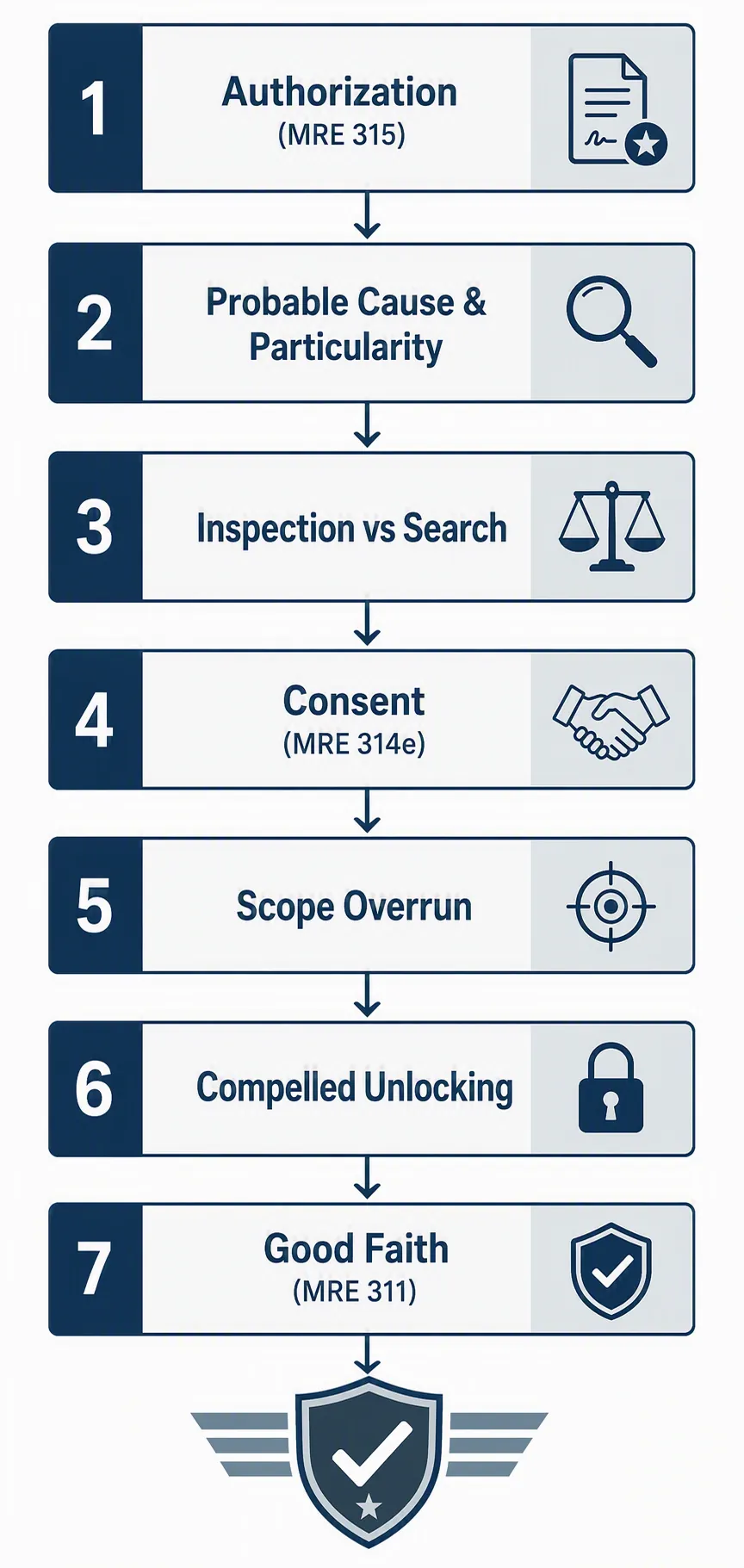
The Seven Nodes
| Node | Controlling checkpoint | Operational result |
|---|---|---|
| 1. Was there lawful authority to seize or search? | MRE 315 search authorization; Kelly and Shields on cellphone privacy.[1][2][3] | If authority is missing or unclear, flag for suppression review. |
| 2. Did probable cause and particularity reach this phone and this data? | Hernandez on cellphone search particularity; Lattin on overbroad warrants and good faith.[4][5] | Separate a bad authorization from an overbroad but possibly good-faith one. |
| 3. Was this really an inspection, or was it a search? | MRE framework and military suppression doctrine; no label controls by itself.[3] | If the purpose was evidence-gathering, preserve facts showing investigative intent. |
| 4. Was consent valid, and whose consent was it? | MRE 314(e), Hutchins on consent requests, Black on third-party consent.[6][7][8] | Gather the words used, rank dynamics, custody facts, and ownership/control facts. |
| 5. Did the extraction outrun the authorization or consent? | Ray on agents exceeding a seizure-only CASS; Shields on unauthorized phone search.[2][9] | Compare the document to the extraction log before assuming the search was covered. |
| 6. Was unlocking compelled? | Mitchell on compelled passcode disclosure and the Fifth Amendment; limited treatment of biometrics.[10] | Separate Fourth Amendment seizure/search issues from testimonial compulsion. |
| 7. Can the government still invoke good faith? | MRE 311(c); Lattin versus Ray tension on overbreadth and knowing scope violations.[3][5][9] | If an error exists, test whether suppression remains available. |
Node 1: Authority Comes Before Extraction
The first useful question is not whether the phone contained evidence. It is who authorized the government to take or search it, and what legal mechanism that person used. Under MRE 315, a commander or military magistrate may authorize a search when the rule’s requirements are met, including probable cause and sufficient particularity.[3] That does not turn every commander’s order into a search warrant, and it does not let an agent convert a limited seizure into a full forensic review.
Kelly and Shields should be near the front of any military cellphone Fourth Amendment review. In Kelly, CAAF rejected the idea that military status strips a service member’s phone of Fourth Amendment protection.[1] In Shields, CAAF reaffirmed that principle and suppressed evidence from an unauthorized cellphone search.[2] Those cases do not mean every search fails. They mean the government has to show its work.
- Get the actual authorization, not a summary in an investigative report.
- Identify whether the document authorized seizure, search, forensic extraction, manual review, or some narrower action.
- Confirm who issued it and whether that person was acting as a neutral and detached authority under MRE 315.
- Preserve the timeline: when the phone was taken, when it was unlocked, when it was imaged, and when data was reviewed.
Node 2: Probable Cause and Particularity Are Not Paperwork Formalities
A phone authorization that says, in effect, “search the phone for evidence,” is where serious litigation often begins. Cellphones are not single-purpose containers. They hold messages, photos, browser records, location data, cloud artifacts, app databases, deleted material, and authentication tokens. Particularity is the rule that forces the government to connect suspected misconduct to places in the phone where evidence is likely to be found.
Hernandez is the main CAAF checkpoint for this node. CAAF addressed cellphone search particularity and made clear that the authorization must meaningfully limit what agents may search, rather than handing them a general license to rummage through digital life.[4] The practical question is simple to ask and often hard for the government to answer: what data categories, date ranges, applications, accounts, or file types did probable cause actually support?
Lattin complicates the remedy question. In 2024, CAAF applied the good-faith exception to OSI’s overbroad warrant, making it a warning against sloppy defense shorthand: overbreadth may be real and still not produce suppression if MRE 311(c) good faith carries the government through.[5] That does not make overbreadth harmless. It changes the next question from “was the authorization too broad?” to “was the defect one a reasonable agent could rely on, and did the issuing process satisfy the good-faith rule?”
| If the authorization says... | Verify... |
|---|---|
| All contents of the phone | Whether probable cause justified all contents or only a narrower data set. |
| Messages or communications | Which apps, accounts, participants, and time periods were actually supported. |
| Images or videos | Whether the suspected offense made those media categories probable evidence. |
| Location or movement data | Whether the alleged timeline supports geolocation review. |
| Any evidence of misconduct | Whether the language becomes a general search in digital form. |
Node 3: Inspection Language Does Not Cure an Investigative Search
The inspection-versus-search problem appears often because phones sit at the intersection of command authority, workplace control, operational security, and personal life. A commander may have legitimate reasons to secure devices in some settings. That does not answer whether opening, scrolling, imaging, or exporting private data was an inspection or a search.
The record needs facts, not adjectives. Who initiated the action? Was misconduct already suspected? Were specific members targeted? Were agents involved before the phone was touched? Did the reviewer look for readiness, safety, property control, or evidence? The more the action was aimed at proving a specific offense against a specific service member, the less useful the word “inspection” becomes.
Practitioner materials repeatedly flag this as a command-level failure point, especially where line supervisors treat phone access like a locker check or equipment accountability measure.[11][12] That observation is useful, but it is not a substitute for the governing record. The motion will turn on purpose, scope, authority, and use.
Node 4: Consent Requires More Than Compliance
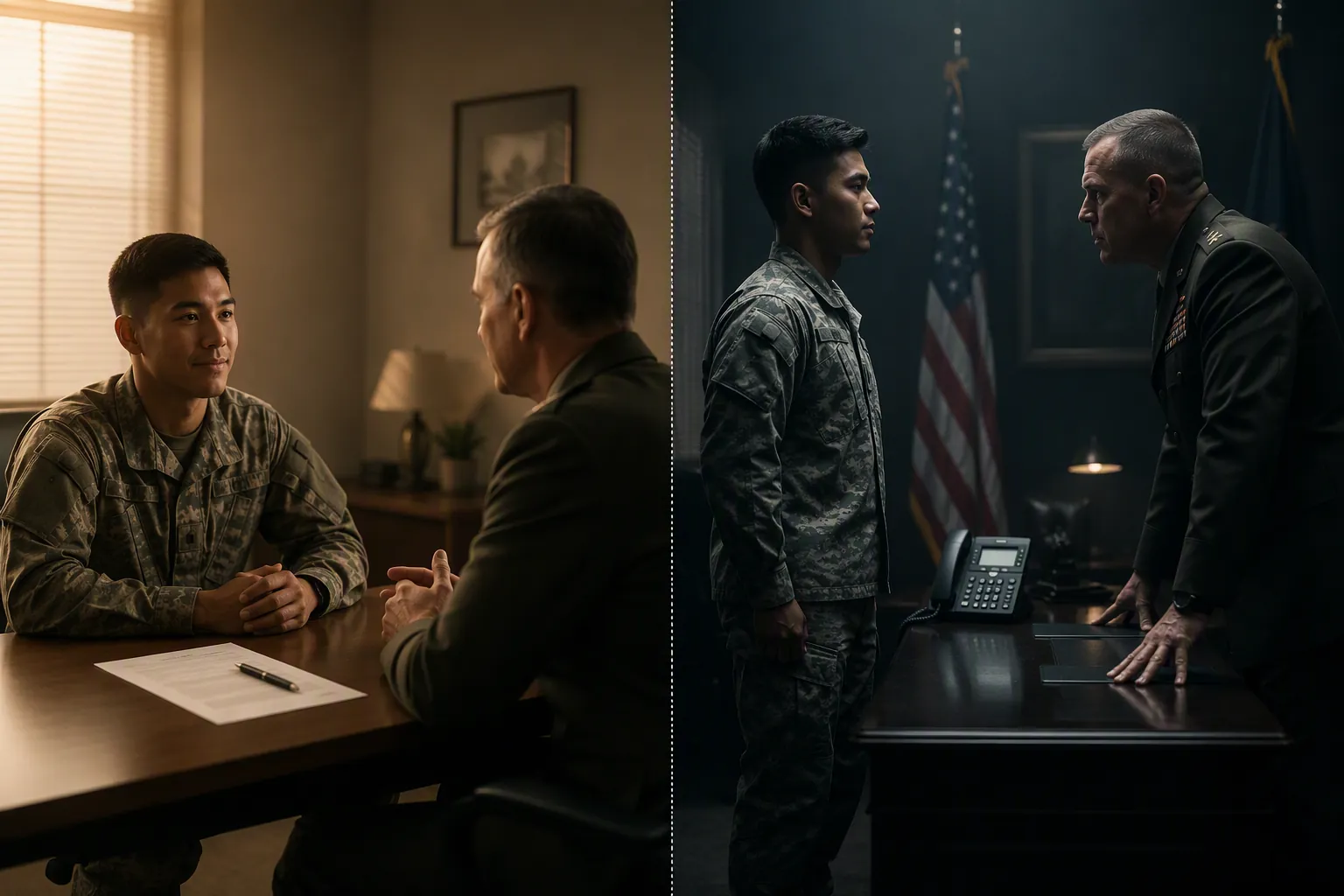
Consent is where service members most often think the legal fight is over too early. If the member signed a form, handed over the phone, entered a passcode, or said “yes, sir,” the government will usually call that consent. The defense still has to verify voluntariness under the totality of the circumstances, including rank dynamics, custody, tone, timing, advisements, prior refusals, and whether the person understood they could limit or refuse consent under MRE 314(e).[6]
Hutchins blocks one overbroad argument. CAAF held that a request for consent to search is not Article 31(b) interrogation.[7] That matters because a consent request does not automatically become defective merely because rights advisement rules would have applied to questioning. The better consent challenge usually lives in voluntariness: what happened in the room, who was present, what was said, whether the member was isolated or ordered, and whether refusal felt practically available.
Black adds another necessary separation. The consent issue may not be whether the accused was pressured, but whether the person who gave consent had authority over the device or the relevant data. In Black, CAAF affirmed suppression involving third-party consent on a loaned phone.[8] A phone temporarily held, borrowed, loaned, shared, or accessed through another person is not automatically open to third-party consent.
- Preserve the consent form, including any scope boxes, handwritten limits, and revocation language.
- Write down the exact words used before the member handed over the device or unlocked it.
- Identify whether the member was free to leave, under escort, in custody, or under direct order.
- Separate consent to seize the phone from consent to search, extract, retain, or review cloud-linked data.
The Compliance Trap Is a Fact Pattern, Not a Free Suppression Rule
Military defense practitioners have warned about the “compliance” problem: junior members often experience a request from command or law enforcement as something closer to an order.[12] That concern is real enough to investigate and too unsettled to treat as an automatic rule. The record needs the facts that made the request feel optional or mandatory. Without that, the argument becomes atmosphere, and atmosphere alone rarely carries a suppression motion.
Node 5: Scope Overrun Is Where the Extraction Log Matters
Once a phone goes to a forensic lab or digital examiner, the cleanest suppression issue may be hiding in the mismatch between the authorization and the extraction. A seizure-only document is not a forensic-search authorization. Consent to look at text messages is not consent to harvest app databases. An authorization for one date range does not necessarily justify review of years of unrelated data.
Ray is the case that should make counsel ask for the extraction paperwork before deciding whether a motion is weak. In 2025, the Fourth Circuit refused to apply the good-faith exception where NCIS agents knowingly exceeded a seizure-only Command Authorization for Search and Seizure.[9] That is a different problem from Lattin. Lattin involved overbreadth and good faith; Ray involved agents going beyond what they knew they had. Those are not the same failure.
The verification move is mechanical: place the authorization, consent form, forensic request, extraction report, and examiner notes side by side. Then mark each step the government actually took. If the paperwork allowed seizure on Monday and full logical extraction happened Tuesday without a search authorization or valid consent, the issue is not academic. It is a scope problem that belongs in MRE 311 analysis before the evidence is used.
| Document | What to compare |
|---|---|
| Command authorization or warrant | Device identifiers, data categories, date limits, offense description, and whether search was actually authorized. |
| Consent form | Scope granted, limits imposed, revocation language, and whether consent covered extraction. |
| Forensic request | What agents asked the examiner to do. |
| Extraction log | What the tool collected, when, and from which source. |
| Review notes or reports | Which data the agent actually opened, searched, exported, or relied on. |
Node 6: Unlocking Raises a Separate Fifth Amendment Question
Do not fold compelled unlocking into the general Fourth Amendment phone-search issue. It may matter to both seizure and search, but Mitchell is primarily a Fifth Amendment testimonial-compulsion checkpoint. CAAF held that compelling a suspect to disclose a passcode after he had invoked counsel violated the Fifth Amendment; the case also treated biometric unlocking, such as fingerprint or facial recognition, as a physical-characteristic issue rather than testimonial disclosure.[10]
Mitchell should not be inflated into a broad Supreme Court-style rule for every forced unlock. The safer verification question is narrower: did the government require the member to reveal the contents of the mind, such as a memorized passcode, pattern, or phrase, and did it do so after invocation, in custody, or under circumstances that made the act testimonial? If the government used a finger, face, or other biometric method, the Mitchell issue changes; it does not disappear, but counsel should not brief it as if the biometric question has been conclusively resolved by the Supreme Court in the military context.
- Passcode spoken or written: preserve who asked, what was asked, and whether counsel had been invoked.
- Passcode entered silently: preserve whether the member was ordered, asked, threatened, or told refusal was allowed.
- Biometric unlock: preserve whether agents physically positioned the member, requested cooperation, or used the device while the member was restrained.
- Remote or cloud access: preserve whether unlocking the phone also exposed accounts or data beyond the device.
Node 7: Good Faith Is the Last Gate, Not a Cleanup Phrase
If a defect appears, the next question is not automatically “evidence suppressed.” MRE 311 governs the exclusionary-rule analysis, including the good-faith exception.[3] The point of the workflow is to identify the defect precisely enough that counsel can test the remedy instead of arguing in bulk.
Lattin and Ray are the useful tension. Lattin shows that an overbroad digital search authorization may survive if the good-faith requirements are met.[5] Ray shows that knowing scope violations are harder to rescue; agents who had only seizure authority could not treat that paper as permission for full search activity.[9] A lawyer who collapses those cases into “broad phone searches are suppressed” or “good faith always saves the government” is skipping the node that decides the motion.
| Defect found | Next MRE 311 question |
|---|---|
| No valid authorization | Did another exception apply, such as valid consent, and can the government meet its burden? |
| Overbroad authorization | Could agents reasonably rely on it under the good-faith exception? |
| Authorization did not cover extraction | Did agents knowingly exceed scope, or did they reasonably misunderstand the authorization? |
| Consent questionable | Was consent voluntary under the totality of circumstances, and did it cover the search performed? |
| Compelled passcode disclosure | Does the Fifth Amendment violation taint the evidence or require a separate remedy analysis? |
What the Record Should Contain Before Anyone Calls the Search Legal
A suppression decision made from a command synopsis is usually premature. The useful record is boring, and that is why it gets missed. Defense counsel, trial counsel, and reviewing authorities need the documents that show the path from first seizure to final evidentiary use.
- The search authorization, warrant, CASS, or written command directive.
- All consent forms and notes about verbal consent, refusal, limitation, or revocation.
- Agent notes showing when the phone was seized, unlocked, imaged, searched, and returned or retained.
- The forensic request, extraction report, tool output summary, and review logs.
- Any Article 31(b), counsel-invocation, custody, or interrogation chronology relevant to unlocking or consent.
- The charge theory or administrative basis for which the government wants to use the phone evidence.
Digital evidence practice guides from military-defense sources are useful as issue spotters, especially on preservation, consent, and extraction scope.[11][12][13][14] They should not be treated as controlling authority. The cases and rules decide the motion. Practitioner pages help counsel notice which missing form or skipped step to demand next.
Stopping Point
If this workflow identifies a defective authorization, weak probable cause, missing particularity, inspection/search mismatch, invalid or overextended consent, testimonial compulsion, scope overrun, or good-faith problem, the evidence should go to counsel for MRE 311 review before it is used at court-martial or allowed to drive administrative separation consequences. If no node fails, admissibility still depends on the actual record, not the command’s characterization of what happened.
This is Lex Machina Review’s first military-justice workflow node. It is structured for later cross-links to CAAF suppression records, MRE 311–317 regulation entries, Article 31(b) materials, and forensic extraction tool evaluations.
References
- United States v. Kelly, 72 M.J. 237, U.S. Court of Appeals for the Armed Forces
- United States v. Shields, 83 M.J. 226, U.S. Court of Appeals for the Armed Forces
- Manual for Courts-Martial, Military Rules of Evidence 311 and 315, Joint Service Committee on Military Justice
- United States v. Hernandez, 81 M.J. 432, U.S. Court of Appeals for the Armed Forces
- United States v. Lattin, CAAF 2024, U.S. Court of Appeals for the Armed Forces
- Military Rule of Evidence 314(e), Joint Service Committee on Military Justice
- United States v. Hutchins, 72 M.J. 294, U.S. Court of Appeals for the Armed Forces
- United States v. Black, 82 M.J. 447, U.S. Court of Appeals for the Armed Forces
- United States v. Ray, 4th Cir. 2025, DLG Learning Center
- United States v. Mitchell, CAAF 2017, ACLU of DC; Matt Barry Law
- Military Search and Seizure Rights Overview, Kral Military Defense
- Lock Down Your Shit — Know Your Military Rights, Veritas Military Law
- Lattin/Shields cellphone search analysis, Court-Martial.com
- Digital Evidence FAQs, UCMJDefense
Grounded in
This procedure is grounded in Manual for Courts-Martial, Military Rules of Evidence 311 and 315, independent of any single documented case. See the Regulation tracker for the governing text.
Cases this step would have prevented
No cases have been explicitly linked to this checklist yet. See Risk Digest for documented incidents generally.
← Back to WorkflowsReport a correction or tip
Spotted an outdated figure, a misstated fact, or a ruling this workflow checklist should reflect? Public comments are disabled for this content given the professional cost of a misreported case outcome, penalty amount, or rule text — use the structured correction channel instead.
Report a correction or tip for this record →