
Why on-device AI creates a larger verification burden for lawyers
On-device AI promises data privacy but introduces inherent accuracy ceilings that demand more—not less—attorney verification. This article examines the hardware constraints, model size limits, and ethical obligations lawyers must understand before relying on smartphone-based AI for legal work.
- Applicable role
- attorney
- Workflow stage
- review
- Primary source
- ABA Model Rule 1.1 Comment 8
On-device AI has an attractive first answer to a real legal problem: the prompt, the draft, and the client facts may stay on the phone instead of traveling to a remote model provider. For lawyers handling privileged material, that is not a minor procurement feature. It can reduce one category of confidentiality exposure.
It does not answer the question that gets a filing signed, served, and later challenged: is the output correct enough for this use, and who verified it? A fabricated citation generated locally is still fabricated. A bad summary of a contract clause is still bad. The data path has changed; the professional responsibility analysis has not become optional.
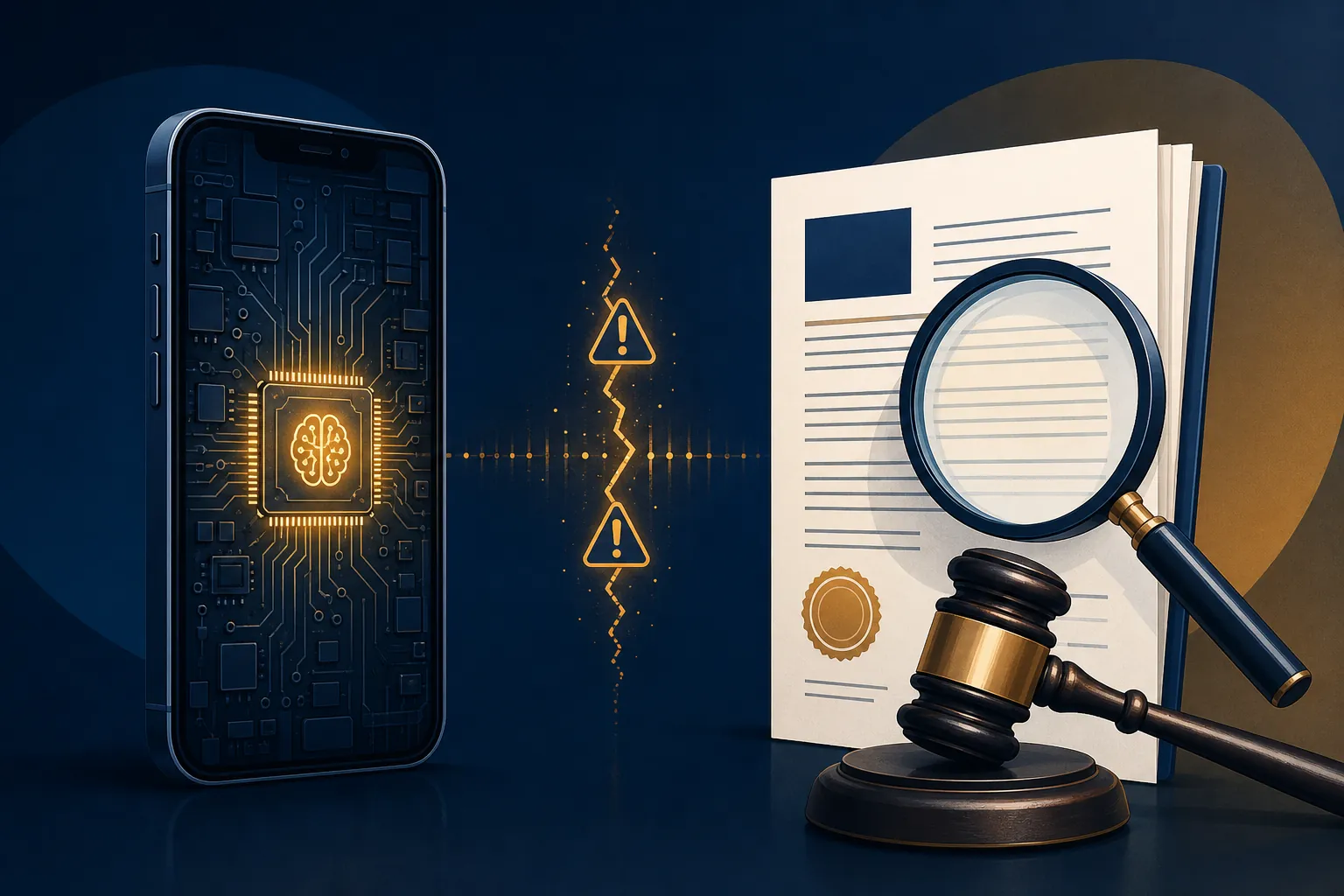
The practical limit starts with hardware, not with a generalized fear of artificial intelligence. Current on-device LLMs run inside tight mobile budgets: Meta’s 2026 overview describes mobile NPUs in the range of roughly 35 to 60 TOPS, but identifies memory bandwidth as the binding constraint, with mobile devices around 50 to 90 GB/s compared with 2 to 3 TB/s for datacenter GPUs. The same overview places typical available RAM for these models below 4GB, limiting viable local models to sub-7B parameters even with 4-bit quantization.[1]
That gap matters because token generation is not only a processor-speed problem. Each generated token requires model weights and context to be moved through memory. A phone can have a capable NPU and still be constrained by the amount of model and context it can keep moving fast enough. The result is not “the same AI, privately deployed.” It is a smaller, compressed model operating with a narrower working set.
Privacy Reduces Exposure, Not the Verification Duty
The privacy claim is still worth taking seriously. Local processing can reduce the amount of client information sent to cloud systems, stored in vendor logs, routed through third-party infrastructure, or made dependent on representations the firm cannot easily audit. For firms that have already restricted external AI tools because of confidentiality concerns, a local model may be easier to contain in policy.
But confidentiality and reliability are different controls. A model can keep the document on the device and still misunderstand the document. It can avoid transmitting a prompt and still invent a rule. It can make procurement counsel more comfortable while making the reviewing lawyer less alert, which is exactly the wrong trade if the output is headed toward a client memo, a motion, or a certification.
That distinction belongs in any law-firm policy discussion about AI hallucinations and attorney ethics. A privacy-preserving workflow may be preferable to an uncontrolled cloud workflow. It is not, by itself, a verified legal workflow.

The Phone-Sized Model Is the Point
The usual consumer framing hides the most important legal fact: on-device models are smaller because they have to be. The constraints are physical before they are contractual. A flagship phone can perform impressive local inference, but it cannot offer datacenter memory bandwidth, datacenter-class VRAM, or the same model scale as a frontier cloud system.
| Constraint | Typical on-device implication for legal work |
|---|---|
| Available RAM below 4GB for local models | Sub-7B models are more realistic than large frontier models, even with 4-bit quantization |
| Mobile memory bandwidth around 50-90 GB/s | Long prompts and repeated generation are harder to sustain than on datacenter GPUs |
| Datacenter GPU bandwidth around 2-3 TB/s | Cloud systems can support larger models and heavier context processing |
| On-device context windows commonly around 8K-32K tokens | Many pleadings, exhibits, contracts, and research packets exceed the comfortable working range |
| Cloud frontier context windows can reach 128K-1M+ tokens | Even cloud context is not self-verifying, but it changes the feasible document-analysis envelope |
The legal consequence is straightforward. Smaller, quantized models have less capacity for stored knowledge, fewer internal resources for multi-step reasoning, and less room to carry long source material. That does not make every answer wrong. It means the lawyer should expect more boundary failures when the task asks the model to behave like a research associate across a large legal record.
Context length is especially unforgiving in legal work. The harmful error is often not a visible collapse; it is a quiet omission from the middle of a record, a missed exception in an exhibit, or a conclusion drawn from the first and last documents while the controlling qualification sat between them. Chroma’s 2026 context-window testing across 18 frontier models reported accuracy degradation of more than 30% in mid-window positions, a problem often described as context “rot.” Because the available materials do not provide a source link for that report, the figure should be treated here as a risk signal rather than as a fully documented benchmark citation.
Legal Benchmarks Do Not Let Anyone Relax
The most-cited legal hallucination figures need careful handling. Stanford RegLab and HAI reported that general-purpose LLMs hallucinated on 69% to 88% of legal queries, but the tested systems were GPT-3.5, Llama 2, and PaLM 2. That is important because those are older model generations, and the result should not be quoted as a universal 2026 hallucination rate for every current AI system.[2]
The study still matters for a narrower reason. It shows that legal questions are not ordinary chat prompts. Legal research requires current authority, jurisdictional precision, procedural posture, and the ability to distinguish a real holding from a plausible sentence that sounds like one. Those are exactly the places where a smaller local model, cut off from comprehensive retrieval and operating in a limited context window, should not be given the benefit of the doubt.
The same Stanford discussion also reported that specialized legal retrieval-augmented generation systems hallucinated at more than 17%.[2] That is not a condemnation of every legal AI product. It is a floor warning: even systems designed around legal sources and retrieval did not eliminate hallucination. A phone-based general assistant should not be treated as less risky merely because the prompt never left the device.
Other benchmark signals point in the same direction while requiring their own caveats. The Vals AI VLAIR report, described second-hand through MIT Sloan in October 2025, found ChatGPT with search achieved about 80% accuracy on legal research queries. Because no direct source link is provided here, that figure should not carry more weight than its provenance permits. Even taken at face value, 80% accuracy is not a filing standard. It means one in five answers may still require correction in the measured task.
Small Models Can Be Useful When the Job Is Narrow
The right conclusion is not that small models are useless. Intel’s evaluation of smaller models reported that Neural Chat 7B had a 2.8% hallucination rate on Vectara’s HHEM summarization benchmark.[3] That result is important precisely because it prevents a lazy rule of thumb. A smaller model can perform well when the task is narrow, grounded, and measured against source fidelity rather than open-ended legal reasoning.
Summarizing a short, clearly bounded document is different from answering whether a statute has been interpreted in a particular circuit after a recent amendment. Extracting dates from one uploaded agreement is different from reconciling conflicting exhibits across a production set. Drafting a first-pass internal note from provided text is different from supplying pinpoint citations for a motion.
Task Type Should Decide the Workflow
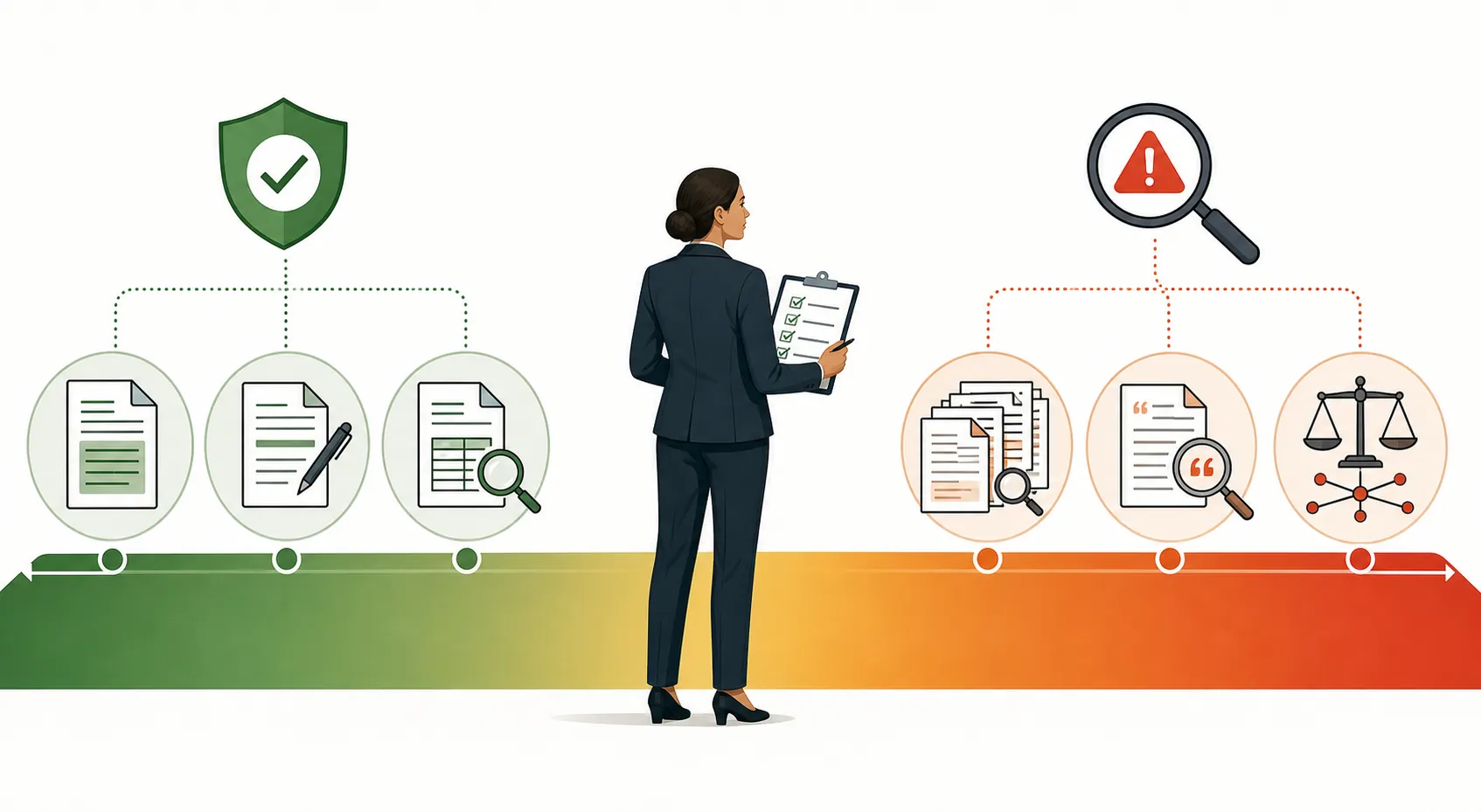
A useful on-device AI policy should not begin with a brand name. It should begin with task boundaries. The question is not whether a smartphone assistant is “allowed” or “banned” in the abstract. The question is what the model is being asked to do, what source material it can actually see, and what independent check stands between its output and legal reliance.
| Task | On-device posture | Verification that remains necessary |
|---|---|---|
| Summarize one short document supplied by the lawyer | Potentially defensible with review | Compare the summary against the source; check omitted qualifications and defined terms |
| Draft a local first-pass email or internal note from lawyer-provided facts | Potentially useful if treated as drafting assistance | Confirm facts, legal characterizations, tone, and privilege-sensitive wording |
| Extract names, dates, deadlines, or clause references from a bounded document | Potentially useful when the source is short and visible | Spot-check every extracted field before use |
| Analyze multiple pleadings, exhibits, or contracts | High caution | Use a source index, human review, and independent comparison across documents |
| Conduct legal research | Not suitable as a substitute for verified research | Confirm all authorities in a trusted legal database and update-check the rule |
| Generate or verify pinpoint citations | High risk | Independently open the cited authority and confirm the page, proposition, jurisdiction, and procedural posture |
The middle column is deliberately modest. On-device AI may be acceptable for assistance that remains visibly tied to a source the lawyer is already reviewing. It becomes much harder to defend when the output asks the lawyer to trust hidden reasoning, unstated retrieval, or memory of law.
Where Review Time Actually Moves
The time savings from a phone-generated summary may be real. But in a legal workflow, saved drafting time often reappears as verification time. Someone still has to check whether the model skipped the indemnity carveout, reversed the burden of proof, treated dicta as a holding, or supplied a citation that does not support the sentence.
That “someone” is not an abstraction. It is the associate cleaning up the memo, the paralegal checking citations, the knowledge-management lawyer approving a template, or the partner whose signature turns a generated sentence into a professional representation. Local processing does not move that responsibility to the device manufacturer.
Ethics Rules Care About Competence, Not Model Location
ABA Model Rule 1.1 Comment 8 ties competent representation to keeping abreast of the benefits and risks associated with relevant technology.[4] State and local ethics guidance has moved in the same direction. The Maryland State Bar Association’s May 2024 guidance states that the duty of competence requires understanding AI capabilities and limitations; NYC Bar Formal Opinion 2025-6 and Oregon State Bar Formal Opinion 2026-208 also belong to the developing professional-responsibility framework.
For practical implementation, that means the lawyer or firm approving on-device AI should be able to answer basic questions before the tool enters a legal workflow:
- What tasks is the local model permitted to perform, and which tasks are excluded?
- What model class, context window, and retrieval capability does the device actually use for the relevant feature?
- Does the workflow keep the source material visible to the reviewer?
- Who verifies citations, quotations, legal propositions, and factual extractions?
- What outputs may not be sent to a client, court, regulator, or counterparty without independent review?
Those questions fit within a broader AI compliance framework for law firms. A phone-based AI feature should not bypass the firm’s verification protocol because it feels more private than a browser-based tool.
A Safer Use Case Is Source-Grounded and Short
The defensible zone is narrower than consumer AI marketing suggests, but it is not empty. On-device AI can be considered for local, bounded, source-grounded assistance: summarizing one short document, rewriting lawyer-drafted text, extracting obvious facts from a visible source, or producing a first-pass internal outline that will be checked before anyone relies on it.
The higher-risk zone begins when the model is asked to supply law, synthesize many documents, resolve conflicts, or verify authorities. In those workflows, the small local model’s privacy advantage does not compensate for model-size limits, context vulnerability, and the absence of independent legal-source validation. If the task would require a human lawyer to open the case, read the statute, check the docket, or compare exhibits, the AI output needs the same independent check.
The operational rule is plain enough for policy language: local processing may reduce confidentiality exposure, but it does not reduce the lawyer’s duty to understand the tool’s limits and verify the work. The smartphone changes where the data goes. It does not sign the filing.
References
- On-Device LLMs: State of the Union, 2026, Vikas Chandra, Meta, 2026.
- Hallucinating Law: Legal Mistakes with Large Language Models are Pervasive, Stanford HAI.
- Do Smaller Models Hallucinate More?, Intel.
- Model Rules of Professional Conduct: Rule 1.1 Competence, American Bar Association.
Grounded in
This procedure is grounded in ABA Model Rule 1.1 Comment 8, independent of any single documented case. See the Regulation tracker for the governing text.
Cases this step would have prevented
No cases have been explicitly linked to this checklist yet. See Risk Digest for documented incidents generally.
← Back to WorkflowsReport a correction or tip
Spotted an outdated figure, a misstated fact, or a ruling this workflow checklist should reflect? Public comments are disabled for this content given the professional cost of a misreported case outcome, penalty amount, or rule text — use the structured correction channel instead.
Report a correction or tip for this record →