
Why OpenAI API Pricing Misleads Legal Professionals
Raw OpenAI API token pricing hides the dominant cost of using GPT models in legal work: mandatory human verification required by ABA Formal Opinion 512 and escalating sanction risk. This article breaks down the total cost including verification hours and sanction-risk premium, showing why the sticker price is a dangerous proxy.
- Applicable role
- attorney
- Workflow stage
- review
- Primary source
- ABA Formal Opinion 512
A legal team can open an OpenAI API pricing table and come away with a comforting number: a long contract costs pennies to run through a small model. That number is real enough for infrastructure planning. It is not the cost of using the output in a legal workflow.
The working formula is less flattering:
Total Cost = Token Cost + (Verification Hours × Attorney Hourly Rate) + Sanction-Risk Premium
OpenAI's public pricing tables make the first term easy to calculate. The catalog includes low-cost entries such as GPT-4.1 Nano at $0.10 per 1 million input tokens and $0.40 per 1 million output tokens, GPT-5.4 Mini at $0.75 per 1 million input tokens, GPT-5.6 Terra at $2.50 per 1 million input tokens and $10 per 1 million output tokens, and o4-mini at $0.55 per 1 million input tokens and $2.20 per 1 million output tokens. OpenAI also lists cached-input discounts and Batch API pricing that can materially lower raw API spend when latency is acceptable.[1][2]
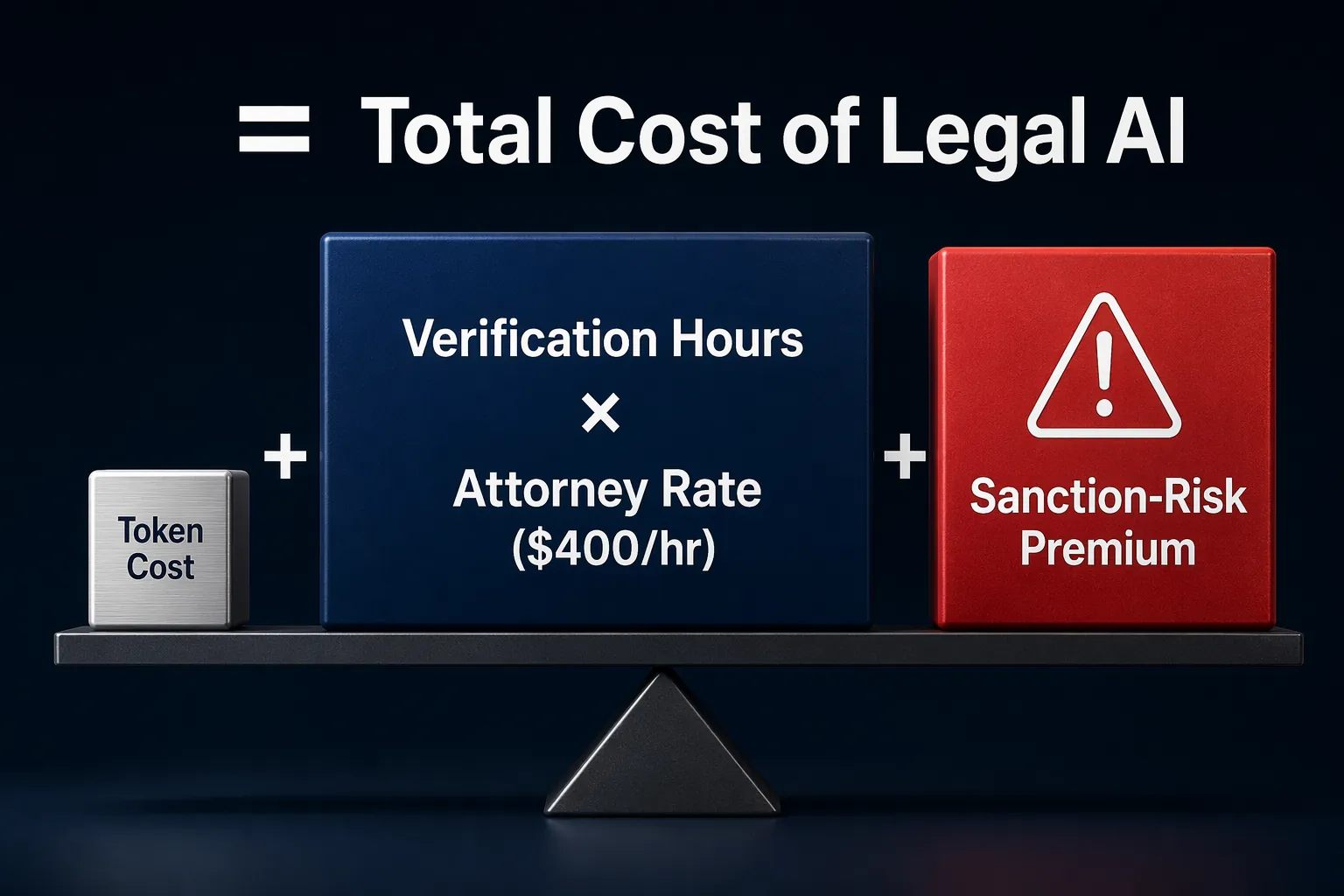
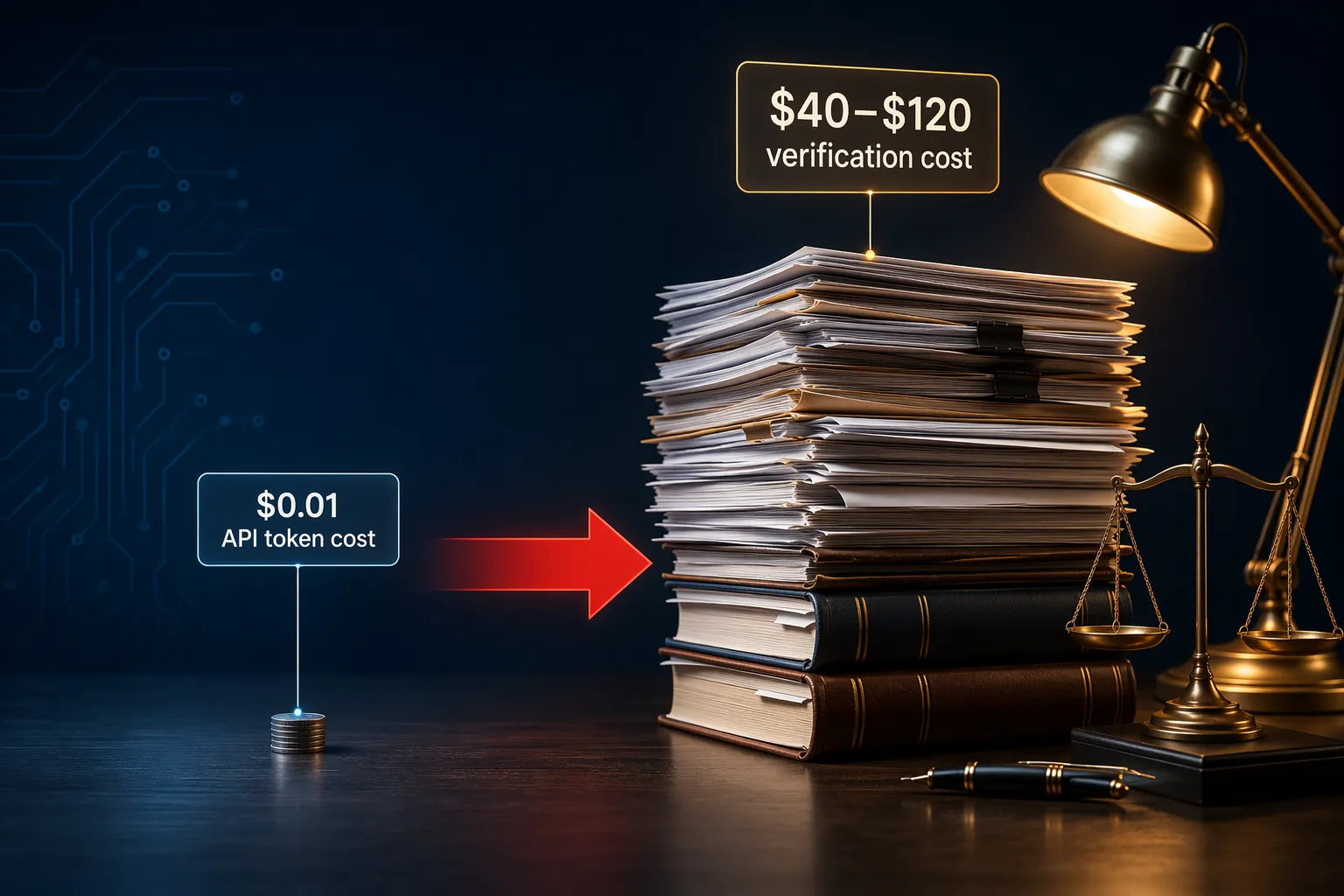
That is where many procurement spreadsheets stop. They should not. CloudZero's 2026 pricing analysis gives the kind of example that makes API pricing look almost trivial: a 50,000-token contract processed through a low-cost GPT-5.4 Nano-style workflow can carry roughly one cent of input-token cost, depending on assumptions.[3] If a lawyer must spend six to eighteen minutes checking the resulting clauses, citations, obligations, and omissions at a $400 hourly rate, the verification layer adds $40 to $120. The model bill is no longer the main event; it is the receipt stapled to the real invoice.
The Cheap Part Is the Part the Firm Does Not Rely On
The token price matters when a firm is deciding whether a workflow should use GPT-4.1 Nano, GPT-5.4 Mini, GPT-5.6 Terra, o4-mini, or a delayed Batch API job. It matters to engineering, matter-margin analysis, and vendor negotiations. It matters less to the person who must sign a filing, approve a contract position, or certify that a research answer is safe to circulate.
| Cost Component | What It Measures | Why It Matters in Legal Work |
|---|---|---|
| Token cost | Input, output, cached-input, and batch-processing charges | Useful for infrastructure budgeting, especially at scale |
| Verification hours | Attorney or trained reviewer time spent checking the output | Often dominates the economics because legal work requires human review |
| Sanction-risk premium | Expected cost of mistakes reaching clients, courts, or adversaries | Changes the model-selection decision when hallucinated authority or false analysis can cause court penalties |
ABA Formal Opinion 512, issued in 2024, did not ban lawyers from using generative AI. It did make the professional-duty layer explicit. Lawyers using generative AI must understand relevant benefits and risks, protect confidentiality, communicate appropriately with clients, supervise subordinate and nonlawyer work, and ensure that fees remain reasonable.[4] In cost terms, that means the review step is not optional quality assurance. It is part of the lawyer's work.
This is why a one-cent contract example can become a $40 to $120 task without anyone behaving inefficiently. Someone has to compare the model's summary against the contract. Someone has to notice if an indemnity carveout disappeared, if a governing-law clause was overstated, if a defined term was imported from the wrong section, or if a generated negotiation position assumes law that has not been checked. The cheaper model may still be the right model. But the savings are real only if the review burden does not expand to consume them.
What Verification Actually Buys
Verification is easy to understate because it sounds like a final skim. In legal use, it is closer to controlled re-performance of the risky parts of the task.
- For legal research, the reviewer checks that cited authorities exist, say what the model claims, remain good law, and apply in the relevant jurisdiction.
- For contract review, the reviewer checks source text, defined terms, exceptions, cross-references, missing issues, and whether the output quietly normalized unusual language.
- For drafting, the reviewer checks factual predicates, procedural posture, client-specific instructions, and whether language borrowed from a template creates unintended commitments.
- For client-facing summaries, the reviewer checks tone, privilege risk, overstatement, and whether uncertainty has been presented as a conclusion.
A lower hallucination rate can reduce this work, but it does not eliminate it. A vendor-reported improvement in hallucination behavior is a useful procurement signal only after the firm asks what the benchmark measured, whether it resembles the firm's work, and how the remaining error rate affects the review protocol. If a model produces fewer false claims but still requires full citation checking before court filing, the saving may appear in reviewer speed, not in the disappearance of review.
That distinction matters because the strongest business case for model routing is not “the cheapest model is good enough.” It is “this lower-cost model creates an output that a reviewer can verify faster, with a known scope of risk.” Those are different claims. The second one can be tested.
Sanctions Turn Small Errors Into Portfolio Costs
The sanction-risk premium is harder to price than tokens, but it is not theoretical. Humanoid Liability Law's legal AI hallucination tracker reports more than 206 documented hallucination cases globally, including 91 in the United States. The same research summarizes an escalation pattern that includes the $5,000 sanction in Mata v. Avianca in 2023, a $31,100 sanction involving Ellis George and K&L Gates, and more than $145,000 in U.S. sanctions in Q1 2026, with a 2025 case, Couvrette v. Wisnovsky, exceeding $110,000.[5]
Those figures should not be converted into a simple average and pasted into every AI budget. The count comes from a documented-case database, not a universal frequency measure. The sanctions are court outcomes, not proof that every AI-assisted workflow carries the same probability of failure. Still, they change the arithmetic. A $31,100 sanction can erase the token savings from choosing a cheaper model across a large volume of routine work. A six-figure sanction can wipe out an entire annual discount obtained through aggressive model downgrading.
The risk premium also belongs to a specific owner. If a hallucinated case reaches a brief, the API invoice does not answer the court. The lawyer does. If a vendor bundles multiple models behind a clean interface, the firm still needs to know whether the workflow generated legal authority, whether a human checked it, and whether the audit trail proves that review occurred.
The Model Table Is Useful, but Only After the Workflow Is Classified
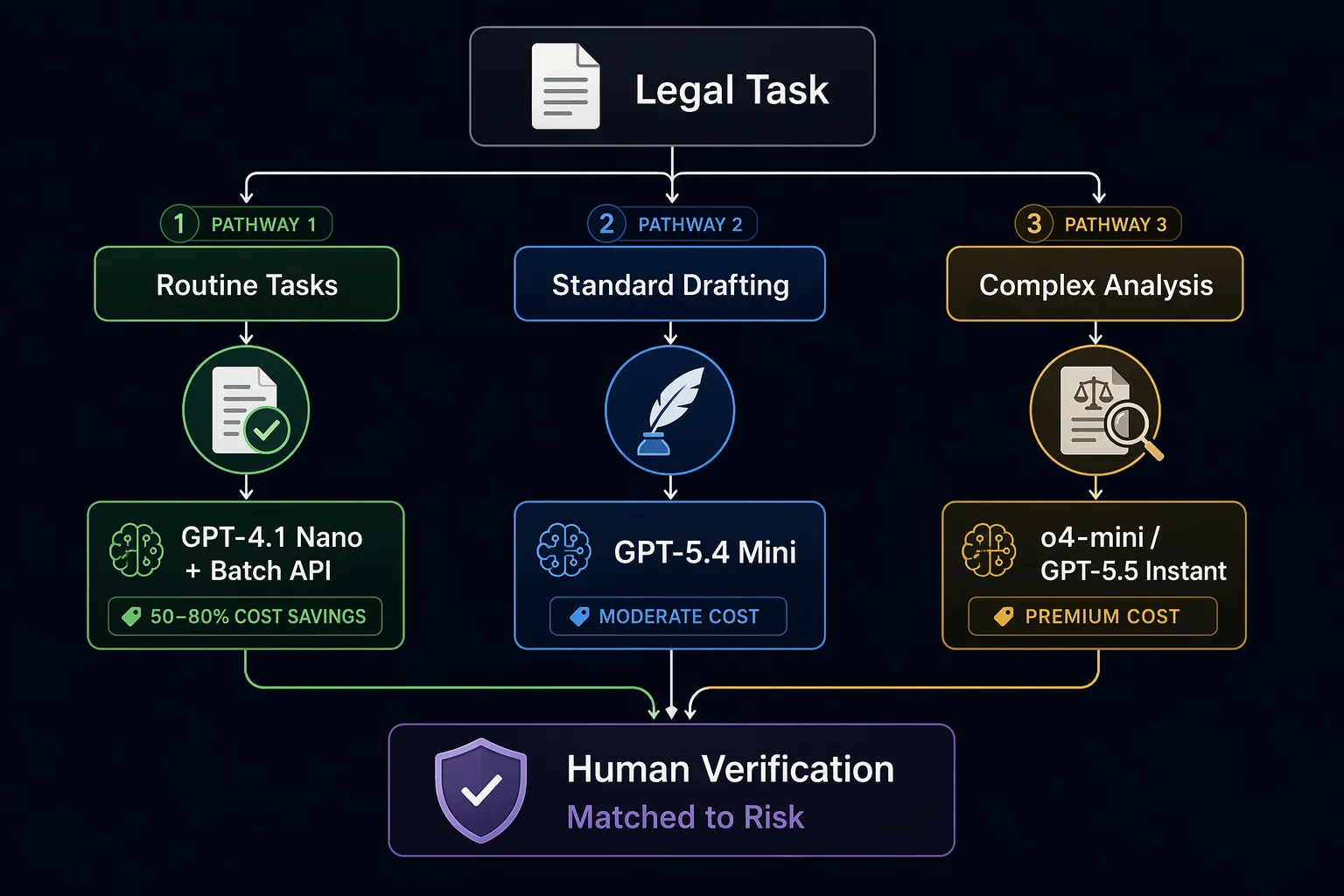
A practical architecture starts by sorting work by legal risk and latency tolerance, then selecting the lowest-cost model that preserves the required review quality. The API price table is the second document, not the first.
| Workflow Type | Likely Routing Choice | Cost Logic | Review Logic |
|---|---|---|---|
| Routine extraction, classification, intake tagging, duplicate detection | GPT-4.1 Nano or similar low-cost model; Batch API when 24-hour turnaround is acceptable | Raw token spend can fall sharply through small-model pricing and batch discounts | Reviewer checks samples, exceptions, and edge cases rather than treating output as legal advice |
| First-pass contract summaries, issue lists, internal research triage | GPT-5.4 Mini or comparable mid-tier model | Higher token cost may be justified if it reduces cleanup and improves reviewer speed | Reviewer verifies source text, omitted issues, and jurisdiction-sensitive claims |
| Complex analysis, litigation strategy, high-stakes research, court-facing drafts | o4-mini, GPT-5.5 Instant, GPT-5.6-class models, or specialized legal tools depending on the task | Premium model cost is justified only if it improves accuracy, reasoning, or verification efficiency | Attorney performs full legal review and documents the basis for reliance |
Batch API-style delayed processing deserves more attention than it usually receives in legal AI discussions. OpenAI describes Batch API as a way to process jobs asynchronously with a 24-hour completion window and a 50% pricing discount.[1][2] Many legal tasks are not urgent: nightly contract-metadata extraction, privilege-log clustering, billing narrative normalization, knowledge-base tagging, and large-scale document cleanup rarely need interactive response times. If latency is acceptable, the firm can save money without moving riskier legal analysis to a weaker model.
Cached input creates a similar opportunity. If a workflow repeatedly sends the same policy, template, playbook, or matter background into the model, cached-input discounts can reduce raw API cost without changing the legal standard applied to the output.[1] That is good operations design. It is also a reminder that savings should first be taken from waste, repetition, and latency tolerance before they are taken from review.
A Cheap Model Can Be Expensive If It Creates More Review
The routing decision should be tested against reviewer time, not just output plausibility. Suppose a low-cost model produces a contract-risk summary for roughly one cent in input tokens. If review takes eighteen minutes, the attorney-time cost at $400 per hour is $120. If a more capable model costs several times more in tokens but reduces review to six minutes because it preserves clause structure, flags uncertainty better, and cites source passages more consistently, the attorney-time cost falls to $40. The model price went up; the task cost went down.
That example is hypothetical, but the principle is not. Legal AI cost should be measured by completed, verified work product. A firm does not buy tokens for their own sake. It buys a shorter path to an output that a lawyer can responsibly use.
This is also where model benchmarking often disappoints legal operations teams. A general accuracy score may not reveal whether the answer is easier to verify. For legal work, a useful evaluation asks whether the model quotes from the provided record instead of inventing missing facts, separates binding authority from persuasive authority, labels uncertainty, preserves citations through editing, and gives the reviewer a clear route back to the source. A model that is slightly less fluent but more auditable may be cheaper in the only sense that matters.
Vendor Seat Prices Can Hide the Same Problem
The same analysis applies when the firm buys a legal-AI subscription instead of building on the API. Vendor pricing can look simpler because it converts usage into a seat price, but the legal-risk question remains: which model or model family is producing which kind of work, and what verification obligation survives the interface?
Zylo reports that 78% of IT leaders have experienced unexpected AI charges and that 60% lack visibility into which models their tools use.[6] That visibility gap matters in legal procurement because model routing is no longer a back-end engineering detail. If a premium legal-AI product silently routes routine tasks to a low-cost model, that may be sensible. If it routes high-stakes legal analysis to a cheaper tier without disclosure, the buyer cannot evaluate either cost or risk.
Public pricing discussions for legal-AI tools show why the audit question is worth asking. The Legal Prompts reports Harvey pricing in the range of roughly $1,000 to $2,000 per seat, CoCounsel in the range of roughly $225 to $428 per seat, and Spellbook at roughly $179 per seat; Clio's legal-AI pricing commentary likewise frames the market around bundled capability, workflow integration, and seat economics rather than raw model tokens.[7][8] Those products may provide valuable legal-specific workflow design, retrieval, document handling, and administrative controls. The seat price, however, does not by itself prove that the firm is receiving the highest-capability model for every task or that verification time has been reduced.
Metacto's 2026 pricing discussion gives a different scale example: a SaaS legal chatbot using GPT-5.4 Mini may cost around $518 per month for 10,000 conversations, depending on token assumptions.[9] That can be attractive for client intake, internal FAQs, or triage. It does not answer whether the chatbot is allowed to give legal advice, whether a lawyer reviews escalations, or whether the system logs enough context to reconstruct what happened when a user relies on the answer.
How to Price a Legal AI Workflow Without Fooling Yourself
A defensible business case does not need to make AI look expensive. It needs to put every cost in the right column.
- Start with the legal task, not the model. Classify whether the output is administrative, internal legal-support work, client-facing advice, or court-facing material.
- Estimate token cost using the actual prompt, source materials, expected output length, caching, and batch eligibility.
- Measure verification time with real reviewers. Use completed, checked outputs as the unit of cost.
- Assign a risk owner. Decide who signs off, who supervises, who documents review, and who handles exceptions.
- Price sanction exposure by scenario, not by average. Court-facing hallucinations, client advice errors, and internal tagging mistakes do not belong in the same risk bucket.
- Re-test routing periodically. Model names, prices, and vendor configurations change quickly enough that a 2025 assumption may be stale in Q3 2026.
The measurement step is where a firm can find the promised 60% to 80% raw token savings without pretending that all legal work is the same. Put routine extraction and bulk cleanup into low-cost or batch workflows. Use mid-tier models where the output is standard but benefits from better structure. Reserve higher-capability models for tasks where the additional spend changes the quality of reasoning, the ease of verification, or the risk of a costly miss.
The attorney-review estimate should be attached to each category. A workflow that saves $500 in monthly API spend but adds ten hours of senior associate review has not saved money. A workflow that raises API spend by $50 but eliminates five hours of repetitive checking may be a bargain. Token price is the input. Verified legal work is the deliverable.
The Procurement Question
OpenAI's API pricing is useful. It gives legal teams a concrete way to compare model tiers, batch processing, cached input, and the economics of direct API use versus subscription tools. It becomes dangerous only when it is treated as a proxy for the cost of legal AI.
Before approving a model, workflow, or vendor, the better questions are plain: who verifies the output, how long does that take, what sanctions or client harms is the workflow designed to prevent, and does cheaper routing reduce total risk-adjusted cost after review? If those answers are missing, the API price is not a business case. It is only the smallest line item.
References
- OpenAI API Pricing (Official) — OpenAI
- OpenAI Developer Pricing — Full Model Table — OpenAI Developers
- OpenAI API Cost In 2026: Every Model Compared — CloudZero
- ABA Issues First Ethics Guidance on a Lawyer's Use of AI Tools — Formal Opinion 512 — American Bar Association, July 2024
- Legal AI Hallucinations: Cases, Ethics Rules, and Risk Management — Humanoid Liability Law
- OpenAI API Pricing: How to Control Costs Before They Escalate — Zylo
- Legal AI Pricing 2026: Harvey vs CoCounsel vs Clio — The Legal Prompts
- What's Driving Legal AI Pricing in 2026? — Clio
- OpenAI API Pricing May 2026: GPT-5.5, o4-mini & All Models — Metacto, May 2026
Grounded in
This procedure is grounded in ABA Formal Opinion 512, independent of any single documented case. See the Regulation tracker for the governing text.
Cases this step would have prevented
No cases have been explicitly linked to this checklist yet. See Risk Digest for documented incidents generally.
← Back to WorkflowsReport a correction or tip
Spotted an outdated figure, a misstated fact, or a ruling this workflow checklist should reflect? Public comments are disabled for this content given the professional cost of a misreported case outcome, penalty amount, or rule text — use the structured correction channel instead.
Report a correction or tip for this record →