
How to Report Dealer Retaliation for a Bad Review
If a car dealership is threatening you or taking other retaliatory actions after you left an honest bad review, this guide walks you through the five reporting channels available — from the FTC and state attorney general to your DMV licensing board — and explains what each can actually do.
- Applicable role
- pro se litigant
- Workflow stage
- post-filing
- Primary source
- FTC Consumer Reviews and Testimonials Rule (2024); Consumer Review Fairness Act (2016)
If a dealership starts threatening you after an honest bad review, do not delete the review just to make the calls stop. First, preserve the review, every message, every envelope, every caller ID screen, every voicemail, and every public response the dealer posts about you. Do not sign a nondisclosure agreement, settlement, retraction, or “mutual release” without legal advice. Then report the conduct to the agency that has power over the thing the dealer actually did.
The main federal rule now says businesses may not suppress reviews through “unfounded or groundless legal threats, physical threats, intimidation, or certain false public accusations.” The FTC Consumer Reviews and Testimonials Rule took effect in October 2024, and later FTC materials placed potential civil penalties at up to $53,088 per violation as of December 2025.[1][2] That does not mean every angry email from a dealer produces an FTC case. It does mean a documented complaint belongs somewhere more useful than a private inbox.
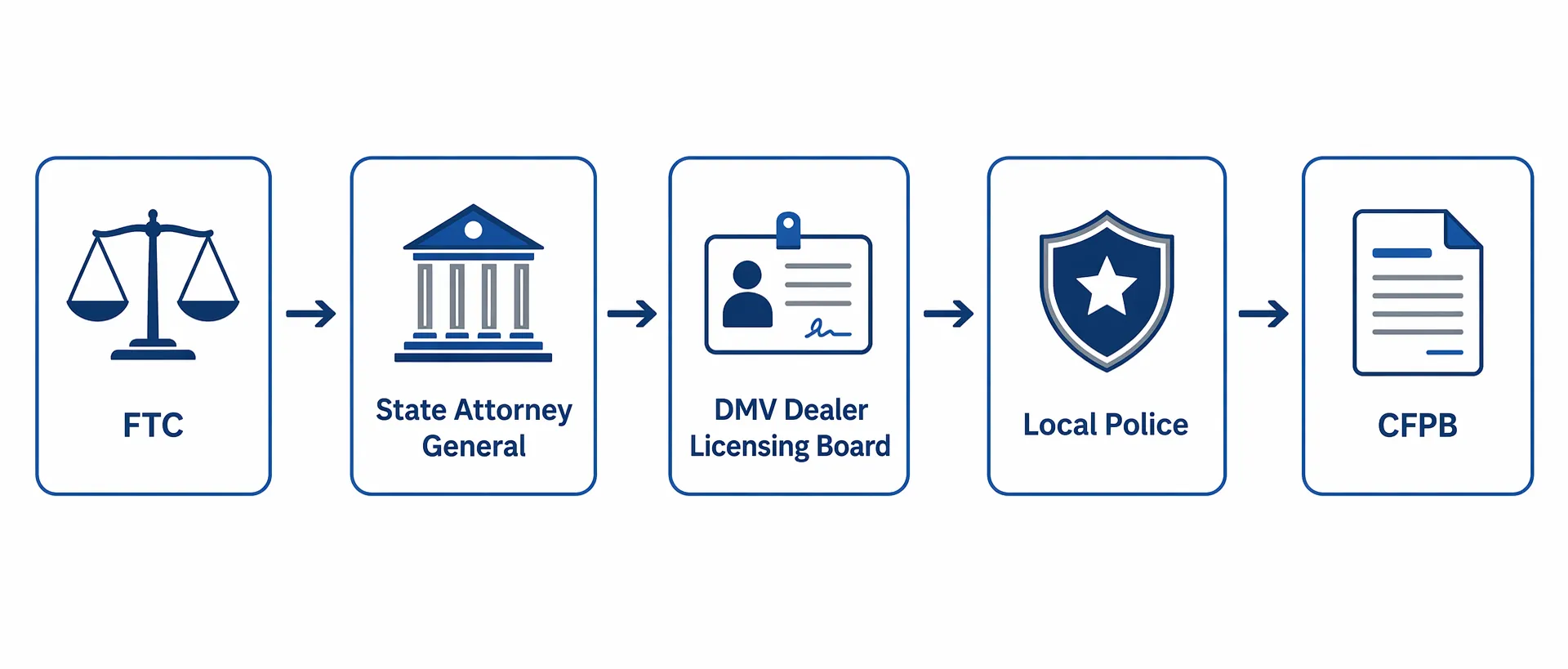
Start by matching the retaliation to the right reporting channel
| What the dealer did | Where to report first | What that channel can realistically do |
|---|---|---|
| Threatened to sue over an honest review, demanded deletion, sent a baseless legal letter, posted false public accusations about you | FTC and state attorney general | Receive unfair or deceptive practice complaints, look for patterns, and bring enforcement actions |
| Used a contract clause, settlement form, or dealership paperwork to punish or silence reviews | FTC and state attorney general | Enforce federal limits on gag clauses in standardized consumer contracts |
| Threatened your title, registration paperwork, warranty processing, delivery, refund, trade-in, or other dealership-controlled transaction | State DMV dealer licensing board or motor vehicle commission | Investigate licensed dealer conduct and, depending on state law, discipline, suspend, or revoke a dealer license |
| Made physical threats, stalked you, repeatedly harassed you, showed up at your home or workplace, or made you fear immediate harm | Local police | Create a safety record, respond to threats, and handle conduct that may be criminal |
| Retaliated through financing, credit reporting, loan servicing, payment processing, or repossession pressure | CFPB, plus state attorney general if appropriate | Route financial-product complaints to the company and preserve records for consumer-finance oversight |
Those channels are not interchangeable. The FTC does not issue a local police report. A police department does not decide whether a dealer keeps its sales license. A DMV board usually will not litigate whether your Google review was defamatory. A CFPB complaint is useful when the retaliation touches credit or financing, not when the only issue is a rude manager demanding that you take down a Yelp post.
Before you file anything, preserve the evidence
Agency complaints are only as strong as the records attached to them. A frightened consumer often wants to explain the whole story in one long paragraph. That is understandable, but the better file is chronological: review posted, dealer response, first threat, second contact, demand letter, public accusation, financing consequence, police contact if any.
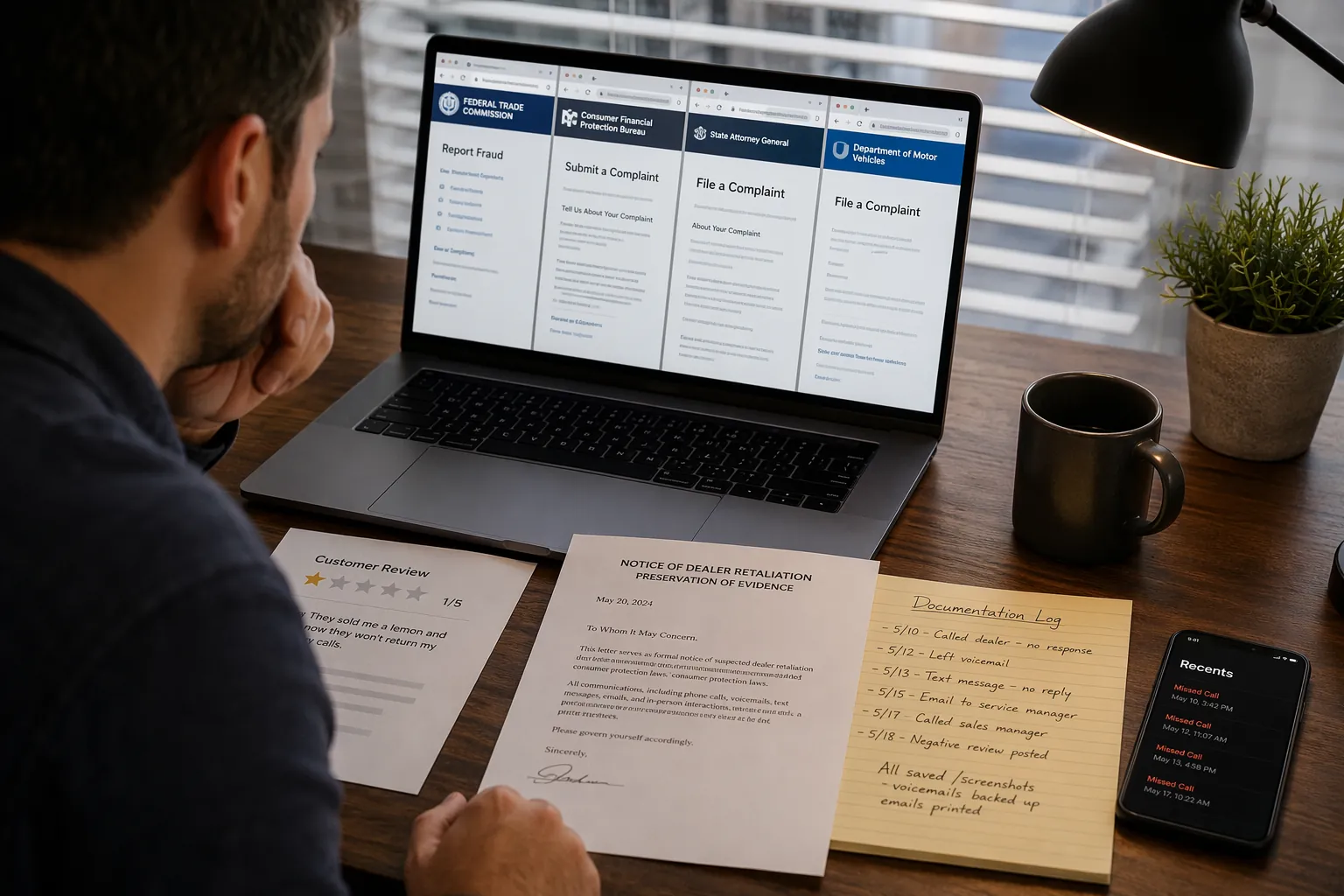
- Save a screenshot of the original review with the date, platform, star rating, and full text visible.
- Screenshot the dealer’s public replies, including any accusation that you lied, committed fraud, extorted them, or were never a customer.
- Keep emails, texts, direct messages, voicemails, call logs, certified-mail envelopes, and letterhead from any lawyer or collection firm.
- Save the sales contract, finance agreement, buyer’s order, warranty forms, add-on product paperwork, repair orders, title documents, and any nondisparagement or confidentiality language.
- Write a short timeline with dates and names. If you do not know the name of the caller, write the phone number, time, and what was said.
- If there is a threat to your safety, stop organizing the perfect file and contact local police or a lawyer first.
Do not improve the facts to make the complaint sound stronger. If the review contains something you cannot prove, separate what you personally experienced from what you inferred. An honest review about your own purchase, financing experience, repair delay, add-on charge, or customer-service interaction is very different from a provably false claim that a named employee committed a crime. Federal review protections do not turn defamation, threats, harassment, or knowingly false statements into protected conduct.
File with the FTC when the dealer is trying to suppress the review
Use ReportFraud.ftc.gov when the retaliation looks like review suppression: legal threats with no real basis, intimidation, pressure to delete an honest review, a contract clause that penalizes bad reviews, or public accusations meant to scare you into silence. Consumer complaints go into the FTC’s enforcement database; they do not function like a private lawsuit or a customer-service ticket.
Two federal frameworks matter here. The Consumer Review Fairness Act of 2016 makes it illegal for businesses to use form-contract provisions that bar, restrict, or penalize honest consumer reviews. The FTC’s own business guidance is blunt about the target: companies cannot put gag clauses in standardized contracts to stop people from posting truthful reviews.[3] The catch is important: the CRFA does not give you a private right to sue the dealer directly under that statute. Enforcement belongs to the FTC and state attorneys general.
The newer Consumer Reviews and Testimonials Rule gives the FTC another tool. In December 2025, the agency announced warning letters to 10 companies about possible violations of the new rule and published a template warning letter.[4] That same month, FTC staff also warned businesses that the rule reaches review suppression through unfounded legal threats, physical threats, intimidation, and certain false public accusations, with penalties listed at up to $53,088 per violation.[2] A single consumer complaint may not trigger an investigation, but a cluster of complaints about the same dealer, same ownership group, same lawyer letter, or same review-deletion script is the kind of pattern enforcement databases are built to see.
When filing with the FTC, keep the complaint factual. Identify the dealership’s legal name if you have it, the trade name on the sign, the address, the website, the names of managers or employees involved, the review platform, and the exact words used to pressure you. Attach or preserve the demand letter and screenshots. If the dealer threatened to sue, say whether the letter identified a specific false statement or merely demanded removal of the entire review.
The FTC has also kept auto dealer conduct on its radar. In March 2026, it announced warning letters to 97 auto dealership groups about deceptive pricing.[5] Those letters were not about review retaliation, so they should not be treated as proof that the FTC is investigating your dealer for your review dispute. They do show that dealership practices remain a live enforcement category, which matters when you decide whether your complaint is worth filing.
Send the same core file to your state attorney general
A state attorney general complaint is the state-level companion to the FTC report. State AG offices enforce consumer-protection laws, and the CRFA can be enforced by state attorneys general as well as the FTC.[3] Some offices mediate individual complaints; others mainly collect complaints for investigations. Read the complaint page before you file so you do not mistake an intake form for a promise of representation.
Use the same evidence package, but add any state-specific facts: the dealer’s license number if available, the county, whether financing was arranged in-state, whether the car was delivered across state lines, and whether the dealer is still holding paperwork, refund money, title documents, or trade-in proceeds. If the retaliation letter came from a lawyer, upload it. If a manager threatened you by phone and then emailed a milder version, include both the call log and the email.
Do not oversell the complaint as a constitutional case. A private dealership is not the government, and most enforcement offices will look first at unfair or deceptive practices, contract gag clauses, licensing violations, threats, and financial harm. The stronger phrasing is often simpler: “The dealer is demanding that I delete a truthful consumer review and is threatening consequences that appear designed to suppress it.”
Use the DMV dealer licensing board when the dealer’s license is the pressure point
The most underused report is often the one closest to the dealer’s right to keep selling cars. State motor vehicle agencies, dealer boards, or motor vehicle commissions handle dealer licensing, and USAGov directs consumers with car complaints to state motor vehicle departments or similar state offices.[6] Car Consumers also maintains a state-by-state “where to complain” resource for auto sales issues.[7]
This channel matters because a dealer license is not a public-relations asset; it is permission to operate. Depending on the state and the violation, a licensing authority may investigate complaints, request documents from the dealer, require a response, impose discipline, suspend a license, or revoke it. The exact powers and procedures vary by state, so the complaint should be written for your state’s form rather than copied blindly from a federal complaint.
A DMV or dealer-board complaint is especially important when the retaliation is tied to a transaction the dealer still controls: title work, registration, temporary tags, warranty cancellation, repair completion, delivery, add-on refunds, trade-in payoff, or release of documents. If the dealer says, in effect, “Delete the review or we will make the car paperwork difficult,” that belongs in the licensing file.
- Search for your state plus “dealer complaint,” “motor vehicle dealer board,” “dealer licensing complaint,” or “DMV dealer complaint.”
- Use the dealer’s licensed name and address from your contract, buyer’s order, temporary tag paperwork, or state license lookup if available.
- Attach the review screenshot, retaliation messages, contract documents, title or registration documents, and any proof that the dealer is withholding action.
- Ask for the complaint to be reviewed as possible licensed-dealer misconduct, not merely as a disagreement about an online review.
- Keep the complaint number. If the dealer escalates, add a supplemental filing instead of starting over from scratch.
Licensing boards are not uniform. Some are responsive and practical; some are slow; some limit themselves to narrow statutory violations. Still, this is the office that can make a dealer explain conduct to the regulator that controls its license. That is a different kind of attention than a one-star review.
Call local police when the retaliation becomes a safety issue
Police are not the right office for an ordinary review dispute. They are the right office for threats, stalking, harassment, physical intimidation, trespass, repeated unwanted contact after you have told the person to stop, or conduct that makes you reasonably fear for your safety. If someone from the dealership shows up at your home, threatens to hurt you, follows you, or uses others to harass you, treat it as a safety matter first.
When you contact police, ask how to make a report and how to provide digital evidence. Bring the timeline, phone numbers, voicemails, screenshots, license plates if relevant, and names. If the department will not take a report because it views the matter as civil, write down the date, time, officer or desk name if provided, and what you were told. That record can still matter when you later speak to a lawyer, an attorney general office, or a licensing board.
Use the CFPB only when financing or credit is involved
The CFPB is not a general dealership-review agency. It becomes relevant when the retaliation touches a consumer financial product or service: auto financing, credit reporting, loan servicing, payment allocation, repossession pressure, debt collection, or a finance-related add-on. If the dealer threatens to “mess up your credit,” refuses to correct financing paperwork unless you remove the review, reports inaccurate information, or uses a lender relationship to pressure you, a CFPB complaint may fit.
File against the finance company, lender, servicer, credit-reporting issue, or dealer-related finance conduct as accurately as the CFPB form allows. Attach the retail installment contract, credit denial or approval documents, payment records, credit-report screenshots, and the retaliation messages that connect the financial harm to the review. If the problem is only “the dealer yelled at me about Yelp,” use the FTC, state AG, and DMV paths instead.
What not to rely on
Do not cite the FTC’s CARS Rule as if it is currently active. The rule was vacated by the Fifth Circuit in January 2025 on procedural grounds, while the FTC continued case-by-case auto enforcement under other authority.[8] For review retaliation, the cleaner federal footing is the FTC Act, the Consumer Review Fairness Act, and the Consumer Reviews and Testimonials Rule.
Do not assume the platform will protect you either. Google, Yelp, Facebook, DealerRater, and similar sites may have policies against harassment or review manipulation, and you can report abusive replies or fake retaliatory reviews through the platform’s tools. But platform moderation is not the same as government enforcement, and it does not create the licensing or consumer-protection record that agencies use.
Also do not sign away the dispute casually. Dealerships sometimes frame a deletion demand as a “resolution,” “goodwill agreement,” or “mutual nondisparagement” provision. Non-disparagement clauses can create serious legal pressure in other settings too, as discussed in this site’s article on post-termination silence and legal risk. In a consumer dealership dispute, the immediate question is whether the paper asks you to delete, retract, stay silent, or pay a penalty for an honest review. If it does, get advice before signing.
A practical filing order
If there is no immediate safety issue, the cleanest order is usually: preserve evidence, file with the FTC, file with the state attorney general, file with the DMV or dealer licensing board, then add police or CFPB reports only if the facts fit those narrower channels. If there is a threat of harm, reverse the order and deal with safety first.
- Create one evidence folder with the review, retaliation messages, contract documents, and a dated timeline.
- Submit the review-suppression complaint at ReportFraud.ftc.gov, using the dealer’s full identifying information.
- Submit a state attorney general complaint with the same core facts and any state-specific consumer harm.
- Submit a DMV or dealer licensing complaint if the dealer is threatening paperwork, delivery, title, registration, refunds, trade-in payoff, warranty handling, or other licensed-dealer conduct.
- Contact local police if there are threats, stalking, harassment, or physical intimidation.
- File with the CFPB if the retaliation involves financing, credit reporting, loan servicing, debt collection, or repossession pressure.
Each complaint should mention the others briefly: “I also filed a complaint with the FTC,” or “I have opened a DMV dealer complaint because the dealer is withholding title paperwork.” Do not exaggerate. The point is to show that the same evidence has been routed to the offices with different authority over the same conduct.
No report guarantees that the dealer will stop, that an agency will open a case, or that you will receive individual compensation. What a coordinated complaint package does is give each office the part it can use: the FTC and state AG get the review-suppression record, the licensing board gets the dealer-conduct record, police get the safety record, and the CFPB gets the financial record. At that point, you have moved the dispute out of the dealer’s private pressure campaign and into files that other people can act on.
References
- Federal Trade Commission Announces Final Rule Banning Fake Reviews and Testimonials, Federal Trade Commission, August 2024, link
- A warning letter (or ten) for businesses, Federal Trade Commission Business Blog, December 2025, link
- Consumer Review Fairness Act: What Businesses Need to Know, Federal Trade Commission, link
- FTC Warns 10 Companies About Possible Violations of the Agency's New Consumer Review Rule, Federal Trade Commission, December 2025, link
- FTC Warns 97 Auto Dealership Groups About Deceptive Pricing, Federal Trade Commission, March 2026, link
- Where to file a complaint about your car, USAGov, link
- Where to Complain, Car Consumers, link
- Texas Automobile Dealers Association v. Federal Trade Commission, U.S. Court of Appeals for the Fifth Circuit, January 2025, link
Grounded in
This procedure is grounded in FTC Consumer Reviews and Testimonials Rule (2024); Consumer Review Fairness Act (2016), independent of any single documented case. See the Regulation tracker for the governing text.
Cases this step would have prevented
No cases have been explicitly linked to this checklist yet. See Risk Digest for documented incidents generally.
← Back to WorkflowsReport a correction or tip
Spotted an outdated figure, a misstated fact, or a ruling this workflow checklist should reflect? Public comments are disabled for this content given the professional cost of a misreported case outcome, penalty amount, or rule text — use the structured correction channel instead.
Report a correction or tip for this record →