
San Diego Affordable Housing Permit Program Requirements
A source-checked record of San Diego's Affordable Housing Permit Now program requirements as of 2026: eligibility gates, the 55-year deed restriction, review and issuance deadlines, fees, and inclusionary-housing obligations. Every requirement is pinned to its primary source with a last-verified date, so counsel can confirm the current rule before filing.
- Applicable role
- attorney
- Workflow stage
- pre-filing
- Primary source
- Information Bulletin 195 (Affordable Housing Permit Now Program)
Record type: verification-workflows. This article is a source-checking record, not legal advice. Record last verified: August 3, 2026, UTC. For any filing, client memo, permit package, or diligence note, re-open the primary City materials and confirm the current rule, form, fee schedule, coastal status, and effective date before relying on the answer.
The filing question is narrow: can this project use the City of San Diego’s Affordable Housing Permit Now program, and what must be re-checked before counsel treats that answer as filing-ready? The short answer is that the program is available for 100%-affordable multiple-dwelling-unit projects and emergency shelters/navigation centers, but the operative requirements do not live in one neat place. They sit across an executive order, Information Bulletin 195, Information Bulletin 532, SDMC Chapter 14, the DS-530 checklist path, and the City’s program and building-permit pages.
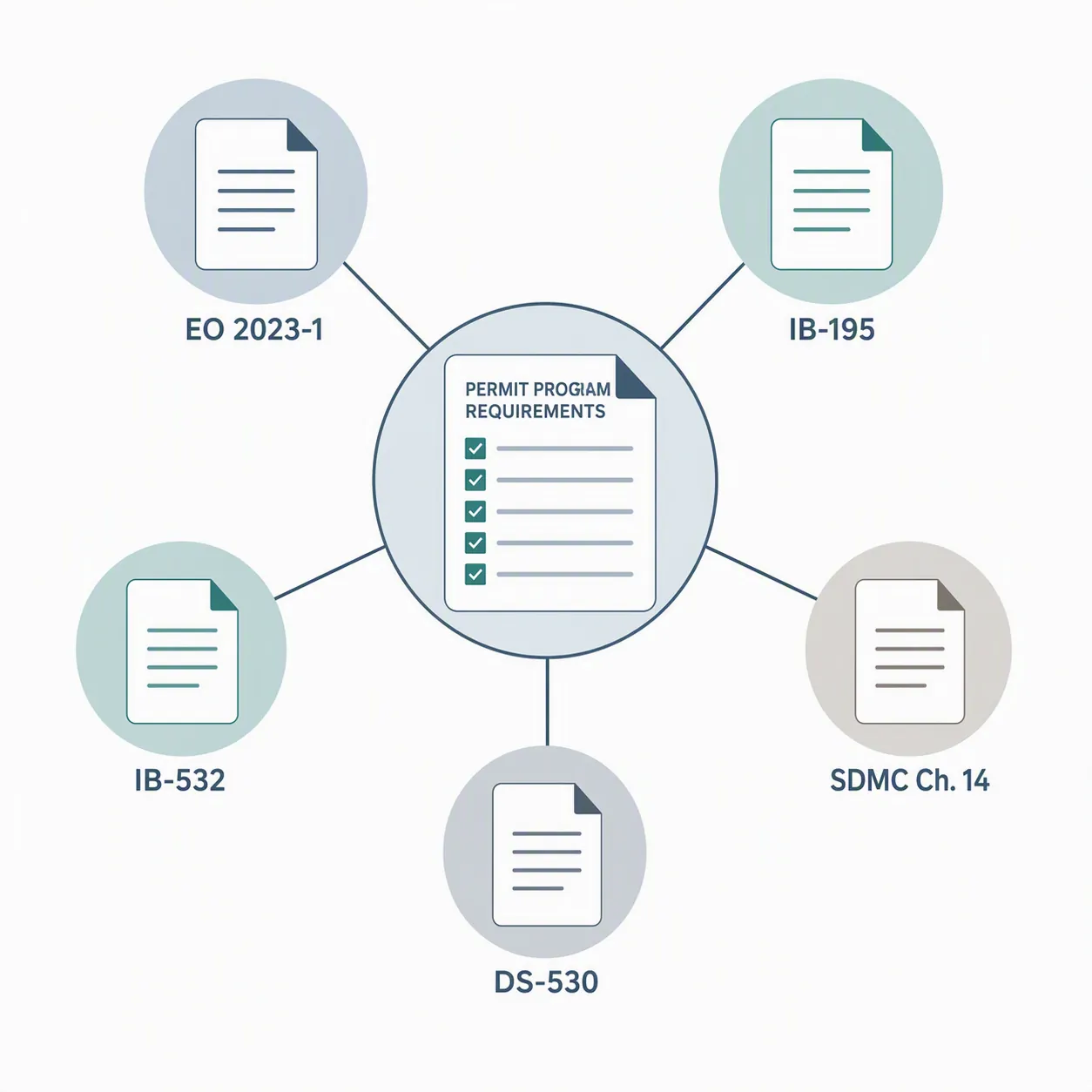
The source set to open before filing
A reliable Permit Now answer starts by separating the City program from adjacent housing regimes. State density-bonus, SB 35, AB 2011, ADU affordability terms, and County of San Diego inclusionary rules may matter to a project, but they are not substitutes for the City of San Diego’s Permit Now requirements. If a summary pulls one term from one regime and one deadline from another, the result may look plausible and still be wrong.
| Primary source | What it controls for this record | Filing-time recheck |
|---|---|---|
| Executive Order 2023-1 [1] | Creates the City fast-track direction for qualifying affordable housing and shelter projects. | Confirm the order is still the operative executive authority and has not been superseded. |
| Affordable Housing Permit Now Program - Information Bulletin 195 [2] | States eligibility, affordability restriction, ministerial processing path, review timelines, resubmittal expectation, and express plan-check/collaborative-meeting fee structure. | Re-open the current bulletin before using any deadline, fee description, or affordability term. |
| Requirements for Inclusionary Affordable Housing - Information Bulletin 532 [3] | States DS-530 and inclusionary-housing implementation details, including current in-lieu fee information. | Confirm the fiscal-year fee, thresholds, and form requirements in the current bulletin. |
| Affordable Housing Permit Now program page [4] | Provides the City’s program page, public program description, and current program status information. | Use for current program page status, not as the only source for legal requirements. |
| Building Permit page with DS-530 path [5] | Identifies the building-permit application route and Affordable Housing Requirements Checklist submission path. | Confirm the current DS-530 form link and any building-permit intake changes. |
| SDMC Chapter 14, Article 2, Division 13 [6] | Contains the City’s inclusionary affordable housing regulations, including the ordinance framework referenced by IB-532. | Open the code text for current ordinance language and any amended thresholds or fee mechanics. |
| SDMC Chapter 14, Article 3, Division 7 [7] | Provides related municipal-code provisions that may interact with affordable-housing processing and incentives. | Do not infer Permit Now eligibility from related code provisions without checking IB-195. |
| Housing Action Package page [8] | Provides effective-date context for Housing Action Package 2.0, including the Coastal Zone effective date. | Confirm whether the site is inside the Coastal Zone and which effective date applies. |
Requirements record
“Last verified” below means this article’s record was checked on August 3, 2026, UTC, against the source set identified above. It does not mean the City will treat a later filing under the same forms, fee amounts, or code language. The recheck column is the part to use before a deadline memo or permit application leaves the desk.
| Requirement | Controlling source | Last verified | Filing-time recheck |
|---|---|---|---|
| Eligible project type: 100%-affordable multiple-dwelling-unit projects and emergency shelters/navigation centers are the Permit Now categories identified for the fast-track path. | EO 2023-1; IB-195 [1][2] | Aug. 3, 2026 | Confirm the project is being filed under the City Permit Now program, not a County, SB 35, AB 2011, density-bonus, or ADU-only pathway. |
| Affordability gate: every dwelling unit must be deed-restricted for at least 55 years to very-low, low, or moderate income households. | IB-195 [2] | Aug. 3, 2026 | Do not import a shorter affordability term from an ADU, SB 35, or other housing-program summary. |
| Processing route: Permit Now is described as a ministerial fast-track process for qualifying projects. | IB-195 [2] | Aug. 3, 2026 | Confirm the project scope, approvals, and site conditions do not move the application outside the ministerial path described by the City. |
| Completeness review timing: housing projects are listed for completeness review within 5 business days; emergency shelters/navigation centers within 2 business days. | IB-195 [2] | Aug. 3, 2026 | Check the current bulletin and intake instructions before promising a date to a client or project team. |
| First project review timing: first project review is listed within 30 business days. | IB-195 [2] | Aug. 3, 2026 | Confirm whether the City’s timing is measured from a complete application and whether the project has any intake deficiencies. |
| Final signoff/issuance timing: final signoff or issuance is listed within 5 business days. | IB-195 [2] | Aug. 3, 2026 | Recheck what must be cleared before the final 5-business-day period can run. |
| Expected resubmittal timing: the program materials identify an expected 10-business-day resubmittal timing. | IB-195 [2] | Aug. 3, 2026 | Confirm whether this is an applicant-side expectation, a City-side review measure, or both in the current bulletin. |
| Fee structure: express plan-check fees apply, and collaborative meetings are charged hourly. | IB-195 [2] | Aug. 3, 2026 | Confirm the current fee schedule and whether meetings have been requested, required, or separately authorized. |
| DS-530 checklist: residential projects of 2 or more units must submit the signed Affordable Housing Requirements Checklist with the building permit application. | IB-532; Building Permit page [3][5] | Aug. 3, 2026 | Download the current DS-530 from the City path rather than reusing a stored copy. |
| Inclusionary threshold: the City inclusionary ordinance applies at 10 or more units outside the Coastal Overlay Zone and 5 or more units inside it. | IB-532; SDMC Chapter 14, Article 2, Division 13 [3][6] | Aug. 3, 2026 | Verify Coastal Overlay Zone status before selecting the threshold. |
| Inclusionary compliance option: IB-532 identifies a 10% set-aside or an in-lieu fee; for FY2026-27, the in-lieu fee is $25.92 per square foot. | IB-532; SDMC Chapter 14, Article 2, Division 13 [3][6] | Aug. 3, 2026 | Confirm the fiscal year, application vintage, fee rate, and whether an older pre-July-2020 rate is even relevant to the application. |
| Coastal effective-date check: HAP 2.0 is identified as effective March 16, 2024 outside the Coastal Zone and March 11, 2026 inside the Coastal Zone. | Housing Action Package page [8] | Aug. 3, 2026 | Confirm Coastal Zone status and whether the specific HAP 2.0 change being cited is actually in effect for the parcel. |
The eligibility answer starts with the project, not the program name
Executive Order 2023-1 is the starting point because it explains why the fast-track exists and directs the City toward expedited handling for qualifying affordable housing and shelter projects. But the filing answer usually turns on Information Bulletin 195, because that is where the operational eligibility and processing requirements are stated for Affordable Housing Permit Now. The program name is not the test; the project category and affordability restriction are.
For multiple-dwelling-unit housing, the key eligibility gate is 100% affordability. A mixed-income project with market-rate units may have other affordable-housing obligations or incentives, but the Permit Now eligibility premise described in the City materials is not simply “some affordable units.” The record to check is whether the project is a 100%-affordable multiple-dwelling-unit project, with every dwelling unit deed-restricted for at least 55 years to very-low, low, or moderate income households [2].
The 55-year deed restriction is the easiest number to lose in a reused memo. If a draft summary contains a 10-, 15-, 30-, or 45-year affordability period, treat that as a conflict to resolve before it reaches a permit package. Those numbers may come from another housing context; the Permit Now record identified here is the 55-year restriction in IB-195 [2].
Emergency shelters and navigation centers sit in the same Permit Now universe, but they should not be flattened into the housing-unit analysis. The completeness-review timing is different: IB-195 identifies 5 business days for housing projects and 2 business days for emergency shelters/navigation centers [2]. That difference matters because a summary that states only “5 days” has already lost one of the program’s filing distinctions.
Affordability and inclusionary review are separate checks
A 100%-affordable project still needs the inclusionary-housing intake question handled correctly. Information Bulletin 532 states that all residential projects of 2 or more units must submit the signed Affordable Housing Requirements Checklist, DS-530, with the building permit application [3]. The City’s building-permit page is the practical route for confirming the current form path before submission [5].
The inclusionary threshold then depends on location. IB-532 states that the City’s Inclusionary Affordable Housing Regulations apply to residential development of 10 or more dwelling units outside the Coastal Overlay Zone and 5 or more dwelling units inside the Coastal Overlay Zone [3]. The municipal-code source to open for the ordinance framework is SDMC Chapter 14, Article 2, Division 13 [6].
| Filing check | Why it matters |
|---|---|
| Is the project 100% affordable for Permit Now eligibility? | This controls whether the project fits the Permit Now housing category described in IB-195. |
| Are all dwelling units deed-restricted for at least 55 years? | This is the affordability-duration trap most likely to be misstated from another regime. |
| Does the residential project have 2 or more units? | If yes, DS-530 must be handled with the building permit application. |
| Is the site inside the Coastal Overlay Zone? | The inclusionary threshold shifts from 10 or more units outside the Coastal Overlay Zone to 5 or more units inside it. |
| Which fiscal-year in-lieu fee applies? | IB-532 identifies the FY2026-27 in-lieu fee as $25.92 per square foot, while older application vintages may be treated differently. |
For FY2026-27, IB-532 lists the in-lieu fee at $25.92 per square foot and identifies a 10% set-aside or in-lieu fee compliance path [3]. The same bulletin also flags a $12.73 per square foot rate for pre-July-2020 applications [3]. That older number should not appear in a 2026 filing analysis unless the application’s procedural history actually puts it in play.
Coastal status deserves its own line in the verification file. It affects the inclusionary threshold, and it also affects the effective-date analysis for Housing Action Package 2.0. The City’s Housing Action Package page identifies March 16, 2024 as the effective date outside the Coastal Zone and March 11, 2026 as the effective date inside the Coastal Zone [8]. A parcel near the coast should not be cleared by address familiarity or a project-team assumption; confirm the mapped status.
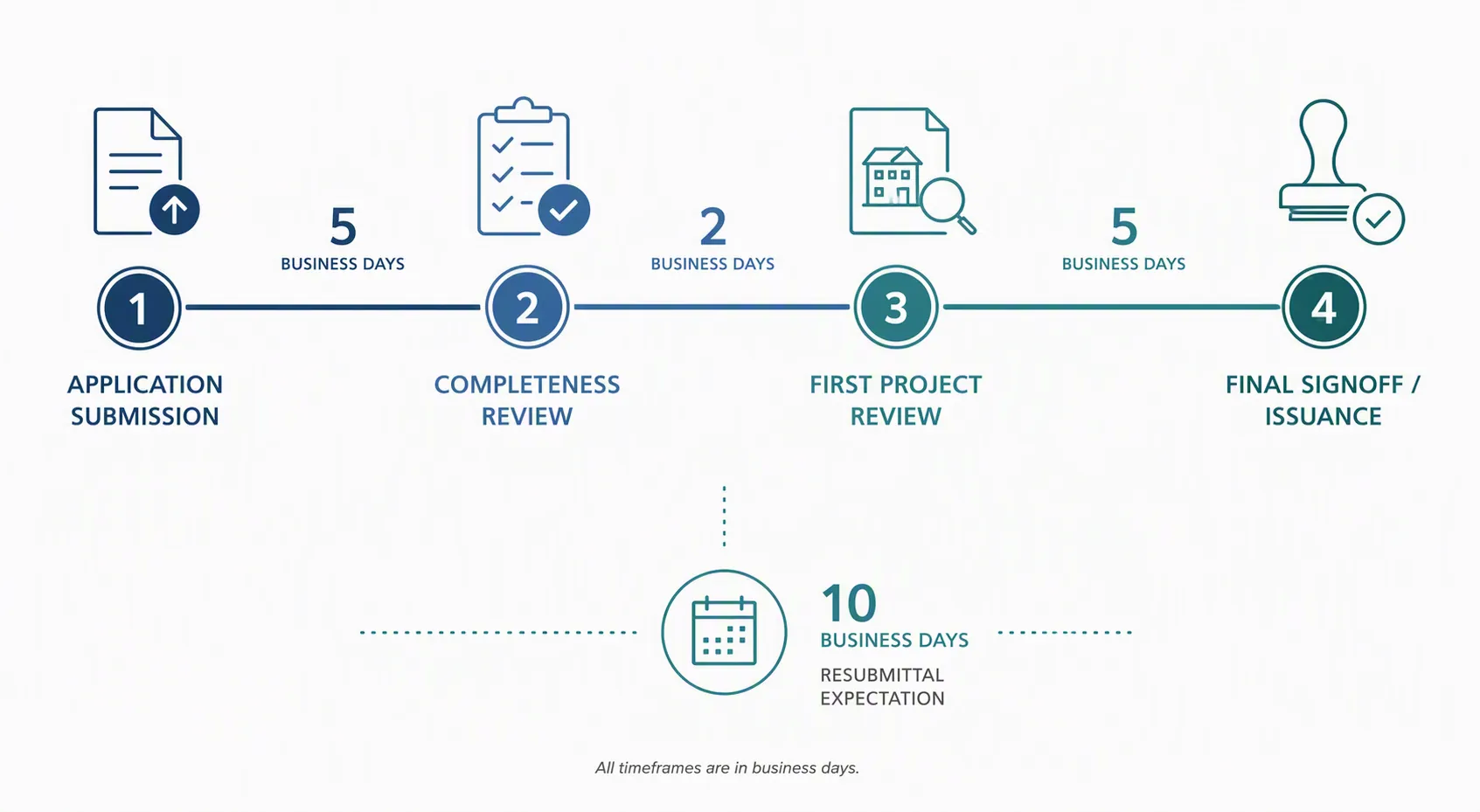
How the filing moves through review
Once eligibility and affordability are confirmed, the review timeline becomes a package-management issue. IB-195 identifies a completeness review within 5 business days for housing projects, a 2-business-day completeness review for emergency shelters/navigation centers, first project review within 30 business days, and final signoff or issuance within 5 business days [2]. Those numbers should be copied exactly, including “business days,” because calendar-day shorthand changes the promise.
The applicant-side clock also matters. The program materials identify an expected 10-business-day resubmittal timing [2]. If the project team has not budgeted for that response window, the City’s fast-track commitments may not produce the calendar result the client expects. A clean filing is not only a City obligation; it is also an applicant discipline problem.
| Stage | Timing or charge to verify | Source |
|---|---|---|
| Application package | Confirm Permit Now eligibility, DS-530 submission, affordability restriction, coastal status, and inclusionary path before intake. | IB-195; IB-532; Building Permit page [2][3][5] |
| Completeness review | 5 business days for housing projects; 2 business days for emergency shelters/navigation centers. | IB-195 [2] |
| First project review | 30 business days. | IB-195 [2] |
| Applicant resubmittal | Expected 10-business-day resubmittal timing. | IB-195 [2] |
| Final signoff or issuance | 5 business days. | IB-195 [2] |
| Plan-check and meetings | Express plan-check fee plus hourly charges for collaborative meetings. | IB-195 [2] |
The fee note is not cosmetic. IB-195 identifies an express plan-check fee and hourly collaborative-meeting charges [2]. A project budget that only mentions “fast-track review” without the express fee and meeting charges is not yet a filing-ready budget note. Confirm the current fee schedule and whether the planned meetings are optional, requested, or necessary to resolve review comments.
Performance numbers are context, not a filing guarantee
The City has publicized meaningful production numbers, but they should be dated before they are repeated. Inside San Diego reported on April 8, 2026 that the program had permitted 6,746 homes over three years, with 2,148 completed and occupied, and an average staff review time of 9 days [9]. Those figures are useful context for the program’s operation as of that publication date. They do not guarantee a future project’s review time, completeness determination, or issuance date.
The City’s program page separately reported 26 completed projects as of July 2026 [4]. That is a different cutoff and a different presentation of program status. Do not merge the April and July figures into a single undated claim, and do not use either number to avoid the eligibility, deed-restriction, DS-530, fee, or coastal-zone checks.
Boundary warnings for the 2026 file
- Do not conflate the City of San Diego Permit Now program with County of San Diego inclusionary rules. If the site or entitlement path is outside the City program, open the separate County materials.
- Do not treat state-law streamlining or density-bonus eligibility as Permit Now eligibility. A project can raise several housing-law issues at once, but the City program has its own eligibility and processing record.
- Do not substitute an internal checklist for DS-530. The City form path should be confirmed through the building-permit materials before submission.
- Do not use a stored fee number without checking the fiscal year. The FY2026-27 in-lieu fee identified in IB-532 is $25.92 per square foot, and fee rates can reset.
- Do not let a coastal-zone assumption ride through review. Coastal status can change the inclusionary threshold and the effective-date analysis for HAP 2.0.
This is also why verification discipline matters in legal work more generally. If the source cannot be opened, the citation cannot be trusted; if the number is not current, it should not be repeated. For a broader ethics-focused treatment of that problem, see AI Hallucinations and Attorney Ethics.
Filing-time re-verification posture
A defensible 2026 Permit Now review does not end with “the project is affordable.” Before filing, confirm the project category, the 100%-affordable status, the 55-year deed restriction, the correct completeness-review timing, the 30-business-day first-review period, the 5-business-day final signoff or issuance period, the expected 10-business-day resubmittal timing, the express plan-check and meeting charges, the DS-530 submission, the inclusionary threshold, the current fiscal-year in-lieu fee, and the parcel’s coastal status.
The headline rules are clear enough to identify the City program. They are not concentrated enough to justify filing from any single summary. Open EO 2023-1, IB-195, IB-532, the current DS-530/building-permit path, the relevant SDMC divisions, and the coastal effective-date materials at the time of filing, then let the application answer follow the documents.
References
- Executive Order 2023-1 — City of San Diego, Jan. 11, 2023.
- Affordable Housing Permit Now Program - Information Bulletin 195 — City of San Diego.
- Requirements for Inclusionary Affordable Housing - Information Bulletin 532 — City of San Diego, July 2026.
- Affordable Housing Permit Now — City of San Diego.
- Building Permit — City of San Diego.
- SDMC Ch. 14 Art. 2 Div. 13 — City of San Diego.
- SDMC Ch. 14 Art. 3 Div. 7 — City of San Diego.
- Housing Action Package — City of San Diego.
- Affordable Housing Program Permits 6,746 Homes Over Three Years — Inside San Diego, Apr. 8, 2026.
Grounded in
This procedure is grounded in Information Bulletin 195 (Affordable Housing Permit Now Program), independent of any single documented case. See the Regulation tracker for the governing text.
Cases this step would have prevented
No cases have been explicitly linked to this checklist yet. See Risk Digest for documented incidents generally.
← Back to WorkflowsReport a correction or tip
Spotted an outdated figure, a misstated fact, or a ruling this workflow checklist should reflect? Public comments are disabled for this content given the professional cost of a misreported case outcome, penalty amount, or rule text — use the structured correction channel instead.
Report a correction or tip for this record →