
How to Track SSA's AI Tools Through the Appeals Process
The SSA has deployed multiple AI tools across its four-level appeals process, but no public source tracks which tools touched a specific claim. This article inventories those tools and identifies the verification obligations practitioners face as of mid-2026.
- Workflow stage
- pre-filing review
The first practical question in a 2026 Social Security disability appeal is no longer only whether the administrative law judge misread the record, whether a vocational answer was incomplete, or whether the Appeals Council ignored new evidence. A second question now sits underneath the file review: which Social Security appeals digital tools or AI systems touched this claim before the denial reached counsel?
The public record does not answer that at the claim level. SSA publishes an AI Inventory, updated in April 2026, and it has announced new online disability tools as part of a broader digital-service push in July 2026.[1][2] Those sources matter. They show that the agency is not experimenting at the margins. But they do not give a representative the things needed to reconstruct a denial: a case-specific tool history, transcript accuracy results, audit reports, error rates, or a way to tell whether HeaRT, IMAGEN, ACAT, PAT, QDD, or CAL affected a particular file.

That distinction changes the work. A public inventory can tell a lawyer that a tool exists. It cannot tell the lawyer whether an algorithmic medical-record summary shaped what an adjudicator saw first, whether an AI-generated transcript preserved a claimant's testimony accurately, or whether an automated screen diverted the claim into a different handling path. In appeals practice, the dangerous gap is often not the dramatic machine error. It is the missing breadcrumb.
Start With the Appeals Path, Not the Technology
The four-level SSA appeals pathway gives the cleanest reconstruction frame: reconsideration, administrative law judge hearing, Appeals Council review, and federal court. The tools in the public materials do not sit neatly inside one procedural box. Some act before an appeal is filed. Some shape materials later used on appeal. Some assist internal staff rather than adjudicate a claim. That is why a practitioner has to map tools to artifacts, not to agency labels.
| Tool | Where It Can Matter in the Appeals Path | Publicly Supported Function | What the Practitioner Cannot Determine From Public Sources |
|---|---|---|---|
| HeaRT | ALJ hearing and later review of the hearing record | Generates transcripts for virtual hearings | Whether a specific transcript contains AI transcription errors, and no public accuracy benchmark exists as of July 2026 |
| IMAGEN | Initial and reconsideration evidence review; later appeals that inherit the medical record | Uses NLP and predictive analytics to extract clinical information from medical records | Whether a specific adjudicator relied on the summary, what was omitted, or whether the summary changed the order in which evidence was considered |
| ACAT | Appeals Council review | Uses structured electronic forms to guide Appeals Council adjudication workflow | Whether the structure narrowed reasoning in a particular case or merely organized a human review |
| PAT | Internal policy research around claims and appeals | Provides AI-assisted policy guidance to employees, with SSA instructing employees to verify against authoritative policy documents | Whether staff consulted it in a specific file |
| QDD | Early disability-claim triage before later appeals | Automated or model-supported identification of claims likely to qualify quickly | Whether a claimant was screened in, screened out, or left unaffected |
| CAL | Early claim identification before later appeals | Compassionate Allowances identification of conditions that may qualify for expedited handling | Whether the absence of CAL handling reflected a tool result, coding issue, or ordinary adjudication |
The table is deliberately cautious. It does not treat adoption as proof that outcomes improved. It does not treat an agency description as an audit. It simply marks where a record reviewer should expect automation to have produced, ordered, filtered, or structured something that might later appear ordinary.
HeaRT: The Transcript Is Now a Verification Object
HeaRT deserves the closest attention because it produces an artifact counsel can actually inspect: the hearing transcript. SSA announced in March 2025 that the Hearing Recording and Transcription system, or HeaRT, would serve about 500,000 hearing participants each year and projected $5 million in annual savings.[3] The same rollout replaced older hearing-recording hardware with a centralized system for virtual hearings.[3]
Those are agency-reported operational claims, not accuracy findings. For the practitioner, the more important fact is narrower: virtual hearing transcripts are now produced through an AI transcription system at very large scale, and the public materials available as of July 2026 do not provide a benchmark showing how often HeaRT gets medical terms, names, medication histories, vocational testimony, or claimant statements wrong.
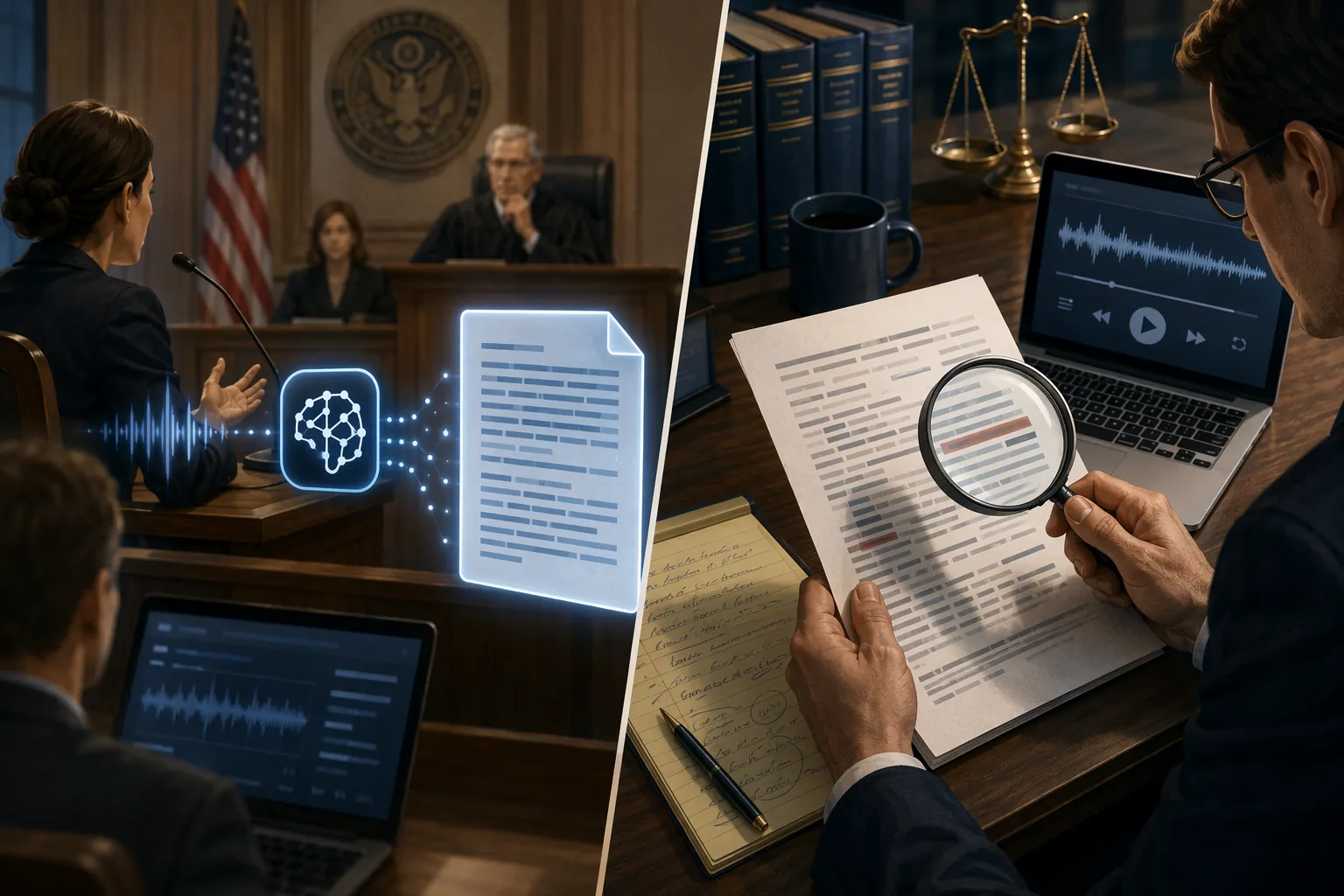
This is not an abstract speech-to-text complaint. Disability hearings turn on small linguistic distinctions. A symptom frequency can change residual functional capacity. A medication name can signal a diagnosis. A vocational expert's answer can depend on whether a limitation was phrased as occasional, frequent, or constant. A transcript that flattens an abbreviation or substitutes a plausible word for an unfamiliar medical term may still read smoothly. That is part of the problem.
Newsweek reported Professor Daniel Ho's warning that automated transcription systems can still hallucinate.[4] The point is not that every HeaRT transcript is suspect. The point is that an appeal file gives counsel no public, case-level reason to know whether this transcript was clean, marginal, corrected, or never checked against audio. Without that trail, transcript review has to be treated as substantive work, not clerical cleanup.
The usual proffer-letter safeguard does not fully solve this. When evidence is added after a hearing, a claimant may receive notice and an opportunity to respond. That safeguard is aimed at added evidence. It does not make the transcript itself a separately litigated object in the ordinary course. If the transcript quietly changes what the claimant said, the representative may be the first person positioned to catch it.
The review posture should therefore change. In a hearing appeal, counsel should compare the transcript against hearing notes, recollection, and available audio where obtainable. The highest-risk passages are not always dramatic. They are often proper names, medical abbreviations, medication lists, dates of treatment, exertional limits, off-task testimony, absenteeism testimony, and vocational-expert exchanges. The question is not whether the transcript looks professional. The question is whether it can be trusted for the issue being appealed.
IMAGEN: The Summary May Arrive Before the Record
IMAGEN creates a different kind of verification burden. It is not primarily a transcript problem. It is a sequencing problem.
The ACT-IAC case study describes IMAGEN as applying natural language processing and predictive analytics to disability applicants' medical records, extracting clinical data and generating an algorithmic summary for adjudicators before they read the underlying medical record.[5] That last sequence matters more than the label. If a summary appears first, it can frame the human review that follows.
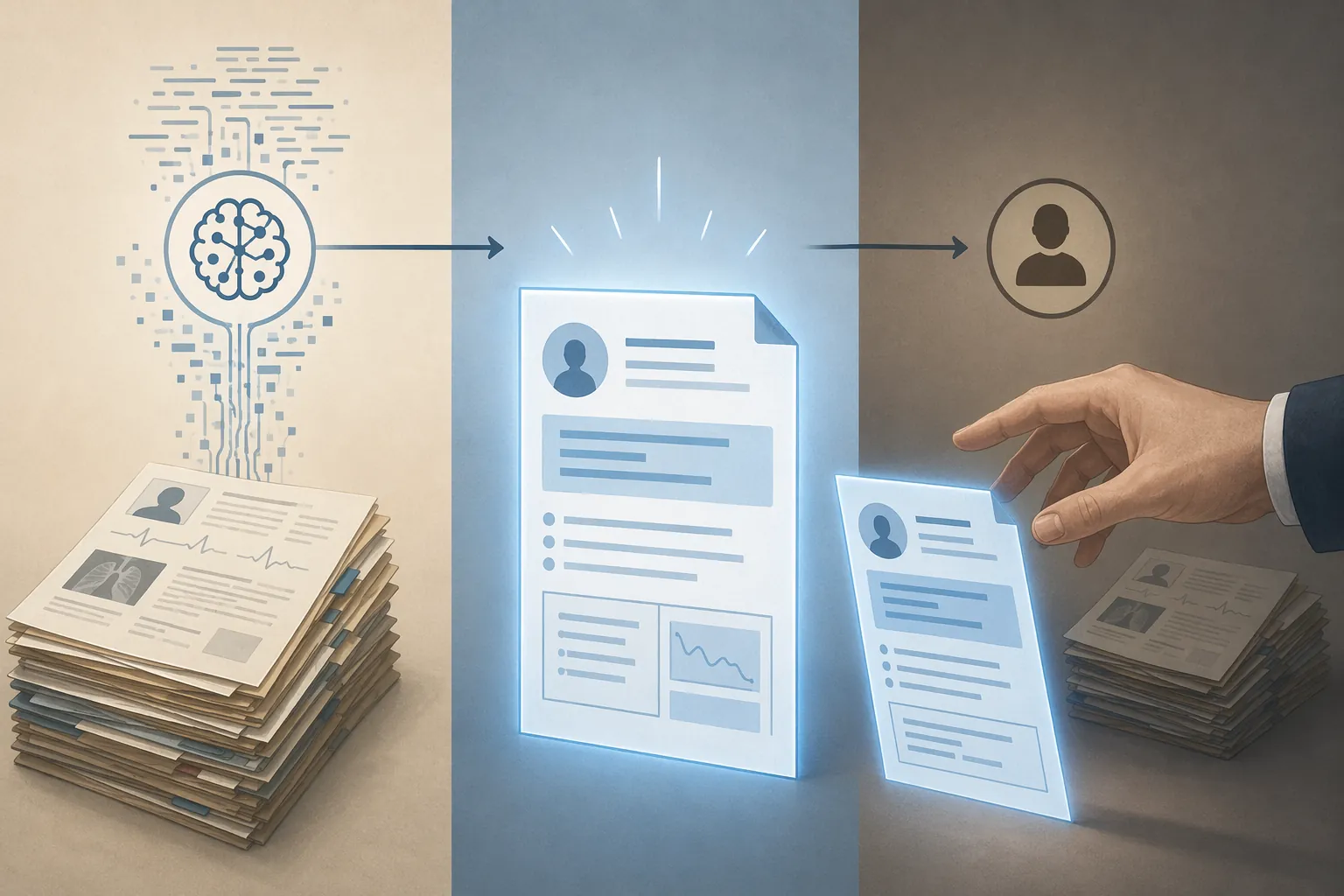
A medical-record summary can be useful. Anyone who has opened a disability file with hundreds or thousands of pages knows the administrative pressure. Buried evidence is real. Duplicative records are real. A tool that helps identify diagnoses, lab results, imaging, hospitalizations, and treatment history could make review faster and sometimes better. But a summary is not neutral simply because it is efficient. It chooses what appears salient.
The appeal task is to test the summary against the record it claims to compress. That means looking for omitted longitudinal facts, not just wrong extracted terms. Did the summary capture waxing and waning symptoms? Did it preserve failed treatments, medication side effects, therapy notes, mental-health observations, or specialist restrictions? Did it overemphasize normal findings that appeared in routine templates while missing abnormal findings in narrative notes? Did it extract diagnoses without functional consequences, or functional consequences without the clinical context that made them credible?
The public materials do not show whether IMAGEN affected a specific denial. They also do not show whether a particular adjudicator relied on the algorithmic summary, skimmed it, ignored it, or used it only as an index. That uncertainty should not lead to speculation in briefing. It should lead to a disciplined comparison: summary against source record, source record against finding, finding against issue on appeal.
A useful way to document the review is to separate three categories: record facts correctly surfaced by the summary, record facts surfaced but stripped of functional significance, and record facts missing from the summary that bear on the denial. The third category is usually the most important. It gives the appeal a record-based objection without needing to prove that IMAGEN caused the error.
ACAT: Structured Review Is Not the Same as a Case-Level AI Trail
At the Appeals Council level, the better-known tool is ACAT, the Appeals Council Analysis Tool. ACUS materials and a George Washington Law Review analysis describe ACAT as using structured electronic forms to guide Appeals Council adjudication workflow, with operational history going back to the 2010s.[6][7]
ACAT should not be oversold as a claim-specific AI smoking gun. The public sources support a narrower point: Appeals Council review has been shaped by structured electronic forms and workflow design. That structure can promote consistency. It can also make some reasoning easier to select, reuse, or standardize than other reasoning.
For counsel, the practical review is not to argue that a form decided the case. It is to check whether the Appeals Council's action actually responds to the issues presented. Did it address the evidence submitted? Did it identify the correct period? Did it treat a new medical opinion as cumulative without explaining why? Did it recite a standard while avoiding the claimant-specific defect raised in the request for review?
Structured workflow leaves a different kind of mark than a mistranscribed word. It may show up as a gap between the issue counsel raised and the reason the Appeals Council gave for denying review. That gap still has to be argued from the record. The public materials do not let a practitioner prove, from outside the file, that ACAT caused the gap.
PAT, QDD, and CAL Are Adjacent Verification Concerns
PAT, QDD, and CAL matter in a different way. They are less likely to give counsel a visible artifact like a hearing transcript or an IMAGEN-style medical summary. Their importance is that they may influence staff guidance, early claim routing, or expedited handling before the appeal file reaches the lawyer.
The Policy Assistant Tool is the cleanest example of the verification principle because SSA's own internal warning, as described in the available materials, tells employees that PAT guidance is not the authoritative source and that employees must refer to actual policy documents. That is a useful admission of method. If agency employees are told to verify AI-assisted policy guidance against primary policy materials, representatives should not treat AI-adjacent outputs in the appeals record as self-authenticating.
QDD and CAL raise more limited appeal questions on the public record. They are associated with early identification or expedited handling of claims that may qualify quickly. For a denied claimant, the issue is usually not to prove that an automated screen harmed the case. The issue is to notice when the file's early triage history seems inconsistent with the severity of the documented impairment, the diagnosis coding, or the timing of medical evidence.
That kind of review is modest but still useful. It asks whether the claim was routed, delayed, or developed in a way that left important evidence out of the record. It does not require pretending that a public inventory can identify the exact screen result for a specific claimant.
Governance Materials Confirm the Gap Without Filling It
The oversight record supports caution, but it does not give practitioners a hidden map. A bipartisan Wyden-Crapo letter requested AI risk-management information from SSA and warned that without proper governance, AI could jeopardize beneficiaries' financial security.[8] The National Academy of Social Insurance Task Force's April 2025 Phase One report, summarized by Empire Justice Center, found AI already in use at SSA and recommended meaningful human review, bias prevention, and adequate oversight.[9]
Those materials are important because they confirm that the concern is not invented by claimant representatives after an unfavorable decision. They also have limits. They do not tell counsel whether a particular ALJ saw an IMAGEN summary, whether an Appeals Council analyst worked through ACAT in a way that mattered, whether a PAT answer influenced a policy conclusion, or whether an early screen affected a claimant's path.
The same caution applies to SSA's digital-transformation announcements. In July 2026, SSA announced new online disability tools and framed them as service improvements.[2] That may be true for many users. But a public service announcement is not a claims-file audit. It does not identify the automation history of a denial, and it does not relieve counsel from checking the work product that automation may have shaped.
A Verification Workflow for a 2026 Appeal File
When the agency gives no claim-level tool history, the defensible workflow is artifact-based. The representative verifies the things a tool may have produced, ordered, or influenced, and documents what cannot be confirmed from the public record or the claim file.
- For hearing appeals, compare the transcript against notes, recollection, and available audio, with special attention to medical terminology, vocational testimony, dates, medication names, and functional-limit language.
- For medical-record issues, compare any summary, exhibit list, or extracted medical chronology against the underlying source records rather than treating the summary as a neutral index.
- For Appeals Council review, test the Council's action against the actual request for review, submitted evidence, relevant period, and stated basis for denial.
- For policy-dependent issues, verify any apparent guidance against SSA's authoritative policy documents, especially where the file reflects a conclusion without clear source support.
- For early triage concerns, note whether the claim history suggests expedited-handling, development, or routing questions, but avoid asserting a specific automated screen result unless the file supports it.
- For the appeal record, preserve the uncertainty: identify which tool involvement could not be confirmed, which artifact was reviewed, and which record discrepancy actually matters to the legal issue.
This workflow keeps the appeal grounded. It does not require proving that an AI system caused a denial. It asks whether the denial can be reconstructed from reliable materials. If the transcript is wrong, the problem is the transcript. If the medical summary omitted longitudinal evidence, the problem is the mismatch between the summary and the source record. If the Appeals Council failed to address the issue presented, the problem is visible in the Council's own action.
As of mid-2026, practitioners cannot reliably determine from public SSA materials which AI or automation tools influenced a specific appeal. The available materials identify tools, not claim-level touchpoints. That leaves counsel with a narrower but usable posture: verify the transcript, compare the medical summary to the raw record, check policy conclusions against primary sources, scrutinize Appeals Council reasoning, remain alert to early-screening effects, and document what could not be confirmed.
Last reviewed: July 23, 2026. This article is a verification workflow based on public and identified source materials, not legal advice for any particular claim.
References
- SSA AI Hub, Social Security Administration.
- Social Security Announces New Online Tools to Improve Disability Claims Process, Social Security Administration, July 21, 2026.
- Social Security Announces Hearing Recording and Transcription Technology Rollout, Social Security Administration, March 13, 2025.
- Social Security Announces Major AI Rollout, Newsweek.
- Intelligent Medical Language Analysis Generation (IMAGEN), ACT-IAC.
- Improving Consistency in Social Security Disability Adjudications, Administrative Conference of the United States.
- Social Security Disability Adjudications: The Appeals Council and the Federal Courts, George Washington Law Review.
- Wyden-Crapo Letter to SSA Regarding AI, U.S. Senate Committee on Finance.
- NASI Task Force Issues Report on AI at SSA, Empire Justice Center, April 2025.
Grounded in
This procedure is grounded in the cited rule or opinion, independent of any single documented case. See the Regulation tracker for the governing text.
Cases this step would have prevented
No cases have been explicitly linked to this checklist yet. See Risk Digest for documented incidents generally.
← Back to WorkflowsReport a correction or tip
Spotted an outdated figure, a misstated fact, or a ruling this workflow checklist should reflect? Public comments are disabled for this content given the professional cost of a misreported case outcome, penalty amount, or rule text — use the structured correction channel instead.
Report a correction or tip for this record →