
Why attorneys can't rely on SSA's status tracker
Disability attorneys who depend on SSA's new Claim Status Tracker need to understand its documented accuracy limitations and implement cross-verification steps to avoid missing critical deadlines. This article explains why the tracker alone is insufficient and provides actionable verification workflows.
- Workflow stage
- pre-filing review
SSA's new Claim Status Tracker gives disability claimants and representatives a clearer digital view of where a claim or appeal appears to stand. That is useful. It is also not the same thing as a docket control system. For a disability attorney using the digital appeals status tracker on the 58th day of an appeal window, the practical question is not whether the screen is convenient. It is whether the office can prove what it checked, when it checked it, and why it acted on that information.
SSA announced the Claim Status Tracker on July 21, 2026, describing new online status tools intended to improve transparency for people waiting on disability claim decisions and appeals.[1] Two days after launch, there is no independent accuracy record that would justify treating the tracker as authoritative for deadline-sensitive legal work. That does not make the tool bad. It makes it untested in exactly the setting where claimant representatives carry the most risk: the gap between what a portal says and what the official case record, mailed notice, electronic exhibit file, or SSA office action actually shows.
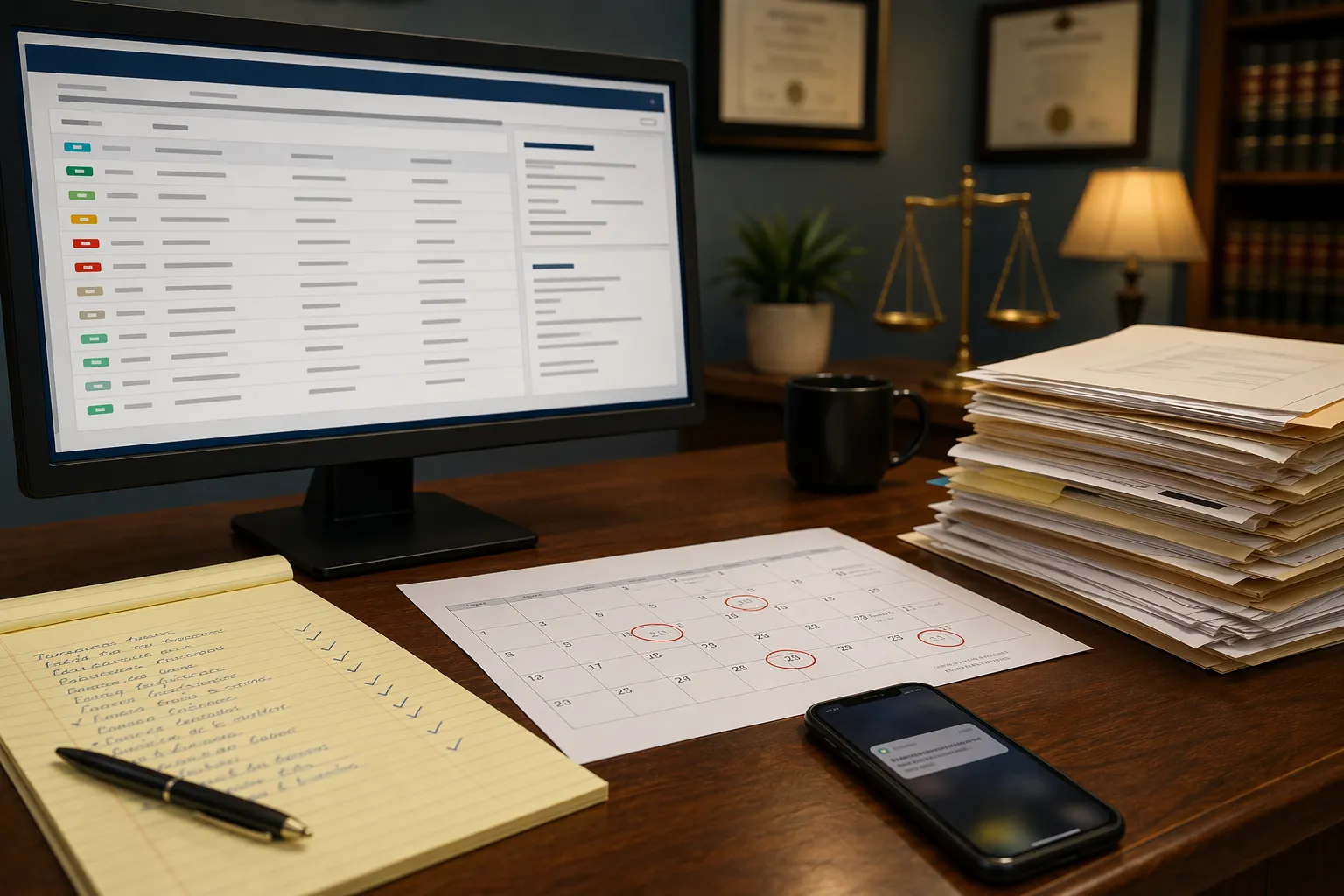
A status display is a lead, not a deadline source
Most representatives already know the dangerous version of this problem. A client calls after checking an online account. A paralegal sees a different status in another system. The file contains no notice. The calendar says the office is approaching an appeal deadline. Nobody is arguing about disability law yet; everyone is trying to determine whether the case has moved, whether a decision exists, and whether the clock has started.
Historical practitioner reports make that concern hard to dismiss. In an Avvo discussion visible across the 2021-2026 period, disability attorneys described SSA online case status information as “frequently wrong” and said they often advise clients not to rely on it for meaningful case updates.[2] That is not proof that the July 2026 tracker is inaccurate. It is proof that representatives have had enough prior mismatch between SSA digital status and case reality to treat a new status screen cautiously until the agency or independent users can show otherwise.
The concern becomes sharper at scale. Chronicle Legal describes disability firms building automated ERE monitoring because manual portal checking was consuming 15-20 hours per week per paralegal and because status monitoring across active matters was structurally hard to manage by hand.[3] The important point is not the vendor's product. It is the operational fact underneath it: once a representative office carries many pending matters, checking status is no longer a casual task. It becomes a repeatable control, and weak controls fail quietly.
The real loss is often time, not information
A wrong or stale status label does not have to be dramatic to cause damage. It only has to delay discovery. Chronicle Legal's missed-deadline analysis gives a useful measure of that risk: a 10-day delay in discovering a decision posted in ERE consumes more than 15% of the 65-day effective appeal window.[4] In a small file, that may still leave room to recover. In a busy practice with client outreach, medical-record follow-up, representative review, drafting, and filing queues, those lost days are not abstract.
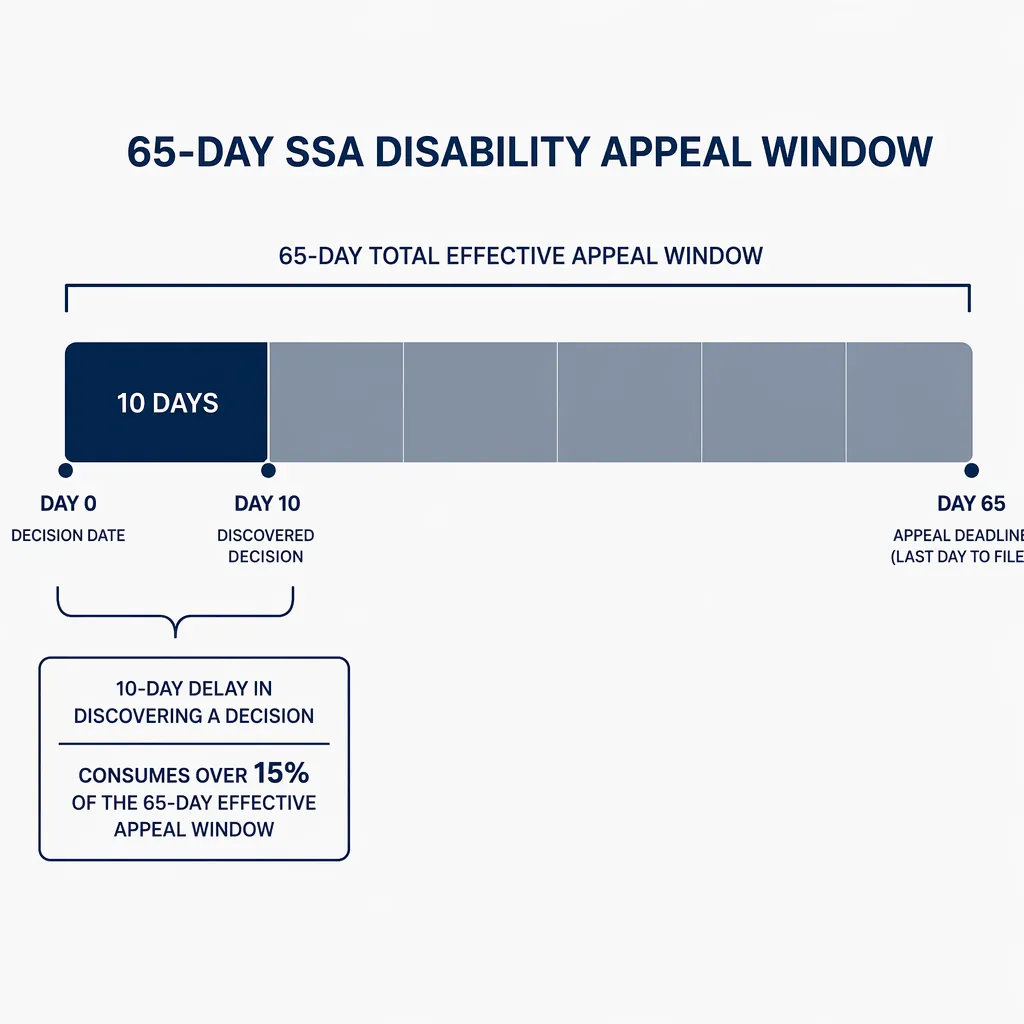
This is where digital status becomes risky as a single source. A tracker that says a case is still pending may be lagging behind a notice. A tracker that says a case moved to a later step may be reflecting an internal event that does not mean what the client thinks it means. A tracker that shows no change may still cause the office to postpone the very check that would have found a decision.
The office consequence lands on staff first. Someone has to compare the portal screen to ERE, review notices, call SSA, update the case-management system, explain the discrepancy to the attorney, and often calm the client. If the file later becomes a good-cause argument or a malpractice concern, the question will not be whether the tracker was modern. It will be whether the representative's office had a reasonable verification trail.
SSA's own guidance points to multiple channels
SSA's Best Practices for Claimants' Representatives tells representatives to monitor case status through established channels, including ARS and phone contact, and addresses representative conduct around pending claims and appeals.[5] What it does not appear to provide is an accuracy protocol for resolving contradictions among a public tracker, ARS, ERE notices, office records, and direct SSA statements.
That gap matters. If SSA tells representatives to check status through more than one channel, a claimant representative should not collapse all of that into one portal view just because the new interface is easier to read. The tracker can help staff spot movement. It should not, by itself, decide whether to advise a client that nothing has happened, whether to stop checking ERE, whether to close a monitoring task, or whether to calculate an appeal deadline.
A workable verification route
For most firms, the practical answer is not to ban staff from using the Claim Status Tracker. It is to make the tracker the first signal in a short verification sequence. The sequence should be simple enough for a small office to use on a crowded day and documented enough to defend later.
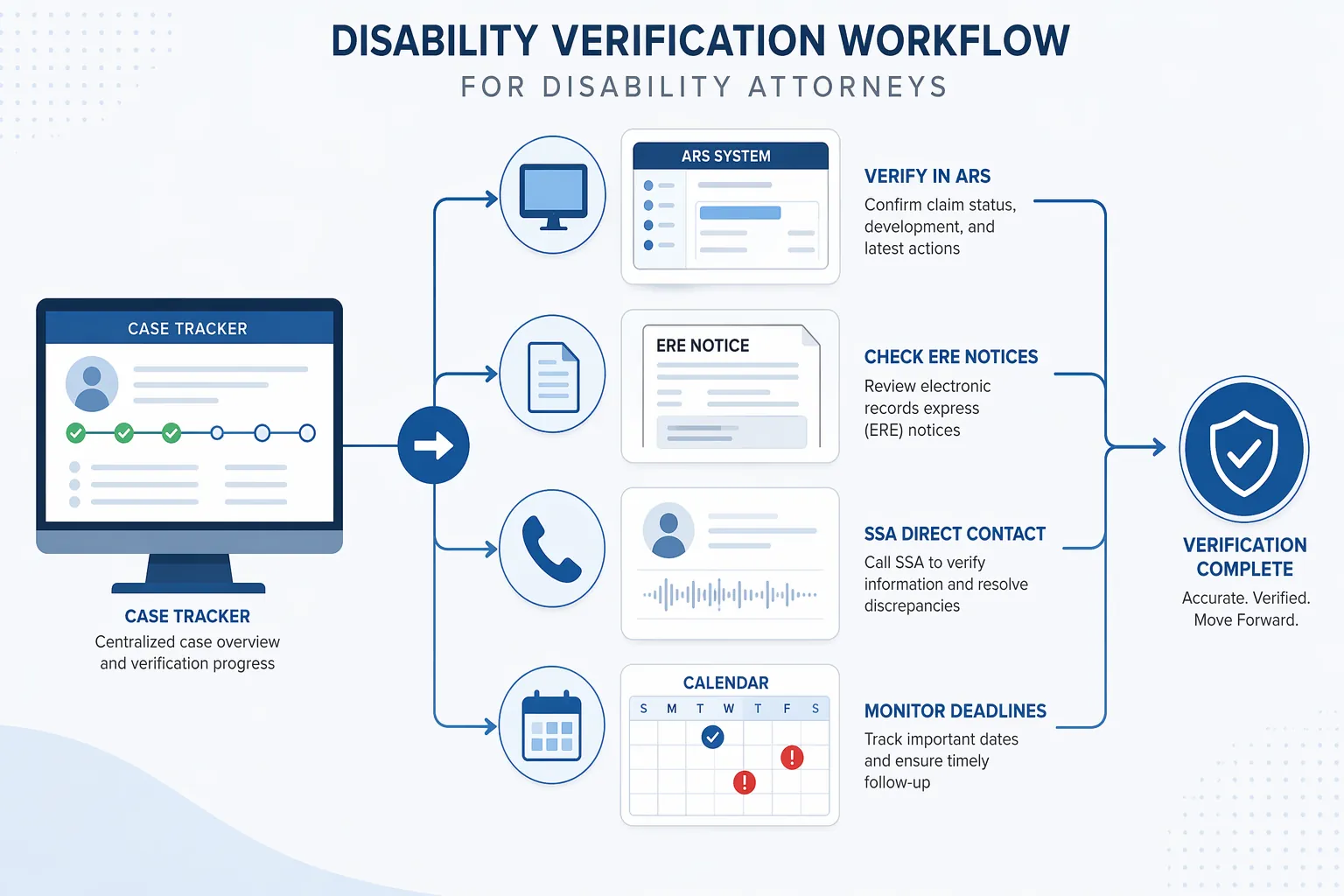
| Trigger | Verification step | Office record to keep |
|---|---|---|
| Tracker shows no movement | Check ARS or the representative-facing status source already used by the office | Date, time, staff initials, source checked, and displayed status |
| Tracker shows a decision, step change, closure, or appeal movement | Check ERE for notices, decision documents, or postings that explain the status | Document title, posting date if visible, and whether a deadline may be running |
| Tracker conflicts with ERE, ARS, client information, or the file calendar | Call SSA or the appropriate hearing/field office when the discrepancy affects advice or deadline control | Number called, person or unit reached if available, summary of what was said, and next follow-up date |
| Any source suggests a decision or appealable action | Calculate the deadline from the controlling notice or confirmed case event, not from the tracker label alone | Deadline entry, reviewer, basis for calculation, and supporting document location |
| No second source confirms the tracker | Treat the status as unconfirmed and schedule a follow-up check | Unconfirmed-status note and tickler date |
The point of this workflow is not paperwork for its own sake. It separates observation from action. A staff member may observe that the tracker says “pending,” “decision made,” or any other status label. The office acts only after checking whether another source supports that observation, especially when the next action involves client advice, appeal rights, hearing preparation, or file closure.
When the tracker and ERE disagree
A contradiction should change the task from routine monitoring to discrepancy resolution. If ERE contains a decision notice and the tracker still appears to show the case as pending, the office should treat the notice as the controlling document for deadline review unless SSA confirms a different procedural posture. If the tracker suggests a decision but ERE contains no notice, the office should not tell the client that a decision is final without checking the representative's other SSA channels or contacting SSA when the answer affects the client's rights.
This is also where very small practices feel the strain. A solo attorney or two-person office may not have a paralegal who can run a perfect cross-check every morning. Still, the minimum defensible habit is modest: record the tracker check, check one representative-facing source, and create a tickler when the sources do not line up. The firm can scale the workflow to its staffing, but it should not let convenience erase the second source.
When a delay may have started the appeal clock
The most dangerous status problem is not always a false statement. Sometimes it is a late discovery. If the office learns today that a decision was posted days ago, the first question is not why the tracker lagged or why the client did not call sooner. The first question is what date controls the appeal period and how much time remains.
That calculation belongs in the case-management system with the source attached or identified. A deadline entered from memory, a client text, or a portal label is too fragile. A deadline entered from the notice, reviewed by a second person when possible, and linked to the ERE document or call note gives the attorney something to stand on if the file later needs explanation.
What the file note should say
A useful verification note does not need to be long. It needs to answer the questions that come up after something goes wrong: who checked, what source they checked, what the source showed, what second source was reviewed, what conflict existed, who resolved it, and what deadline or next task was created.
- Record the date and time of the tracker review.
- Identify the staff member or attorney who performed the check.
- State the exact status shown without paraphrasing it into a legal conclusion.
- Identify the second source reviewed, such as ARS, ERE, a notice, or direct SSA contact.
- Enter any deadline or follow-up tickler created from the verification.
Screenshots can help when the status is unusual or contradictory, but the screenshot is not the workflow. A screenshot without a source comparison only proves what the office saw on one screen at one moment. It does not prove that the office checked the record source that mattered.
Client advice should lag behind verification
Clients will use the tracker. Some will call after every change; others will assume silence means nothing is happening. Representatives do not need to discourage clients from looking. They do need to avoid letting a client's screenshot become the office's case posture.
The safer response is plain: “We see what the tracker shows. We are checking it against the representative record before we advise you.” That sentence buys time for competent verification without dismissing the client's effort to stay informed. It also prevents the office from overpromising based on a public-facing status label that may not explain what procedural event actually occurred.
The same rule applies internally. A case should not be moved to a closed queue, an appeal-drafting queue, or a no-action queue solely because the Claim Status Tracker appears to say so. Queue movement should follow the verified event: a notice in ERE, a confirmed SSA communication, a representative system entry, or another source the office has decided is reliable enough for that category of action.
What would make the tracker more reliable for representatives
The missing piece is not more enthusiasm about modernization. Representatives need accuracy guidance. SSA could make the tracker more useful for legal workflow by explaining update frequency, identifying which system events feed each label, stating whether notices control over tracker status, and giving representatives a route for resolving contradictions. Without that, offices have to build their own controls around a tool whose public-facing language may be clearer than its legal significance.
Until SSA publishes that kind of guidance, or until independent accuracy data exists for the July 2026 tracker, disability attorneys should use the Claim Status Tracker as an alerting tool. It belongs in the monitoring routine. It does not belong at the top of the hierarchy for deadlines, client advice, or case posture.
References
- SSA Launches New Digital Tools to Improve Customer Experience, Social Security Administration, July 21, 2026.
- Has there been any reports of the SSDI websites giving inaccurate updates?, Avvo.
- How AI Collaboration Helps SSD Law Firms Save Time and Improve Outcomes, Chronicle Legal.
- Missed SSA Deadline? How to Avoid Late Appeals and Protect Your Clients, Chronicle Legal.
- Best Practices for Claimants' Representatives, Social Security Administration.
Grounded in
This procedure is grounded in the cited rule or opinion, independent of any single documented case. See the Regulation tracker for the governing text.
Cases this step would have prevented
No cases have been explicitly linked to this checklist yet. See Risk Digest for documented incidents generally.
← Back to WorkflowsReport a correction or tip
Spotted an outdated figure, a misstated fact, or a ruling this workflow checklist should reflect? Public comments are disabled for this content given the professional cost of a misreported case outcome, penalty amount, or rule text — use the structured correction channel instead.
Report a correction or tip for this record →