
The AI School Rules Drafted by 98 Teenagers From Every State
In July 2026, 98 teenagers drafted a model AI school policy with a four-layer verification workflow. This article maps their student-designed provisions to the procedural safeguards that have separated defensible from overturned AI discipline cases, offering a ready-made framework for any district still lacking a formal policy.
- Applicable role
- attorney
- Workflow stage
- review
The most interesting part of the July 2026 Students First Act is not that teenagers wrote school AI rules. It is that 98 teenagers from all 50 states drafted something many adult systems still avoid: a sequence for deciding when AI use in schoolwork is allowed, when it must be disclosed, and when an accusation has to slow down before it becomes discipline. NPR reported that the model policy passed 82–16 on July 30, 2026, at the Edward M. Kennedy Institute, after a convening hosted by AASA, Day of AI/MIT RAISE, and the Kennedy Institute; the package contained 15 student-focused provisions and was to be circulated to AASA’s 10,000 school leaders. NPR’s crawl did not capture the complete bill text, so the safest reading is limited to the provisions reported there, not to an unseen statutory instrument. It is a model policy, not enacted law. [1]
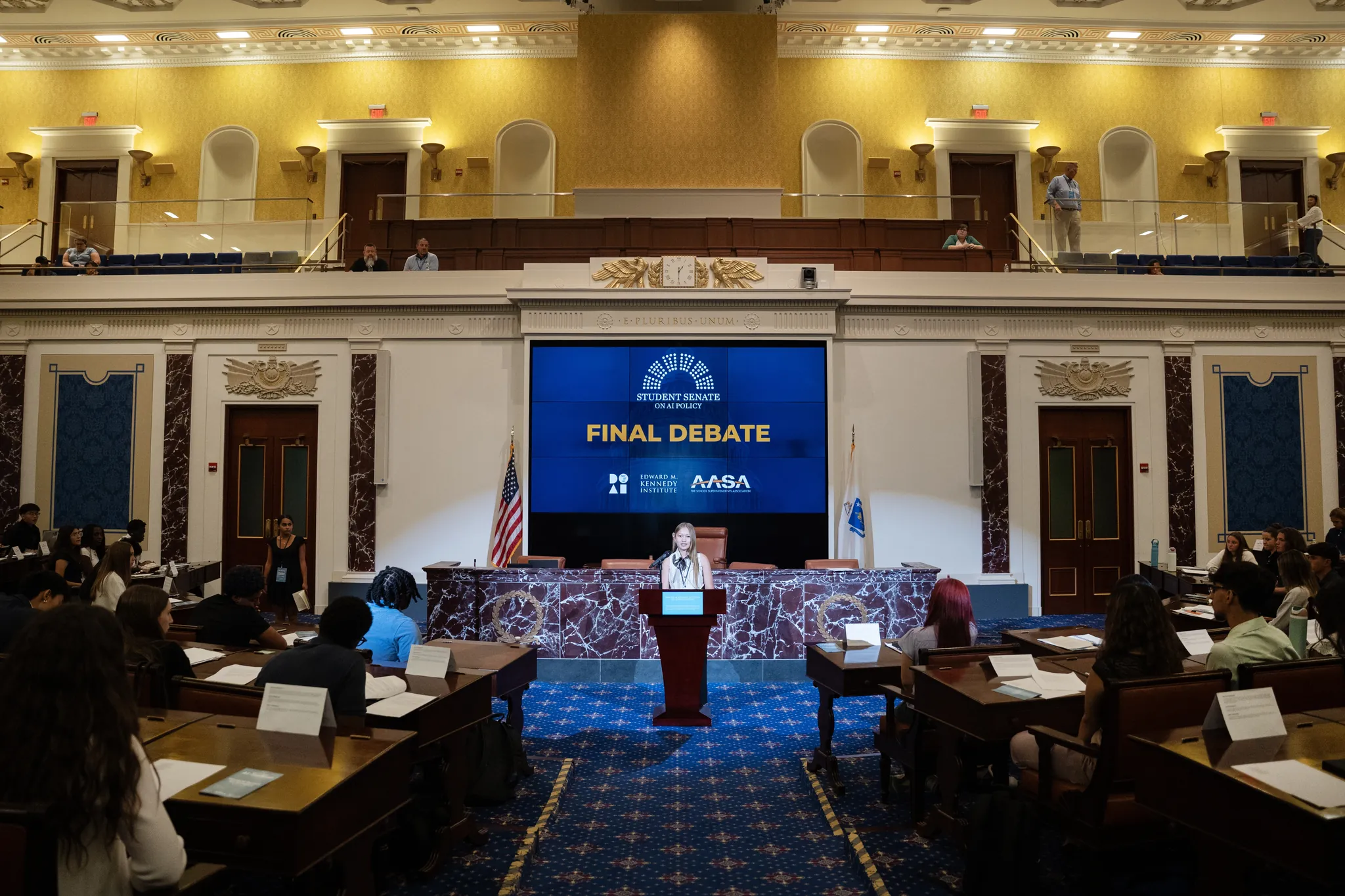
That limitation matters. A model bill drafted in a civic simulation does not bind a principal, cure a vague student handbook, or make a plagiarism finding defensible by itself. But the reported provisions do answer the practical question districts face: what would a school actually have to do before it could fairly distinguish permitted AI assistance from substituted work?
The answer, as reported, is a four-layer verification workflow. First, students receive AI literacy instruction before they receive school-issued devices. Second, teachers post semester-specific AI policies. Third, students cite permitted AI use and may be required to orally defend their work. Fourth, any AI-detector flag must be reviewed by two school officials before disciplinary action. [1]
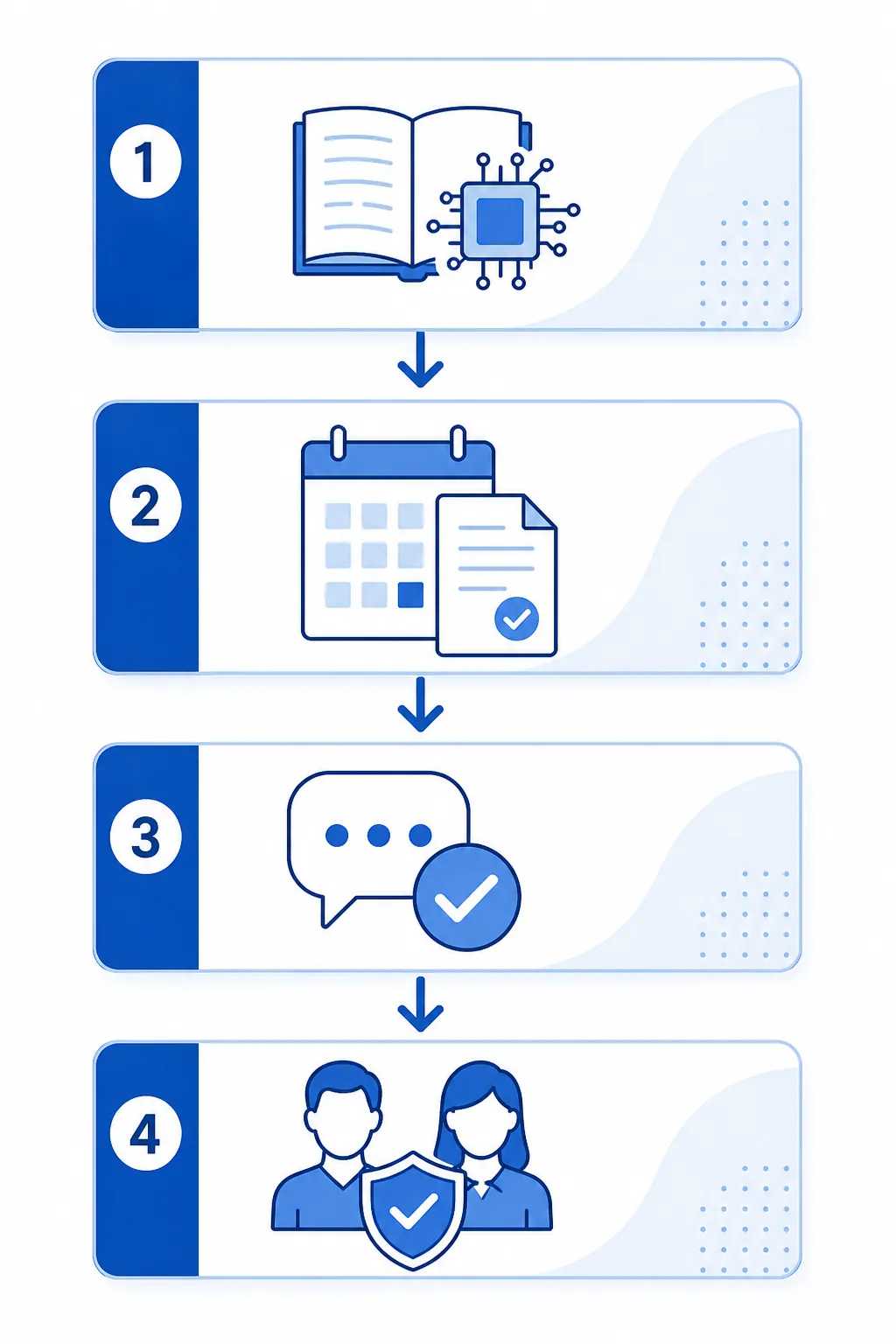
| Layer | What the reported provision does | Procedural failure it tries to prevent |
|---|---|---|
| AI literacy before device access | Teaches students what AI tools are and how school rules treat them before enforcement begins | Punishment under a rule the student was never taught |
| Teacher-posted semester policies | Requires assignment-facing clarity before students submit work | Retroactive ambiguity about what counted as cheating |
| Citation plus oral defense | Lets students identify permitted help and lets teachers test mastery | Treating all AI contact as the same kind of misconduct |
| Two-official human review | Stops a detector flag from becoming discipline without human judgment | Automated accusation without accountable review |
Why the Workflow Looks Like Litigation Hygiene
Early AI-cheating disputes have not turned on a broad judicial rule that detectors are lawful, unlawful, reliable, or useless. The visible line is procedural. GradPilot’s lawsuit tracker describes one student win tied to process failure and two school wins tied to proper process. That is a small litigation record, not a national doctrine, but it is already enough to show where the pressure falls: notice, evidence, human judgment, and an opportunity to respond. [2]
Fisher Phillips, writing after the RNH v. Hingham preliminary-injunction decision, framed a five-step safe-harbor approach for schools: adopt clear policies, educate students and parents, document evidence, use AI tools cautiously, and provide fair process. The article is legal-practice guidance, not a court order. Still, its steps are useful as a comparator because they describe what careful school lawyers now tell districts to build before a dispute arrives. [3]
The teenagers’ sequence lands in the same territory from the opposite direction. They did not merely say students should use AI responsibly. They placed instruction before access, disclosure before grading, mastery checks before conclusions, and human review before discipline. That is why the model policy is worth taking seriously even if no district adopts it word for word.
Layer 1: Teach the Rule Before Enforcing the Rule
Mandatory AI literacy before device access does something student handbooks often fail to do: it puts the school’s expectations into the student’s path before the student can violate them. A student cannot be expected to infer the difference between brainstorming, grammar support, outline generation, paraphrasing, and full draft substitution if the school has never taught that difference in operational terms.
This is not a soft civics flourish. It is notice. In a discipline record, notice is the hinge between “the student should have known” and “the adults changed the meaning after the fact.” If the school wants to say a student knowingly crossed a line, the school should be able to show when the line was taught, what examples were used, and how the student acknowledged the rule.
Layer 2: Put the Teacher’s AI Policy Where the Assignment Lives
A district-wide AI statement can announce values, but assignment disputes usually begin lower down: in a classroom, on a semester syllabus, inside an essay prompt, or in a learning management system note that students may or may not read. The Students First Act provision requiring teachers to post semester policies recognizes that AI permission is often course-specific. A world history teacher, a computer science teacher, and an English teacher may all make different judgments for legitimate reasons.
The important part is timing. A teacher-posted semester policy gives the school a fixed reference point before the disputed work exists. Without that, the discipline conversation can become a reconstruction exercise: what did the teacher mean, what did the student hear, what did the class usually do, and whether a chatbot was treated differently last month. That is not where a school wants to be when a parent asks for the evidence.
Layer 3: Require Disclosure, Then Test Mastery
Citation of permitted AI use is the layer that turns a hidden-input problem into a reviewable record. If a student used AI to generate practice questions, translate a confusing instruction, suggest counterarguments, or polish grammar where allowed, the teacher can see the claimed use. If the submitted work depends on undisclosed generation, the record looks different.
The oral-defense check is equally important because it does not pretend that a citation line proves authorship. A student who used permitted support should still be able to explain the thesis, define key terms, walk through a calculation, or describe why a source was used. The defense does not need to be theatrical or punitive. It can be a short conference, a few targeted questions, or a recorded explanation. The point is to test mastery rather than worship the artifact.
This is where the student-designed rule is more useful than a blanket ban. It gives teachers a way to separate assistance from substitution. It also gives honest students a way to say what they did without fearing that any AI contact automatically becomes a cheating confession.
Layer 4: Two Humans Before Discipline
The two-official review requirement is the safeguard most directly aimed at detector-driven discipline. It does not ban detectors. It does not declare them legally worthless. It simply refuses to let a detector flag do the work of an investigation.
That distinction is not academic. A detector output is not a witness, cannot answer follow-up questions, and often cannot explain its confidence in a way a student can meaningfully contest. Two human officials can ask whether the assignment policy was clear, whether the student disclosed any permitted use, whether the work matches prior writing, whether the student can defend the content, and whether the detector is being treated as one piece of evidence or the entire case.
The value of two reviewers is not that two adults are automatically right. It is that the process creates friction. One person has to persuade another that the evidence supports discipline. If the school later has to explain itself, the record can show that the decision did not begin and end with an opaque percentage.
Why Districts Need a Workflow Now
The urgency is not that every AI-assisted assignment is suspicious. The urgency is that student use has outrun school procedure. Fortune and The Conversation reported survey data indicating that only 29% to 33% of school districts had formal AI policies. [4] College Board research reported that 84% of high school students use generative AI for schoolwork and that roughly 40% of schools ban it entirely. [5] RAND survey data also points to student AI use and educator concern about critical thinking, while remaining survey-based and therefore dependent on self-reporting. [6]
Those figures do not prove how often students cheat with AI. They do show the administrative mismatch: many students are already using the tools, many schools still lack formal rules, and some schools respond with total bans that may be easier to announce than to enforce. In that setting, the worst place to create policy is inside a single disputed grade.
Districts are not starting from zero. Business Insider described a California district using a traffic-light approach to classify AI use. [7] Edutopia has published a 0–4 AI-use scale that helps teachers communicate how much AI support is allowed for a task. [8] Both models address an essential classification problem: students need to know whether AI is prohibited, limited, encouraged, or expected.
The Students First Act workflow is broader because it does not stop at classification. It connects permissions to disclosure, disclosure to mastery checks, and flags to human review. A traffic-light system can tell a student whether AI is allowed. The student-drafted workflow asks what happens next if the student uses it, hides it, misunderstands the rule, or is accused by a tool.
The Detector Problem Is a Process Problem Too
Detector skepticism is not the same as detector abolition. A school may have reasons to screen work, especially where the assignment required unaided writing and the submitted text looks inconsistent with the student’s known performance. The procedural mistake is treating the screen as a verdict.
The false-positive literature gives schools reason to be careful. Liang et al. reported that AI detectors misclassified non-native English writing at a 61.3% false-positive rate in the tested setting. [9] A 2025 Booth working paper reported detector false-positive rates ranging from less than or equal to 1% for the best-performing detectors to much higher rates in other conditions, while the paper remains a working paper and its vendor-specific rankings have been disputed. [10] In an enforcement action against Workado, the FTC said the company advertised 98% accuracy for an AI-content detector even though testing showed accuracy around 53%; the final order was issued in August 2025. [11]
None of that supports the overbroad claim that every detector result is useless in every school context. It does support a narrower and more defensible rule: a detector flag should trigger review, not punishment. The student-drafted two-official safeguard fits that rule precisely.
What a District Could Translate Into a Checklist
A district does not need to wait for a perfect national consensus to borrow the workflow. The model policy’s reported provisions can be translated into a practical verification checklist while lawyers, administrators, teachers, students, and families adapt the language to local rules.
- Before device access: document AI literacy instruction, including examples of permitted assistance, prohibited substitution, citation expectations, and consequences.
- Before the semester begins: require each teacher to post course-level AI rules that students and families can locate later.
- Before grading disputed work: compare the submission to the posted rule and review any student citation of AI assistance.
- Before discipline: use an oral-defense or mastery check when authorship or understanding is uncertain.
- Before relying on a detector flag: require two school officials to review the full record, not just the tool output.
- Before final action: preserve the assignment prompt, teacher policy, student disclosure, detector report if used, reviewer notes, and the student’s response.
Future case entries in this site’s Risk Digest can track how courts treat these elements as more disputes reach written decisions. Future Tool Reliability Evaluations can separately track detector benchmarks and vendor claims. Keeping those records separate is healthy: case procedure and tool performance overlap, but they are not the same question.
The Students First Act is not binding law, not a complete district policy, and not proof that AI detectors are unlawful as a class. Its value is narrower and more useful. Teenagers assembled a verification workflow that many districts still lack, and that workflow follows the same procedural safeguards that have begun to separate defensible AI-discipline decisions from decisions vulnerable to being overturned.
References
- Students set AI policy, NPR, July 30, 2026
- AI Cheating Lawsuits Tracker, GradPilot
- Court Backs School in AI Cheating Case: 5 Things Your School Can Do to Avoid Trouble, Fisher Phillips
- School AI policy detection tools failing, Fortune, July 16, 2026
- New Research: Majority of High School Students Use Generative AI for Schoolwork, College Board
- RRA4742-1, RAND
- Teenager uses AI homework; mom helped school write AI policy, Business Insider, 2026
- Creating AI Usage Guidelines for Students, Edutopia
- GPT detectors are biased against non-native English writers, Patterns/Cell, 2023
- BFI Working Paper 2025-116, Becker Friedman Institute, 2025
- FTC v. Workado final order, Federal Trade Commission, August 2025
Grounded in
This procedure is grounded in the cited rule or opinion, independent of any single documented case. See the Regulation tracker for the governing text.
Cases this step would have prevented
No cases have been explicitly linked to this checklist yet. See Risk Digest for documented incidents generally.
← Back to WorkflowsReport a correction or tip
Spotted an outdated figure, a misstated fact, or a ruling this workflow checklist should reflect? Public comments are disabled for this content given the professional cost of a misreported case outcome, penalty amount, or rule text — use the structured correction channel instead.
Report a correction or tip for this record →