
How to Verify Truck Wrongful Death Settlement Averages
Most settlement figures for commercial truck wrongful death cases trace to four conflated data sources, and none is a national average. This verification workflow shows litigators, risk staff, and journalists how to trace a quoted figure to its origin and state its data type, sample, and date before using it.
- Applicable role
- litigators, risk staff, journalists
- Workflow stage
- review
- Primary source
- 49 CFR Part 387

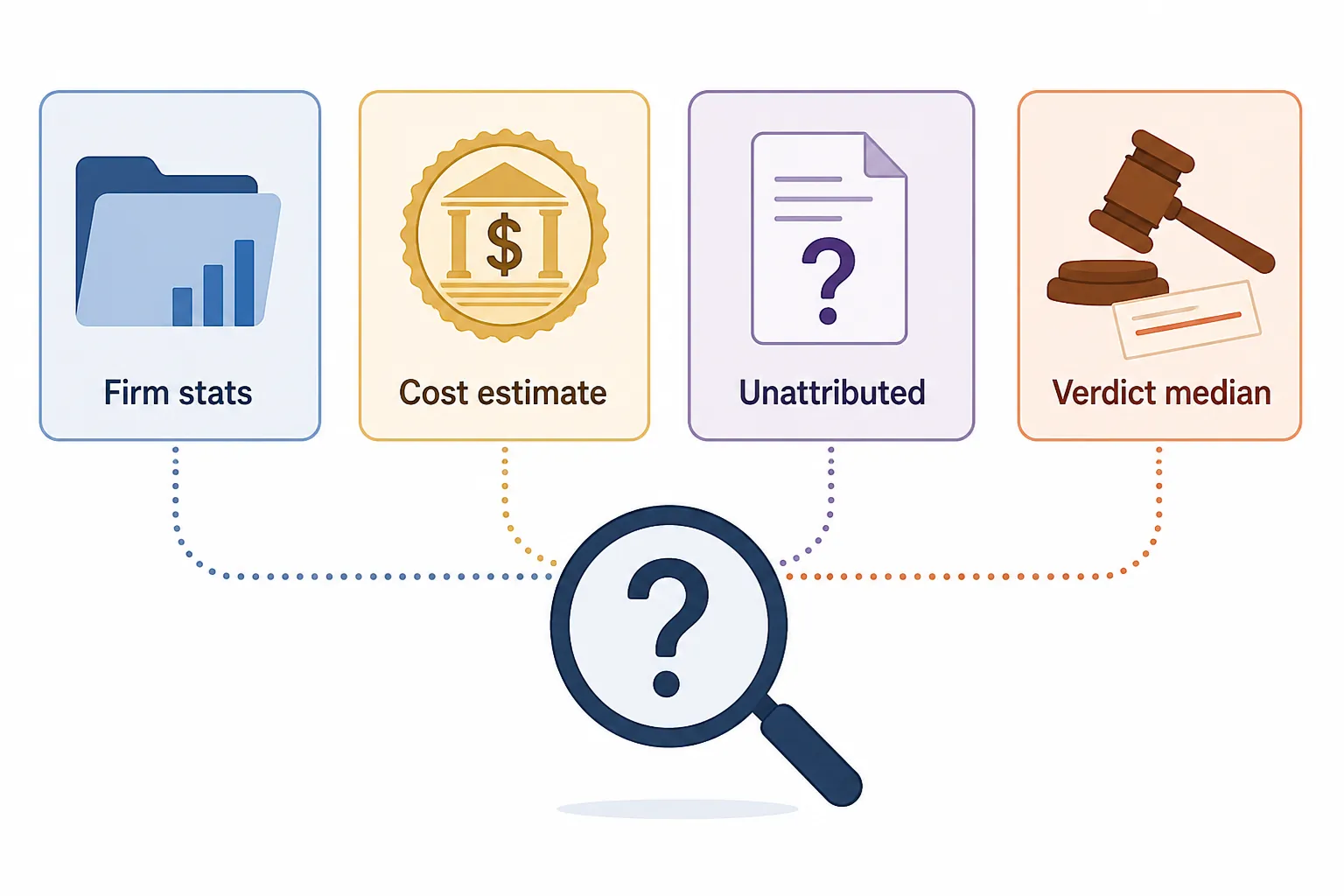
Search for the average settlement in a commercial truck accident wrongful death case and the results look more confident than the underlying data deserves. The hard answer is that there is no authoritative national dataset of commercial truck wrongful death settlements. Settlement data is largely private, and the figures that circulate online are usually one of four different things: a firm’s own closed-case statistics, a federal crash-cost estimate, an unattributed state-level number, or a verdict median from a filtered set of trial outcomes.
Those are not interchangeable labels. A mean from one firm’s book of business is not a national benchmark. A crash-cost estimate is not a payout. A median from verdicts above a threshold is not the median of all truck death claims. Before any number goes into a demand letter, partner memo, risk report, or news story, it needs three tags attached to it: data type, sample, and date.
| Circulating figure | What it actually is | Sample or scope | Date or period | How to use it |
|---|---|---|---|---|
| $103,654.08 average / $30,000 median | Law-firm internal settlement statistics | Brown & Crouppen’s own 400+ truck accident cases | Settled 2021–2024 | Firm-specific context only; not a national settlement average |
| $3,604,518 fatal-truck figure | Federal comprehensive crash-cost estimate, often mislabeled as a settlement figure | FMCSA 2007 Unit Costs of Truck Crashes estimate as cited by Jacoby & Meyers | 2007 study cited on current marketing page | Do not cite as an observed settlement or payout |
| About $973,000 average / about $294,000 median in California | Repeated state-level wrongful-death figures with no identified underlying dataset in the pages reviewed | Unverified from available materials | Unclear | Treat as unattributed unless the original dataset is produced |
| $2.5–$3.6 million medians | Conditional verdict medians | ATRI trucking trial cases with awards at or above $1 million | Published December 2025 | Useful only as a verdict anchor for that filtered trial set |
Start with the label, not the dollar sign
Brown & Crouppen gives the cleanest example of a number that can be useful if it is kept in its lane. The firm reports an average truck accident settlement of $103,654.08, a median of $30,000, a maximum of $4,478,799.75, and a minimum of $900 from more than 400 truck cases settled from 2021 through 2024.[1]
That is a real sample statement. It tells the reader the publisher, the case category, the approximate sample size, and the period. It also tells the careful reader what the number is not. It is not limited to wrongful death. It is not a national truck litigation dataset. It is not a carrier-industry settlement database. It is not a court-verified population of all commercial truck injury outcomes.
The average and the median also tell different stories. In a skewed injury dataset, a few severe cases can pull the mean upward while the median remains far lower. Calling the $103,654.08 figure a “typical” truck settlement would overstate what the median in that same sample says. Calling the $30,000 figure a ceiling would be just as careless, because the same sample includes a multimillion-dollar maximum.[1]
For professional use, the defensible sentence is narrow: “Brown & Crouppen reports that, in its own dataset of more than 400 truck cases settled from 2021–2024, the average was $103,654.08 and the median was $30,000.” Once the words “its own dataset” disappear, the citation starts doing more work than the source can support.
The $3.6 million figure is the easiest one to misuse
The most serious mislabeling problem is the fatal-crash figure that appears as if it were a settlement benchmark. Jacoby & Meyers lists truck accident figures of $15,144, $195,258, and $3,604,518 and links them to FMCSA’s 2007 “Unit Costs of Truck Crashes” study.[2]
That provenance changes the entire meaning of the number. A unit-cost study estimates comprehensive crash costs. It is not a dataset of wrongful death settlements. It does not tell the reader what insurers paid, what estates accepted, what juries awarded, or what defendants reserved. If a demand memo calls $3,604,518 the average fatal truck accident settlement, the problem is not just imprecision. The cited source does not measure settlements.
This is where a bad citation can survive several rounds of copying. One page cites the number as a cost. Another summarizes it as a value. A third turns it into an “average settlement.” By the time it reaches a deck or article, the original measurement has been stripped off. The correction is simple but often unwelcome: cite it as a 2007 crash-cost estimate or do not cite it for settlement value at all.
Verdict medians are useful, but only after the filter is stated
ATRI’s December 2025 trucking litigation analysis belongs in a different category. It is not a settlement study; it is a verdict-oriented litigation analysis. The reported medians—$2,517,500 in federal court and $3,600,000 in state court—come from trucking trial cases with awards at or above $1 million.[3]
That threshold matters. A median drawn from awards of at least $1 million cannot be used as the median of all commercial truck death cases, all truck injury cases, or all truck claims. It excludes lower verdicts by design. It also excludes settlements. The number is still useful when the task is to understand high-exposure trucking verdicts, especially in a case already being evaluated in seven-figure trial-risk territory.
The same ATRI analysis, summarized by NEFI, reports that crash-related trucking case filings have increased by about 3.7% per year since 2014.[4] That is litigation-volume context, not a settlement multiplier. It may explain why trucking litigation receives more attention from carriers, brokers, excess insurers, and the plaintiffs’ bar, but it does not convert a verdict median into a settlement average.
The California number should not be treated as verified without the missing source
The California wrongful death figures—roughly a $973,000 average and a $294,000 median—are repeated by multiple firms, but the materials reviewed do not identify the underlying dataset. That does not mean the figures are false. It means they are not ready for professional citation as statistics.
A state label alone is not provenance. A usable citation would need to say whether the number came from settlements, verdicts, reported appellate decisions, a verdict reporter, a firm intake database, a carrier study, or a curated marketing survey. It would also need the time period and inclusion rules. Without those pieces, the number is only a repeated claim.
Crash frequency is context, not valuation
National fatality data can explain why truck wrongful death litigation is consequential, but it still does not provide settlement value. The National Safety Council’s Injury Facts reports 5,340 deaths in large-truck crashes in 2024, down 2.5% from 2023 but up 30% over ten years; it also reports that 70% of deaths in large-truck crashes are occupants of other vehicles.[5]
Those figures are important for public-safety framing and industry exposure. They do not answer what estates recovered. A fatality count does not reveal liability disputes, venue, insurance layers, decedent earnings, household services, conscious pain and suffering, comparative fault, punitive exposure, or whether the case resolved confidentially before suit.
Policy limits create a floor, not an average
Federal minimum financial responsibility rules are often relevant in truck death cases because they may define the first layer of available coverage. Under 49 CFR Part 387, the minimum public-liability levels include $750,000 for certain general freight operations, $1 million for oil, and $5 million for certain hazardous materials transportation.[6]
Those amounts should not be confused with settlement averages either. A minimum required coverage level is not proof of actual available insurance, excess coverage, collectability, liability, damages, or settlement behavior. It is a coverage floor to verify early, especially where catastrophic damages may exceed the first layer.
Older verdict snippets need their vintage attached
Some truck-case figures circulating online trace to secondhand descriptions of Jury Verdict Research data. Maryland Injury Law Center reports a 60% plaintiff win rate in truck accident verdicts, an average fatal truck case value just over $1 million, and a head-on truck accident average of $532,034 from a 1996–2005 study.[7]
Miller & Zois separately reports rear-end truck accident data with a $93,909 median, a 63% plaintiff win rate, and 12% of verdicts exceeding $1 million.[8]
The citation problem here is not that historical verdict data is useless. It can be helpful for orientation if the user states the source chain and age. The problem is when a dated verdict-reporter snippet becomes a current settlement benchmark. A 1996–2005 study period, a secondhand law-firm summary, and a verdict-only sample must travel with the number.
Single outcomes illustrate exposure; they do not create ranges
Large individual outcomes have a place in a valuation file, but that place is not the same as an average. Expert Institute’s 2025 wrongful death roundup includes, for example, a $10.5 million Cook County dump-truck verdict.[9]
A result like that can help identify issues to investigate: venue tolerance, commercial-driver conduct, vehicle type, comparative fault, evidentiary themes, and damages presentation. It cannot tell the reader what the next wrongful death truck case should settle for. One verdict is one verdict.
AI-generated settlement estimates inherit the same defects
An AI tool that gives a truck wrongful death “average settlement” without source labels is not solving the provenance problem. It is usually compressing the same online claims into a more polished sentence. If the underlying web pages confuse federal cost estimates, firm-specific means, conditional verdict medians, and unattributed state numbers, the AI output will inherit that confusion unless every figure is traced back to a primary or clearly identified source.
For legal teams, that is not just a research-quality issue. AI-cited numbers still have to be checked before professional use, just as AI-cited cases do. The same discipline discussed in AI Hallucinations and Attorney Ethics applies here: a confident citation is not a verified citation. The compliance record should show who checked the number, where it came from, and whether the source actually measured the thing being claimed.
Law-firm AI policies should treat settlement estimates as unverified drafts until the data type, sample, and date are confirmed. That fits within the broader workflow discipline described in The Double-Compliance Burden and the attorney-responsibility concerns addressed in From Ethics Opinions to Enforcement.

A repeatable citation check for truck wrongful death numbers
The working rule is simple enough to put in a review note: no truck wrongful death settlement figure is ready for professional use unless it carries its data type, sample, and date. If one of the three is missing, the number can remain in a research scratchpad, but it should not appear as a cited benchmark.
- Identify the data type. Is the number a settlement, verdict, crash-cost estimate, insurance limit, fatality count, survey response, or single case result?
- Identify the sample. Does it cover one firm’s cases, one state, reported verdicts, cases above a threshold, federal data, or an unknown group?
- Identify the date. State the publication date, study period, settlement period, or verdict period. If only a current web page is available, do not assume the underlying data is current.
- Check whether the source measures the claim being made. A crash-cost estimate cannot support a sentence about average settlements. A verdict median cannot support a sentence about confidential settlements.
- Preserve the qualifier in the final sentence. Do not cite “the average truck wrongful death settlement” when the source supports only “one firm’s average truck accident settlement” or “a median award among trucking verdicts of at least $1 million.”
Applied to the four recurring figures, that workflow leaves a narrower but safer set of statements. Brown & Crouppen can be quoted as a firm-specific 2021–2024 truck-case dataset. The $3.6 million FMCSA-derived figure can be quoted as a 2007 comprehensive crash-cost estimate, not a settlement. The California average and median should be treated as unattributed unless the original dataset is found. ATRI’s $2.5–$3.6 million medians can be used as conditional verdict medians for cases with awards at or above $1 million.
That does not produce a single national average settlement for commercial truck wrongful death cases. It produces something more useful: a number that can survive the next person asking, “Where did that come from, and what does it actually measure?”
References
- Truck Accident Settlement Amounts, Brown & Crouppen
- Average Truck Accident Settlement, Jacoby & Meyers
- Trucking Litigation: A Forensic Analysis, American Transportation Research Institute, December 2025
- ATRI Publishes Analysis of Growing Crash Truck Litigation Awards, NEFI
- Large Trucks, NSC Injury Facts
- 49 CFR Part 387 - Minimum Levels of Financial Responsibility for Motor Carriers, Legal Information Institute
- Truck Accident Statistics, Maryland Injury Law Center
- Truck Accident Statistics, Miller & Zois
- Top Wrongful Death Verdicts and Settlements of 2025, Expert Institute, 2025
Grounded in
This procedure is grounded in 49 CFR Part 387, independent of any single documented case. See the Regulation tracker for the governing text.
Cases this step would have prevented
No cases have been explicitly linked to this checklist yet. See Risk Digest for documented incidents generally.
← Back to WorkflowsReport a correction or tip
Spotted an outdated figure, a misstated fact, or a ruling this workflow checklist should reflect? Public comments are disabled for this content given the professional cost of a misreported case outcome, penalty amount, or rule text — use the structured correction channel instead.
Report a correction or tip for this record →