
The Supreme Court Didn't Settle Trump's Mail-In Ballot Order
The Aug. 24, 2026 per curiam stay in Trump v. California (26A124) resolved only justiciability, not the legality of the Administration's mail-in ballot restrictions, and it left a second nationwide injunction in force. The verified record and step-by-step workflow here show how to confirm that holding against the slip opinion and docket before relying on any AI-generated summary of the ruling.
- Applicable role
- Attorney
- Workflow stage
- review
- Primary source
- Trump v. California, No. 26A124 (U.S. Aug. 24, 2026)
Verified answer as of Aug. 25, 2026
For anyone searching “trump mail in ballot restrictions supreme court decision,” the answer is: no, the Supreme Court did not settle whether President Trump’s mail-in ballot restrictions are lawful. On Aug. 24, 2026, the Court issued an unsigned per curiam stay in Trump v. California, No. 26A124, holding that the 23-state and District of Columbia challenge was not justiciable at the time it was filed. The order stayed one preliminary injunction; it did not decide the merits, and it expressly warned that its disposition “does not mean that any measure taken by the Government to implement the Order will necessarily be lawful.” [1][2]
| Item to verify | Current record |
|---|---|
| Case and docket | Trump v. California, No. 26A124. |
| Document | Unsigned per curiam stay order dated Aug. 24, 2026, checked against the Cornell LII opinion text and the Supreme Court slip opinion PDF. [1][2] |
| What the Court did | Stayed the district court’s preliminary injunction in the 23-state/D.C. suit because the Court found the suit nonjusticiable at filing. [1][2] |
| What the Court did not do | It did not hold the executive order or any implementing measure lawful. The order says legality remains for later litigation. [1][2] |
| Other injunction | A separate nationwide injunction in the League of Women Voters case remains outside this stay order and was still being reported as in force after the Aug. 24 order. [5] |
| Record instability | The Court’s treatment of Section 3 rested on the absence of a final rule when the states sued, while a USPS final rule had appeared on public inspection on Aug. 21, with Federal Register publication listed for Aug. 26. [1][7] |
| Last verified | Aug. 25, 2026, UTC, based on the primary opinion text, slip opinion link, public-inspection rule, and cited docket-status reporting. |
That is a narrower answer than many fast summaries invite. SCOTUSblog’s headline said the Court allowed the Trump administration “to move forward” with the order imposing mail-ballot restrictions, while Votebeat framed the result as lifting “1 of 2 blocks,” and Election Law Blog immediately flagged that another injunction remained. Those formulations are not equivalent. “Move forward” is a practical description of one stay; “1 of 2 blocks” preserves the operative complication; “another injunction remains” is the fact a briefing note cannot omit. [3][4][5]
The difference matters because an emergency stay can change who may act tomorrow morning without answering who will win later. Here, the Court’s own limiting sentence is the safest anchor: “On that score, time will tell.” [1][2]
What the Court actually held
The challenged executive order, EO 14399, was issued as an election-integrity directive concerning citizenship verification and federal elections. For present purposes, the background only needs to carry three pieces of the order into view: Section 2(a), concerning citizenship-related lists; Section 2(b), concerning federal prosecution priorities; and Section 3, concerning mail ballots and postmark-related handling. [6]
The per curiam opinion treated the executive order, at the moment the states filed suit, as “an internal directive from the President to his subordinates.” From there, the Court analyzed standing and ripeness provision by provision. It did not start from whether the provisions were wise, disruptive election-administration policy; it started from whether these plaintiffs had a justiciable dispute at filing. [1][2]
On Section 2(a), the Court reasoned that the citizenship-list provision did not itself impose obligations on the states. That point is easy to flatten into a merits conclusion, but it is not one. The Court’s logic was that a presidential instruction to federal subordinates, without present legal obligations on the plaintiff states, did not yet give those states the kind of concrete dispute needed for this suit. [1][2]
On Section 2(b), the Court described prosecution priorities as lying within Article II. Again, the immediate consequence was justiciability: the states had not shown a ripe, concrete legal injury from that instruction at the time they filed. A summary that turns this into “the Court approved the prosecution policy” adds a conclusion the Court did not write. [1][2]
Section 3 is the provision most likely to produce stale summaries. The Court said the challenge to Section 3 was not ripe when filed because, at that point, the Postal Service had not issued a final rule. The legal significance of that sentence is temporal. It says something about the suit as filed, not about every later challenge to a completed agency rule. [1][2]
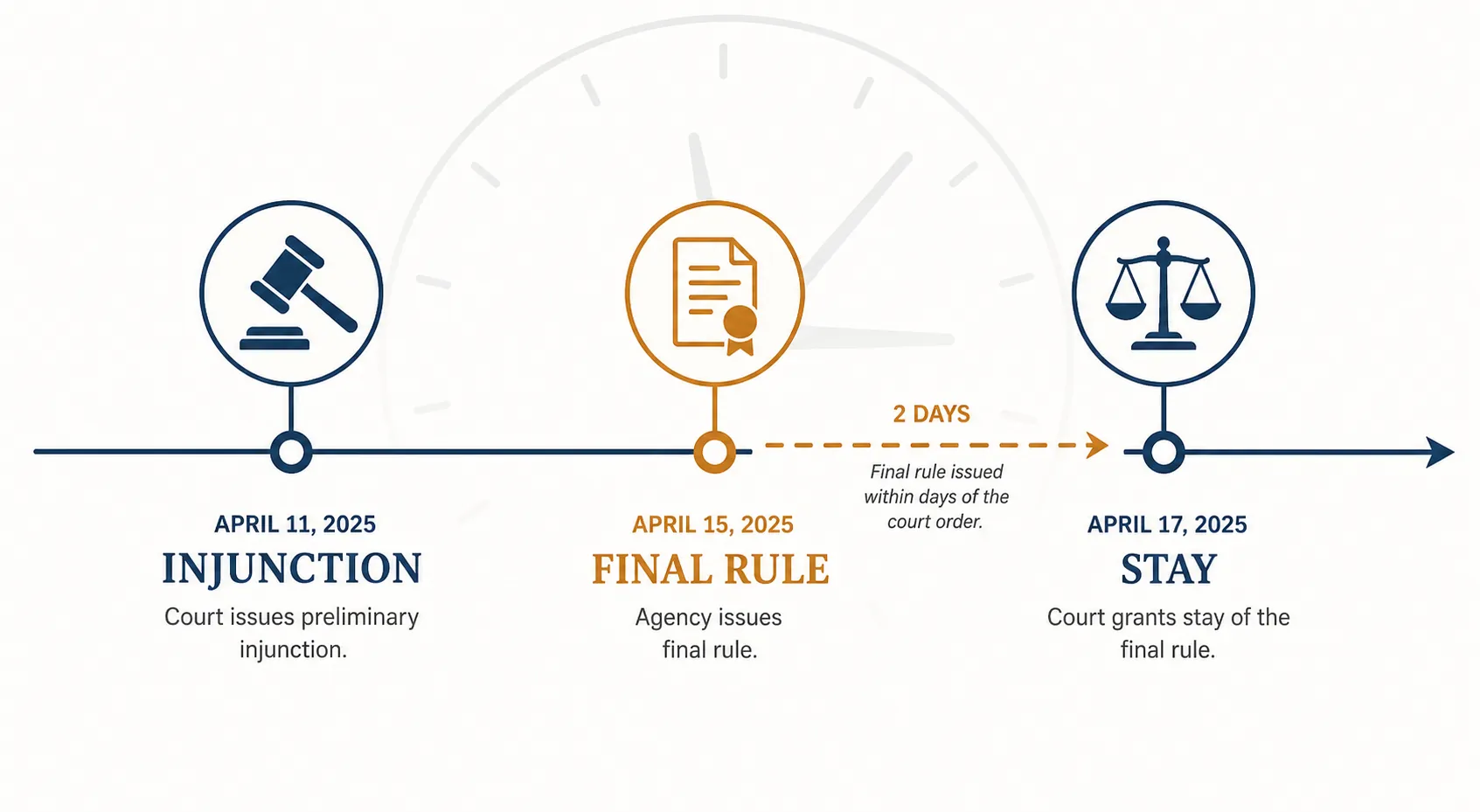
That is why the Aug. 21 USPS final rule matters. The Federal Register public-inspection document appeared before the Aug. 24 stay order, with publication listed for Aug. 26. The Court’s reason for treating Section 3 as unripe was tied to the record at filing; the rule’s arrival changes the practical verification task even if it does not rewrite what the Court held in 26A124. [1][7]
One injunction lifted does not mean the policy is clear to implement
The operational trap is the word “the.” If a summary says “the injunction was lifted,” ask which injunction. The Aug. 24 order addressed the preliminary injunction in the 23-state and District of Columbia case. Election Law Blog’s contemporaneous account emphasized that another injunction against the executive order remained in place. [5]
That distinction is not docket trivia. A government lawyer, state election official, campaign counsel, or newsroom standards editor needs to know whether an action is blocked by any operative order, not merely whether one order has been stayed. A national headline can survive some compression; an implementation memo usually cannot.
The second trap is the final-rule timing. If an AI tool or rushed summary was generated from material before Aug. 21, it may accurately describe the absence of a final USPS rule at one moment and still be unsafe after the public-inspection filing. If it was generated after Aug. 24 but does not separate the Court’s filing-date justiciability analysis from the later final rule, it may sound current while carrying the wrong legal premise. [1][7]
Why AI summaries are especially vulnerable here
This case has the profile that exposes weak legal summarization: an unsigned emergency order, several active dockets, a merits-sounding public controversy, a narrow procedural holding, and a factual record that changed within days. A model can produce a fluent answer by blending the headline, the executive order, and the stay result. Fluency is not verification.
The available benchmark evidence is general, not case-specific. Stanford RegLab and Stanford HAI reported that Lexis+ AI and Ask Practical Law AI were incorrect more than 17% of the time, and Westlaw AI-Assisted Research more than 34% of the time, on a benchmark of more than 200 legal queries. The same Stanford account contrasted those legal tools with an earlier study in which general-purpose chatbots hallucinated 58% to 82% of the time, and it identified “misgrounded” citations—sources that are real but do not support the proposition—as a distinct failure mode. Those studies did not test Trump v. California. They do explain why a polished legal answer still needs source checking in a case like this. [8]
Misgrounding is the likely failure here. A summary may cite the real Supreme Court order but attach the wrong proposition to it: that the mail-in ballot restrictions are lawful, that all injunctions are gone, or that the final USPS rule was validated. The source exists; the support does not.
A primary-source workflow for 26A124
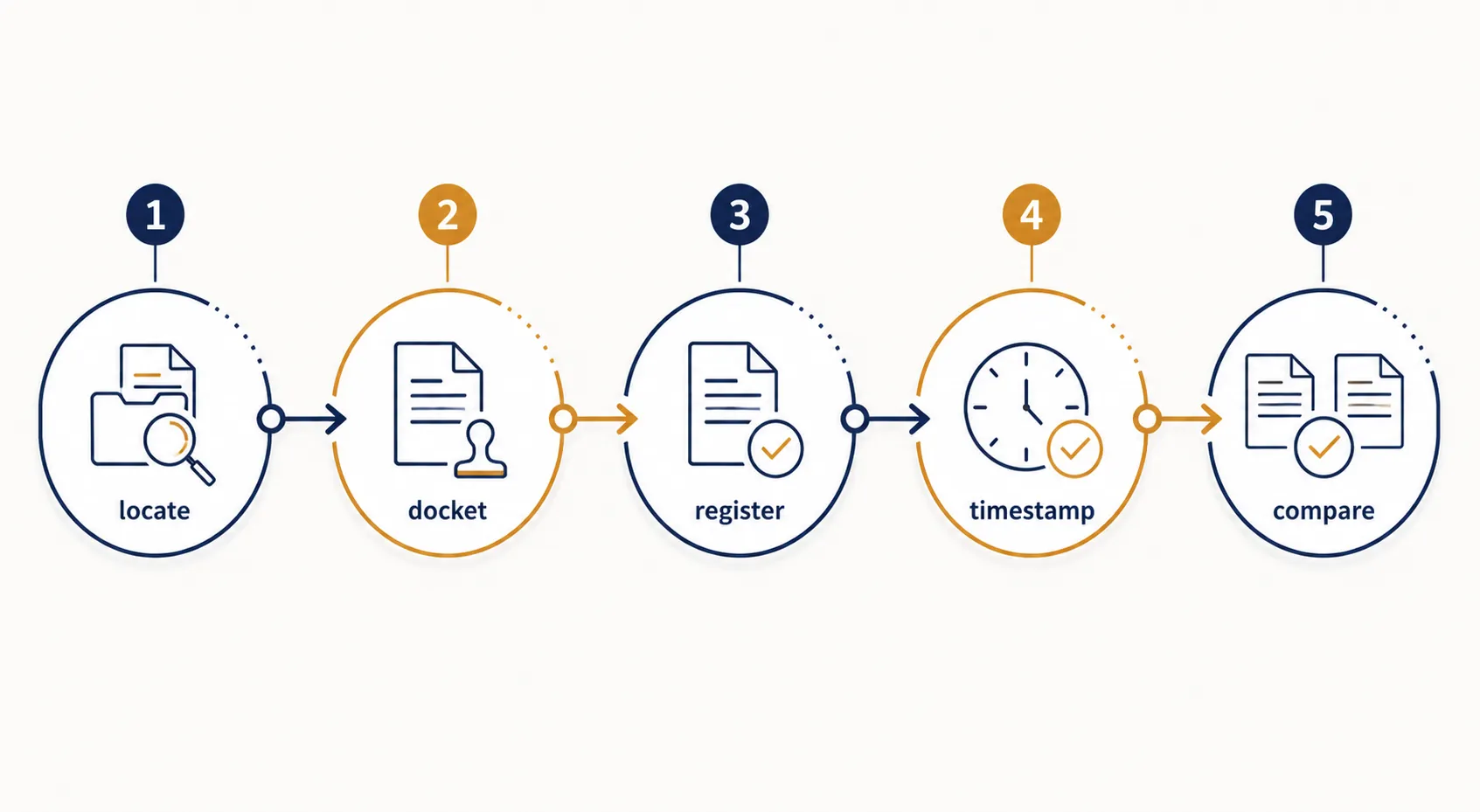
A defensible verification workflow for this ruling is short, but it has to be performed in order. The point is not to collect more commentary; it is to prevent one correct sentence from being carried into the wrong procedural universe.
| Step | Action | What it prevents |
|---|---|---|
| 1. Locate the order | Pull Trump v. California, No. 26A124, from the Supreme Court slip opinion PDF and a reliable text mirror such as Cornell LII. [1][2] | Prevents reliance on a paraphrase of the stay. |
| 2. Read for holding, not result | Mark the justiciability language: standing and ripeness at filing, internal-directive characterization, Section 2(a), Section 2(b), and Section 3 treatment. [1][2] | Prevents converting a stay into a merits ruling. |
| 3. Check live docket posture | Confirm whether related injunctions remain in force and whether a case page or docket update changes the current posture. SCOTUSblog maintains a Trump v. California case page that should be treated as secondary to the primary docket but useful for orientation. [9] | Prevents saying one lifted injunction removed every block. |
| 4. Check agency-record changes | Open the Federal Register public-inspection record for the USPS final rule and note the Aug. 21 public-inspection date and listed Aug. 26 publication date. [7] | Prevents relying on a pre-final-rule factual premise. |
| 5. Timestamp the conclusion | Record the date and UTC time of verification in any client note, newsroom script, KM update, or model-evaluation log. | Prevents a correct morning summary from becoming a stale afternoon answer. |
| 6. Compare before publishing | If the summary mentions RNC v. Mi Familia Vota or another election case, separate the dockets before using the answer. The 26A124 order decides only the application before it. [1][2] | Prevents importing holdings from a different election-law dispute. |
The second step deserves the most time. Search within the opinion for the sentence limiting the Court’s disposition. Then search for the Section 3 discussion. If those two passages are absent from a summary, the summary has not done the work needed for this case.
The third and fourth steps are where many AI and headline answers drift. A Supreme Court order may be current and incomplete at the same time: current as to the application it resolved, incomplete as to another injunction, and incomplete as to agency action that supplies a new target for litigation.
What the dissents add to the verification record
The dissents are not necessary to state the current operative holding, but they are necessary to understand why the posture is contested. Justice Sotomayor, joined by Justice Kagan, accused the Government of trying to “have it both ways”: treating implementation as too speculative to support standing while also claiming an urgent need to implement the order for purposes of emergency relief. [1][2]
Justice Jackson’s dissent used sharper institutional language, describing the case as “another chapter in the Kafkaesque nightmare” of election-claim timing and criticizing the majority for missing what she described as the Government’s objective “to foment chaos ahead of the November elections.” [1][2]
Those dissents do not transform the per curiam order into a merits decision either. They do, however, flag the practical stakes that a purely procedural summary can understate: mail-ballot rules are administered on calendars, and uncertainty itself can burden voters, state officials, campaigns, and courts. A careful note should preserve both things at once—the majority’s narrow justiciability holding and the dissents’ warning about election-administration consequences.
A safe briefing formulation
For a partner, editor, client, or internal risk log, a defensible short formulation would read:
“As of Aug. 25, 2026 UTC, the Supreme Court’s Aug. 24 per curiam order in Trump v. California, No. 26A124, stayed the preliminary injunction in the 23-state/D.C. challenge on justiciability grounds. The Court measured standing and ripeness at filing, treated the executive order as an internal directive, found no present state obligation under Section 2(a), treated Section 2(b) as prosecution-priority material, and held the Section 3 challenge unripe because no final rule existed when suit was filed. The Court expressly did not decide whether implementing measures are lawful. A separate League of Women Voters injunction remains outside this order, and the Aug. 21 USPS final rule must be checked separately.” [1][2][5][7]
That formulation is less dramatic than “green light.” It is also less likely to embarrass the person who has to stand behind it after the next docket entry appears.
References
- Trump v. California, 26A124 — Cornell Legal Information Institute — Aug. 24, 2026
- Trump v. California, 26A124 Slip Opinion — Supreme Court of the United States — Aug. 24, 2026
- Supreme Court allows Trump administration to move forward with order imposing restrictions on mail ballot voting — SCOTUSblog — Aug. 24, 2026
- Supreme Court lifts stay Trump executive order on elections mail ballot restrictions — Votebeat — Aug. 24, 2026
- Breaking: The Supreme Court, over the dissents of Democratic-appointed Justices, stays the district court preliminary injunction in Trump mail-in voting case, but another injunction against it remains — Election Law Blog
- Ensuring Citizenship Verification and Integrity in Federal Elections — The White House — 2026
- USPS final rule public inspection PDF — Federal Register Public Inspection — Aug. 21, 2026
- AI on Trial: Legal Models Hallucinate in 1 out of 6 (or More) Benchmarking Queries — Stanford HAI
- Trump v. California — SCOTUSblog
Grounded in
This procedure is grounded in Trump v. California, No. 26A124 (U.S. Aug. 24, 2026), independent of any single documented case. See the Regulation tracker for the governing text.
Cases this step would have prevented
No cases have been explicitly linked to this checklist yet. See Risk Digest for documented incidents generally.
← Back to WorkflowsReport a correction or tip
Spotted an outdated figure, a misstated fact, or a ruling this workflow checklist should reflect? Public comments are disabled for this content given the professional cost of a misreported case outcome, penalty amount, or rule text — use the structured correction channel instead.
Report a correction or tip for this record →