
How to Verify a US Passport Visa-Free Claim in 2025
A step-by-step verification workflow to confirm visa-free claims for US passport holders, drawing on documented 2025-2026 AI-chatbot failures that led to denied boarding and missed flights.
- Applicable role
- in-house counsel
- Workflow stage
- pre-departure
- Primary source
- Travel.State.gov
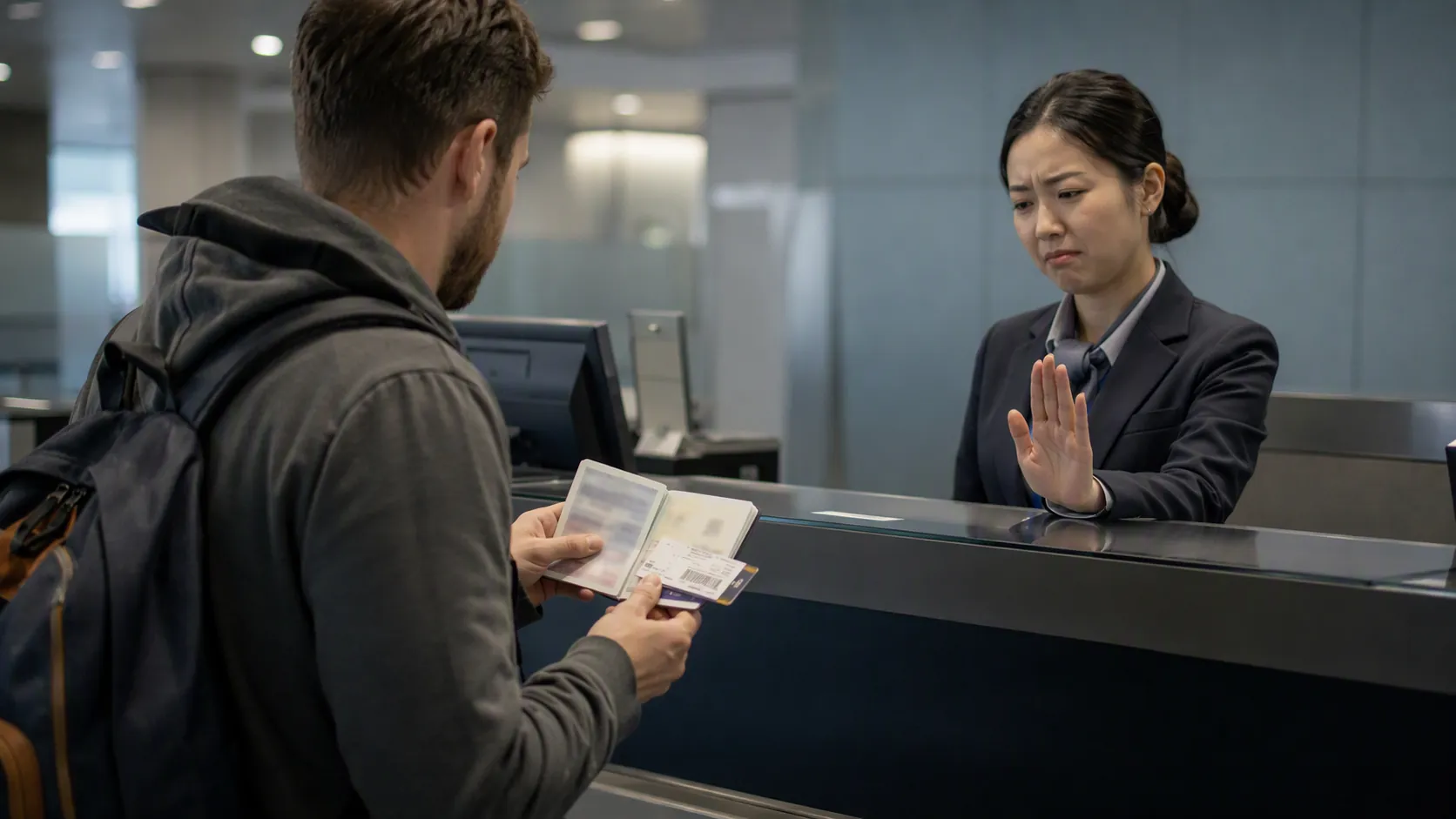
The bad moment does not happen when someone reads a US passport visa-free countries list for 2025. It happens later, at the airline counter, when the agent says the traveler cannot board because the list answered the wrong question.
That is the practical weakness in any “no visa required” answer. It may be true in the narrow sense and still omit an electronic travel authorization, a tourist card, a passport-validity rule, a transit condition, or a nationality-specific document. In August 2025, influencer Mery Caldass said she relied on ChatGPT for travel advice; it told her no visa was required for a Puerto Rico trip but did not flag the ESTA requirement that applied to her situation. She was denied boarding at check-in, missed the flight, and flew the next day after correcting the issue and rebooking under stress. [1][2]
This page is therefore not a definitive country inventory. It is a verification workflow. No single 2025 visa-free count should be treated as authoritative without knowing the date, methodology, traveler nationality, trip purpose, length of stay, and boarding-document rules behind it. A count can be useful as a starting clue. It is not something to book on.
The pre-departure verification flow
For a US passport holder, the defensible answer is not “I found a list.” It is “I checked the entry rule, cross-checked the U.S. traveler guidance, and confirmed the airline-side document requirement before departure.” Keep dated screenshots or PDFs, because the record matters if a booking, client meeting, filing deadline, or family trip depends on the answer.
| Step | Source to check | What it decides | Record to keep |
|---|---|---|---|
| 1. Treat the visa-free claim as unverified | Any list, chatbot answer, agency note, or forwarded message | Only identifies a possible route to check | The original claim and date seen |
| 2. Check the destination authority | Destination government immigration ministry, border agency, official eVisa portal, or embassy/consulate page | The legal entry rule for the traveler’s nationality, purpose, stay length, and passport type | URL, access date, screenshots/PDFs, and any application confirmation |
| 3. Cross-check U.S. traveler guidance | U.S. State Department country page via Travel.State.gov | Entry, exit, passport-validity, safety, and country-specific guidance for U.S. citizens | Country page, date checked, and any conflict with the destination page |
| 4. Confirm the boarding rule | Airline document-check tool or IATA Timatic-backed check | Whether the airline is likely to let the traveler board that itinerary | Result screen, airline confirmation, and date checked |
| 5. Recheck close to departure | The same official and airline sources | Whether rules changed after booking | Final dated record before travel |
Start with the destination authority
The destination government is the first serious source because it controls entry law. For a US passport holder, that usually means the destination’s immigration authority, border agency, foreign ministry, official eVisa portal, or embassy page for U.S. citizens. If those pages disagree, do not average them. Treat the conflict as unresolved until the embassy, consulate, or official immigration contact clarifies it.
The check should be traveler-specific. A short tourist stay may have one rule; work, journalism, study, adoption, paid speaking, remote work, or extended stays may have another. Ordinary passport holders may be treated differently from diplomatic, official, emergency, refugee, or non-citizen travel document holders. A clean workflow records those variables before looking for the answer.
This is where many visa-free lists are too thin. They often compress several permissions into one label: “visa-free,” “visa on arrival,” “eVisa,” “ETA,” or “tourist card.” The label may not tell you whether advance registration is required, whether payment must be made online, whether the traveler needs proof of onward travel, or whether the passport must be valid for a fixed period after arrival. Those are not decorative details. They are the facts the check-in agent will ask the system to enforce.
Then check the U.S. State Department country page
The second source should be the U.S. State Department country page. USA.gov directs U.S. citizens traveling abroad to Travel.State.gov for visa requirements and country-specific travel information, with the USA.gov page last updated on March 25, 2026. [3]
This layer does not replace the destination authority. It serves a different purpose: it translates the issue into U.S.-traveler guidance and often surfaces entry, exit, passport-validity, health, safety, local-law, and embassy-contact information in one place. If the destination page says “no visa” but the State Department page flags a passport-validity rule, exit fee, vaccination requirement, or registration obligation, the narrower operational answer is not “visa-free.” It is “visa-free subject to the listed conditions.”
For offices that manage travel for partners, witnesses, executives, or client teams, this is the point where the record should become formal. Save the State Department page, note the access date, and keep it with the itinerary. A forwarded chatbot answer has little value when someone is trying to reconstruct why a traveler missed a filing, hearing, site visit, or closing dinner.
Confirm the rule the airline will enforce
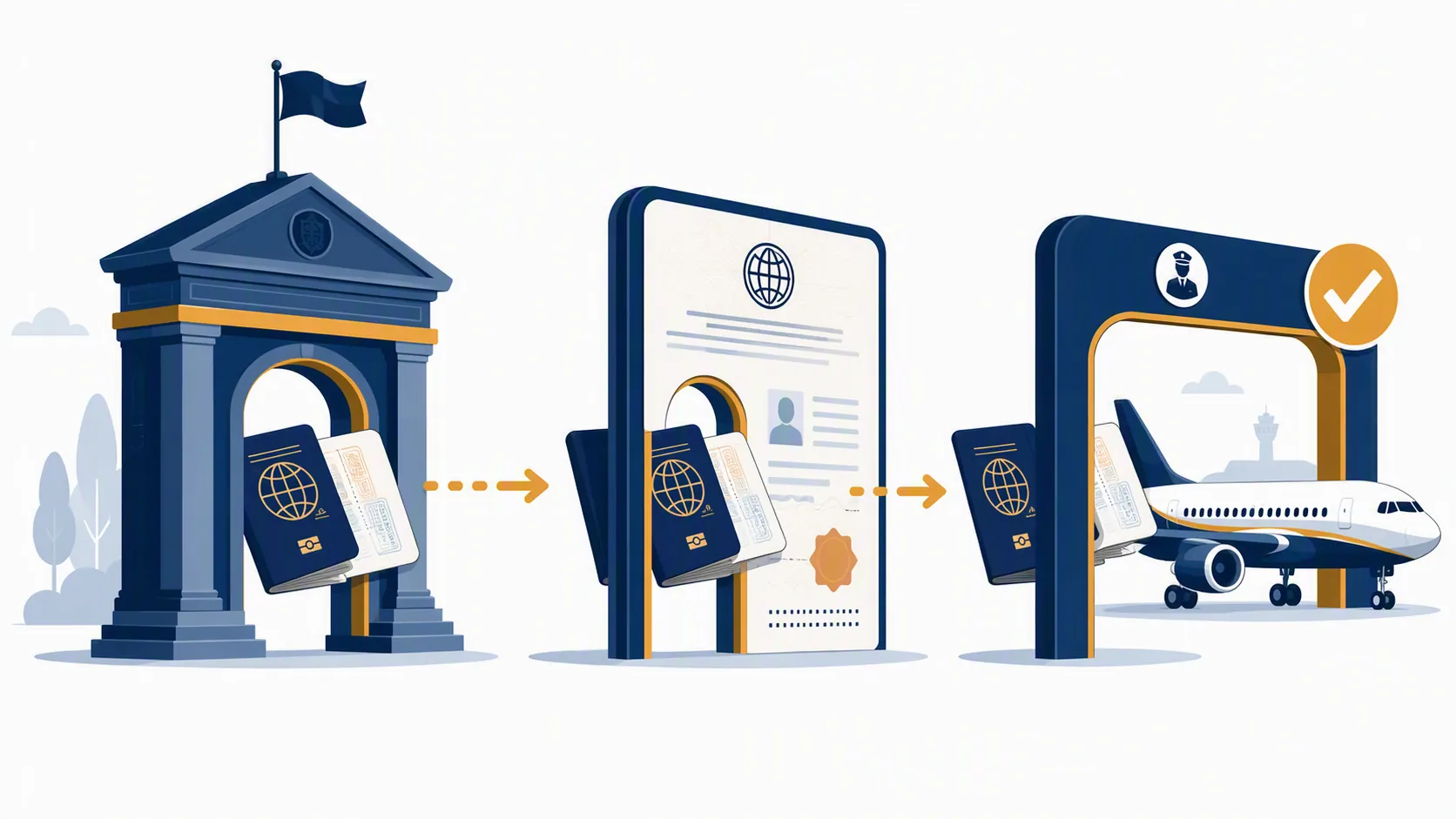
A traveler can satisfy the destination rule and still be stopped if the airline’s document check says the file is incomplete. That is why the final pre-departure layer is the carrier’s own document-check tool or a Timatic-backed verification.
IATA describes Timatic as a passenger-document compliance system used for more than 700 million passenger document checks per year, sourced from more than 2,000 government and airline officials and updated about 70 times per day. [4]
That does not make Timatic a substitute for law. It makes it the practical boarding layer. The destination authority tells you what the country requires. The State Department page tells you what the U.S. government is telling U.S. citizens about that country. Timatic, or the airline’s Timatic-fed system, tells you what the airline is likely to enforce at the counter for the exact routing, passport, transit points, stay length, and document set.
Run this check after booking and again near departure. Rules can change after a ticket is purchased. If the trip includes transit through a third country, do not check only the final destination; transit visa and airport-transfer rules can be the problem.
What a visa-free answer often leaves out
When a list, chatbot, or travel forum says a US passport is visa-free for a destination, the next task is to look for the conditions hidden behind the shortcut. Use this as a compact omission check, not as a substitute for the official sources above.
- Electronic travel authorizations: ESTA, UK ETA, K-ETA, and similar systems may be treated casually in summaries even when they are mandatory for boarding or entry.
- eVisa or online pre-clearance: some systems are called “visa-free” in informal lists even though an online approval must be obtained before travel.
- Tourist cards and arrival forms: the traveler may need to buy, complete, or upload a document before arrival or at the airport.
- Passport validity: many destinations require validity beyond the travel dates; the required period may differ by country.
- Blank passport pages: a traveler can have a valid passport and still lack enough blank pages for stamps or visas.
- Vaccination or health-document rules: these can be route-specific, outbreak-specific, or tied to recent travel through another country.
- Nationality, residence, and companion differences: a US passport answer may not apply to a dual national traveling on another passport, a non-U.S. spouse, a child, a lawful permanent resident, or a mixed-nationality team.
- Purpose and paid activity: tourism rules may not cover client work, filming, speaking, business development, installation, training, or remote work.
- Transit: a connection can trigger document requirements even when the final destination does not.
ESTA is the cleanest illustration of the gap between “no visa” and “no authorization.” The U.S. Department of Homeland Security describes the Visa Waiver Program as allowing eligible nationals of participating countries to travel to the United States for tourism or business for stays of 90 days or less without a visa, but ESTA authorization is still required. DHS listed 41 participating countries as of May 2, 2025, while noting Romania’s designation had been rescinded. [5]
That count is included here only to show why dated sourcing matters. Even where the word “visa-free” is accurate, the traveler may still need an authorization, and country counts can move when designations change.
Where AI answers fit—and where they stop

A chatbot can help at the beginning of the process. It can suggest that a destination may be visa-free, name possible authorization systems, or generate a checklist of questions to take to official sources. It should not be the source that decides whether a traveler boards.
The Caldass episode is the most concrete warning because the missing item was operational, not theoretical: no ESTA, no boarding, missed flight. [1][2] The same pattern appears in other reported 2025–2026 travel-advice failures, but those examples should be treated more cautiously because the available material is thinner.
Legal Indonesia reported a March 2025 case in which an Australian traveler allegedly received AI advice that Chile required no visa—an answer described as correct for 2019 but stale by 2025—and said the embassy process could take up to 20 days. The same page reported a June 2026 North Macedonia case in which a Russian family allegedly lost 50,000 rubles, about $700, after AI advice omitted a nationality-based documentation condition. [6]
Those two reports are useful as warning patterns: outdated policy and nationality-specific conditions. They are not strong enough, on the sources available here, to prove how often those failures occur. The correct response is not panic about every AI answer; it is a workflow that refuses to let a fluent summary displace dated primary-source verification.
The same discipline applies outside travel. In the site’s record on Hank Green and unverified ChatGPT research, the legal problem is not that someone used AI; it is that the output was not checked against sources capable of bearing the weight placed on it. And as the comparison of Claude vs. ChatGPT for legal work puts it, the safer result usually comes from the verification workflow, not from treating model choice as a control by itself.
Liability is not the same as making the flight
The Air Canada chatbot ruling is worth keeping in the background, but it should not become the center of a traveler’s risk plan. In Moffatt v. Air Canada, the British Columbia Civil Resolution Tribunal ordered Air Canada to pay CAD $812.02 after its chatbot gave a passenger incorrect bereavement-fare information. Tribunal Member Christopher Rivers wrote, “It makes no difference whether the information comes from a static page or a chatbot.” [7][8]
That is an operator-chatbot accountability case. It says something important about a company’s responsibility for information it gives customers through its own tool. It does not mean a traveler can rely on a general-purpose chatbot and expect someone else to absorb the loss at check-in. If ChatGPT, a forum, or an undated list is wrong, the immediate consequence still lands on the traveler standing at the counter.
For legal and operations teams, the lesson is familiar: accountability arguments after the fact are weaker than controls before the event. A travel SOP should require source names, access dates, screenshots, and airline-document confirmation for any international trip with meaningful consequences. The same habit appears in other verification checklists, including this site’s San Jose bicycle accident lawyer verification workflow: the point is not to collect impressive claims, but to identify which claim can be checked and relied on.
A defensible 2025 visa-free check
Before relying on any US passport visa-free countries list from 2025, reduce the claim to a specific itinerary: traveler nationality and passport, destination, transit points, purpose, stay length, departure date, and return or onward plan. Then verify the destination government rule, cross-check the U.S. State Department country page, and confirm the airline’s document-check result through Timatic or the carrier’s own system.
If all three layers agree, keep the dated record. If they conflict, do not resolve the conflict by choosing the answer that is easiest or most recent-looking. Escalate to the embassy, consulate, airline, or travel-document specialist before the ticket becomes a missed flight.
“Visa-free” is only the opening claim. The answer worth relying on is the one confirmed through dated official sources and airline document data before travel.
References
- Influencer Misses Flight After Trusting ChatGPT for Visa Advice, People.com
- ChatGPT gives wrong visa info, couple's vacation falls apart, VisasNews
- Visa requirements for U.S. citizens traveling abroad, USA.gov, March 25, 2026
- Timatic Solutions, IATA
- Visa Waiver Program, U.S. Department of Homeland Security
- When AI Gets Your Visa Wrong: Cases From 2025–2026, Legal Indonesia
- Airline held liable for its chatbot giving passenger bad advice, BBC Travel
- Moffatt v. Air Canada, British Columbia Civil Resolution Tribunal
Grounded in
This procedure is grounded in Travel.State.gov, independent of any single documented case. See the Regulation tracker for the governing text.
Cases this step would have prevented
No cases have been explicitly linked to this checklist yet. See Risk Digest for documented incidents generally.
← Back to WorkflowsReport a correction or tip
Spotted an outdated figure, a misstated fact, or a ruling this workflow checklist should reflect? Public comments are disabled for this content given the professional cost of a misreported case outcome, penalty amount, or rule text — use the structured correction channel instead.
Report a correction or tip for this record →