
How to Verify AI Research on Korean Lease Opposing Power
A step-by-step verification workflow for practitioners to check AI-generated citations to the Housing Lease Protection Act Article 3 opposing power doctrine, using the National Court Administration's three countermeasures to avoid ghost-precedent sanctions in Korean jeonse deposit recovery filings.
- Applicable role
- attorney
- Workflow stage
- pre-filing
- Primary source
- Housing Lease Protection Act Article 3
This is a verification-workflows resource, not legal advice; external sources were last verified on July 31, 2026. Start with the filing problem, not with the model. An AI-generated memo says a Korean tenant lost opposing power after moving out, changing resident registration, or failing to meet Housing Lease Protection Act Article 3 requirements. It cites Article 3, perhaps Article 3-2, and a few supposed Supreme Court decisions. Before that language goes into a jeonse deposit recovery complaint, answer, injunction paper, or client advice, the response procedure is a verification procedure: identify the exact statutory category, confirm the facts that perfect or defeat it, and prove that every cited authority exists and says what the memo claims.
That is not a stylistic preference. Korean courts are already dealing with AI-generated ghost precedents. In one reported Ulsan District Court incident, an attorney admitted using Google Gemini to look up precedents and said the content had not been properly reviewed.[1] Separate Korean incidents involving Daegu High Court and Gwangju have also been tracked in the public hallucinated-cases database, which listed four confirmed South Korean AI hallucination cases as of July 29, 2026.[2] None of the located sanction reports identifies an Article 3 opposing-power filing as the subject. The point is narrower and more practical: this doctrine is unusually easy to damage with a false case number, a mistranslated timing rule, or a category error.
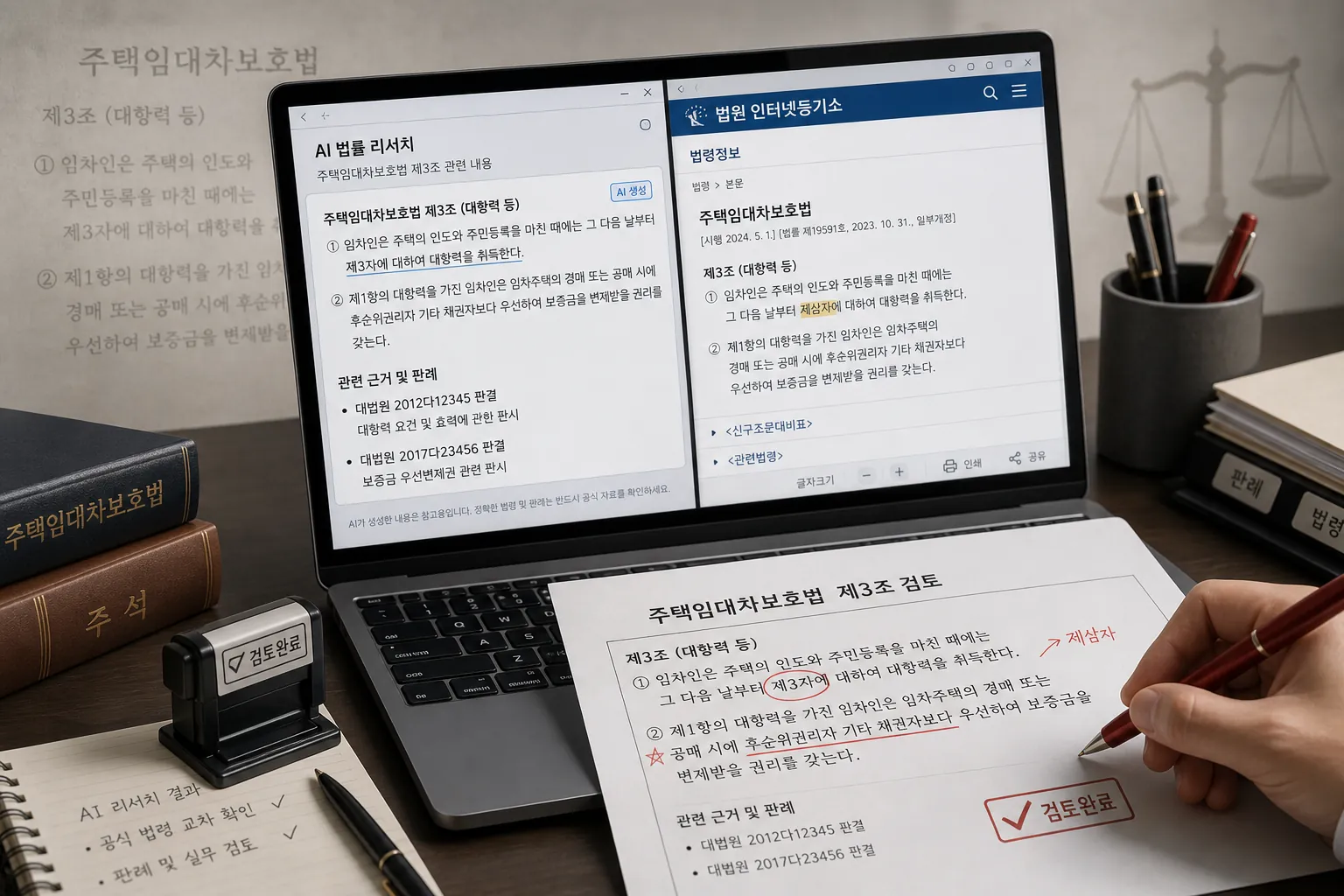
The minimum doctrine to verify before discussing loss
Article 3 opposing power is not perfected by a lease contract alone. The usual working formulation is delivery of the leased dwelling plus resident registration, with effect from the following day. Seoul Law Group summarizes the rule this way for English-language readers, and the statutory English text of the Housing Lease Protection Act likewise separates Article 3 opposing power from other lease-protection concepts.[3][4]
The “following day” detail deserves disproportionate attention. A memo that treats opposing power as effective immediately after move-in or registration may change the priority analysis against a purchaser, mortgagee, attachment creditor, or insolvency scenario. In a filing, that is not a harmless translation issue; it can change who is alleged to have taken subject to the lease.
| Question in the AI memo | What must be separated before filing |
|---|---|
| Did the tenant have opposing power against a third party? | Check Article 3 delivery of possession, resident registration, and the following-day effective time. |
| Did the tenant have priority repayment rights? | Do not treat this as the same issue. Article 3-2 introduces the fixed-date priority repayment analysis. |
| Did a purchaser or successor landlord assume the lessor position? | Check Article 3(4) separately. Lessor succession is not the same proposition as priority repayment or loss of opposing power. |
There is also no neat statutory checklist called an “opposing power loss response procedure.” The procedure depends on the factual reason the Article 3 requirements are missing or disputed. A voluntary move-out, a cancelled or changed resident registration, an incomplete move-in history, and a later sale of the property do not all call for the same pleading point. The safe filing response is to rebuild the chain: possession, registration, effective date, competing third-party event, fixed date if priority repayment is asserted, and succession facts if Article 3(4) is invoked.
Three AI errors that matter in Article 3 work
The most dangerous AI answer is often not absurd. It is the answer that gets the vocabulary right and then slides one element out of place. In Korean lease work, three patterns deserve a hard stop before filing.
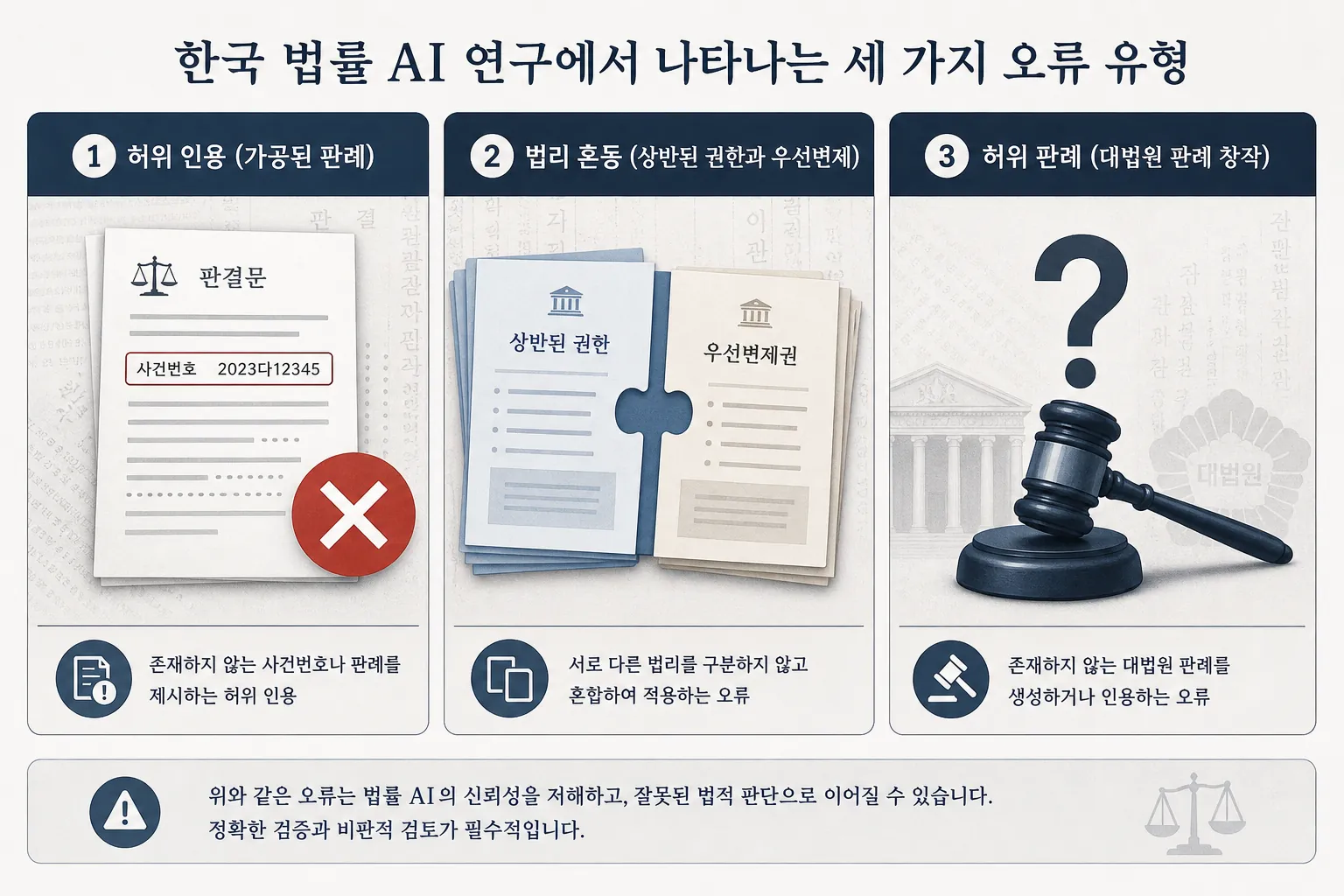
1. Fabricated or borrowed case numbers
A fake Korean case number can look normal to a cross-border team. It may have a court name, year, case type, and plausible sequencing. That is exactly why it must be checked as a case number before anyone spends time polishing the proposition it supposedly supports. The National Court Administration added a False Case Number Verification function to the Judicial Information Disclosure Portal in February 2026, and reporting states that the portal lets users check whether cited case numbers exist and view 900- to 1,000-character judgment previews before payment.[5]
If the number does not exist, the citation dies there. Do not replace it with a nearby-looking decision unless the replacement has been independently found, read, and matched to the proposition. A ghost precedent is not cured by a real citation that proves something adjacent.
2. Doctrinal conflation
The second failure is quieter: the memo treats Article 3 opposing power, Article 3-2 priority repayment, and Article 3(4) lessor succession as if they are interchangeable. They are not. The English statutory text places these concepts in separate provisions, and each one answers a different litigation question.[4]
This matters when the pleading asks for recovery of a jeonse deposit from a successor owner or when a tenant is trying to preserve a priority position against other creditors. A tenant may have a strong contract claim and still face a separate problem proving enforceability against a third party. A tenant may have opposing power and still need to prove the fixed-date element for priority repayment. A purchaser may become a successor lessor under Article 3(4), but that does not automatically answer every priority question.
3. Invented Supreme Court propositions about timing
The third failure is the most tempting to leave alone because it sounds like legal research: “The Supreme Court has held that opposing power is lost immediately upon move-out,” or “registration changes do not affect opposing power if the lease remains economically continuous.” The problem is not that either sentence is impossible in every factual setting. The problem is that a filing cannot rely on an uncited generalization when the statutory trigger is already timing-sensitive.
For Article 3, the cited judgment language matters more than the AI’s English gloss. The proposition must be matched to the Korean text of the decision, the facts of possession and resident registration, and the procedural posture in which the court discussed those facts. If the AI gives only an English paraphrase, that is a research lead, not authority.
The pre-filing verification chain
The National Court Administration’s response to AI hallucinations gives practitioners a workable sequence. It is not enough to ask the same AI tool whether its own citations are real. The check has to move outside the generated memo.
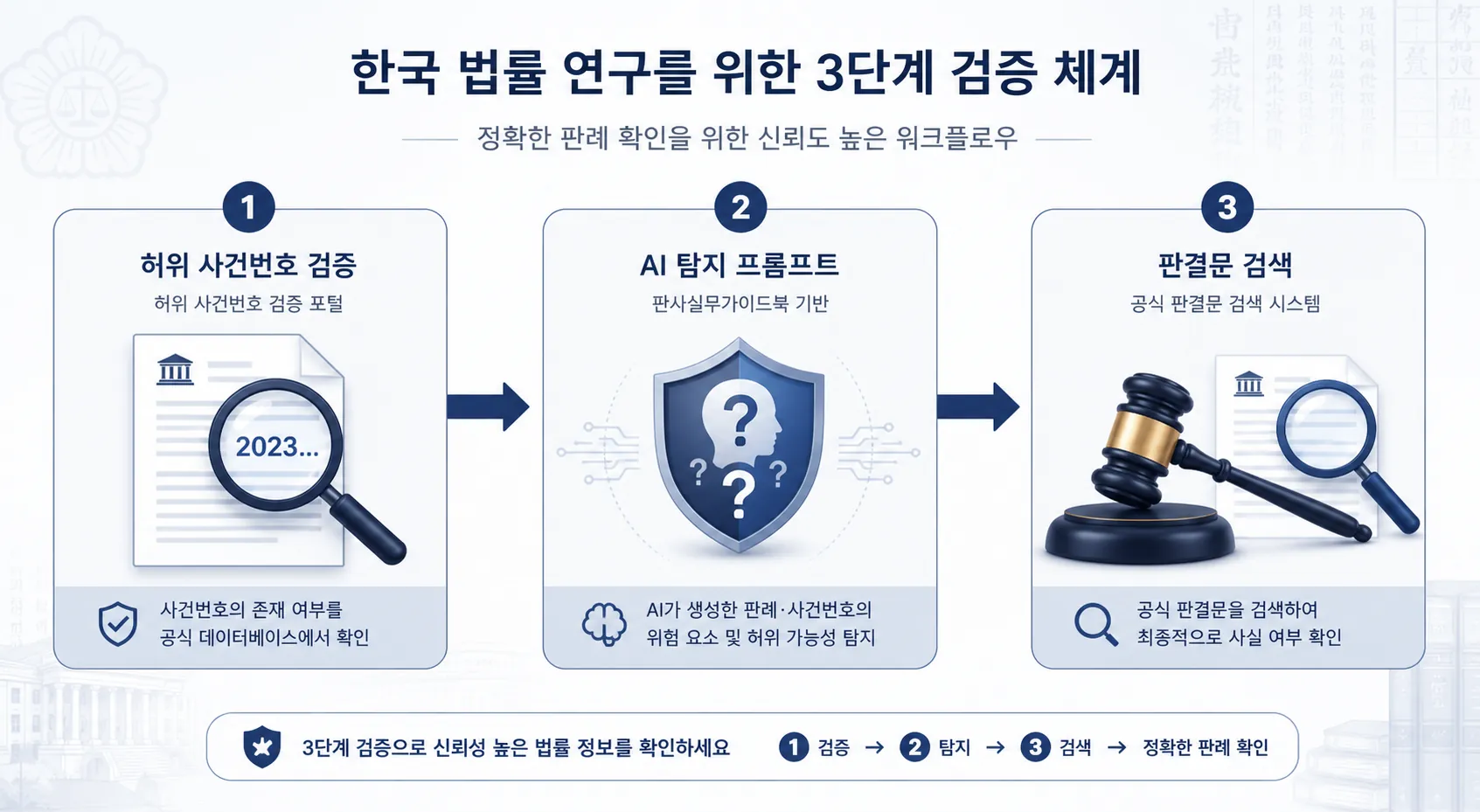
| Step | Action | Do not proceed until |
|---|---|---|
| 1 | Run every cited Korean case number through the False Case Number Verification portal. | The case number exists, and the preview or judgment record matches the court, date, and subject area claimed. |
| 2 | Use adversarial AI-detection prompts modeled on the judicial guidebook. | The memo has survived targeted questions about fabricated precedents, unsupported statutory propositions, and missing Korean text. |
| 3 | Search for real judgments and compare the AI proposition against the actual language. | The filing proposition is supported by judgment text, not merely by the AI’s summary. |
| 4 | Record the verification trail. | The file identifies the statute, doctrinal category, case number check, judgment source, and date of verification. |
Step 1: Verify the case number before the doctrine
Take the AI memo’s authorities one by one. For each Korean decision, record the cited court, case number, decision date, and proposition. Then check whether the case number exists through the court portal function reported by Chosun Ilbo. The same reporting states that Korean courts have imposed costs for AI-generated fake precedents and that the court system introduced the verification portal in February 2026.[5]
- If the number does not exist, remove the citation and treat any linked proposition as unverified.
- If the number exists but the preview concerns a different legal field, do not cite it for Article 3.
- If the case exists but the AI’s proposition is broader than the preview supports, obtain and read the judgment before using it.
- If the memo cites only a case name or an English description, require a Korean case number or a retrievable primary source.
This step should happen before translation polishing. A well-translated fake citation is still a fake citation, and it is more likely to survive internal review because it looks professional.
Step 2: Run the memo against fabricated-precedent prompts
The Korean courts’ AI guidebook for judges reportedly contains 20 practical use cases across civil, criminal, administrative, and intellectual-property matters and includes prompts for detecting fabricated precedents.[6] A practitioner does not need to pretend to be a judge to use the same discipline: ask targeted, hostile questions of the memo before the other side or the court does.
- Ask whether each cited decision can be independently retrieved from a court or recognized legal database.
- Ask which sentence in the judgment supports the claimed Article 3 proposition.
- Ask whether the memo has confused opposing power, fixed-date priority repayment, and lessor succession.
- Ask whether the effective date is stated as immediate or as the following day, and require a statutory or judgment source for the wording.
- Ask whether any authority is only an English-language secondary summary rather than Korean statutory or judgment text.
This is also where the responsible reviewer should mark the memo’s trust status. A draft can say “AI-assisted research lead; citations not yet verified.” It should not be converted into advice saying the issue is settled unless the next step confirms the actual authority.
Step 3: Search judgments for the real proposition
After fake-number screening and adversarial prompting, search for real judgments that address the specific fact pattern: move-out, resident-registration cancellation or transfer, later purchaser, competing creditor, auction, or landlord insolvency. The proposition to search is not “tenant opposing power loss response procedure korea” in the abstract. It is the narrower sentence the filing needs to prove.
The National Court Administration has also announced an intelligent judgment search system for jeonse disputes, including natural-language queries such as a landlord saying there is no money, but that system should not be described as already operational. The ChosunBiz report describes it as announced on June 9, 2026, with an ISP budget request for 2027, and notes that the NCA itself says human verification is still required.[7]
That caveat belongs in the work product. If a research memo mentions the intelligent jeonse search system, it should say whether it was actually used, whether it was available at the time, and whether the result was independently verified. A planned search tool is not a source of law, and an operational search tool would still not replace judgment reading.
Step 4: Build the filing record around verified elements
Once the authorities survive the first three checks, the pleading or advice should be organized around the verified elements rather than around the AI memo’s narrative. For a tenant asserting continuing protection, identify delivery, registration, following-day effect, the relevant third-party event, fixed date if priority repayment is claimed, and any Article 3(4) succession facts. For a defendant challenging opposing power, identify exactly which element failed, when it failed, and why that failure matters against the particular third party.
- Statute checked: Article 3, Article 3-2, or Article 3(4), with the relevant Korean wording reviewed.
- Facts checked: possession delivery, resident registration, fixed date, transfer or sale, and timing of any move-out or registration change.
- Authority checked: every case number exists and every proposition is tied to judgment text.
- Tool status checked: any court search or AI tool is identified as operational, planned, or merely reported.
- Last verified: record the date of the statutory, case-number, and judgment-text checks.
Sanctions risk is real, but the Article 3 link must be stated carefully
The Korean AI-citation incidents are enough to justify a mandatory verification workflow. They are not enough to say that Korean courts have already sanctioned a lawyer for hallucinated Article 3 opposing-power authority. The Korea Herald report describes ghost-case incidents in Korean courtrooms, including the Ulsan episode, and the public database records confirmed South Korean hallucination matters, but the located materials do not isolate an opposing-power lease filing as the sanctioned event.[1][2]
The court-system response is nevertheless pointed. Chosun Ilbo reported that a task force proposed amending the Civil Procedure Act to impose monetary penalties for citing false statutes and amending the Civil Procedure Rules to require mandatory AI-use disclosure to the court.[5] Those are reported proposals, not a license to write that every Korean civil filing already carries an AI-disclosure obligation. The operational fact available now from that report is the case-number verification portal; the proposed penalties and disclosure rules should be tracked before filing.
The Charlotin database’s four confirmed South Korean cases should also be read as a floor, not a national rate. Reporting lags and the very small share of Korean decisions publicly disclosed make undercounting plausible, but they do not turn four identified matters into a statistically reliable pattern for every court or every subject area.
What a usable response procedure looks like in practice
Suppose the AI memo says: “The tenant lost opposing power when she temporarily changed resident registration, and the Supreme Court has consistently held that the landlord’s purchaser is not bound.” Treat that as a hypothesis. Do not cite it. Break it into filing questions.
- Which Article 3 requirement is allegedly missing: possession, resident registration, or effective timing?
- When did the relevant competing third-party event occur?
- Is the filing also asserting Article 3-2 priority repayment, and if so, where is the fixed date in the evidence?
- Is the opposing party relying on Article 3(4) succession, and what sale or transfer fact triggers that argument?
- Do the cited Supreme Court case numbers exist, and does the judgment language actually address the registration-change fact pattern?
Only after those questions are answered should the practitioner decide the litigation move: amend the pleading to assert the correct statutory category, remove an unsupported priority allegation, distinguish a purchaser-succession case, seek additional resident-registration evidence, or advise that the AI proposition cannot be used. The procedure is not glamorous, but it is the part that prevents an AI first pass from becoming someone else’s emergency correction.
AI can still be useful at the start. It can surface Article 3, suggest that resident registration matters, flag a possible fixed-date issue, and remind a foreign team that a purchaser may enter the story. Its role should end where filing authority begins. No Korean lease opposing-power argument should be filed until the statutory article, doctrinal category, case number, judgment text, and deployment status of any court search tool have each been independently verified and documented.
References
- AI ghost cases haunt S. Korean courtrooms, The Korea Herald, June 14, 2026.
- Hallucinations, Damien Charlotin.
- The Opposing Power of a Leasehold in Korea, Seoul Law Group.
- Housing Lease Protection Act, Korea Legislation Research Institute / Korean Law Information Center.
- Courts Impose Costs for AI-Generated Fake Precedents, Chosun Ilbo, March 31, 2026.
- Korean Courts Publish AI Guidebook for Judges, Seoul Economic Daily, February 24, 2026.
- ChosunBiz report on intelligent judgment search system for jeonse disputes, ChosunBiz, June 9, 2026.
Grounded in
This procedure is grounded in Housing Lease Protection Act Article 3, independent of any single documented case. See the Regulation tracker for the governing text.
Cases this step would have prevented
No cases have been explicitly linked to this checklist yet. See Risk Digest for documented incidents generally.
← Back to WorkflowsReport a correction or tip
Spotted an outdated figure, a misstated fact, or a ruling this workflow checklist should reflect? Public comments are disabled for this content given the professional cost of a misreported case outcome, penalty amount, or rule text — use the structured correction channel instead.
Report a correction or tip for this record →