
How to Verify Air Travel Safety for Noncitizen Clients
A step-by-step workflow for immigration attorneys to assess whether a noncitizen client can safely fly, based on six database and document checks grounded in current ICE arrest patterns and verified sources.
- Applicable role
- attorney
- Workflow stage
- review
- Primary source
- NILC Community Alert, July 8, 2026
The client’s question usually arrives too late: “Can I fly next week?” By then there may already be a funeral, a work assignment, a family emergency, or a paid ticket. The answer cannot start with “usually.” For a noncitizen client in 2026, responsible immigration lawyer advice on air travel and ICE arrest risk starts before booking and does not become an answer until the record has been checked.
The reason is no longer theoretical. Reuters reported in April 2026 that TSA had shared more than 31,000 traveler records with ICE since January 2025, leading to more than 800 arrests.[1] CNN then reported on July 28, 2026 that immigration attorneys were seeing a sharp increase in ICE airport arrests, including cases involving people with expired parole, pending applications, or documents they believed were enough to travel.[2] That does not mean every noncitizen client will be stopped. It means domestic air travel can no longer be treated as a low-friction identity check divorced from immigration enforcement.

A defensible answer requires six checks, in sequence: EOIR database, current status validity, criminal history, pending applications, travel documentation, and attorney record-keeping. The order matters because each step can change the advice before the next document is even useful.
Start With The Record, Not The Client’s Label
Clients often describe themselves by the paper they remember: “I have DACA,” “I have asylum pending,” “I have parole,” “I have a work permit,” “I have a green card.” Those statements may be true and still incomplete. The pre-flight question is narrower: what do government records show today, and does any record expose the client to detention if immigration enforcement sees it during airport screening?
The National Immigration Law Center’s July 8, 2026 community alert is the most practical starting point because it ties airport arrest risk to verifiable categories and gives a safe way to check EOIR records. NILC instructs people to search the EOIR Automated Case Information System or call 1-800-898-7180 with the person’s A-number, and states that using those tools does not alert DHS.[3]
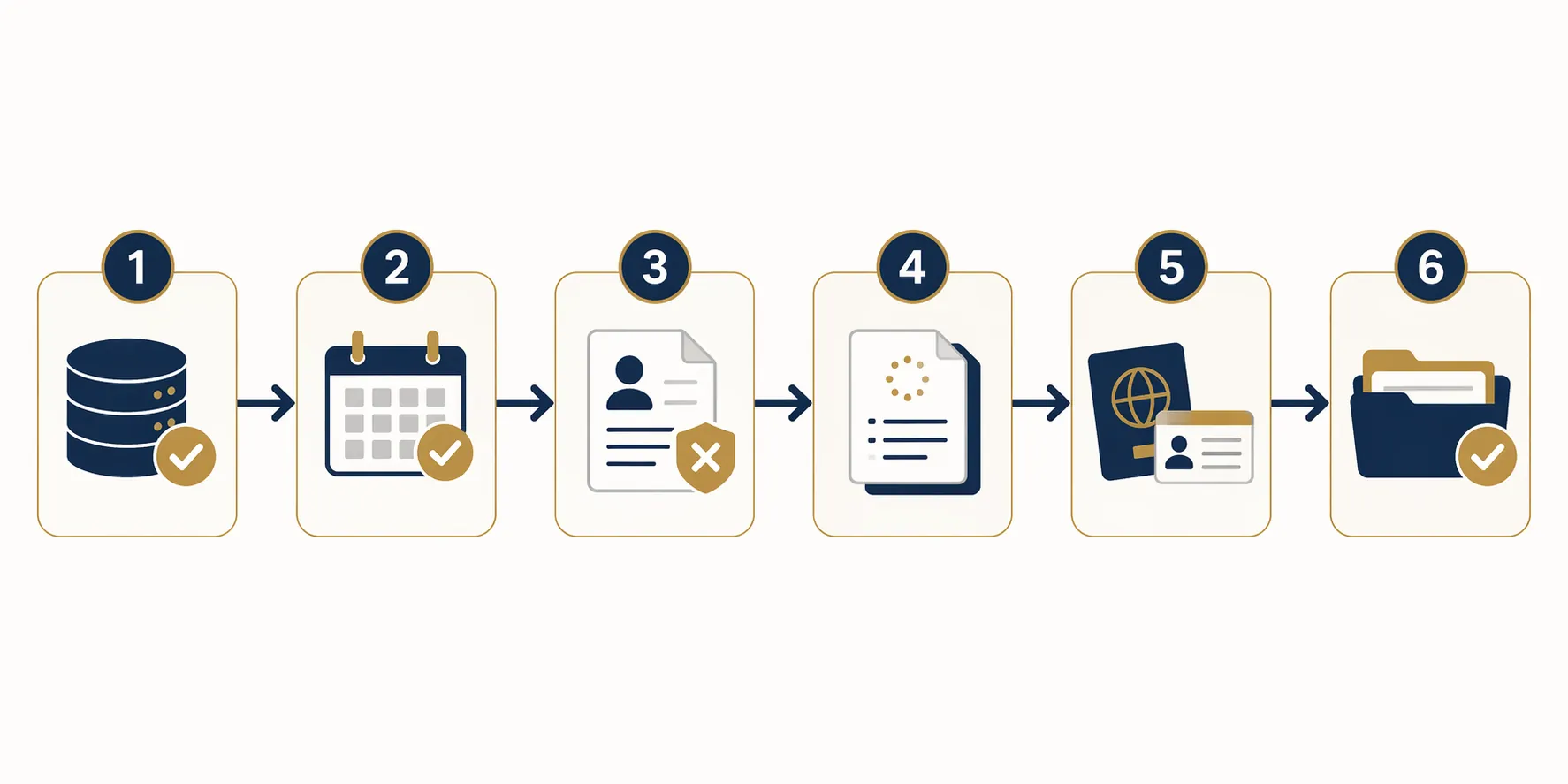
| Sequence | Verification point | What the lawyer is trying to rule in or out |
|---|---|---|
| 1 | EOIR database check | Prior removal order, in absentia order, or open removal proceedings |
| 2 | Status-validity check | Expired TPS, parole, or other time-limited protection |
| 3 | Criminal-history scan | Immigration consequences from arrests, pleas, convictions, or unresolved cases |
| 4 | Pending-application assessment | Mistaking a receipt notice or work authorization for lawful status |
| 5 | Client documentation plan | What the client can physically present and whom the client can reach |
| 6 | Attorney record-keeping | A dated basis for the advice and the limits of the risk assessment |
Step 1: Check EOIR Before Discussing The Ticket
The first check is not the passport. It is not the boarding pass. It is the A-number. Search EOIR’s Automated Case Information System at acis.eoir.justice.gov or call 1-800-898-7180 and check whether the client has removal proceedings, a removal order, an in absentia order, or any history the client does not understand. NILC specifically identifies the EOIR database and hotline as verification tools and says the check itself does not notify DHS.[3]
A prior removal order belongs in the highest risk tier for air travel. It may be old. It may have been entered when the client was a child. It may be attached to an A-number the client has not used in years. None of that makes it disappear at an airport. If EOIR shows a final order, the advice cannot be softened by a valid state ID, a pending filing, or the fact that the client has flown before without incident.
This is also where the lawyer should slow down when the client says, “I never went to court.” That may mean there was no case. It may also mean the client never received notice, moved as a child, used a different address, or does not recognize the name of the immigration court. The database result should be saved or otherwise documented with the date checked, because the later advice depends on this first branch.
Step 2: Verify That The Status Still Exists
The second check is current validity, not historical eligibility. TPS, CHNV parole, Uniting for Ukraine parole, family reunification parole, and similar time-limited protections need end dates. July 2026 reporting specifically flags that many programs ended January 14, 2026, making stale parole or expired protection a concrete airport-risk problem rather than a paperwork technicality.[2]
CNN’s reporting on Iryna Gorb is useful here because it illustrates the category without turning it into a universal rule. Her case was tied to expired TPS or parole, and it shows why a client who once had permission to be in the United States may still be exposed if that permission has ended by the time of travel.[2] The relevant lesson is not that every person with a complicated parole history will be arrested. The lesson is that “had parole” and “has parole today” are different answers.
For this step, the file should show the document reviewed and the expiration date relied on. If the client has an online account, approval notice, I-94, EAD, parole document, or TPS approval, the lawyer should compare the dates rather than accepting the client’s summary. If a benefit was extended by a public announcement or litigation order, the authority for the extension should be identified in the file. A screenshot without legal context can be as misleading as no screenshot at all.
Step 3: Run The Criminal-History Question Through Immigration Law
The third check is criminal history, but it cannot be handled as a casual intake question. Immigration law can treat dispositions as convictions even when the client was told something different in criminal court. A dismissed case, diversion program, old plea, probationary sentence, or sealed record may still matter depending on the statute, disposition, sentence, and immigration category.
NILC’s alert identifies criminal history as one of the risk factors in airport arrest situations.[3] That supports a narrower conclusion: the existence of a criminal record can elevate travel risk and should be reviewed before the lawyer gives air-travel advice. It does not support pretending that the public sources reveal ICE’s full targeting logic.
At minimum, the lawyer should ask for the client’s full criminal-history disclosure, any RAP sheet already available, court dockets, complaint or indictment, plea documents, sentencing order, and proof of completion. If time is short, the advice may need to say that the criminal-history check is incomplete and that the travel risk cannot be responsibly downgraded until the missing records are reviewed.
Step 4: Separate Pending Applications From Lawful Status
This is the point where many client-facing explanations become dangerous. A pending asylum application, green card application, change-of-status request, or employment authorization renewal may be important. It may give the client a filing history, a receipt number, or an argument against immediate removal in some contexts. It does not automatically mean the client has lawful status.
CNN’s reporting on Chantal Morales Rojas makes the distinction explicit. In that case, DHS confirmed that receipt notices do not constitute status.[2] That statement is blunt, and it should be treated as a drafting constraint for travel advice: a receipt notice is evidence that something was filed, not proof that the client is insulated from immigration enforcement at an airport.
The same caution applies to work authorization. An EAD may be valid for employment and still not answer the status question by itself. The lawyer should identify what the pending application is, what legal period of stay or protection it does or does not create, whether any unlawful-presence or removal-order issue remains, and whether the client is relying on a document that airport officers may not treat as permission to remain.
DACA deserves the same discipline. NILC’s alert includes the example of Catalina Santiago, a DACA recipient detained in August 2025, underscoring that DACA should not be described as a guarantee against airport detention.[3] That does not mean every DACA recipient faces the same risk. It means DACA is not the end of the inquiry.
Step 5: Build A Travel Document Packet That Matches The Advice
Documentation does not cure a bad record, but poor documentation can make a manageable encounter worse. Once the first four checks are complete, the lawyer can decide what the client should carry and what the firm should be ready to send if the client is detained or questioned.
- Valid passport or other identity document appropriate to the trip.
- Current I-94, if relevant, with the date verified against the government record.
- Current EAD, parole document, TPS approval, green card, or approval notice, if applicable.
- Copies of receipt notices only with a clear warning that receipts are not status by themselves.
- Signed privacy releases or representation forms that allow the firm to respond quickly.
- Emergency contact instructions for the client, a family member, and the law firm.
For international travel, the packet also has to account for admissibility on return, advance parole where required, visa validity, possible abandonment issues, and any criminal or removal-order consequences at reentry. This six-check process is aimed at pre-flight risk verification, including domestic airport exposure, but the same first principle applies more strongly to international travel: the lawyer should not answer from the document the client likes best.
Step 6: Record The Risk Tier And The Limits Of The Answer
The final step is the lawyer’s record. The file should show what was checked, when it was checked, what result was found, what risk tier was assigned, what advice was given, and what the client decided. This is not defensive paperwork for its own sake. It is the only way to reconstruct the advice if the client is later detained, misses a hearing, loses documents, or says the risk was not explained.
| Risk tier | Record result | Practical effect on advice |
|---|---|---|
| Tier 1 | Removal order, in absentia order, or unresolved EOIR danger signal | Do not treat air travel as routine; address the immigration record before travel advice is finalized. |
| Tier 2 | Expired parole, TPS, or other time-limited protection | Do not rely on old approval documents; verify whether any current lawful basis remains. |
| Tier 3 | Pending application without current lawful status | Explain that receipts and pending filings do not by themselves make travel safe. |
| Tier 4 | Lawful permanent resident, DACA, or other documented category with complicating facts | Do not give blanket reassurance; check criminal, travel, and immigration history before downgrading risk. |
The fourth tier is important because lawful documents can create false comfort. NPR reported on Fabian Schmidt, a green card holder detained in March 2025 after travel abroad.[4] That case does not mean lawful permanent residents should be treated as categorically unable to travel. It does mean a green card is not a substitute for reviewing criminal history, abandonment issues, prior immigration encounters, and inspection risk.
Regional reporting points in the same direction without changing the workflow. KQED reported in July 2026 that Bay Area immigrant advocates were warning noncitizens to avoid air travel after airport arrests involving local clients.[5] That is useful confirmation that the issue is not confined to one national article or one airport anecdote. It is not, by itself, a complete map of where enforcement is happening.
What The Workflow Cannot Promise
No public workflow can predict every airport screening outcome. ICE’s internal targeting criteria are not public. DHS has also declined to confirm full deployment locations in some reporting contexts, citing operational security, and airport lists can become stale quickly. A lawyer can verify records, identify known risk categories, and document advice. The lawyer cannot certify that a client will not be questioned or detained.
That limit should be part of the advice, not a footnote. A completed workflow may produce a relatively lower-risk recommendation, a high-risk warning, or a refusal to give a travel-clearance answer because records are missing. What it should not produce is casual reassurance based on the client having “papers.”
The defensible work product ends with a dated file note: EOIR checked, status validity reviewed, criminal history assessed to the extent records allowed, pending applications classified correctly, client documents identified, emergency plan set, risk tier assigned, advice given, and uncertainty disclosed.
References
- ICE arrested more than 800 people after tips from US airport security agency, Reuters, April 7, 2026.
- ICE airport arrests, CNN, July 28, 2026.
- Community Alert: Immigration Arrests at Airports, National Immigration Law Center, updated July 8, 2026.
- Green card holders travel abroad, NPR, March 29, 2025.
- Bay Area immigrant advocates warn noncitizens to avoid air travel after ICE arrests, KQED, July 2026.
Grounded in
This procedure is grounded in NILC Community Alert, July 8, 2026, independent of any single documented case. See the Regulation tracker for the governing text.
Cases this step would have prevented
No cases have been explicitly linked to this checklist yet. See Risk Digest for documented incidents generally.
← Back to WorkflowsReport a correction or tip
Spotted an outdated figure, a misstated fact, or a ruling this workflow checklist should reflect? Public comments are disabled for this content given the professional cost of a misreported case outcome, penalty amount, or rule text — use the structured correction channel instead.
Report a correction or tip for this record →