
How to Verify Domestic Violence Lawyer Costs and Fees
Published averages for domestic violence lawyer fees are unverified survey and marketing figures. The costs that actually bind are statutory court fees, the written fee agreement under ABA Model Rule 1.5, and state fee-arbitration programs — all verifiable from primary sources rather than an AI chatbot.
- Applicable role
- pro se litigant
- Workflow stage
- pre-filing
- Primary source
- ABA Model Rule 1.5
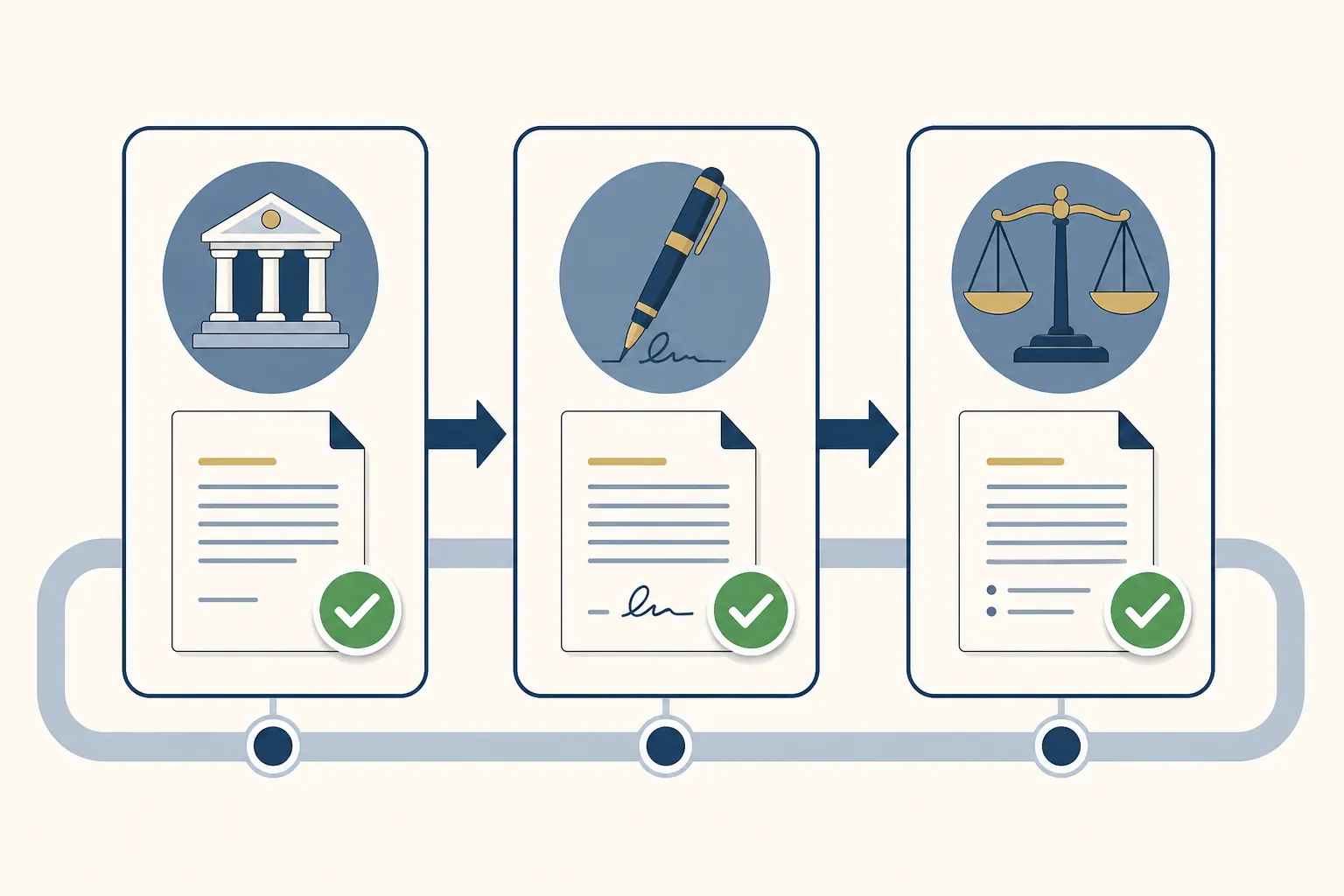
The safest answer to “how much do domestic violence lawyer costs and fees run?” is not a national average. It is a verification sequence. First, separate court costs from lawyer fees. Second, separate a lawyer’s advertised or spoken quote from the written fee terms that will actually govern the representation. Third, if the bill later exceeds those terms, identify the state fee-dispute process before the dispute becomes a shouting match over memory, screenshots, and invoice labels.
That order matters because protection-order access and private legal representation are often collapsed into one frightening price question. They are not the same cost category. A filing fee set by a court or statute can be verified from a public source. A private lawyer’s hourly rate, retainer, flat fee, or litigation budget must be verified from the lawyer’s fee agreement. A market estimate on a cost-guide page does neither.
Start With Court Costs, Not Lawyer Prices
If the immediate task is filing for a protection order, the first cost question is usually administrative: filing, service, copies, certification, and any fee waiver form. Those figures should come from the court system, a statute, or a judicial-branch self-help page. They should not come from a chatbot, a lawyer directory, or a law firm’s “how much does it cost?” article.
Arizona is a clean example of the right source type. ArizonaCourtHelp states that there is no fee to file a protective order and no fee to have it served by law enforcement.[1] Colorado is also useful because it shows why the exact legal source matters. Colorado’s judicial self-help materials describe a general $95 fee for filing certain civil protection order matters, while also explaining that the fee is waived for domestic violence, sexual assault, and stalking petitioners.[2] Colorado then changed the baseline further through HB24-1122, effective January 1, 2025, which prohibits courts from assessing costs or fees, including attorney fees, against a protection-order petitioner.[3]
Other states also publish no-fee protection-order rules through court or statutory sources. Texas, Georgia, North Carolina, Tennessee, Maryland, and Florida are among the states where the no-fee protection-order filing or service rule should be checked from the state court or statute before anyone assumes that courthouse access requires the same budget as hiring private counsel.[4][5][6][7][8][9]
The practical point is narrow but important: “I need protection” and “I need to hire a lawyer” may both be true, but they do not create one blended price. A petitioner may be able to file without paying a court filing or service fee, while still facing separate questions about legal advice, hearing preparation, related family-court proceedings, criminal exposure, or enforcement. A respondent may face different stakes and may need counsel urgently, but the court’s filing-fee rule still has to be verified from the court source rather than guessed from a private-lawyer price page.
| Cost Question | Best Source | What To Save |
|---|---|---|
| Is there a fee to file for a protection order? | State court, statute, or judicial-branch self-help page | The current fee schedule, statute, or self-help page URL |
| Is service free? | Sheriff, law enforcement, court rule, or state court page | The service-fee rule and any exception language |
| Is there a waiver? | Court fee-waiver form or statute | The form, eligibility rule, and filing instructions |
| Can costs be assessed against the petitioner? | Statute or court rule | The exact statutory text or court rule |
Treat Published Lawyer Fee Ranges as Leads, Not Proof
Private-lawyer prices are harder to verify because they are not public rates. They vary by lawyer, location, matter type, scope, billing model, urgency, and what the lawyer is actually being asked to do. That does not mean every number is useless. It means a number has to be labeled for what it is.
Some cost pages report market figures. Lawful’s 2026 domestic violence lawyer cost guide lists $150 to $500 per hour and $3,500 to $20,000 for flat fees or retainers.[10] Individual firm pages publish their own ranges, such as $3,000 to $10,000-plus on one criminal-defense pricing page and $2,500 to $15,000-plus on another.[11][12] Those are advertising or guide figures, not a rate sheet binding a lawyer who has not signed an agreement with the client.
Thumbtack figures require even more caution. Reported snippets and secondary pages attribute to Thumbtack 2025 survey data a $250 to $300 hourly range and typical bills of $795 to $2,460. The underlying Thumbtack page is JavaScript-gated, and the figures are visible through snippets or pages quoting the dataset rather than a fully reviewable methodology. That makes the number a reported market estimate, not a verified cost fact.[13]
A person can use those figures to prepare better questions. They should not use them to decide what a judge will charge, what a lawyer must charge, or what a final bill will be. The only lawyer-fee document that can do serious work is the engagement letter or fee agreement.
The Fee Agreement Is Where the Quote Becomes Checkable
ABA Model Rule 1.5 requires the lawyer to communicate the basis or rate of the fee and expenses for which the client will be responsible, preferably in writing, before or within a reasonable time after the representation begins.[14] State versions of the rule may vary in wording or administration, but the core verification move is the same: do not rely on a phone quote, intake-screen estimate, or web range when the written fee terms say something narrower, broader, or conditional.
For a domestic violence matter, the scope language is often where the real price question sits. A lawyer may be agreeing only to prepare for one protection-order hearing. Another agreement may include related custody issues, criminal-court appearances, negotiations with prosecutors, evidence review, subpoenas, post-order enforcement, or appeal work. A “retainer” may be an advance deposit billed against hourly time, a flat fee earned under stated conditions, or some other arrangement allowed under the governing state rules. Those are not details to clean up later; they are the cost terms.
- The fee basis or rate: hourly, flat, hybrid, limited-scope, or another permitted structure.
- The scope of work: which hearings, filings, negotiations, or related matters are included.
- The retainer treatment: advance deposit, flat fee, trust accounting, refund conditions, and replenishment requirements.
- Billing intervals: when invoices are sent, how time is recorded, and when payment is due.
- Expenses: filing charges, service charges, investigators, experts, transcripts, travel, copies, and electronic-service costs.
- Additional-charge triggers: trial setting, emergency motions, criminal complications, contested custody issues, continuances, appeal work, or enforcement proceedings.
The question to ask is not “What is the average domestic violence lawyer cost?” The better question is: “Where, in this agreement, does it say what I am paying for, what is excluded, when the lawyer may charge more, and what happens to unused funds?” If the answer is not in the document, the client has not yet verified the fee.
Do Not Let AI Fill the Missing Price Terms
AI tools are an especially bad fit for this particular cost question because the answer depends on jurisdiction, current fee schedules, state-specific protection-order rules, and the private terms of an engagement letter the tool has not seen. A chatbot can produce a confident number without knowing whether the user is asking about a filing fee, a service fee, a criminal-defense retainer, a civil protection-order hearing, or a later fee dispute.
The reliability problem is not theoretical. Stanford RegLab and Stanford HAI reported that general-purpose chatbots hallucinated on 58% to 82% of legal queries in their benchmark, while legal-specific tools hallucinated on 17% to 34% or more.[15] In a fee-request dispute in JG v. New York City Department of Education, Judge Paul Engelmayer awarded about $53,000 of roughly $113,000 requested and criticized reliance on ChatGPT as “misbegotten at the jump” and “utterly and unusually unpersuasive,” barring ChatGPT references in future fee requests absent “a paradigm shift in the reliability of this tool.”[16]
The verification gate is simple. If an AI tool says a protection order filing costs a certain amount, it needs to point to the current court fee schedule, statute, or judicial-branch page. If it says a lawyer “usually” charges a certain amount, it has not verified what any particular lawyer will charge. If it summarizes a fee-arbitration program, it needs to point to the state bar or court program page. Anything else is a lead to check, not a fact to rely on.

If the Bill Is Disputed, Check the State Fee-Arbitration Path
A fee dispute should not begin and end with “that seems too high.” The useful comparison is between the bill and the governing fee agreement, billing records, expense terms, trust-account treatment, and any required state notices. Many states route lawyer-fee disputes through bar or court fee-arbitration programs, and the forum, deadline, filing cost, and mandatory-or-voluntary status differ by state.
California, for example, operates a Mandatory Fee Arbitration program for attorney-client fee disputes.[17] Arizona’s State Bar describes a free fee-arbitration program for disputes over $1,000.[18] Oregon publishes filing fees of $300 or $400 depending on the amount in dispute.[19] North Carolina and Nevada describe no-cost fee-dispute programs through their state bar channels.[20][21]
Those examples are not interchangeable. A California client should not rely on an Oregon filing-fee figure. An Arizona client should not assume Nevada’s process applies. The verification step is to find the state bar or court program for the jurisdiction that governed the representation, then check eligibility, deadlines, required forms, filing cost, and whether the lawyer must participate.
| If the Number Is... | Verify It From... | Do Not Treat As Verified... |
|---|---|---|
| A filing or service fee | Court fee schedule, statute, sheriff page, or judicial-branch self-help page | A chatbot answer or private cost guide |
| A lawyer hourly rate, retainer, or flat fee | The written engagement letter or fee agreement | A national average, directory estimate, or intake call alone |
| An expense charge | The fee agreement and invoice backup | A generic statement that litigation is expensive |
| A disputed bill | The state fee-arbitration program and the signed fee terms | Another state’s bar program or an AI summary |
That is the repeatable test. If the cost is a court fee, verify it from the court or statute. If it is a lawyer fee, verify it from the written fee agreement. If it is disputed, verify the state fee-arbitration path. If it came from AI, a cost guide, or a snippet, treat it as unverified until one of those primary sources confirms it.
References
- Orders of Protection, ArizonaCourtHelp.org.
- Protection Orders, Colorado Judicial Branch.
- HB24-1122 Protection Orders For Victims, Colorado General Assembly, 2024.
- Family Violence Protective Orders, Texas State Law Library.
- Family Violence Protective Orders, Judicial Council of Georgia.
- Domestic Violence, North Carolina Judicial Branch.
- Order of Protection, Tennessee Courts.
- Peace and Protective Orders, Maryland Courts.
- Injunctions for Protection, Florida Courts.
- Domestic Violence Lawyer Cost, Lawful, 2026.
- How Much Does a Criminal Defense Lawyer Cost?, Foley Family Law.
- Domestic Violence Lawyer Cost, Lexinter.
- How Much Does a Domestic Violence Lawyer Cost?, Thumbtack, 2025.
- Rule 1.5: Fees, American Bar Association.
- AI on Trial: Legal Models Hallucinate in 1 out of 6 (or More) Benchmarking Queries, Stanford HAI.
- Lawyers Use ChatGPT to Add Up Fees, Judge Faults Their Math, Bloomberg Law.
- Resolve a Fee Dispute, State Bar of California.
- Fee Arbitration Program, State Bar of Arizona.
- Fee Dispute Resolution Program, Oregon State Bar.
- Fee Dispute Resolution, North Carolina State Bar.
- Fee Dispute Arbitration, State Bar of Nevada.
Grounded in
This procedure is grounded in ABA Model Rule 1.5, independent of any single documented case. See the Regulation tracker for the governing text.
Cases this step would have prevented
No cases have been explicitly linked to this checklist yet. See Risk Digest for documented incidents generally.
← Back to WorkflowsReport a correction or tip
Spotted an outdated figure, a misstated fact, or a ruling this workflow checklist should reflect? Public comments are disabled for this content given the professional cost of a misreported case outcome, penalty amount, or rule text — use the structured correction channel instead.
Report a correction or tip for this record →