
What Happens After Arrest Before Trial — and Where AI Enters
A stage-by-stage map of the pretrial process after arrest, from booking to plea, showing where AI tools now operate and where documented failures have landed. Defense counsel, prosecutors, and risk staff can use the per-stage verification checkpoints, each anchored to primary records rather than vendor claims.
- Applicable role
- Defense counsel, prosecutors, pretrial-services officers
- Workflow stage
- Arrest-to-plea
What happens after arrest before trial is best understood as a custody-and-record corridor. A person is booked, a charging record is created, a judge sees the file, custody is argued, discovery is exchanged, motions are filed, and many cases stop at plea. AI can enter that corridor early and quietly: a police narrative may be drafted from audio or video, a risk assessment may shape a bail argument, review software may sort discovery, and generative tools may help draft a motion. This is a verification workflow, not legal advice. Timing varies by jurisdiction; where timing is stated below, it is labeled. For example, in New York City, Vera describes the first court appearance as occurring within 24 hours of arrest.[1]
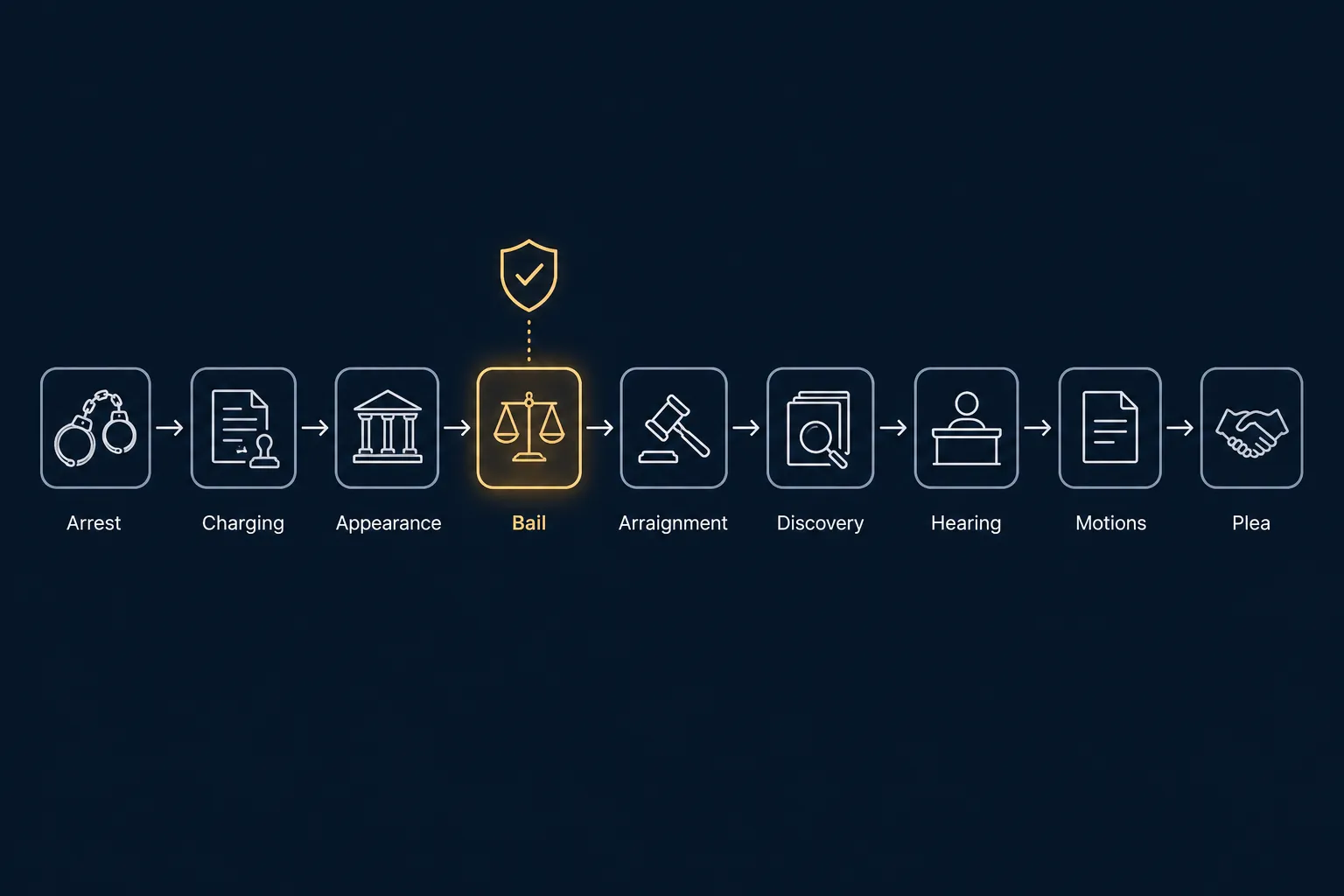
The arrest-to-plea corridor, with the AI checkpoint at each stage
The table below is not a universal criminal-procedure checklist. State systems, federal systems, local standing orders, and courtroom practices differ. It is a working map of where the file changes hands before trial and what record should be checked before someone relies on the next document.
| Stage | What legally happens / timing label | Where AI may enter | What can fail | Record to check before the next act |
|---|---|---|---|---|
| Arrest and booking | The person is taken into custody, identified, searched, fingerprinted or otherwise processed, and the first durable law-enforcement records are created. Timing label: jurisdiction-specific booking and presentment rules. | AI-assisted report writing, transcription, video summarization, identity matching, data extraction from booking systems. | A narrative can absorb an error from audio, omit qualifying footage, misstate timing, merge two events, or turn an officer’s assumption into a clean sentence. | Original body-camera or dash-camera footage where available, officer notes, dispatch or timestamp records, booking data, warrant record, arrest paperwork. |
| Charging decision | A prosecutor or charging authority decides what offense, if any, to file; in some systems the first court filing is based on a complaint, information, indictment, citation, or sworn statement. Timing label: local charging and custody deadlines. | Summaries of police reports, intake triage, prior-record lookup, charge-suggestion tools, document assembly. | The charge can be built on a polished report that has not yet been compared with source material. | Charging instrument, sworn complaint or probable-cause statement, arrest report, available footage index, officer notes, applicable statute, docket entry. |
| Initial appearance | A judge or magistrate addresses the arrest, rights, counsel, custody status, and the next date. New York City example: first court appearance within 24 hours of arrest.[1] | Calendar triage, form generation, risk-screening inputs, automated summaries for court staff or counsel. | The court may see a compact record before defense counsel has a practical chance to test the underlying narrative. | Court file, complaint, probable-cause materials, counsel appointment record, custody status, interpreter or accommodation record, next-date notice. |
| Bail or detention decision | The court decides release, conditions, bail, supervision, or detention under the governing local standard. Timing label: jurisdiction-specific and often tied to the first appearance or an early detention hearing. | Algorithmic risk scores, pretrial-services screening tools, criminal-history matching, supervision recommendation systems. | A score can carry institutional weight without exposing methodology, source inputs, local validation, or correctable data errors. | Risk assessment report, methodology or policy disclosure if available, interview notes, criminal-history source, warrant and failure-to-appear records, local rule or order governing use, transcript or minute entry. |
| Arraignment | The accused is formally advised of charges and enters a plea or has a plea entered under local practice. Conditions may be revisited. Timing label: jurisdiction-specific. | Document assembly, charge-sheet comparison, courtroom workflow tools, translation or transcription assistance. | Count numbers, names, enhancements, conditions, and dates can be copied forward from an earlier record that has not been corrected. | Charging instrument, docket sheet, arraignment minute entry, conditions-of-release order, interpreter record, counsel appearance. |
| Discovery | The parties exchange discoverable materials under statutes, rules, orders, and constitutional obligations. Timing label: jurisdiction-specific discovery deadlines and continuing duties. | Technology-assisted review, deduplication, transcription, exhibit indexing, auto-summarization, privilege or confidentiality screening. | The production can look complete while source files, metadata, body-camera segments, lab materials, or impeachment material remain missing or mislabeled. | Discovery index, production correspondence, file list, source-document links, protective order, privilege log where applicable, chain-of-custody or evidence records. |
| Preliminary hearing or grand jury | A court or grand jury tests whether the case proceeds under the applicable standard; procedures differ sharply by jurisdiction. Timing label: local statute, rule, or constitutional deadline. | Transcript summarization, exhibit organization, witness-outline generation, issue flagging. | The decision-maker may hear a condensed version of facts while omitted source material remains outside the practical hearing record. | Transcript, exhibits, witness statements, charging document, court order, grand-jury return or preliminary-hearing ruling. |
| Pretrial motions | Counsel files suppression, dismissal, discovery, evidentiary, bail-review, severance, or other motions before trial. Timing label: scheduling order and local rule. | Generative drafting, citation checking, research tools, fact chronology tools, exhibit binders. | A motion can contain false citations, inaccurate quotations, unsupported factual assertions, or a chronology that traces back to an unverified report. | Actual cited authority, quoted pages, exhibits, affidavits, transcript pages, discovery source files, certification rules, signature block. |
| Plea | The parties negotiate and the defendant decides whether to plead, proceed, or seek another disposition. Timing label: case-specific and controlled by court calendar, discovery posture, motion schedule, and local practice. | Offer comparison, sentencing exposure worksheets, discovery summaries, mitigation packets, negotiation memos. | Advice can rest on a risk score, missing discovery, untested police narrative, or motion assessment that no one has traced back to the original record. | Written offer, charge sheet, criminal-history record, discovery status, motion rulings, custody-credit information, conditions, plea colloquy requirements. |
Arrest, booking, and intake: the first record is not just paperwork
The first durable record after arrest has a way of hardening. It is read by an intake prosecutor, a pretrial-services officer, a judge at first appearance, and a defense lawyer trying to make a custody argument with minutes rather than days. If an AI-assisted tool helps draft the police report, transcribe an officer’s account, summarize body-camera footage, or populate a booking packet, the problem is not that a machine touched the file. The problem is that a later actor may treat the resulting prose as if it has already been reconciled against the source.
A careful read of the report is not enough. The verification gate at intake is comparison. The report should be checked against original footage where available, officer notes, timestamps, dispatch records, booking fields, warrant data, and any document that shows how the person was identified, where the arrest occurred, and what the officer claims happened before custody. A sentence that says the suspect “ignored commands,” “reached toward the waistband,” or “matched the description” may become material to probable cause, detention, suppression, or plea advice. Those are not decorative facts.
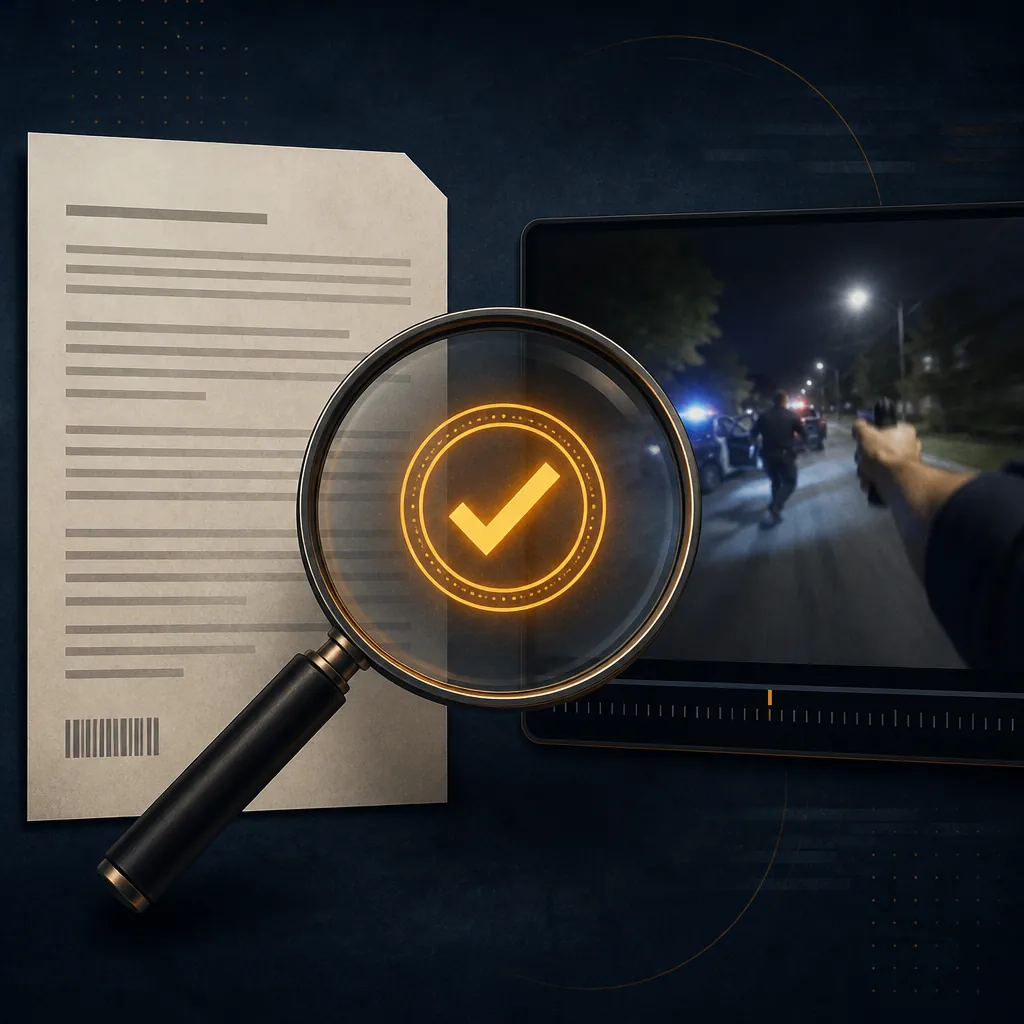
The cleanest intake packet is sometimes the most dangerous one. A rough handwritten note, a choppy video, and a dispatch log announce their incompleteness. A polished AI-assisted narrative can conceal its seams. It may not show whether it paraphrased a recording, filled a gap from a template, accepted a speaker label, or imported a prior description from another field in the system. Before the next legal act, the reviewer needs to know not only what the report says, but what the report was made from.
For defense counsel, the immediate intake questions are practical: Which footage exists? Which footage was reviewed before the report was finalized? Are there officer notes separate from the generated narrative? Do timestamps in the report match the video and booking record? Was the person’s identity confirmed by a source document, by database return, by witness statement, or by officer assertion? For prosecutors, the same questions matter before charge approval. A filing decision based on an unverified summary does not become safer because the summary is convenient.
The intake checkpoint
- Do not treat the AI-assisted or AI-drafted report as the source record.
- Identify the materials used to create or complete the narrative: video, audio, officer notes, dispatch logs, booking data, database returns, witness statements.
- Compare the facts likely to matter at first appearance and bail: identity, location, timing, alleged conduct, injuries, weapons, flight, threats, prior orders, and any claimed admissions.
- Preserve the mismatch, not just the corrected fact. A later motion or bail review may need to show how the first record was wrong.
Charging and first appearance: the short window where summaries travel fastest
The charging decision often happens before the defense has meaningful access to the full source file. The prosecutor may be working from an arrest report, complaint draft, probable-cause statement, criminal-history return, and whatever local intake materials are available. AI may assist by summarizing reports, populating forms, suggesting charge language, organizing priors, or producing a chronology. None of those uses resolves the charging question. They only change the speed and form of the materials placed in front of the charging lawyer.
The verification gate at charging is narrower than trial preparation but more demanding than a face-value read. The charging lawyer should be able to point to the facts supporting each element in a primary record or sworn source, especially when a generated summary supplies the language. If the file says there was a video, the question is whether the charging theory depends on what the video actually shows or on what a report says the video shows. Those are different records.
At initial appearance, the judge may be dealing with a limited file and a crowded calendar. Counsel may be newly appointed or retained on short notice. A compact AI-generated summary can feel useful in that room, but the court act is still human and legal: notice of charges, counsel, custody status, release conditions, and the next date. If the summary carries an error into the first court event, the practical burden of correction usually falls on the person least able to absorb delay: the detained defendant and the lawyer trying to make a record immediately.
Bail and detention: a risk score is not the record
Bail and detention deserve a slower look because the consequence is immediate. A person who remains detained litigates from a different position than a person released with conditions. Work, housing, caregiving, access to counsel, and willingness to consider a plea can all be affected by custody. If an algorithmic risk assessment appears early in the file, it may arrive with institutional authority before anyone has tested the inputs.
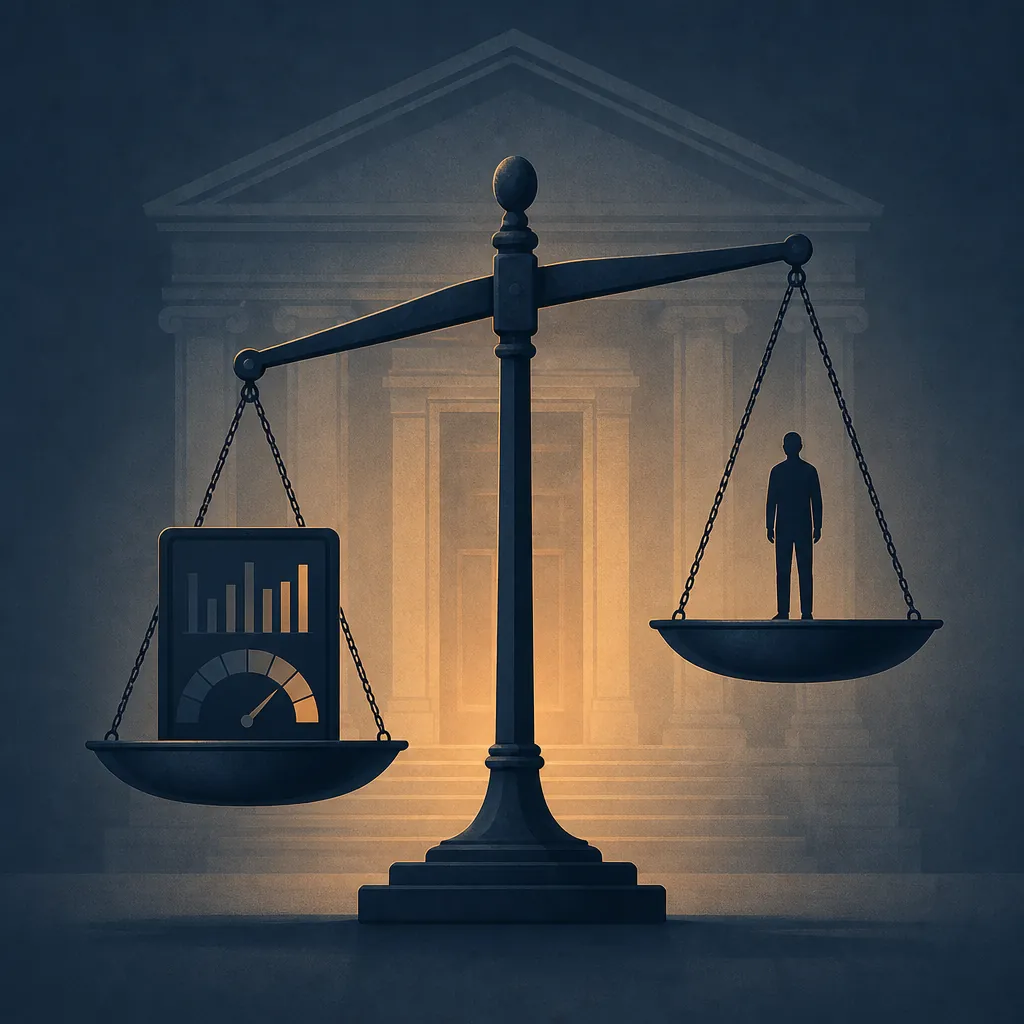
The useful question is not whether the score is “AI” in a marketing sense. The useful questions are method, inputs, disclosure, and use. What instrument produced the score? What local rule, statute, administrative order, or pretrial-services policy authorizes or frames its use? Which variables were entered? Were they drawn from interview answers, criminal-history databases, court records, warrant records, charge severity, prior failures to appear, address information, employment information, or supervision history? Who entered or approved the data? Can counsel see enough to challenge a mistake?
A risk score can fail in ordinary ways before anyone reaches broader debates about algorithms. The criminal-history match may be wrong. A dismissed case may be treated too heavily in a narrative recommendation. A warrant record may be stale. A person may be scored as unstable because intake information was missing, not because it was unfavorable. An interview answer may be misunderstood, translated poorly, or never obtained. If the court hears only the final category, the path from source record to liberty recommendation disappears.
Defense counsel should try to preserve the challenge in record terms. “We object to the algorithm” is usually too general to help the next lawyer, the reviewing judge, or the appellate record. The more useful objection identifies the missing or contested component: no methodology disclosure; no local validation material in the record; wrong criminal-history entry; no explanation of how nonappearance was counted; no access to interview notes; no showing that the court may rely on the score under the local rule; no opportunity to contest the data before detention is requested.
Prosecutors and pretrial-services officers have their own checkpoint. If a recommendation relies on a score, the record should show what was relied on and what was not. A detention argument should not slide from “the instrument returned a high category” to “therefore this person will fail to appear or endanger the community” without the legally relevant facts required by the jurisdiction’s standard. The score may organize information. It does not replace the court’s reasons.
The bail checkpoint
- Ask what instrument or tool produced the assessment and whether local authority permits or limits its use.
- Separate the score from the underlying facts: criminal history, pending cases, warrants, prior nonappearances, interview answers, residence, employment, supervision history, and charge allegations.
- Correct source data before arguing the final category.
- Preserve nondisclosure and methodology objections with enough detail that a later court can see what counsel could not test.
- Tie every liberty argument back to the jurisdiction’s legal standard, not to the tool’s label.
Arraignment: copied-forward errors become courtroom facts
Arraignment can look formal and routine, which is why copied-forward errors matter. Names, dates, count numbers, statutory subdivisions, enhancements, stay-away terms, firearm allegations, immigration-sensitive language, and co-defendant references may have moved from one system to another before anyone with adversarial duties checked them. AI tools may help assemble forms or compare documents, but the court event still depends on the actual charging instrument and the docket.
The verification gate is modest but concrete: compare the charges stated in court with the filed instrument; compare conditions announced orally with the written order; check that counsel, interpreter, and custody status are correctly reflected; and make sure the next date and motion schedule are not merely assumed from an automated calendar entry. If arraignment produces the first signed order in the file, that order becomes the record people follow.
Discovery: the file gets larger, so the checkpoint changes
Once discovery begins, the AI problem is no longer only the first police narrative. The evidentiary universe expands: reports, videos, lab materials, photographs, phone extractions, witness statements, jail calls, dispatch records, audit logs, prior statements, impeachment material, protective-order material, and correspondence about what has or has not been produced. Technology-assisted review can help sort that mass. It can also make an incomplete production look orderly.
The discovery checkpoint is production integrity. Counsel needs to know what was produced, what was withheld, what is unavailable, what is subject to a protective order, and what source file supports a useful summary. A generated witness-summary chart is not discovery. A transcript generated from audio is not the audio. A video description is not the video. A relevance tag is not a legal ruling. If a motion or plea recommendation relies on the summary, counsel should be able to open the underlying item.
This is also where privilege and confidentiality stop being abstract. A review platform or generative tool used on discovery may touch protected witness information, sealed material, juvenile information, medical records, informant issues, or attorney work product. Before material is uploaded, summarized, or used to draft a filing, the responsible lawyer needs to know the protective order, the confidentiality marking, the permitted users, and whether the tool keeps or trains on the data. Vendor assurances are not a substitute for the court order and the lawyer’s own duty to protect the file.
The discovery checkpoint
- Maintain a production index that distinguishes original source files from summaries, transcripts, translations, thumbnails, and work-product notes.
- Track missing categories, not just missing documents: footage segments, metadata, lab bench notes, dispatch audio, impeachment material, chain-of-custody records, prior statements, and court-ordered disclosures.
- Link any AI-generated summary or issue tag to the underlying source item.
- Check protective orders and confidentiality limits before using discovery with a third-party tool.
- Preserve production correspondence so later disputes show what was requested, produced, withheld, corrected, or still outstanding.
Preliminary hearing or grand jury: condensed proof needs source anchors
A preliminary hearing or grand-jury process is not the same thing in every jurisdiction, and the defense role differs sharply depending on the forum. AI may still appear in the preparation work: transcript summaries, exhibit organization, witness outlines, issue lists, and chronological binders. Those tools can be useful if they help counsel and court staff find the record faster. They are dangerous if they become the record.
The checkpoint is the hearing or grand-jury record itself. What testimony was actually given? What exhibits were actually admitted or presented? What objections, limitations, or rulings appear in the transcript or minutes available to the parties? Did a witness adopt a fact from personal knowledge, from a report, or from a summary prepared by someone else? When the case moves forward, later motions should cite the transcript, exhibit, order, or return—not a preparation memo that sounds cleaner than the proceeding.
Pretrial motions: the signature block is the last AI checkpoint before filing
Generative drafting changes the feel of pretrial motion practice because it can produce a serviceable-looking document before the lawyer has done the slow work. Suppression motions, discovery motions, dismissal motions, bail-review applications, and evidentiary motions all depend on two kinds of accuracy: law and record. A false citation is an obvious defect. A true citation attached to a false fact is just as dangerous.
The filing system will not put the model’s name under the motion. It will put a lawyer’s name, a certification, a declaration, or a signature block. That is the practical control point. Before filing, every cited case, statute, rule, transcript page, exhibit, quotation, and factual assertion should be checked against the actual source. Checking an AI draft against another AI-generated answer does not close the loop. It only compares one unverified output with another.
A workable prefiling review does not require theatrical suspicion of every tool. It requires separation of tasks. Let a tool help build a chronology, locate possible issues, format a table, or identify documents that may matter. Then assign a human reviewer to verify the propositions that will be represented to the court. If the motion says the body-camera footage begins after the alleged command, someone must have watched the footage and noted the timestamp. If the motion quotes a witness, someone must have compared the quotation with the transcript, statement, or recording. If the motion cites authority, someone must have read the authority that actually exists.
The prefiling checkpoint
- Citations: confirm the case, statute, rule, court, date, holding, and current status using an authoritative legal source.
- Quotations: compare every quoted sentence with the source page, transcript line, exhibit, or recording.
- Facts: link each material assertion to a report, exhibit, transcript, video timestamp, affidavit, docket entry, or discovery item.
- Confidentiality: confirm that sealed, protected, juvenile, medical, informant, or victim-identifying material may be included or must be filed under restriction.
- Record preservation: keep notes showing what was verified, by whom, and against which source.
Plea: where the pretrial record becomes advice
Plea is where many pretrial AI risks converge. A plea decision may reflect the first police narrative, the risk assessment that affected custody, the completeness of discovery, the strength of suppression or dismissal motions, the likely sentencing exposure, and the practical cost of continued litigation. AI may help compare offers, summarize discovery, prepare mitigation materials, or draft advice memos. Those uses are only as reliable as the record beneath them.
Before plea advice rests on an AI-assisted summary, counsel should know what remains unproduced, which motions are unresolved, whether custody pressure is distorting the negotiation, whether the criminal-history record is accurate, whether immigration or collateral consequences require separate analysis, and whether the offer matches the charges and sentencing exposure actually in the file. A summary can help organize those questions. It cannot answer them unless it is tied back to the documents, recordings, orders, and transcripts that will survive the conversation.
AI risk after arrest is not one warning label pasted over “criminal justice.” It moves. At intake, the gate is report-to-source comparison. At bail, it is score-to-methodology and score-to-inputs. In discovery, it is production completeness and source linking. Before motions, it is citation, quotation, and fact verification. At plea, it is whether the advice rests on the actual pretrial record rather than on a convenient abstraction of it. The responsibility remains with the person who relies on, files, discloses, recommends, or signs.
References
- What Happens After You Get Arrested, Vera Institute of Justice
Grounded in
This procedure is grounded in the cited rule or opinion, independent of any single documented case. See the Regulation tracker for the governing text.
Cases this step would have prevented
No cases have been explicitly linked to this checklist yet. See Risk Digest for documented incidents generally.
← Back to WorkflowsReport a correction or tip
Spotted an outdated figure, a misstated fact, or a ruling this workflow checklist should reflect? Public comments are disabled for this content given the professional cost of a misreported case outcome, penalty amount, or rule text — use the structured correction channel instead.
Report a correction or tip for this record →