
AI Contract Review Workflow Implementation: A Phased Roadmap for Legal Teams
A step-by-step phased roadmap for in-house counsel, legal ops leaders, and law firm partners to implement AI contract review tools — from needs assessment through iterative optimization — with professional responsibility guardrails at every stage.
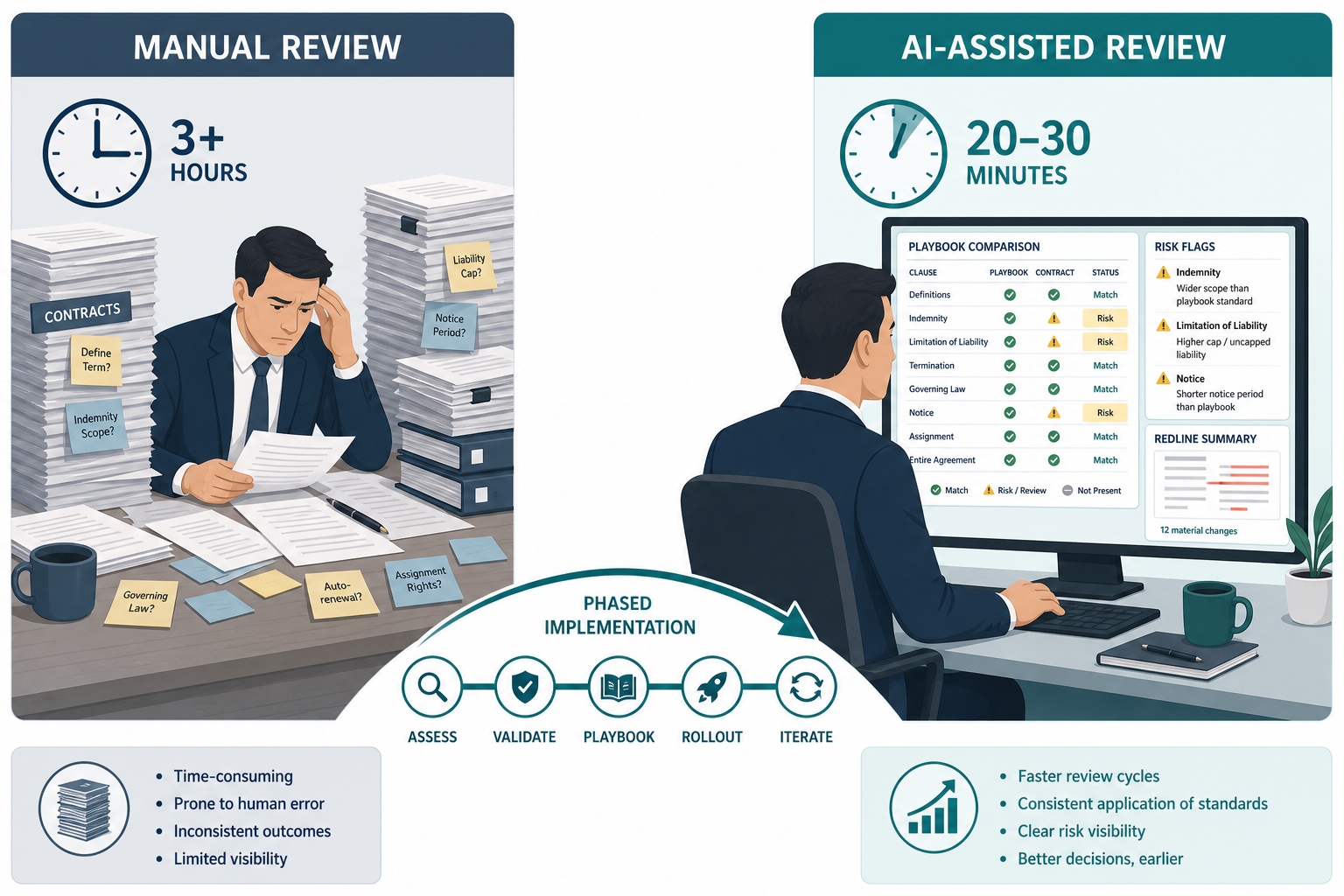
Introduction: Why Most AI Contract Review Pilots Stall
The appetite for AI in contract review is unmistakable. A global study of 607 senior in-house leaders found that 94% of legal departments want AI solutions, yet only one in five have the basic maturity safeguards — usage policies, staff training, and governance frameworks — to deploy them safely. That mismatch between intent and readiness explains why so many pilots stall.
This article presents a repeatable, five-phase implementation roadmap — from needs assessment to iterative optimization — that balances the speed gains of AI with the professional responsibility obligations that govern every licensed attorney. The framework is independent, source-cited, and designed to prevent the pilot-stalling failures that plague 80% of legal teams. Each phase includes specific ethical guardrails derived from ABA Formal Opinion 512 (July 2024), ensuring that the roadmap respects Model Rules 1.1, 1.6, 1.4, 1.5, and 5.3 at every stage.
Phase 0: Needs Assessment and Workflow Mapping
Before evaluating a single tool, your team must understand the current workflow with precision. Jumping straight to demos is the most common cause of failed pilots. The goal of Phase 0 is to identify which contract types consume the most attorney hours per week and determine the readiness of your organization to adopt AI.
- Audit your contract volume and complexity. Pull a six-month sample of all contracts reviewed. Classify them by type (NDA, services agreement, MSA, licensing, M&A documents) and by complexity (standard boilerplate vs. heavily negotiated). Manual review averages three hours per contract according to LegalOn’s 2026 survey; high-complexity documents can take eight hours or more.
- Map the current manual workflow. Document every step: receipt, initial review, redlining, legal review, approval, negotiation, finalization. Identify bottlenecks — for example, the 3-hour average per contract may be inflated by back-and-forth email negotiations that AI cannot fully replace.
- Define success metrics. Set baselines for speed (hours per contract), consistency (error rates), and attorney satisfaction (qualitative feedback). These will anchor your Phase 5 iteration cycle.
- Get stakeholder alignment. Involve IT, compliance, and practice group leaders early. The Wolters Kluwer 2026 Future Ready Lawyer Survey found that 35% of professionals cite resistance to change as a top barrier — addressing it upfront prevents later derailment.
Phase 1: Tool Evaluation Against a Structured Criteria Framework
With your workflow mapped, you can now evaluate tools against capabilities that directly address your pain points. Avoid feature lists; instead, use a structured criteria framework grounded in real contract review tasks. The five capabilities that the GC AI In-House Legal Bench (May 2026) identifies as essential for in-house contract review are a solid starting point: playbook automation, character-level citation, native Word workflow, matter memory, and multi-document agentic review.
- Playbook discipline. Does the tool allow you to ingest, create, or customize playbooks for your specific clause preferences? Pre-built playbooks can reduce setup time to 1–2 days (LegalOn).
- Character-level citation. When the AI flags a risky clause, can it pinpoint the exact sentence and show the reasoning? This is critical for professional responsibility under Model Rule 1.1 — the lawyer must understand the basis of the output.
- Native Word workflow. Tools that force you to export documents to a web interface disrupt lawyer workflows. Look for plugins that allow review and redlining inside Microsoft Word or Google Docs.
- Matter memory. Can the tool retain context across related documents within a matter? This avoids repetitive setup and improves consistency.
- Multi-document agentic review. For complex transactions involving schedules, exhibits, and ancillary agreements, agentic workflows that can cross-reference multiple documents are a significant force multiplier.
For detailed side-by-side comparisons of specific platforms — including Luminance, Kira Systems, and Ironclad CLM — visit our Legal AI Contract Review Software comparison guide. The criteria framework above will help you interpret those profiles in the context of your specific workflow.
Phase 2: Parallel Validation — Running AI and Manual Review Side-by-Side
Once you have selected one or two candidate tools, run a 30-day parallel validation pilot. The goal is not to replace your attorneys but to build evidence: does the AI actually save time without sacrificing quality? The Axiom pilot found that teams using DraftPilot achieved 40–60% time savings on routine contract review, with 89% of attorneys reporting improved work quality and consistency.
How to run the pilot:
- Select a representative sample of 20–50 contracts covering your highest-volume types (NDAs, MSAs, simple service agreements). Exclude complex M&A documents in this first pass.
- Have both the AI tool and a human attorney review each contract independently. Record the start and end times for both. Use a shared spreadsheet to log issues found, false positives, and missed items.
- Compare outputs. Calculate precision (how many AI flags were correct), recall (how many issues the AI missed that the human caught), and the time delta.
| Metric | Definition | Typical Range (Benchmark Data) |
|---|---|---|
| Precision (AI flags correct) | Proportion of AI-flagged clauses that required a change | 94% on NDAs, 87% on service agreements (Sirion 2026) |
| Recall (human-identified issues also caught by AI) | Proportion of issues identified by the human that the AI also flagged | Varies widely; purpose-built tools often exceed 85% on standard contracts |
| Time savings per contract | Reduction in review time compared to manual baseline | 40–60% for routine contracts (Axiom pilot); 50–90% depending on complexity (Sirion) |
| Discrepancy rate | Clauses where AI and human disagree | Track per contract type; use to calibrate playbooks in Phase 3 |
Phase 3: Playbook Creation and Encoding
This phase is where most legal teams underinvest — and it explains why 95% of teams report playbook gaps. LegalOn’s 2026 survey found that 34% of in-house teams have no playbooks at all, 42% rely on general or partial playbooks, and only 5% have comprehensive coverage. A playbook is the translation of your organization’s risk appetite and negotiation standards into a machine-readable rule set.
- Start with pre-built templates. Most AI contract review tools offer pre-built playbooks for common clause types (indemnification, liability caps, governing law, confidentiality). LegalOn reports that pre-built playbooks can be up and running in 1–2 days. Use these as a starting point, then customize them with your organizational preferences.
- Incorporate your own negotiation history. Review the last 50–100 contracts your team actually signed. Identify the deviations from your standard template — these real-world examples are the most valuable inputs for your playbook.
- Use context-aware redlining features. True playbook automation goes beyond clause extraction to generate redlines aligned with organizational standards. Dioptra reports 95% accuracy on first-party paper revisions; this level of precision depends on a well-curated playbook.
- Budget customization time realistically. According to LegalOn, hybrid customization (pre-built plus your adjustments) takes 1–3 weeks. A fully custom build from scratch can take three months or more. For most teams, hybrid is the pragmatic choice.
Phase 4: Staged Rollout — The Three-Tier Autonomy Model
Rather than flipping a switch from manual to fully automated, adopt a staged autonomy model. This approach is consistent with the change management playbook described in the JD Supra article on AI change management: start with use cases aligned to practice areas, use staged rollouts, and invest in continuous training.
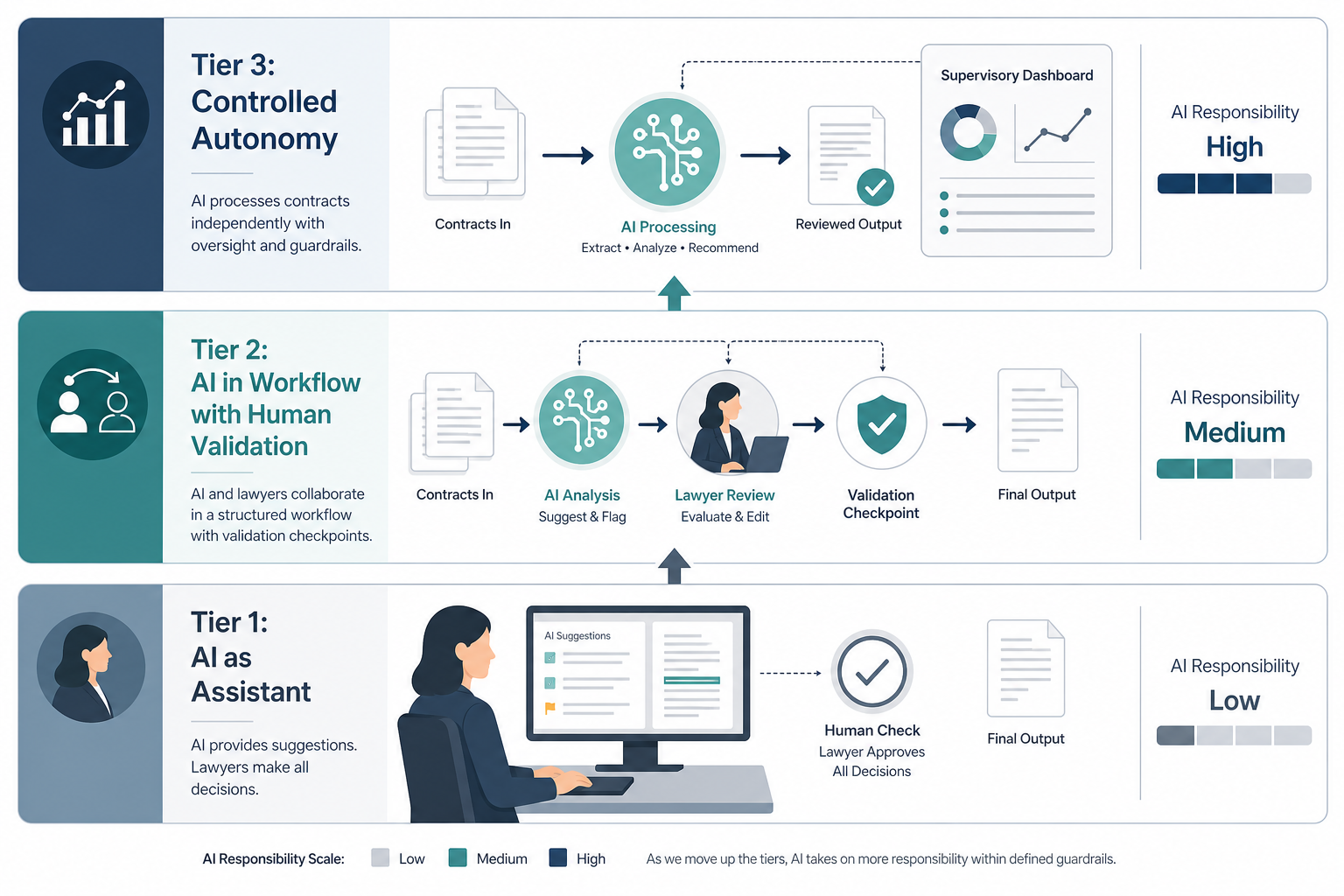
- Tier 1: AI as Assistant (weeks 1–4). The AI produces an initial review and redline suggestions, but the human attorney makes every final decision. This is the natural continuation of the parallel validation phase. It builds user confidence and allows for fine-tuning of playbooks based on real feedback.
- Tier 2: AI in Workflow with Mandatory Human Validation (months 2–3). The AI’s redlines are applied automatically, but the attorney must review and approve or revert each change before the contract is sent to the counterparty. A mandatory validation checkpoint at the end of the workflow ensures no AI-generated language is deployed without a human sign-off.
- Tier 3: Controlled Autonomy with Exception Handling (months 4–6). For standard, low-risk contracts, the AI may finalize the review and generate the redline without case-by-case human input — provided the system flags exceptions (e.g., nonstandard clauses requested by the counterparty). Human review is required only when the AI detects a deviation beyond defined thresholds.
Real-world adoption patterns: Harvey reports that customers achieve an average of 92% monthly adoption rate when using a structured rollout with tailored training. Repsol achieved 96% adoption across its legal department. Macfarlanes saw more than 80% lawyer adoption firmwide. These results demonstrate that staged rollouts — combined with strong change management — can overcome the resistance identified in the Wolters Kluwer survey.
Phase 5: Measurement, Iteration, and Implementation Timeline
The final phase is ongoing. You cannot simply set the AI loose and declare success. Establish a KPI framework that tracks precision, time savings, adoption rate, and error trends. Use the data to refine playbooks, adjust the autonomy tier, and justify further investment.
- Precision rate targets: Sirion’s 2026 benchmarks suggest aiming for 85%+ on standard contracts (NDAs, simple services) and 70%+ on complex agreements (MSAs, M&A documents). Track precision per contract type and per playbook.
- Time savings: LegalOn’s survey indicates purpose-built AI reduces review time by 70–85% per contract. Set internal targets based on your validated pilot results — a realistic starting goal is 50% reduction for routine contracts.
- User adoption rate: Track daily or weekly active users. If adoption falls below 70% after the first month, investigate training gaps or workflow friction. Harvey’s customer data shows a 92% monthly adoption rate for teams that persist through the first month.
- Error trend monitoring: Log all discrepancies between AI output and final contract language. Review the log monthly to identify systematic errors — for example, the AI repeatedly missing a particular clause type. Update the playbook accordingly.
| Phase | Estimated Duration | Key Activities |
|---|---|---|
| 0 – Needs Assessment | 2–4 weeks | Audit current workflow, define metrics, align stakeholders |
| 1 – Tool Evaluation | 2–4 weeks | Apply criteria framework, test candidate tools on sample contracts |
| 2 – Parallel Validation | 4 weeks (30 days) | Run AI vs. human pilot, collect precision/time/recall data |
| 3 – Playbook Creation | 1–2 days (pre-built); 1–3 weeks (hybrid); 3+ months (custom) | Import pre-built playbook, customize with organizational preferences |
| 4 – Staged Rollout | 3–6 months | Progress through three autonomy tiers; continuous training |
| 5 – Measurement & Iteration | Ongoing (monthly reviews) | Track KPIs, refine playbooks, adjust autonomy level |
Ethical Guardrails: What ABA Formal Opinion 512 Requires at Every Phase
The American Bar Association’s Formal Opinion 512, issued in July 2024, is the first comprehensive ethics guidance on the use of generative AI in legal practice. It applies five Model Rules directly to AI use: competence (1.1), confidentiality (1.6), communication (1.4), fees (1.5), and supervision (5.3). Each phase of your implementation roadmap must account for these obligations.
- Model Rule 1.1 (Competence). Comment 8 requires lawyers to understand the benefits and risks of technology they use. In Phase 0, this means your team should develop a baseline understanding of how AI contract review works — including hallucination risk, data boundaries, and the limits of automated reasoning. The opinion states that a lawyer must keep abreast of changes in technology, and this includes understanding AI tools’ capabilities and limitations.
- Model Rule 1.6 (Confidentiality). Client information must be protected. When evaluating tools in Phase 1, scrutinize the vendor’s data retention policy: does the AI model retain your contract text for training purposes? Are there zero-retention options? Ensure the vendor contract explicitly prohibits model training on your data. Our Luminance tool profile, for example, discusses enterprise data retention practices that satisfy Rule 1.6 concerns.
- Model Rule 1.4 (Communication). You must reasonably consult with the client about the means of representation. If your legal department or firm plans to use AI for contract review, disclose this to the client where required by applicable ethics opinions. Some state bar guidance may require explicit client consent.
- Model Rule 1.5 (Fees). You may charge for attorney time spent using AI, but you cannot charge for the time spent learning the tool. Bill only for value-added work. The opinion makes clear that AI does not create a new category of billable activity.
- Model Rule 5.3 (Supervision). The opinion analogizes AI to a nonlawyer assistant: the supervising attorney must ensure the AI’s output is reviewed for accuracy and that the AI is not equivalent to a licensed attorney. In practice, this means never sending an AI-generated redline to a counterparty without a human attorney’s review — a requirement that aligns directly with the staged autonomy model in Phase 4.
“A lawyer using GAI must be vigilant in complying with the ethical rules that govern the lawyer’s conduct in all representations.”
State-level variation. As of mid-2026, 42 states have adopted ABA Model Rule 1.1 Comment 8 requiring technology competence. However, state bar opinions on specific AI use cases may differ. Check your jurisdiction’s current guidance; the site’s Regulation Tracker maintains a living record of state ethics opinions and court-specific AI disclosure rules.
Conclusion: From Pilot to Practice
The five-phase roadmap — needs assessment, tool evaluation, parallel validation, playbook encoding, and staged rollout — transforms AI contract review from a risky experiment into a measurable, defensible component of legal practice. The data shows the reward is substantial: 62% of legal professionals report time savings of 6–20% per week (Wolters Kluwer 2026), and 97.5% of active users see value within the first month (GC AI customer survey). But the risk of stalling is real: without structured safeguards, even enthusiastic teams fail to scale.
By embedding professional responsibility obligations — competence, confidentiality, supervision — into every phase, the roadmap ensures that speed never comes at the expense of ethical duty. The technology will continue to evolve, but the process of careful validation, gradual deployment, and continuous iteration will remain the foundation of responsible AI adoption in legal practice.
Grounded in
This procedure is grounded in the cited rule or opinion, independent of any single documented case. See the Regulation tracker for the governing text.
Cases this step would have prevented
No cases have been explicitly linked to this checklist yet. See Risk Digest for documented incidents generally.
← Back to WorkflowsReport a correction or tip
Spotted an outdated figure, a misstated fact, or a ruling this workflow checklist should reflect? Public comments are disabled for this content given the professional cost of a misreported case outcome, penalty amount, or rule text — use the structured correction channel instead.
Report a correction or tip for this record →