
61.6% of Federal Judges Are Already Using AI — What Litigators Must Know About the New Judicial AI Landscape
A landmark survey of 502 federal judges reveals that 61.6% have used AI in chambers, creating a strategic asymmetry for litigators. This article breaks down the data on judicial AI usage, tool preferences, training gaps, and policy fragmentation, then provides actionable guidance for recalibrating litigation strategy in an era where the bench may be more AI-literate than the bar.
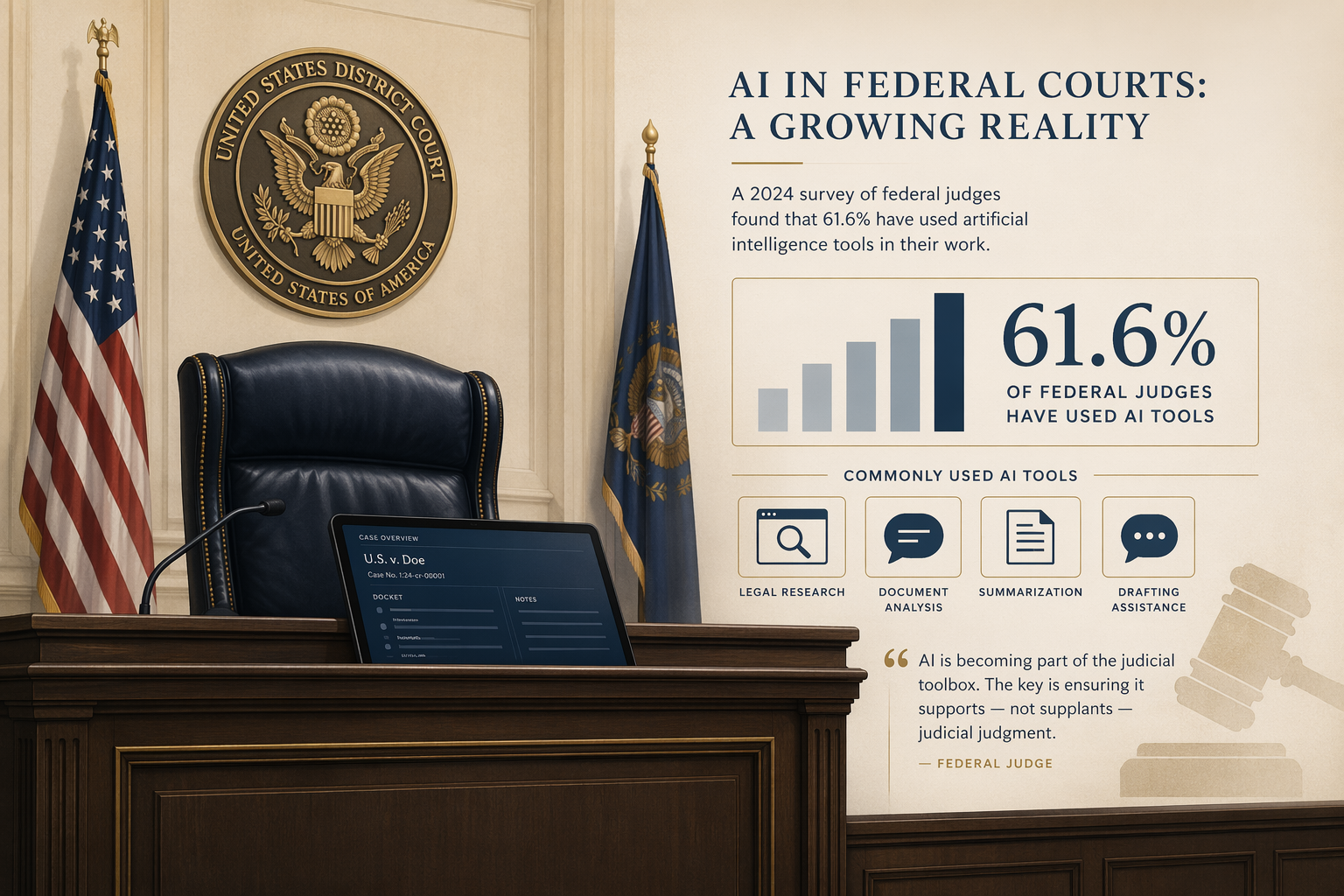
The Headline: 61.6% of Federal Judges Have Used AI in Chambers
In December 2025, researchers at Northwestern University's Pritzker School of Law, in partnership with the New York City Bar Association and the Sedona Conference, fielded a survey to 502 randomly selected federal judges. The question was straightforward: had they used any artificial intelligence tool in their judicial work? The answer, published in the Sedona Conference Journal in March 2026, was a decisive yes from 61.6% of the 112 respondents (a 22.3% response rate, with a ±9% margin of error at 95% confidence).
This finding is not merely a data point for legal technology enthusiasts. It represents a structural shift in the courtroom power dynamic. The people evaluating legal work product — federal judges — are now, in significant numbers, personally experienced with the same tools that litigators are still debating whether to adopt. The asymmetry thesis that emerges from this survey is counterintuitive and consequential: the bench may be more AI-literate than the bar.
The survey's timing is critical. It captures judicial behavior in late 2025, before the explosion of high-profile sanctions rulings in early 2026 — including the 9th Circuit's first AI sanctions decision in June 2026 and the Northern District of Mississippi's unprecedented disqualification of attorneys on both sides of a contract dispute. If anything, judicial AI adoption has likely increased since the survey was conducted.
How Judges Are Using AI: Frequency, Tools, and Tasks
The headline 61.6% figure captures any use at all. A deeper look at frequency reveals a more nuanced picture: only 22.4% of responding judges use AI daily or weekly. The remaining 39.2% who have used AI do so monthly or less. And 38.4% of judges have never used AI in their judicial work.
| Usage Frequency | Percentage of Responding Judges |
|---|---|
| Daily | 5.4% |
| Weekly | 17.0% |
| Monthly | 19.6% |
| Less than monthly | 19.6% |
| Never | 38.4% |
The tool preference data is equally instructive. When judges use AI, they overwhelmingly turn to legal-specific platforms rather than general-purpose chatbots.
| AI Tool | Percentage of Judges Using |
|---|---|
| Westlaw AI-Assisted Research | 38.4% |
| ChatGPT | 28.6% |
| Lexis+ AI | Data not separately reported |
| Claude | 0.9% |
| Other / unspecified | Remainder |
The dominance of Westlaw AI-Assisted Research (38.4%) over ChatGPT (28.6%) is a meaningful signal. Judges are primarily using AI through established legal research platforms — tools that come with data privacy protections, citation verification features, and vendor accountability. The low adoption of Claude (0.9%) suggests that general-purpose chatbots have not yet penetrated judicial workflows at scale, though ChatGPT's 28.6% share indicates they are far from absent.
The tasks judges assign to AI reveal a careful, bounded approach to deployment.
| Use Case | Judges (%) | Chamber Staff (%) |
|---|---|---|
| Legal research | 30.0% | 39.8% |
| Document review / summarization | 15.5% | 16.7% |
| Drafting orders or opinions | 1.8% | Not reported |
| Administrative tasks | Not separately reported | Not separately reported |
The most striking figure in this table is the 1.8% of judges who use AI for drafting filed documents. This is not a typo. The overwhelming majority of judges who use AI confine it to research and review — tasks where AI serves as a tool for the judge's own analysis, not as a substitute for judicial reasoning. This bounded adoption pattern should inform how litigators think about AI in their own work: if the bench is using AI primarily for research and review, they are likely to expect the same disciplined approach from counsel.
Bankruptcy judges lead all categories in AI adoption. The survey found that 32.2% of bankruptcy judges use AI daily or weekly, compared to 13.9% of district judges. This makes intuitive sense: bankruptcy courts handle high-volume, document-intensive proceedings where AI-assisted document review and research provide immediate efficiency gains. Litigators appearing in bankruptcy court should assume a higher baseline of judicial AI literacy than in other federal forums.
The Training Gap and Policy Fragmentation
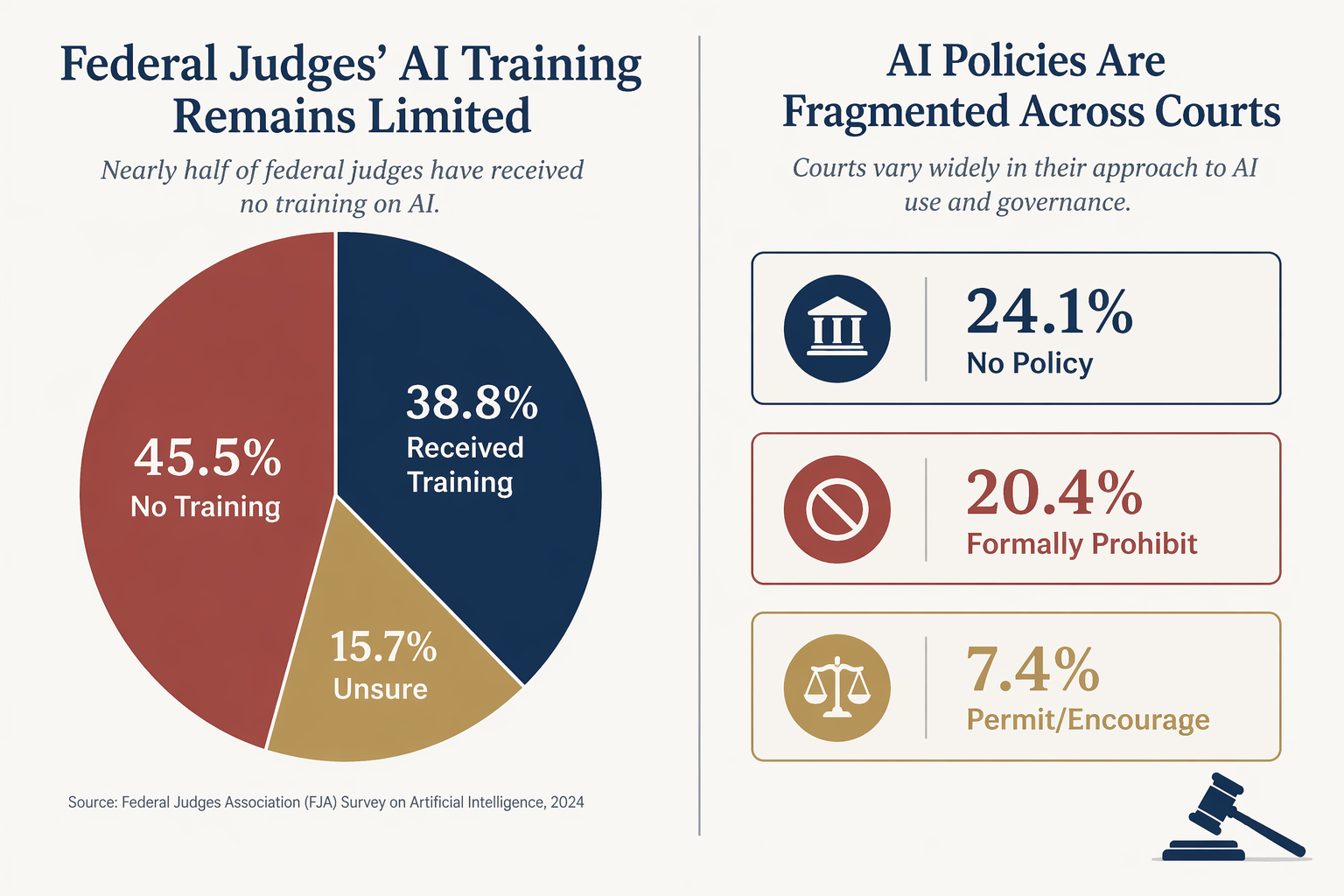
The survey's most concerning finding for litigators may not be how many judges use AI, but how few have been trained to use it responsibly. Nearly half of responding judges — 45.5% — reported receiving no AI training from court administration. An additional 15.7% were unsure whether they had received training. Only 38.8% confirmed they had received some form of AI training.
The policy landscape in chambers is equally fragmented. The survey found that 24.1% of chambers have no official AI policy at all. Another 20.4% formally prohibit AI use. Only 7.4% of chambers permit and encourage AI use. The remaining chambers fall somewhere in between — allowing AI use on a case-by-case basis or with unspecified restrictions.
| Chamber AI Policy | Percentage of Responding Judges |
|---|---|
| No official policy | 24.1% |
| Formally prohibit AI | 20.4% |
| Permit with restrictions (unspecified) | 48.1% (remainder) |
| Permit and encourage | 7.4% |
This policy fragmentation creates a compliance challenge for litigators. A lawyer appearing before three different judges in the same courthouse may face three different AI governance regimes — one with no policy, one that prohibits AI entirely, and one that permits it with restrictions. The absence of uniform guidance from the Judicial Conference of the United States means that individual judges are making policy on an ad hoc basis, often without training or institutional support.
The proposed Federal Rule of Evidence 707, which would subject machine-generated evidence offered without expert testimony to Rule 702 reliability standards, represents an attempt to create uniform standards. The Advisory Committee on Evidence Rules was scheduled to vote on the proposal on May 7, 2026, with a final report expected in June 2026. If adopted, FRE 707 would not directly govern judicial AI use in chambers, but it would signal that the federal judiciary is moving toward a more structured approach to AI governance.
What This Means for Litigators: The Asymmetry in Practice
The asymmetry between judicial AI literacy and law firm AI adoption creates concrete strategic implications for litigators. Here is what the data suggests about the current state of play.
- Check judge-specific standing orders before every filing. Over 300 federal judges have adopted AI disclosure or certification requirements since May 2023, according to trackers maintained by Ropes & Gray, Bloomberg Law, and Law360 Pulse. These orders vary widely: some require disclosure only when generative AI is used for drafting; others require certification that no AI was used at all; a growing number require disclosure of the specific AI tool and the scope of its use. The number changes weekly, and there is no centralized registry. Checking the individual judge's standing orders is now a non-delegable pre-filing task.
- Adopt a disclosure-by-default approach. To date, no reported case has sanctioned an attorney for over-disclosing AI use. The risk calculus is asymmetric: the cost of disclosing AI use when not required is negligible; the cost of failing to disclose when required can be career-altering. The 9th Circuit's June 2026 sanctions ruling against attorneys Mike Sethi and William Rounds — $2,500 each, six-month suspension, and mandatory disclosure for two years — demonstrates that courts are willing to punish non-disclosure even when the underlying legal work is substantively correct.
- Assume the judge knows more than you think. With 61.6% of federal judges having used AI, and 22.4% using it daily or weekly, the probability that your judge has personal experience with AI tools is higher than the probability that your firm has a comprehensive AI policy. This does not mean the judge will be lenient with AI errors — it means the judge may be more attuned to AI-generated work product than opposing counsel expects.
- Bankruptcy court requires heightened vigilance. With 32.2% of bankruptcy judges using AI daily or weekly, litigators appearing in bankruptcy court should assume the highest level of judicial AI literacy. This is also the forum where AI-assisted document review is most likely to be used by both sides, creating complex disclosure and verification obligations.
Privilege, Work Product, and Protective Orders in the AI Era
The first quarter of 2026 produced four significant federal court rulings that collectively define the emerging legal framework for AI use in litigation. These rulings address a question that every litigator must now answer: does using an AI tool waive attorney-client privilege or work product protection?
| Case | Court | Date | Key Holding |
|---|---|---|---|
| United States v. Heppner | S.D.N.Y. | Feb. 17, 2026 | Defendant's unsupervised use of a public AI platform was not protected by attorney-client privilege or work product doctrine. No reasonable expectation of confidentiality because the platform's privacy policy disclosed use of inputs for training. |
| Warner v. Gilbarco | E.D. Mich. | Feb. 10, 2026 | Pro se plaintiff's use of AI tools was work product. Generative AI programs are 'tools, not persons,' and disclosure to such a tool does not waive work product protection. |
| Morgan v. V2X | D. Colo. | Mar. 30, 2026 | Work product upheld for pro se plaintiff, but name of AI tool must be disclosed. Court amended protective order to ban input of Confidential Information unless AI provider contractually prohibits using inputs for training and allows deletion. |
| Jeffries v. Harcros Chemicals | D. Kan. | Mar. 25, 2026 | Court banned use of public AI tools for all discovery materials. Found it 'practically impossible' to claw back data once processed by public AI systems. |
These rulings reveal an emerging split that litigators must navigate carefully. The Heppner court in the Southern District of New York took a hard line: if you use a public AI platform whose privacy policy permits training on user inputs, you cannot claim a reasonable expectation of confidentiality. The Warner court in the Eastern District of Michigan reached the opposite conclusion, holding that AI tools are instruments, not adversaries, and that using them does not waive work product protection.
The Morgan ruling in Colorado offers a practical middle ground: work product protection may survive, but the court will require disclosure of the specific AI tool used and may impose protective order conditions. The Jeffries ruling in Kansas goes furthest, effectively banning public AI tools for discovery materials entirely.
For litigators, the practical implications are clear. Before using any AI tool for case work, verify the vendor's data privacy posture. If the tool is a public platform like ChatGPT or Claude, assume that any information entered could be used for training and could be subject to disclosure. If the tool is a legal-specific platform with contractual data privacy protections, document those protections and be prepared to disclose them to the court if challenged.
Bridging the Gap: What Litigators Should Do Now
The asymmetry between judicial AI literacy and law firm AI adoption is not static. It will narrow over time as law firms invest in training and as the regulatory framework matures. But for litigators appearing in federal court today, the gap is real and actionable. Here are the steps to take now.
- Audit your firm's AI training and policies. If 45.5% of federal judges have received no AI training, the percentage of attorneys who have received meaningful AI training is likely higher — but not by enough. Every litigator who appears in federal court should be able to answer three questions: (1) What AI tools am I authorized to use for case work? (2) What are the data privacy obligations for each tool? (3) What disclosure obligations apply in each court where I practice?
- Adopt a disclosure-by-default approach for all court filings. The safest practice is to include a brief AI disclosure statement in every filing, even when not explicitly required. The statement should identify the AI tool used, the scope of its use (research, drafting, review), and confirm that all AI-generated content has been verified by a human attorney. No court has sanctioned an attorney for over-disclosing AI use, and the practice builds credibility with AI-literate judges.
- Choose AI tools with contractual data privacy protections. The Heppner, Morgan, and Jeffries rulings all turn on whether the AI platform's privacy policy protects user inputs. Legal-specific platforms like Westlaw AI-Assisted Research and Lexis+ AI typically offer contractual protections against training on user data. General-purpose platforms like ChatGPT and Claude do not — unless the enterprise version includes such protections. For case work involving confidential information, use only tools with contractual data privacy guarantees.
- Monitor the proposed FRE 707 timeline. The Advisory Committee on Evidence Rules was scheduled to vote on May 7, 2026, with a final report expected in June 2026. If adopted, the rule would subject machine-generated evidence offered without expert testimony to Rule 702 reliability standards. The earliest effective date under the Rules Enabling Act process would be December 1, 2027. Even if the rule is not adopted, the debate itself signals the direction of judicial thinking.
- Build a pre-filing checklist for AI disclosure. For each filing, verify: (1) Does the judge have a standing order on AI disclosure? (2) If yes, what are the specific requirements? (3) If no, does local practice or circuit guidance suggest disclosure is expected? (4) What AI tools were used in preparing the filing? (5) Has all AI-generated content been verified by a human attorney? (6) Is the AI disclosure statement included in the filing?
The Forward View: Judicial AI Literacy as a Competitive Factor
The Northwestern-Sedona Conference survey captures a moment of transition. Federal judges are adopting AI faster than the institutions that govern them can respond. The training gap, policy fragmentation, and emerging privilege rulings all reflect a system that is adapting in real time to a technology that does not wait for consensus.
For litigators, the asymmetry thesis is both a warning and an opportunity. The warning is that the people evaluating your work product may have more hands-on AI experience than you do. If you submit a brief with AI-generated citations that you have not verified, the judge may recognize the pattern before you do. The opportunity is that transparent, competent AI use can differentiate your practice in a market where most law firms are still developing their AI policies.
The sanctions landscape reinforces this point. Damien Charlotin's worldwide database of AI hallucination cases now tracks more than 1,598 decisions globally, of which 1,115 are from U.S. courts. The NPR report in April 2026 noted that 'recently we had 10 cases from 10 different courts on a single day.' The sanctions have escalated from $5,000 in the first Mata v. Avianca ruling in June 2023 to $109,700 in a single Oregon case in March 2026, to attorney disqualification in the Northern District of Mississippi in June 2026.
The 9th Circuit's June 2026 ruling captured the judicial mood precisely. The panel wrote that 'attorneys do not need cutting-edge technology to fabricate citations and make demonstrably false and unsupported statements.' The source of the error was 'ultimately irrelevant' — what mattered was the attorney's failure to verify. This is the standard that AI-literate judges will apply: not hostility to AI, but insistence on professional responsibility.
The most important takeaway from the 61.6% finding is this: the conversation about AI in the legal profession is no longer theoretical. It is happening in chambers, in standing orders, in sanctions rulings, and in the daily workflow of the federal judiciary. Litigators who treat AI as a future concern rather than a present reality are already behind.
Grounded in
This procedure is grounded in the cited rule or opinion, independent of any single documented case. See the Regulation tracker for the governing text.
Cases this step would have prevented
No cases have been explicitly linked to this checklist yet. See Risk Digest for documented incidents generally.
← Back to WorkflowsReport a correction or tip
Spotted an outdated figure, a misstated fact, or a ruling this workflow checklist should reflect? Public comments are disabled for this content given the professional cost of a misreported case outcome, penalty amount, or rule text — use the structured correction channel instead.
Report a correction or tip for this record →