
In an Acorns vs Fidelity Go robo advisor comparison, “AI investing” is the least useful way to pick a winner. Neither service should be understood as a generative AI stock picker or an advanced machine-learning engine making tactical market calls. The public materials point to a more ordinary, and more important, reality: automated portfolio recommendations, passive funds, risk-based allocation, and rebalancing.[1][2]
That distinction matters for legal professionals because a clean interface can make a product feel more intelligent than it is. If you want the deeper technical read on how the two platforms frame their algorithms, start with How Fidelity Go and Acorns Robo-Advisors Use AI Differently. This comparison stays with the practical question: given your balance, habits, account needs, and tolerance for monthly subscriptions, which one fits better?

The Fee Math Changes the Answer
The most useful comparison is not “which robo-advisor is smarter?” It is “which fee schedule makes sense at my balance?” A flat subscription and a percentage-based advisory fee behave very differently as account size changes.
Acorns Bronze is listed at about $36 per year. Fidelity Go charges no advisory fee below the relevant threshold, then charges 0.35% annually once the account reaches $25,000. The Acorns figures come from Acorns’ own comparison page, so they deserve some skepticism; the Fidelity Go fee schedule is cross-checked against NerdWallet’s review.[1][3]
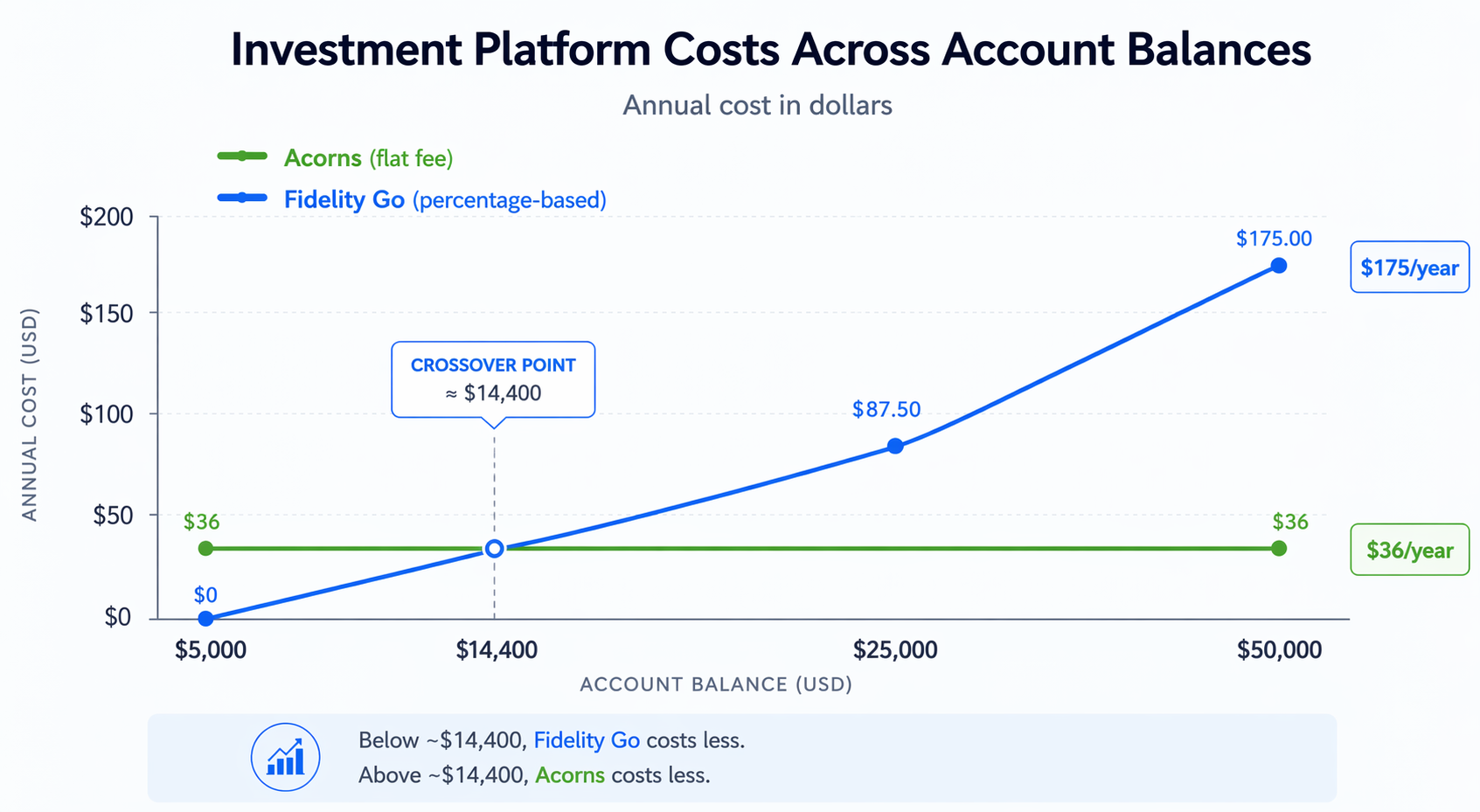
| Account Balance | Acorns Bronze Approx. Annual Cost | Acorns Effective Rate | Fidelity Go Approx. Annual Cost | What It Means |
|---|---|---|---|---|
| $5,000 | $36 | 0.72% | $0 | Fidelity Go is clearly cheaper at this balance. |
| $14,400 | $36 | 0.25% | $0 | Acorns’ flat fee falls to a rate similar to common robo-advisor pricing, but Fidelity Go still costs less. |
| $25,000 | $36 | 0.14% | $87.50 | Fidelity Go’s 0.35% fee begins, and Acorns becomes cheaper on headline advisory cost. |
| $50,000 | $36 | 0.07% | $175 | Acorns’ flat subscription looks inexpensive if you only compare advisory fees. |
At $5,000, Acorns Bronze costs roughly 0.72% of the account each year while Fidelity Go costs $0. That is not a small difference for someone trying to build the first serious investment balance between student loan payments, bar dues, childcare, rent, or an emergency fund.
At $14,400, the Acorns Bronze subscription falls to about 0.25% of assets. That is the point where the flat fee stops looking obviously expensive when compared with common robo-advisor percentage fees. But it is still more than Fidelity Go’s $0 advisory fee below $25,000.[1][3]
At $25,000, the comparison flips. Fidelity Go’s 0.35% fee equals about $87.50 per year, while Acorns Bronze remains about $36 per year. At $50,000, Fidelity Go’s fee rises to about $175 while Acorns Bronze still sits at about $36.[1][3]
That does not make Acorns automatically better above $25,000. It means the burden shifts. Fidelity Go has to justify its higher dollar cost through account fit, fund cost, tax features, and ecosystem convenience. Acorns has to justify whether a taxable brokerage and subscription-based behavioral app are enough for the investor’s actual financial life.
Fund Costs Are Part of the Fee, Too
The headline advisory fee is not the entire cost picture. Fidelity Go uses Fidelity Flex funds with 0% expense ratios, so there is no additional fund-level expense ratio inside those portfolios.[2]
Acorns uses ETFs from Vanguard and BlackRock, which carry standard expense ratios. Those fund costs are separate from the Acorns subscription. The research materials do not support a performance claim for either platform, so this is a cost and structure point, not a prediction about future returns.[1]
For a small balance, the Acorns subscription usually dominates the cost discussion. For a larger balance, the flat subscription becomes less burdensome, but the ETF expense ratios still matter. For Fidelity Go, the advisory fee may eventually become the larger visible cost, while the underlying Flex funds reduce the hidden fund-cost layer.
Acorns Automates Contributions; Fidelity Go Automates Account Management
Acorns is more interesting when the investor’s main problem is not portfolio construction. It is inertia. Round-Ups connect everyday spending to investing by rounding purchases and investing the spare change once the linked balance reaches the platform’s rules. Acorns reports that Round-Ups generated about $45 per month on average from spare change in its internal July 2025 data, but that is company data and may not represent every user’s behavior.[1]
For a busy associate, paralegal, or in-house lawyer who keeps meaning to invest and keeps postponing it, that kind of friction reduction can be worth real money. Not because spare change is magical, but because it turns a vague good intention into a recurring action. A slightly imperfect tool used every month can beat a cheaper tool that sits untouched.
Fidelity Go’s automation is aimed at a different failure mode. It builds and manages a portfolio for the account, rebalances it, and integrates with Fidelity’s broader platform. The useful question is whether you already want to live in Fidelity’s ecosystem, not whether Fidelity Go feels more futuristic.
Where Acorns’ Behavioral Design Helps
Acorns is built for investors who benefit from prompts, automatic small transfers, and visible progress. The Round-Ups feature is the clearest example, but the broader design is the point: the app tries to make contribution behavior feel less like a separate financial chore.
The subscription tiers complicate the analysis. Acorns Gold is listed at $12 per month, and Acorns states that its 3% IRA match on Gold for first-year contributions can offset the subscription cost. That may be meaningful for someone who will actually contribute to the IRA, but it should not be treated as free money without reading the platform’s conditions and holding-period rules.[1]
This is where legal professionals should use the same skepticism they would bring to a vendor demo. A match, a subscription bundle, and an automated feature can be useful. They are not the same thing as lower all-in cost for every household.
Where Fidelity Go’s Structure Helps
Fidelity Go is stronger when the investor wants fewer account silos. Fidelity offers account types beyond a basic taxable robo-advisor account, including HSAs, 529 plans, and Youth Accounts, while Acorns does not provide those same account types.[3]
That matters for households where the investing decision is tied to benefits enrollment, dependent planning, education savings, or health care costs. A robo-advisor does not have to solve every financial problem, but account sprawl has a cost: more logins, more statements, more beneficiary settings, and more opportunities to miss something ordinary but consequential.
Fidelity Go also offers tax-loss harvesting for taxable accounts at $25,000 and above. Acorns does not offer tax-loss harvesting.[2] That feature does not guarantee a better after-tax outcome for every investor, but it is relevant for higher-balance taxable accounts, especially for professionals who have already filled retirement accounts and are building taxable savings.
The Human Advisor Detail Is Easy to Miss
Fidelity Go is not purely algorithmic in the way many people imagine robo-advice. Fidelity states that Fidelity Go accounts are managed by Strategic Advisers LLC. Investopedia also distinguishes between platforms that are algorithm-recommended and those with human advisor management structures.[2][4]
Acorns portfolios are algorithm-recommended from pre-built ETF models. That is not a criticism; model portfolios are a normal way to deliver low-touch investment management. But it does mean the “AI” label should not be doing much work in the decision. The platforms differ more in implementation, account experience, fees, and user behavior than in any public evidence of superior artificial intelligence.
Which One Fits Which Investor?
Choose Fidelity Go if your balance is below $25,000 and you want the lowest starting advisory cost. At those balances, the $0 advisory fee is hard to argue with, especially if you do not need Round-Ups or subscription-based nudges to make contributions happen.[2][3]
Choose Fidelity Go if you already use Fidelity or expect to use more than one account type. HSAs, 529 plans, Youth Accounts, and the broader Fidelity environment can matter more than the robo-advisor label, particularly for households that want one operational center for investing and planning.[3]
Choose Fidelity Go if taxable-account features matter at higher balances. Tax-loss harvesting becomes available at $25,000 and above, which is the same point where the advisory fee begins. That does not make the fee painless, but it gives the higher cost something concrete to buy.[2]
Choose Acorns if the main barrier is contribution behavior. If Round-Ups, small automatic transfers, and app-based nudges get you investing when a conventional brokerage account would not, the subscription may be defensible even when a spreadsheet dislikes it at small balances.
Choose Acorns if your balance is large enough that the flat subscription is no longer the dominant cost and you do not need Fidelity’s broader account ecosystem. At $25,000 and $50,000, the Bronze subscription looks cheaper than Fidelity Go’s percentage fee on a headline basis, though ETF expense ratios and missing tax-loss harvesting still belong in the comparison.[1][2][3]
The Practical Verdict
Fidelity Go is the cleaner choice for investors who want low starting cost, Fidelity account integration, 0% expense ratio Flex funds, broader account options, and tax-loss harvesting once the taxable account reaches the stated threshold.
Acorns is the better fit for investors who need behavioral automation more than ecosystem depth: Round-Ups, recurring nudges, and a flat subscription that becomes easier to justify as balances rise.
Neither platform earns the decision by being more “AI.” The credible comparison is narrower and more useful: what you pay, what the automation actually changes, which accounts you need, and whether the tool will still be doing its job after the novelty wears off.
References
- Acorns vs. Fidelity, Acorns.
- Fidelity Go, Fidelity.
- Fidelity Go Review, NerdWallet.
- The Best Robo-Advisors, Investopedia.
Comments
Join the discussion with an anonymous comment.