
Find the Best AI Legal Software for Your Practice and Firm Size
This comparison guide evaluates AI legal software tools by practice area and firm size, providing pricing data, accuracy benchmarks, and a shortlist-building framework to help legal professionals select the right stack for their needs.
- Hallucination rate
- Not measured / undisclosed
Most firms are no longer deciding whether lawyers will touch AI. That decision has already happened, often quietly, one browser tab at a time. The harder question is whether any of those tools should become part of the official stack: paid for by the firm, connected to firm data, governed by firm policy, and trusted enough to appear in repeatable workflows.
That gap is visible in the adoption numbers. The 8am Legal Industry Report, discussed by the ABA in 2026, reported that 69% of legal professionals were using generative AI individually, while only 9% of firms had an enforced AI policy.[1] Those figures do not measure the same thing as every broader “AI use” survey, and they should not be blended casually with reports that include document automation, spellcheck, or other non-generative tools. But they describe the procurement problem accurately: individual experimentation is moving faster than firm-wide decision-making.
So the useful question is not “What is the best AI legal software?” It is “Which combination of tools fits our practice areas, matter volume, budget, risk tolerance, and ability to supervise the output?” A solo estate-planning lawyer, a litigation boutique, a mid-size transactional firm, and an AmLaw department with legal ops staff do not need the same stack.

Start With The Work, Not The Vendor
AI legal software is not one buying category. A legal research assistant, a contract-review platform, a practice-management AI feature, and an eDiscovery tool may all use generative AI, but they answer different questions and create different supervision burdens.
A research tool needs source grounding and citation checking. A contract tool needs clause comparison, playbook alignment, and redline review. A practice-management assistant needs to reduce intake, scheduling, billing, or matter-status friction. A litigation-support platform needs to fit discovery volume, brief drafting, deposition workflows, or analytics. Buying one broad assistant and expecting it to absorb all of that is how firms end up with a polished demo and an orphaned subscription.
If you want a broader landscape before narrowing the list, a market map of legal AI companies can help. For selection, though, the firm-size and practice-area fit matters more than the number of products in the market.
AI Legal Software Comparison By Practice Area And Firm Size
The comparison below is organized around the buying decision a firm actually has to make. Pricing bands are directional, not quotes. Vendors that do not publish pricing may change minimums, bundle requirements, or contract terms, so every shortlist still needs direct verification.
| Primary use case | Representative tools | Best fit by firm size | Pricing signal | Main caveat |
|---|---|---|---|---|
| Legal research and citation checking | Lexis+ AI; Westlaw Precision with CoCounsel; vLex Vincent; Bloomberg Law AI features | Mid-size and enterprise firms with existing research subscriptions; some small firms if the subscription is already justified | Often in the $150–$500 per-seat monthly band for full-stack research AI, though pricing is frequently bundled or custom | Companion subscriptions matter. CoCounsel’s value changes substantially if the firm already pays for Westlaw access. |
| Contract drafting and review | Spellbook; Definely; Kira; Luminance; Harvey AI | Solo and small transactional practices for lighter drafting; mid-size firms for repeatable review; enterprise teams for high-volume contracting and playbook governance | Solo-accessible tools may sit around the $49–$179 monthly range; enterprise tools can move into custom annual commitments | A tool that drafts quickly still needs clause standards, review ownership, and a defined line between first-pass assistance and legal judgment. |
| Practice management and operational assistance | Clio Manage AI; MyCase AI features | Solo, small, and mid-size firms that already run intake, calendaring, billing, and matter management through the same platform | Usually tied to the practice-management subscription rather than purchased as a standalone legal AI platform | The AI feature is only as useful as the underlying matter data and staff adoption. A messy workflow does not become governed because it has an assistant. |
| Litigation support and eDiscovery | Everlaw; NexLaw; Briefpoint | Litigation boutiques, mid-size firms with recurring motion practice, and enterprise litigation teams with document volume | Ranges from matter- or seat-based subscriptions to enterprise pricing depending on data volume and feature set | Discovery, drafting, and case strategy are different workflows. Confirm what the tool actually does before treating it as a litigation platform. |
| Legal analytics | Lex Machina; Westlaw Litigation Analytics | Litigation-heavy firms, IP practices, and teams making forum, judge, venue, or opposing-counsel assessments | Often bundled into broader research or analytics subscriptions; pricing may be custom | Analytics can inform strategy, but it does not replace legal analysis or matter-specific judgment. |
| Enterprise legal AI platform | Harvey AI and similar enterprise deployments | Large firms and legal departments with legal ops, security review, training capacity, and enough seat volume to justify governance work | Industry pricing guides estimate Harvey-style enterprise minimums at roughly 20 seats and about $288,000 annually; vendors should confirm current terms directly | High capability does not automatically mean high fit. Without workflow owners, training, and evaluation, enterprise AI becomes an expensive pilot. |
The pricing spread is not a proxy for quality. Industry pricing guides describe common per-seat AI legal software models from roughly $50 to $500 per user per month, with hidden costs such as seat minimums, companion subscriptions, and usage overages potentially inflating total cost by 40% to 60%.[2] That is the difference between “we can test this next month” and “we need a budget owner, a security review, and a rollout plan.”
Legal Research AI: Pay For Verifiability, Not Just Speed
Legal research is where lawyers most want AI to feel magical and where the tolerance for error is lowest. The useful features are not just fluent answers. They are source retrieval, jurisdiction control, citation treatment, quote verification, and a workflow that makes it easy for a lawyer to inspect the authority behind the answer.
Lexis+ AI and Westlaw Precision with CoCounsel are natural shortlist candidates for firms already invested in one of those research ecosystems. vLex Vincent may be relevant where jurisdiction-specific coverage is the deciding issue. Bloomberg Law’s AI layer is more likely to make sense for firms already using Bloomberg for research, docket, or business intelligence work.
Be careful with citation-error benchmark claims. Secondary summaries have circulated comparisons between legal-native systems, including Lexis+ AI and Westlaw/CoCounsel, but the primary methodology should be checked before those figures become procurement evidence. The practical lesson still holds: ask vendors to run research tasks on your jurisdiction, your motion types, and your citation-checking process, then have a lawyer review the answer and the underlying authorities. For a deeper treatment of benchmark interpretation, use an AI legal research accuracy guide rather than relying on a vendor slide.
For solo and small firms, the research decision is usually less about the AI feature in isolation and more about the total subscription. If the AI layer requires a premium research plan, the question becomes whether the firm will use the research platform enough to justify the full bundle. A lower-cost general assistant may help with brainstorming or plain-language explanation, but it should not be treated as a legal research system unless the lawyer independently verifies the sources.
Contract Drafting And Review: The Best Fit Depends On Volume And Playbooks
Contract AI is a broad label for several different jobs: drafting from precedent, reviewing third-party paper, comparing clauses to a playbook, extracting obligations, and supporting due diligence. A tool can be strong at one of those jobs and mediocre at another.
Spellbook is one of the more accessible options for transactional lawyers who want drafting and review assistance inside their document workflow. Definely also belongs in the drafting-assistance conversation. Kira remains relevant for high-volume structured contract review and due diligence, especially where the task is extraction and comparison rather than free-form drafting. Luminance is more likely to appear in review and negotiation workflows with larger contract volumes. A dedicated AI contract review comparison for small firms is useful if the buying decision is limited to transactional work.
The strongest contract-review results usually come from repeatable work. Attorney at Work described a midsize firm that cut contract review times by 60% after using an AI assistant integrated into existing workflows.[3] That is meaningful, but it should not be generalized into “AI reduces contract review by 60%.” The result depends on the document type, the review standard, the level of integration, and whether the firm already knows what a good answer looks like.
For small firms, the right contract AI tool is often the one that handles a narrow recurring task reliably: first-pass review of vendor agreements, employment templates, leases, NDAs, or purchase agreements. For enterprise teams, the buying question shifts toward playbook governance, permissions, audit trails, and whether the platform can support multiple teams without turning every exception into a custom implementation project.
Practice Management AI: Useful When The Workflow Already Lives There
Practice-management AI should be judged differently from research or drafting AI. Its promise is not a perfect memo or a negotiated clause. It is fewer administrative handoffs: intake summaries, matter updates, billing support, scheduling help, task creation, and client-communication assistance.
Clio Manage AI, formerly discussed as Clio Duo, is most relevant for firms already using Clio Manage as the operational center of the practice. MyCase is moving in a similar direction with AI features inside the practice-management environment. These tools can be especially attractive to solo and small firms because they do not require a separate enterprise AI platform to start reducing administrative friction. A fuller Clio Manage AI review can help firms that are already considering that ecosystem.
The trap is assuming embedded means effortless. If staff do not consistently enter matter information, if task ownership is unclear, or if billing narratives are already being rewritten three times, the AI feature will surface the same operational gaps faster. That may still be valuable, but it is not the same as automation.
Litigation Support And Analytics: Separate Drafting Help From Case Intelligence
Litigation software gets crowded quickly because “litigation support” can mean brief drafting, discovery review, deposition preparation, docket monitoring, judge analytics, venue research, or damages analysis. Those are not interchangeable.
Everlaw belongs in the eDiscovery and document-review conversation, especially where AI is being used to manage large document sets. Briefpoint is more focused on drafting assistance. NexLaw positions around litigation workflows. Lex Machina and Westlaw Litigation Analytics are better understood as analytics products, useful when the firm needs judge, venue, party, or case-pattern insight rather than a drafting assistant.
The highest-impact litigation examples tend to come from highly repeatable processes. Harvard Law School’s Center on the Legal Profession described an AmLaw 100 firm’s complaint-response system that reduced associate time from 16 hours to 3–4 minutes.[4] That is impressive precisely because the workflow was defined. It does not mean every litigation task can be compressed that way. It means firms should look for repetitive, document-heavy, reviewable work before buying broad litigation AI.
What Solo And Small Firms Should Shortlist
Solo and small firms usually need AI legal software that can be purchased without a long sales cycle, used without an implementation team, and supervised by the lawyer who is already responsible for the matter. That does not mean “cheap is fine.” It means the tool has to match a real bottleneck closely enough that the lawyer can monitor the output without creating a second job.
- Best first shortlist: practice-management AI if intake, billing, and client updates are the pain point.
- Best transactional shortlist: a document drafting or contract-review assistant for recurring agreements.
- Best research shortlist: a legal research AI layer only if the underlying subscription and jurisdictional coverage are already justified.
- Usually poor fit: enterprise platforms with seat minimums, custom implementation, or governance assumptions the firm cannot support.
For this segment, published small-firm pricing bands around $49–$179 per month are more plausible than six-figure enterprise commitments, but the sticker price is not the whole cost.[2] Training time, confidentiality review, template cleanup, and attorney verification all count. Firms comparing small-practice options may want a small-firm AI legal tool guide or a focused review of AI legal assistants for solo firms before evaluating enterprise-style products.
What Mid-Size Firms Should Shortlist
Mid-size firms have the hardest comparison job. They may have enough volume to benefit from serious AI tools, but not enough slack to absorb a messy rollout. A platform that looks affordable per seat can become expensive if it requires every practice group to redesign templates, policies, and review steps at once.
The best mid-size shortlist usually starts with the practice group that has the most repeatable work. A transactional group may begin with contract review and drafting. A litigation group may begin with brief drafting, eDiscovery, or analytics. A general-practice firm may get more immediate value from practice-management AI than from a specialized enterprise assistant.
| If the firm’s bottleneck is... | Shortlist first... | Defer until later... |
|---|---|---|
| Associates spending too much time on first-pass contract review | Contract review or drafting AI with playbook support | General-purpose AI assistants with no clause standards |
| Lawyers duplicating research and citation-checking work | Research AI inside the firm’s preferred research ecosystem | A second research platform that splits authority review across tools |
| Client intake, matter updates, and billing friction | Practice-management AI inside the existing system | Standalone AI tools that do not connect to matter workflows |
| Recurring litigation drafting or discovery volume | Litigation drafting, eDiscovery, or analytics tools matched to the case type | A broad litigation platform before defining which litigation task is repeatable |
Mid-size firms should also be disciplined about pilots. A useful pilot has sample matters, attorney reviewers, error categories, and a decision date. “Let’s see who uses it” is not a pilot; it is a subscription waiting to be forgotten.
What Large And Enterprise Firms Should Shortlist
Large firms and legal departments can justify tools that smaller practices should avoid, but only when the organization can support them. Enterprise AI legal software needs governance: security review, data-handling rules, usage policies, model-output review, training, adoption monitoring, and someone empowered to say no when a workflow is not ready.
Harvey AI is the obvious enterprise example. Industry pricing guides estimate a roughly 20-seat minimum and an annual minimum around $288,000, though those figures should be treated as third-party estimates rather than vendor-confirmed pricing.[2] That level of spend can make sense for firms with high-volume knowledge work, centralized innovation or legal ops support, and practice groups ready to build repeatable workflows. It makes much less sense as a prestige purchase for lawyers who only want occasional drafting help. A dedicated profile of how large law firms deploy Harvey AI is the better next read if Harvey is already on the shortlist.
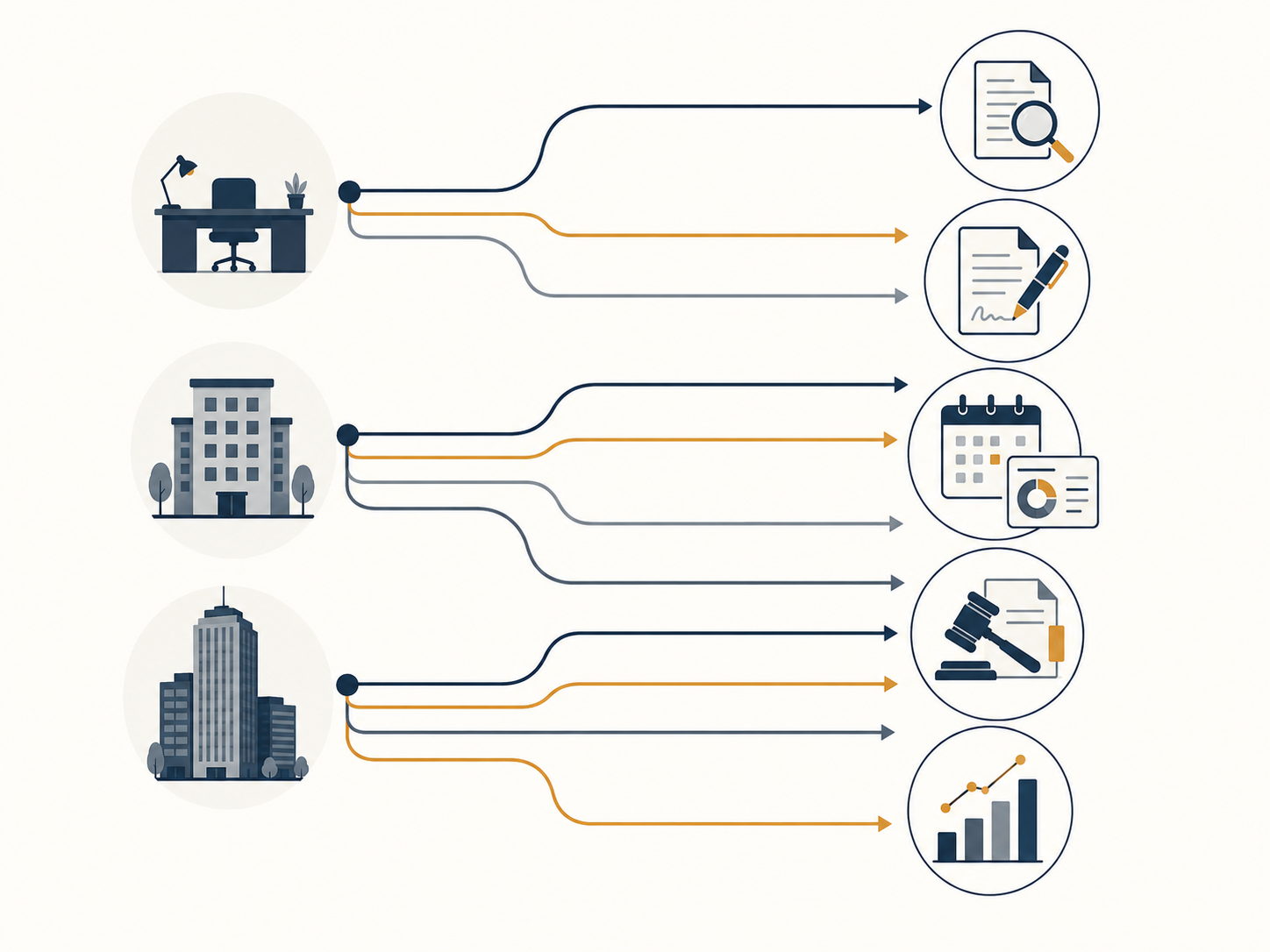
Enterprise buyers should also avoid collapsing every AI need into one platform. A large firm may still need separate research, eDiscovery, contract-review, analytics, and practice-management tools. The enterprise question is not whether one vendor can appear in every workflow. It is whether the firm can govern the handoffs among tools without confusing lawyers about which system is authoritative.
Pricing Questions That Belong In Every Evaluation
AI legal software pricing is difficult to compare because vendors mix per-seat subscriptions, usage-based fees, enterprise minimums, matter-based pricing, and bundled access through existing platforms. A quote that looks clean on the first page may depend on assumptions no one has priced: number of users, data volume, API access, implementation services, premium support, or a required companion subscription.
- Ask whether pricing is per seat, per matter, per document volume, usage-based, or bundled into another subscription.
- Ask whether there is a seat minimum, annual commitment, implementation fee, or required training package.
- Ask whether core functionality depends on a companion product, such as a legal research subscription.
- Ask what happens when usage exceeds the quoted assumptions.
- Ask whether data retention, private workspaces, audit logs, or security features are included or priced separately.
This is where a higher-priced product can be the better fit and a cheaper product can be the more expensive mistake. If the expensive platform replaces a repeatable, high-volume workflow with clear supervision, it may earn the budget. If the low-cost tool produces work that lawyers cannot verify efficiently or should not upload under the firm’s confidentiality rules, the apparent savings disappear.
Professional Responsibility Is A Selection Constraint
Ethics review should not sit in a separate memo after procurement has already picked a favorite. ABA Formal Opinion 512, issued in July 2024, states that lawyers using generative AI must understand the technology’s relevant limits and supervise AI output with the care required for nonlawyer assistance.[5] That obligation changes what belongs on the shortlist.
A tool that cannot explain data handling, retention, confidentiality protections, review workflows, and output verification may still be interesting for low-risk internal brainstorming. It should not become the system lawyers rely on for filed work, client advice, or unsupervised document production. Firms that want a fuller treatment can use a guide to ethical duties for lawyers using artificial intelligence alongside the technical evaluation.
The practical test is simple: before buying, identify who reviews the output, what they are checking, what sources or documents they compare against, and what happens when the AI is wrong. If the firm cannot answer that, it is not ready to make the tool official.
Build A Defensible Shortlist
A defensible shortlist is small enough to test and specific enough to reject. It does not start with ten demos. It starts with the work.
- Identify the practice area where repeatable AI assistance would matter most: research, contracts, practice operations, litigation support, or analytics.
- Define the matter types and documents the tool must handle, using real examples the firm is permitted to test.
- Match the tool class to firm size: solo-accessible subscriptions for small practices, workflow-specific tools for mid-size firms, and governed enterprise platforms only where the organization can support them.
- Verify pricing directly, including seat minimums, companion subscriptions, usage limits, implementation fees, and renewal terms.
- Test accuracy and usefulness on the firm’s own work, not only on vendor demo materials.
- Document the supervision workflow before rollout: reviewer, review standard, escalation path, and prohibited uses.
For a more formal scoring process, use a broader legal AI software evaluation methodology. For a stack-level strategy after the first shortlist, a guide on how to choose AI tools for a law firm can help connect individual products to a longer-term roadmap.
The best AI legal software is not the most powerful product on the market or the one with the most impressive demo. It is the stack whose capabilities, cost structure, data controls, and verification burden match the way the practice actually works.
References
- 8am Legal Industry Report, ABA Law Practice Magazine, March/April 2026
- Legal AI Pricing Guide, Irys
- Legal AI Tools 2026: How Firms Are Really Using AI Today, Attorney at Work
- The Impact of Artificial Intelligence on Law: Law Firms’ Business Models, Harvard Law School Center on the Legal Profession
- Legal Ethics: Practical Considerations for Lawyers Using AI in the Modern Legal Practice, ABA Business Law Today, July 2026
Chronological incident history
No sanction cases have named this tool in the tracked record set to date. This does not imply the tool is safe — see Risk Digest for ongoing monitoring.
← Compare peer toolsReport a correction or tip
Spotted an outdated figure, a misstated fact, or a ruling this tool profile should reflect? Public comments are disabled for this content given the professional cost of a misreported case outcome, penalty amount, or rule text — use the structured correction channel instead.
Report a correction or tip for this record →