
For a law firm making a Q3 2026 shortlist, Claude is still the safest default choice for serious legal work. ChatGPT remains the flexible secondary tool most firms can justify for general drafting, brainstorming, and legal-adjacent analysis. Moonshot AI’s Kimi K3 is worth watching and, for some firms, worth piloting, but not yet worth treating as a replacement for Claude on high-stakes legal tasks.
The reason is not model popularity. It is evidence. The clearest legal-task benchmark available in the current comparison is HAQQ’s June 2026 300-task legal benchmark. In that run, Claude Opus 4.8 scored 30.02 out of 35 and won 130 of 300 tasks, while GPT-5.5 posted the highest accuracy score at 8.41 out of 10 and a 3% hallucinated-citation rate. The same benchmark found that 24% of all 3,000 graded answers cited law that did not support the claim being made, which is the kind of number that should slow down any procurement meeting before it turns into a model beauty contest. [1]
That last finding matters more than the leaderboard. A model that writes fluently but attaches the wrong authority to a legal proposition does not merely create a quality problem. It creates review debt. Someone has to catch the bad citation, determine whether the underlying legal point survives without it, repair the work product, and decide whether the miss reveals a broader workflow failure. The attorney who signs the filing or advice memo owns that consequence, not the vendor demo team.

The Short Answer for Legal Teams
If the task involves legal research, litigation strategy, statutory interpretation, high-value contract analysis, or work product that will move close to a client or court, Claude belongs at the top of the shortlist. Its current advantage is not just the HAQQ score. It is the combination of published legal-task performance, legal-specific product infrastructure, and a clearer privacy posture for professional use.
Claude for Legal is described as including 12 practice-area plugins, more than 90 named legal agents, and more than 20 MCP connectors to systems such as Westlaw, Clio, iManage, Relativity, and Thomson Reuters CoCounsel. It also carries a data-privacy posture that says Anthropic does not train on user data on any tier. [2] Those details are not cosmetic for a law firm. Connectors decide whether lawyers can work inside governed repositories instead of copy-pasting privileged material into loose workflows. Privacy commitments decide whether the pilot can get past information security without a month of exceptions.
Kimi K3 enters the comparison differently. It launched on July 16, 2026, with a 1 million-token context window, hosted pricing reported at $3 per million input tokens and $15 per million output tokens, and an open-weight release timeline that could make it unusually interesting for firms with data-sovereignty or infrastructure-driven requirements. [3][4] But there is no independent legal-specific benchmark for Kimi K3 yet. A Vals AI Index proxy score places it at 74.70% overall, with a Legal Research Bench sub-score of 48.08%, but that legal sub-score comes from a snippet that was not independently verifiable through the full page content in the available research. It is directional, not a deployment-grade legal validation.
ChatGPT is the known quantity. In this comparison, that is both a strength and a limit. It is usually easier to justify for broad legal-adjacent work: summarizing non-confidential background material, organizing lawyer notes into clearer prose, generating issue lists, and supporting administrative or business-development tasks. But if the question is which system should be the default legal reasoning and research environment, the stronger published legal footing currently sits with Claude.
| Use case | Best fit in Q3 2026 | Why |
|---|---|---|
| High-stakes legal research or analysis | Claude | Strongest published legal-task footing and legal-specific infrastructure |
| General drafting, ideation, internal summaries, legal-adjacent work | ChatGPT | Flexible, familiar, and easier to justify when legal specialization is not the gating issue |
| Long-context experiments, open-weight testing, sovereignty-sensitive architecture | Kimi K3 | Interesting technical and pricing profile, but no independent legal-specific validation yet |
Start With Legal-Task Evidence, Not Frontier-Model Branding
The HAQQ benchmark is not perfect. It is published by a vendor whose own product ranks first, so the rankings should be treated as directional rather than dispositive. Still, it is more useful for a law firm than generic claims about reasoning or model size because it evaluates legal work directly. Its citation-failure finding is especially useful because it captures a failure mode that lawyers actually have to remediate: an answer that sounds legal, cites legal material, and still does not support the proposition it is being used for. [1]
That is also why this comparison cannot be decided by the newest launch. Legal teams do not buy accuracy in the abstract. They buy a workflow in which an attorney can see the source, challenge the answer, correct it in time, and avoid turning AI review into a second full-time job.
Claude’s HAQQ showing gives it the clearest current claim for default use. GPT-5.5’s 8.41 out of 10 accuracy score and 3% hallucinated-citation rate also deserve attention, because they show that ChatGPT-class systems can be highly competitive on parts of the legal benchmark. [1] But the purchase decision does not stop at raw task scoring. Once a model is placed into a firm environment, legal-specific connectors, auditability, data handling, and review design often matter as much as the answer quality measured in a test set.
Kimi K3’s problem is simpler: the legal evidence is not there yet. Its general-model signals are strong enough to justify curiosity. They are not strong enough to justify moving privileged, client-facing, or court-facing work to it without a controlled pilot. If your firm uses legal AI accuracy benchmarks as a procurement gate, Kimi K3 should be treated as an unvalidated entrant for legal work, not as a peer to Claude on day one.
What Kimi K3 Actually Changes
Kimi K3 deserves a focused look because it changes the shape of the shortlist, not because it wins the shortlist. The model is reported as a 2.8 trillion-parameter mixture-of-experts system with 896 experts and Kimi Delta Attention, and it has been positioned as a large open-source challenger to top U.S. systems. [5] Those architectural details are interesting, but they do not answer the legal-ops question by themselves. The question is whether the system reduces bottlenecks without creating new verification, security, or remediation burdens.
The long context window is the first serious reason to pay attention. Kimi K3’s 1 million-token context window gives it an obvious trial lane for large record sets, dense contract portfolios, long policy histories, or internal knowledge bases where chunking creates its own failure risk. [3] Claude also supports context windows in the 200,000-to-1 million-token range depending on configuration, while ChatGPT is described in the available comparison materials at 128,000 tokens. [2] The legal value of a long window is not that lawyers can dump everything into one input. It is that fewer seams may reduce the places where context gets lost, duplicated, or mis-ranked.
That said, long context does not excuse weak validation. A model can see a large record and still misunderstand the controlling clause, miss the governing jurisdiction, or cite a case for a proposition it does not support. For high-stakes work, the pilot design should test whether the long window improves attorney review time and source traceability, not merely whether the model can ingest a large file.
The second reason to watch Kimi K3 is deployment optionality. Moonshot’s open-weight timeline, reported for July 27, 2026, could matter for firms or legal departments that cannot accept ordinary hosted-model data flows. [4] A firm with unusual data-sovereignty requirements may prefer a model it can run through a controlled infrastructure partner, even if the model is less mature for legal tasks. That is a real procurement distinction, especially for cross-border matters, regulated clients, or internal investigations with strict access controls.
But the burden moves somewhere. Running a 2.8 trillion-parameter model is not a weekend IT project. The available research indicates that operating Kimi K3 would require 64 or more accelerators, which puts self-hosting outside the practical reach of most firms unless they already have a cloud partnership or specialized infrastructure team. [5] Open weights can improve control, but they also move responsibility for uptime, logging, access management, patching, monitoring, and incident response closer to the firm.
The Distillation Allegations Belong in Due Diligence
There is also a diligence issue that should not be hand-waved away. Anthropic disclosed in February 2026 allegations involving more than 16 million exchanges through more than 24,000 fraudulent accounts in connection with model distillation activity. [6] The available research does not verify those allegations independently, and it would be wrong to treat them as established fact. It would also be careless for a firm to ignore them when assessing vendor risk, licensing posture, reputational exposure, and client comfort.
For a law firm, unresolved allegations are not automatically disqualifying. They are a reason to ask better questions before a pilot expands: what rights attach to the weights, what indemnities exist, what representations the provider will make, and whether the client base would be comfortable with the provenance story if it appeared in a risk memo.
Pricing Looks Simple Until Supervision Is Counted
Kimi K3’s hosted pricing is reported at $3 per million input tokens and $15 per million output tokens, roughly matching Sonnet 5’s standard rate in the available materials. Artificial Analysis also reports a blended Kimi K3 task cost of about $0.94, while the HAQQ benchmark reported Claude at $0.069 per task and ChatGPT at $0.082 per task in its testing context. [3][1] Those are not apples-to-apples subscription invoices, but they are useful warnings against assuming that lower posted token prices automatically produce lower legal-work costs.
Verbosity matters. Kimi K3 reportedly generated 130 million output tokens in the relevant Artificial Analysis evaluation, compared with a 63 million median, which can raise effective cost for routine tasks even when nominal token rates look competitive. [3] In legal workflows, longer answers also create human cost. If a system produces a twelve-page answer where a three-page answer would do, someone still has to review the extra nine pages for unsupported claims, missing qualifiers, and bad citations.
The supervision cost is the number that rarely appears on a model pricing page. A cheap first draft is not cheap if it forces a senior associate to rebuild the research trail. A long-context synthesis is not cheap if the partner must ask for source-by-source verification because the system did not preserve pinpoint support. Firms comparing tools should track review minutes, correction rate, source-checking time, and escalation frequency alongside token or seat cost.
| Cost factor | Why it matters in legal work |
|---|---|
| Token or seat price | Sets the visible budget line but does not measure review burden |
| Output length | Longer answers can increase attorney verification time |
| Citation reliability | Bad authority creates remediation work and professional risk |
| Connector coverage | Determines whether work happens inside governed repositories |
| Hosting model | Affects privacy review, data residency, and infrastructure responsibility |
Claude’s Advantage Is Operational, Not Just Statistical
The strongest case for Claude is that it already looks closer to a legal workflow product than a raw model endpoint. Its reported legal agents and MCP connectors give legal teams a way to test defined tasks inside familiar systems rather than inventing a parallel AI workspace. [2] That reduces one of the hidden risks in legal AI pilots: the pilot looks successful because the test group is unusually careful, unusually technical, and willing to do manual work that the broader firm will not sustain.
The privacy posture also matters. A no-training-on-user-data position across tiers gives legal operations, information security, and client teams a cleaner starting point for review. [2] It does not eliminate the need for matter-level controls, access governance, retention review, or client-specific restrictions. But it removes one common source of delay: uncertainty over whether lawyer or client data may be used to train the provider’s models.
Claude’s current position is therefore not “best because it is smartest.” It is best for the default legal shortlist because the performance evidence, legal workflow infrastructure, and data-handling story line up better than the alternatives. For firms evaluating purpose-built legal AI versus general-purpose AI, this is the practical distinction: the model’s raw ability matters, but the reviewable workflow around it often decides whether the tool can be used responsibly.
Where ChatGPT Still Fits
ChatGPT should not be dismissed just because Claude has the stronger current legal posture. Many firms already have lawyers and staff who know how to use it, and that familiarity has value when the task is not a dispositive legal analysis. It remains a strong secondary tool for drafting internal explanations, preparing first-pass meeting agendas, translating dense business material into plain English, testing negotiation language, and helping attorneys move from messy notes to structured work product.
The constraint is task routing. ChatGPT is easier to justify when the output is low-risk, internally reviewed, or not dependent on precise legal authority. It becomes harder to justify as the sole system of record for legal research or advice if the firm has access to a model with stronger legal-specific infrastructure and benchmark support. Existing legal-sector comparisons continue to frame Claude and ChatGPT as useful but differently positioned systems for lawyers, with Claude often favored for legal analysis and ChatGPT remaining broad and flexible. [8]
That is enough. ChatGPT does not need to win the legal-specialization category to earn a place in the stack. It needs a well-defined lane, clear use policies, and a review rule that prevents lawyers from treating a polished general-purpose response as verified legal authority.
A Practical Routing Rule for Q3 2026
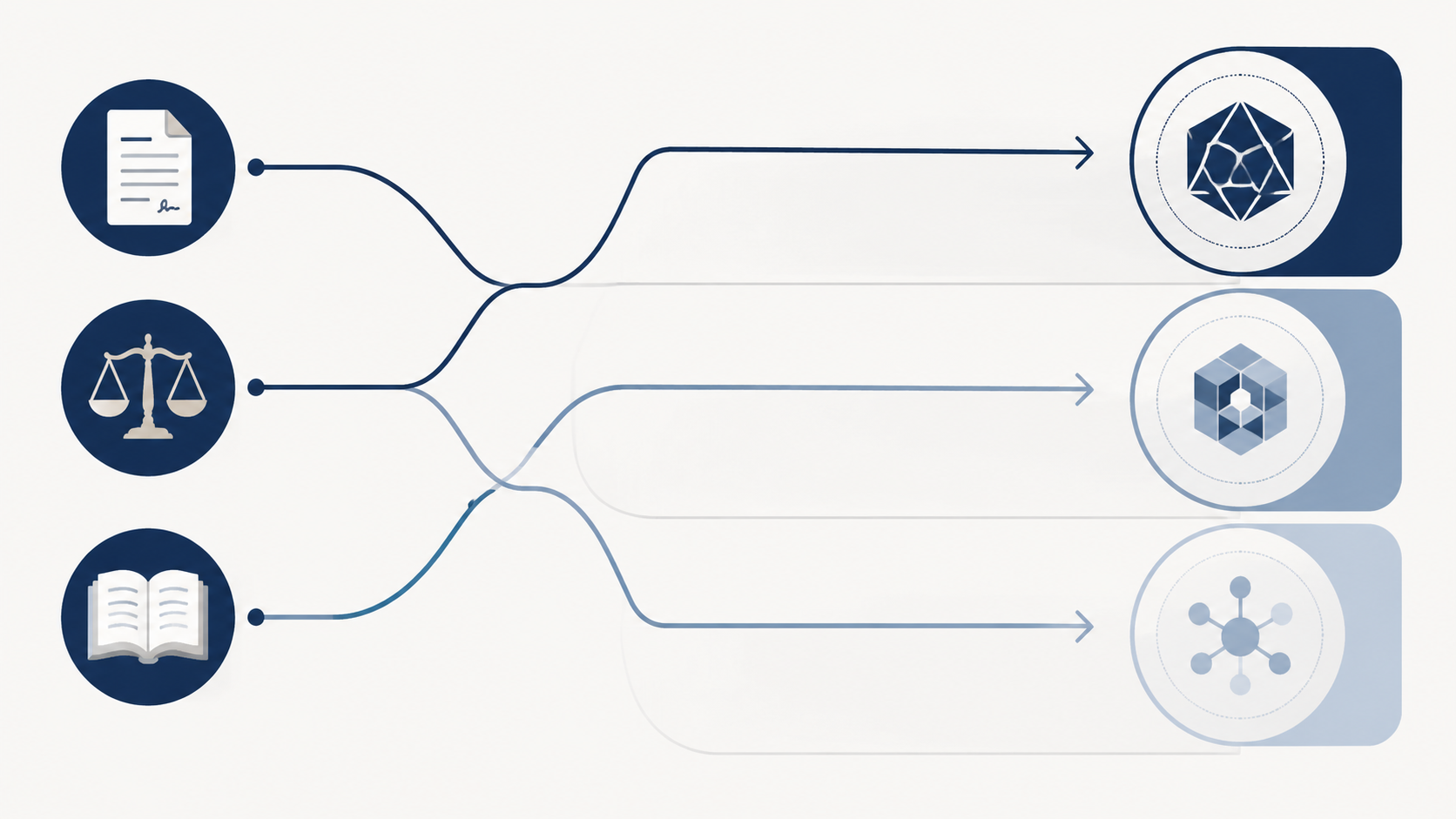
The better answer is a tiered architecture, not a single-model coronation. A firm does not route every legal task to the same lawyer, and it should not route every AI-assisted task to the same model. The routing rule should reflect legal risk, source-dependence, confidentiality, context length, and the amount of human supervision the firm is willing to pay for.
- Use Claude as the default for high-stakes legal work, especially research, analysis, litigation support, and matters where connectors, privacy posture, and legal-task validation matter.
- Use ChatGPT as the versatile secondary tool for general drafting, internal summaries, business-development support, and legal-adjacent work that does not depend on authoritative legal sourcing.
- Use Kimi K3 selectively for pilots where long context, open-weight optionality, or data-sovereignty architecture could justify the extra validation and infrastructure burden.
- Do not use Kimi K3 as the default legal model until independent legal-specific benchmarks, licensing diligence, and workflow-level supervision tests support that move.
A sensible Kimi K3 pilot would not start with client-facing legal advice. It would start with bounded tests: long-document summarization against a known answer key, retrieval from closed internal materials, comparison of output length and review time, and citation behavior on tasks where attorneys can verify every source. The pilot should measure whether Kimi K3 reduces attorney bottlenecks or merely moves the work from drafting to cleanup.
Claude gets the first seat for legal work because the current evidence supports it. ChatGPT keeps a seat because firms need a broad, familiar tool for work around the legal task. Kimi K3 earns a trial lane because its long context and open-weight direction may matter in environments where architecture and control are as important as immediate legal maturity. That is the decision frame worth taking into a pilot meeting.
References
- Best AI for Legal Work Benchmark, HAQQ
- Comparison AI Models Legal Sector, AI Act Blog
- Kimi K3, Artificial Analysis
- Kimi K3 Is Live: Pricing, Benchmarks, TrilogyAI Substack
- China’s Moonshot AI releases Kimi K3, the largest open-source model ever, rivaling top U.S. systems, VentureBeat
- BBC News article on distillation controversy, BBC
- The Catch Behind Kimi K3’s Benchmark Leap, The Deep View
- Claude vs ChatGPT for Lawyers, AI Vortex
Comments
Join the discussion with an anonymous comment.