
How Far Does Free ChatGPT Get You in Legal Practice?
Free ChatGPT handles low-risk legal tasks like brainstorming and routine drafting, but its privacy defaults, message caps, and high hallucination rates make it unsuitable for client-facing work. This guide compares free, paid consumer, and purpose-built legal AI to help you decide what your practice needs.
- Hallucination rate
- Not measured / undisclosed
The practical question is not whether a free ChatGPT workflow for legal work can do anything useful. It can. A solo lawyer facing a blank page at 9 p.m. can ask for a neutral outline, a first pass at a client-friendly explanation, or a list of issues to consider before drafting. That is real value, especially when the alternative is losing an hour to inertia.
The harder question is where the work stops. Free ChatGPT is acceptable for low-risk, non-client-facing work. Paid consumer ChatGPT mainly buys capacity, larger context, and convenience. Purpose-built legal AI buys a different risk profile: legal databases, citation infrastructure, enterprise security, and workflows designed around professional supervision. None of those categories makes the lawyer disappear from the loop.
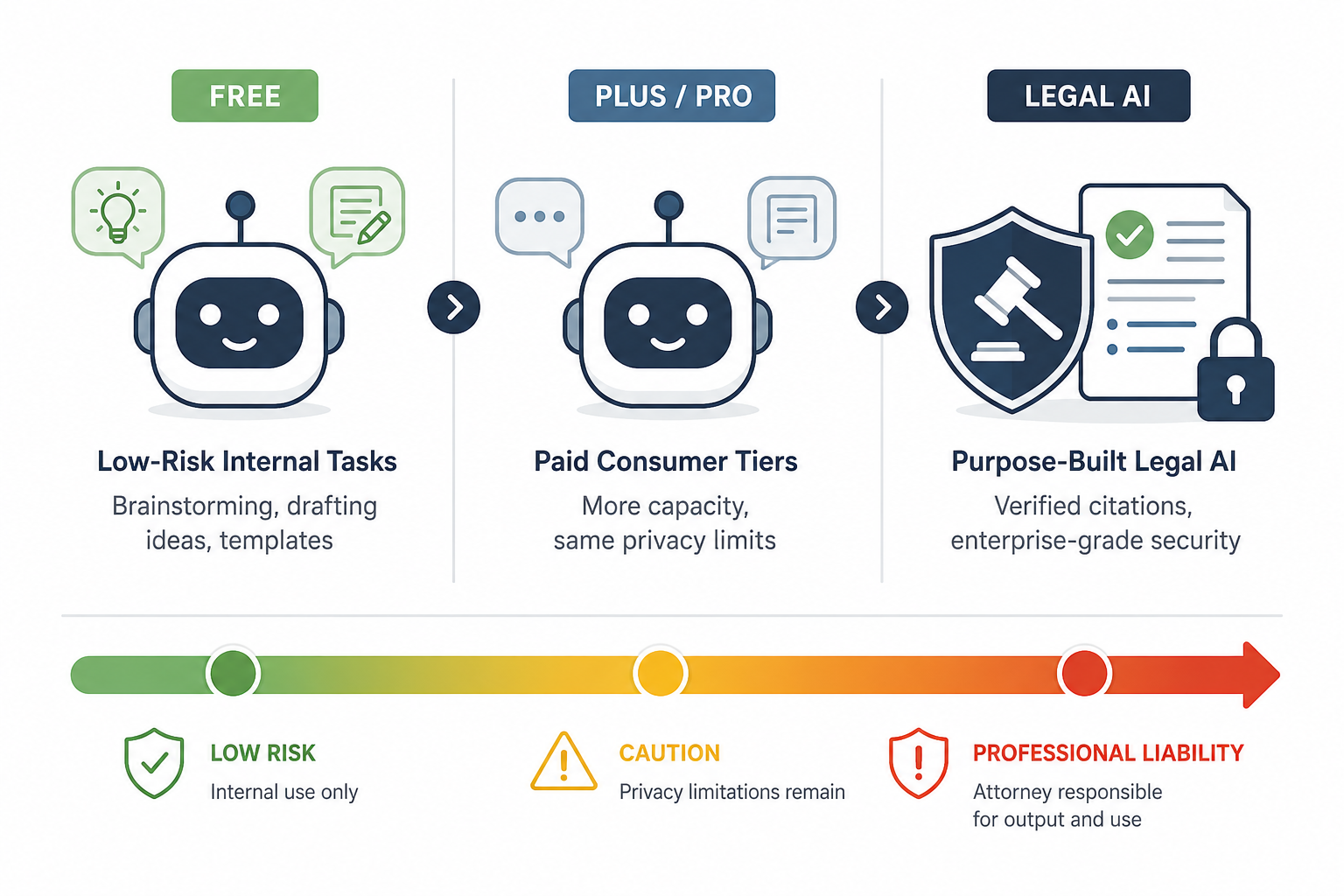
| Work type | Free ChatGPT | Paid consumer ChatGPT | Purpose-built legal AI |
|---|---|---|---|
| Brainstorming, issue spotting, plain-language explanations | Often enough if no client secrets are included | Useful when volume or context becomes annoying | Usually more than needed |
| Routine internal drafting from neutral facts | Useful for rough starts and structure | Better for longer documents and repeated iterations | Helpful if drafting is tied to legal workflow or review |
| Client-confidential facts | Poor fit under consumer privacy defaults | Still a poor fit under the same consumer defaults | Potentially appropriate if security, retention, and contract terms fit the matter |
| Legal research and citations | Not suitable as authority | More capacity, same verification problem | Better fit when sources are retrieved, cited, and reviewable |
| Client-facing legal advice or filings | Do not rely on it without independent lawyer verification | Do not treat payment as professional suitability | Still requires lawyer review, but has stronger workflow controls |
What the Free Tier Actually Gives a Lawyer
The free tier is not useless. Its limits are simply the kind of limits that show up at exactly the wrong moment in legal work. As of a June 2026 comparison, ChatGPT Free allowed 10 messages every 5 hours on the flagship model before a forced downgrade to GPT-5.3 mini, a 16K non-reasoning context window, 3 file uploads per day, and 5 deep research runs per month.[1]
Those numbers sound abstract until they land in a normal workflow. Ten messages can disappear in one drafting session: one prompt to set context, one to revise tone, one to add a section, one to simplify, one to compare alternatives, a few corrections, and then the model cap arrives. Three file uploads per day may be enough for a single public policy document; it is not much for a lawyer trying to compare a complaint, an answer, a contract, and a client's messy notes. A 16K context window, roughly about 20 pages, is helpful for short materials but not a litigation file, diligence set, or full regulatory history.
Within those limits, the free tier can handle tasks that are genuinely useful and low-risk: generating a checklist for a first interview, turning a dense public regulation into plainer language, producing a neutral memo shell, or offering several ways to phrase a non-confidential internal note. The safe version of this work uses public information, invented hypotheticals, or facts stripped of client identity and legal sensitivity.
The unsafe version looks almost the same from the screen. A lawyer pastes in a client's employment timeline, a settlement posture, an acquisition concern, or a draft affidavit because the tool has been helpful for harmless tasks. That is the slide that matters. The problem is not curiosity. The problem is treating a consumer chatbot as if it has the confidentiality posture, authority discipline, and supervision trail of a legal work system.
Plus and Pro Buy Capacity, Not a Legal Safety Net
ChatGPT Plus changes the daily experience. The same June 2026 comparison listed Plus at $20 per month, with 160 messages per 3 hours, 32K non-reasoning context, 256K reasoning context, 80 file uploads per 3 hours, 25 deep research runs per month, agent mode with 40 messages per month, Codex, and custom GPT creation.[1]
For a lawyer using AI as a drafting assistant, those upgrades are meaningful. More messages mean fewer interruptions during a drafting session. More uploads make it easier to work across multiple public documents. A larger context window lets the model keep more of a long memo, public rule, or template package in view. If the bottleneck is annoyance, Plus may remove enough friction to justify the cost.
Pro is still a capacity and performance purchase, not a professional responsibility shortcut. The research brief describes ChatGPT Pro, at roughly $100 to $200 per month, as offering o1 Pro mode, higher reliability, and priority compute, but no change to the consumer privacy defaults or legal-specific accuracy problem.[1]
That distinction is easy to blur because the features sound like legal readiness: reasoning, longer context, deep research, agent mode. Lawyers should translate those words into operational consequences. A longer context window means the system can consider more text at once; it does not mean the text is privileged. More file uploads mean the system can ingest more documents; it does not mean the documents should contain client confidences. A more capable model may produce cleaner prose; it can still invent authority or miss controlling law.

The Privacy Default Is the Line Many Lawyers Miss
The most important consumer-tier fact is not the message cap. It is that paying for Plus or Pro does not, by itself, move a lawyer into a legal confidentiality environment. A May 2026 GC AI analysis states that consumer ChatGPT tiers, including Free, Go, Plus, and Pro, train on conversations by default; Temporary Chat is retained on servers for 30 days; and Business and Enterprise tiers, rather than consumer tiers, are where training exclusion and Zero Data Retention become available.[2]
That does not mean every use is equally dangerous. Asking for ten possible headings for a client-neutral article, or for a plain-English explanation of a public statute, is different from pasting a client's facts into a chat window. But the privacy default means the lawyer has to draw that line before the prompt is written, not after the answer looks useful.
ABA Formal Opinion 512, issued July 29, 2024, frames the professional responsibility issue in familiar terms: competence, confidentiality, informed consent, and supervision. It requires informed client consent before confidential information is entered into self-learning generative AI tools, treats technology competence as part of Rule 1.1 competence, and addresses supervision obligations under Rule 5.3.[3]
The ABA opinion is influential rather than a single binding rule for every jurisdiction. State bars may add their own requirements, and some matters will have contractual, court-order, regulatory, or client-specific restrictions that are stricter than a general ethics opinion. The working standard for a small practice should be conservative: if the prompt contains information the lawyer would not casually disclose to a vendor without checking terms, consent, and retention, it does not belong in a consumer chatbot.
One federal ruling has already treated platform exchanges harshly in privilege terms. In United States v. Heppner, decided February 17, 2026, the Southern District of New York ruled that AI platform exchanges were neither privileged nor work product, applying a three-part analysis: the platform was not an attorney, the terms permitted training or disclosure, and the use was not directed by counsel.[2]
One ruling is not the whole law of privilege and AI. It is still enough to make a careless workflow look less like innovation and more like evidence someone else may later have to explain.
Accuracy Is a Separate Problem From Privacy
Even if a prompt contains no confidential information, legal accuracy remains the harder professional problem. Stanford HAI reported in May 2024 that general-purpose chatbots hallucinated 58% to 82% of the time on legal queries. The same benchmark found that legal-specific retrieval-augmented generation tools also hallucinated, with Lexis+ AI and Ask Practical Law AI above 17%, and Westlaw AI-Assisted Research above 34%.[4]
That benchmark is not a current scorecard for every 2026 model. GPT-5.x and other newer systems may perform differently, and public legal benchmarks have not kept pace with every release. Still, the older public data is useful because it shows the shape of the risk: legal language can sound finished while the authority underneath is missing, distorted, or fabricated.
The court record has supplied the less academic version of the same warning. The AI Hallucination Cases Database documented 1,547 court decisions involving AI-fabricated citations by June 2026, with penalties reported up to about $110,000 in an Oregon matter from December 2025. The database also notes that most documented filings came from self-represented litigants.[5]
The self-represented pattern matters, but it should not comfort lawyers too much. The professional failure is not pressing "generate." It is filing, sending, or advising from output that was not checked against real authority. A licensed lawyer has fewer excuses, not more.
A Task Boundary That Holds Up in Practice
The cleanest way to decide is to classify the task before choosing the tool. The question is not "Can ChatGPT answer this?" It is "What happens if the answer is wrong, retained, disclosed, or copied into a client-facing document?"
- Use free ChatGPT for low-risk thinking: brainstorming arguments, outlining public-facing content, translating legal jargon into plainer language, and generating neutral drafting alternatives.
- Use paid consumer ChatGPT when the same low-risk work is hitting capacity limits: longer public documents, repeated drafting iterations, more uploads, or more frequent research-style exploration.
- Avoid consumer ChatGPT for client-confidential facts unless the lawyer has confirmed terms, consent, retention, and jurisdiction-specific ethics requirements.
- Do not rely on consumer ChatGPT as legal authority. Treat citations, case summaries, statutory claims, and jurisdiction-specific conclusions as unverified leads until checked in a reliable legal research source.
- Move to purpose-built legal AI when the workflow involves client matter data, legal research, citation review, supervised drafting, or repeatable firm processes.
This boundary also protects staff. If a lawyer uses a chatbot to produce a rough internal structure, the associate or paralegal can improve it in the ordinary course of work. If the lawyer uses it to generate a cited research memo and sends it downstream as if the authorities are real, the burden shifts to the person who has to unwind the hallucinations under time pressure.
Where Purpose-Built Legal AI Earns Its Price
Legal AI vendors are not magic malpractice shields. Stanford's benchmark is useful precisely because it found hallucinations even in legal-specific tools.[4] A tool connected to legal databases can still retrieve the wrong material, summarize carelessly, or produce output that needs lawyer judgment. Paying more does not outsource competence.
The better argument for purpose-built legal AI is narrower and stronger: it can change the risk surface. Tools built for legal work may provide verified citations, jurisdiction-specific databases, enterprise security, and workflow integration. Published comparisons place examples such as CoCounsel from about $225 per month and Harvey around $1,200 per year, many times the cost of a free consumer tool.[6][7][8]
Those costs will feel excessive if the only use case is blank-page drafting. They look different when the system is expected to touch client documents, research law, support a team, or produce work that someone may later have to defend. The purchase is not just better answers. It is better plumbing: source visibility, access controls, matter-oriented workflows, vendor terms, and a review path that fits how lawyers actually work.
That is also why a firm should not treat "legal AI" as a single category. A contract drafting assistant, a research platform, a litigation analytics tool, and a general enterprise chatbot solve different problems. The right paid tool is the one whose controls match the work the firm is actually willing to put into it.
The Free Stack Workaround Helps, But It Does Not Remove the Boundary
Cost pressure is real, especially for solos and small firms. A free stack can stretch farther than one tool alone: Claude Free for drafting, ChatGPT Free for flexible brainstorming, NotebookLM for document analysis, and vLex or Fastcase access through a bar association for verified research. AI Vortex described that kind of no-cost stack in 2026, while also noting its failures around confidentiality, citation verification, and jurisdiction awareness.[9]
That approach can be reasonable for public-document work, training, issue lists, and early drafting that contains no client secrets. It becomes fragile when the workflow depends on moving sensitive facts between tools, tracking which system retained what, or proving that a legal conclusion came from current authority in the right jurisdiction.
A Purchasing Judgment, Not a Universal Rule
If the work is exploratory, internal, and stripped of client-sensitive facts, free ChatGPT can be enough. It is especially useful for getting from nothing to something: a rough outline, a neutral email shell, a list of questions, a plain-language explanation, or a first pass at organizing public information.
If the work is still non-confidential but the free tier keeps interrupting the workflow, Plus or Pro may be a rational expense. The upgrade is most defensible when the lawyer needs more messages, larger context, more uploads, or fewer slowdowns. It is not a fix for privilege, confidentiality, or legal authority.
If the work involves client facts, legal research, citations, filings, advice, or a repeatable firm workflow, the decision should move away from consumer ChatGPT and toward a purpose-built legal or enterprise-grade system whose terms, controls, sources, and review process can be evaluated. Even then, the lawyer still owns the answer.
References
- ChatGPT Free vs Paid, nexos.ai, June 2026.
- Is ChatGPT Private?, GC AI, May 2026.
- ABA issues first ethics guidance on a lawyer's use of AI tools, American Bar Association, July 29, 2024.
- AI on Trial: Legal Models Hallucinate in 1 out of 6 (or More) Benchmarking Queries, Stanford HAI, May 2024.
- AI Hallucination Cases Database.
- Free vs. paid legal AI: What's the difference?, Thomson Reuters.
- Claude vs. ChatGPT for Lawyers, Spellbook.
- AI Tools for Lawyers, Darrow.
- Compare Free Legal AI Tools, AI Vortex, 2026.
Chronological incident history
No sanction cases have named this tool in the tracked record set to date. This does not imply the tool is safe — see Risk Digest for ongoing monitoring.
← Compare peer toolsReport a correction or tip
Spotted an outdated figure, a misstated fact, or a ruling this tool profile should reflect? Public comments are disabled for this content given the professional cost of a misreported case outcome, penalty amount, or rule text — use the structured correction channel instead.
Report a correction or tip for this record →